THE DIRECT ANSWER
What a commercial HVAC replacement actually includes
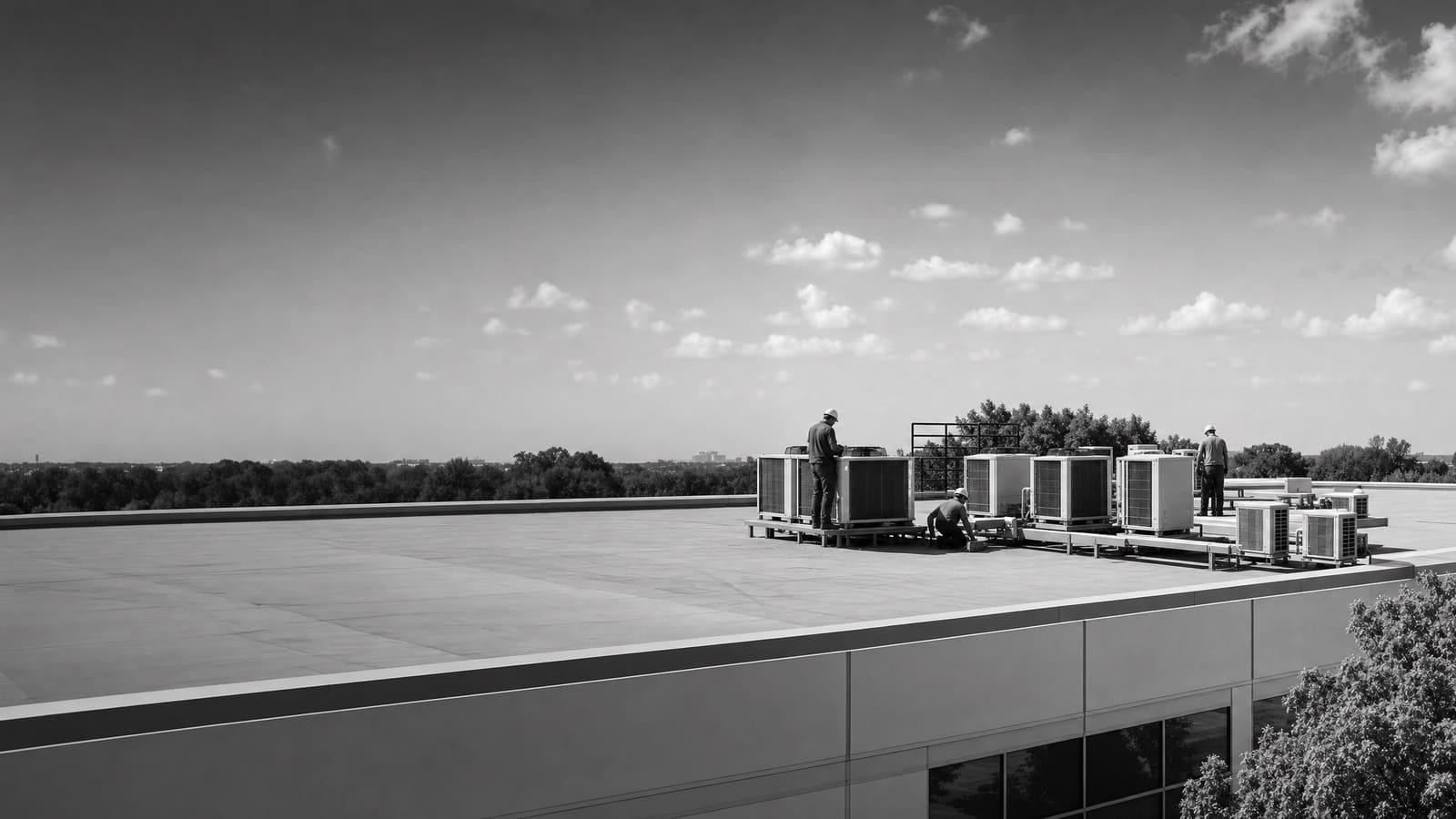
A commercial HVAC replacement covers a confirmed load calculation, equipment selected against real availability, the rigging and curb work to land the unit, gas, electrical, and refrigerant connections, controls integration, and documented commissioning. Replacement beats one more repair when the failure sits in the compressor, coil, or cabinet, and when the unit is already past fifteen years — the point where rooftop units start wasting real energy and money against current models.
A site review has to verify curb dimensions and roof structure, available electrical capacity, existing gas service, crane access to the unit, and how the new controls will tie into what the building already runs.
THE REAL DECISION
Three ways to make heat, and what each one costs you
Most commercial replacements come down to how the building will make heat. A like-for-like swap keeps the existing fuel and the existing connections, which is why it stays the quickest and least disruptive option when the space is used the same way it was when the old unit went in. A heat pump rooftop unit is the same basic machine with reverse-cycle heating added, and it arrives in three forms: dual fuel, all-electric, and cold climate. Heat pump heating efficiency drops as outdoor temperature drops and trends toward electric resistance in deep cold, so the colder your winter design condition, the more the backup heat source matters. The checklist before committing is the same either way: climate, utility rates, building type, equipment availability, electrical capacity, physical constraints, gas lines, and contractor experience with the equipment you are buying.
WHAT MOVES THE NUMBER
Six lines that decide the price
Nobody can price your roof from a web page. But the same handful of lines moves the number on nearly every commercial replacement, and asking for each one broken out lets you tell an equipment decision from a site condition.
HOW TO BUY IT
Planned replacement beats replacement on failure
The most expensive version of this project is the one that starts with a failure in July. Replacement on failure takes away every lever you have: you buy whatever unit is available, you pay for emergency rigging, and you lose the chance to size the system around how the building actually runs today. A planned replacement hands those levers back.
The figure that usually settles the argument is what an aging unit costs to keep. Old, inefficient rooftop units waste anywhere from $900 to $3,700 per unit every year in energy alone. Multiply that by the number of units on your roof, then by the years you are considering waiting, and deferral stops being free.
Efficiency tier is the second lever. A federal performance specification pushed manufacturers to build rooftop units that cut energy use by up to half against the older minimum standard, and more than twenty models now exceed that specification. The premium is not automatic value — a unit that runs a few hundred hours a year will not earn it back — but on a building with long operating hours, it is the difference between a fifteen-year utility bill and a noticeably smaller one.
SCOPE CHECK
Simple job or complicated one
Two replacements of identical tonnage can differ enormously in price and schedule. What separates them is almost never the equipment. It is the conditions around it.
LOWER COMPLEXITY
Same fuel, same footprint
Tonnage holds steady, the new unit fits the existing curb or a standard adapter, the roof structure already carries the weight, the crane has open lot to work from, and the controls are standalone. This is the one-morning version.
HIGHER COMPLEXITY
Changing fuel, size, or access
Tonnage grows, the footprint changes, you are switching to electric heating, service capacity is tight, the lift has to reach over an occupied building, or the unit joins an existing automation system. Each of those adds engineering, permitting, or after-hours work.
BEFORE THE QUOTE
What a real site review has to answer
A quote written from a nameplate photo is a starting point, not a price. The nameplate tells you what was installed years ago. It does not tell you whether that sizing was ever right, whether the roof can carry a heavier unit, or whether the electrical service has room for one.
The review should start with load. Occupancy, plug loads, lighting, and envelope all change over two decades, and a building running at half its original headcount with LED lighting is not the building the old unit was sized for. Oversized equipment short-cycles, dehumidifies poorly, and generates the comfort complaints that no amount of service will fix.
From there it becomes physical. Curb dimensions and roof structure. Available panel capacity and feeder size. Gas line size and routing if gas heat stays. Where the crane sets up, what it has to clear, and how long the lot loses those stalls. Whether the new unit talks to your existing controls or replaces them.
Anything that gets skipped here does not disappear. It reappears as a change order after the old unit is already off the roof.
Ask for the findings in writing
The site review should produce a written summary: confirmed load, curb and structural findings, electrical and gas capacity, crane plan, controls approach, and the permits the installer expects to pull. That document is what makes two quotes comparable.
OWNERSHIP
Who pays, and who gets the savings
The right equipment choice depends partly on who holds the building and who pays the utility bill. When those are the same party, the lifetime-cost math is simple: a higher efficiency tier that trims consumption for fifteen years accrues to you. When they are split, the party writing the capital check often is not the party seeing the savings, and the premium tier becomes a harder sell unless the lease lets you recover it. Sort this out before you specify equipment, not after the proposal lands. It changes which tier is defensible and how the project gets approved.
OWNER-OCCUPIED
The savings come back to you
You carry both the capital cost and the utility bill, so a higher efficiency tier is a straightforward investment decision. Run it against your actual operating hours rather than a generic payback claim.
LEASED OR INVESTOR-HELD
Check the split first
If tenants pay utilities, efficiency savings land on their side of the ledger while you fund the equipment. Look at what the lease allows you to recover, and at what a reliable, documented system does for renewal and asset value.
OVER TIME
Phasing a roof full of units
If you have several units of similar age, do not treat them as several separate emergencies waiting to happen. Spec the replacement once, then phase it. The engineering, the controls approach, and the crane logistics get reused across units, and each unit after the first gets cheaper and faster because the hard thinking is already done.
Phasing also lets you standardize. Mixed fleets are expensive to service because every unit has its own parts list, its own controls quirks, and now its own refrigerant. New commercial equipment ships on newer refrigerants, so a roof replaced piecemeal over ten years leaves your service contractor stocking for several generations at once. Replacing in planned groups narrows that.
One more sequencing note: incentive programs for high-efficiency rooftop upgrades tie eligibility to the equipment specification and frequently require approval before the order is placed. Confirm those requirements in writing before anything is ordered. Organizations working through the federal rooftop upgrade campaign have replaced tens of thousands of units and now save tens of millions annually as a group, and that scale of return comes from planning the sequence, not from reacting to failures.
THE CHECKLIST
Five things a comparable quote shows
A quote you can genuinely compare against another quote shows all five of these. When one is missing, it is not a lower price. It is an unpriced item that surfaces later as a change order.
01
The load basis
What the tonnage was calculated from — today's use of the space, or the old nameplate.
02
Equipment, tier, and availability
Model, efficiency tier, heating type, and a real lead time stated next to the price.
03
Curb, structural, and rigging scope
Adapter or new curb, any roof work, the crane plan, and how long the lot is affected.
04
Utility and connection work
Electrical, gas, and refrigerant work included, plus who pulls and closes the permits.
05
Commissioning and documentation
Charge, airflow, and controls verified against spec, with the results handed to you in writing.
Get a defensible number
Price the equipment and the building together.
Send the address, operating target, and target opening date. Flux will identify what must be verified before the project can be priced.
Get a free estimateQuestions
Straight answers.
When does replacement beat another repair?
When the failure is in the compressor, coil, or cabinet rather than a serviceable part, and when the unit is past about fifteen years. Aging rooftop units waste roughly $900 to $3,700 each per year in energy, so a cheap repair on an old unit often costs more over the next two seasons than the repair saved.
Should we replace like-for-like or resize?
Confirm the load either way. If the space is used the way it was when the old unit went in, like-for-like is usually right and always faster. If occupancy, equipment, lighting, or the envelope changed, resizing fixes comfort problems that service calls never could.
Is a heat pump rooftop unit worth considering?
It depends on your winter heating load and your electrical capacity. Heat pump efficiency falls as outdoor temperatures drop, so buildings with real cold-weather heating demand usually look at dual-fuel or cold-climate units rather than a straight all-electric swap. Electrical service capacity is the constraint that decides it most often.
What usually delays a commercial installation?
Equipment availability first, then anything discovered late — a curb that does not match, roof structure that needs reinforcement, or electrical capacity that cannot carry the new unit. All three are findable during the site review, which is exactly why the review happens before the order.
Does new equipment change our refrigerant situation?
New commercial units ship on newer refrigerants, which changes nothing about day-one operation but does matter for parts stocking and service contracts on a mixed roof. Refrigerant recovered from the old unit must be handled under federal rules, so that work belongs on the quote.
Sources used for this guide
- [1]betterbuildingssolutioncenter.energy.gov — DOE Advanced Rooftop Unit Replacement Guidance
- [2]betterbuildingssolutioncenter.energy.gov — DOE Commercial Heat Pump Rooftop Unit Replacement Guidance
- [3]betterbuildingssolutioncenter.energy.gov — DOE High-Efficiency Commercial Rooftop Unit Toolkit
- [4]energy.gov — DOE Efficient Commercial Rooftop Air Conditioner Program
- [5]epa.gov — EPA Stationary HVAC Refrigerant Management