THE SHORT ANSWER
What a commercial HVAC replacement includes
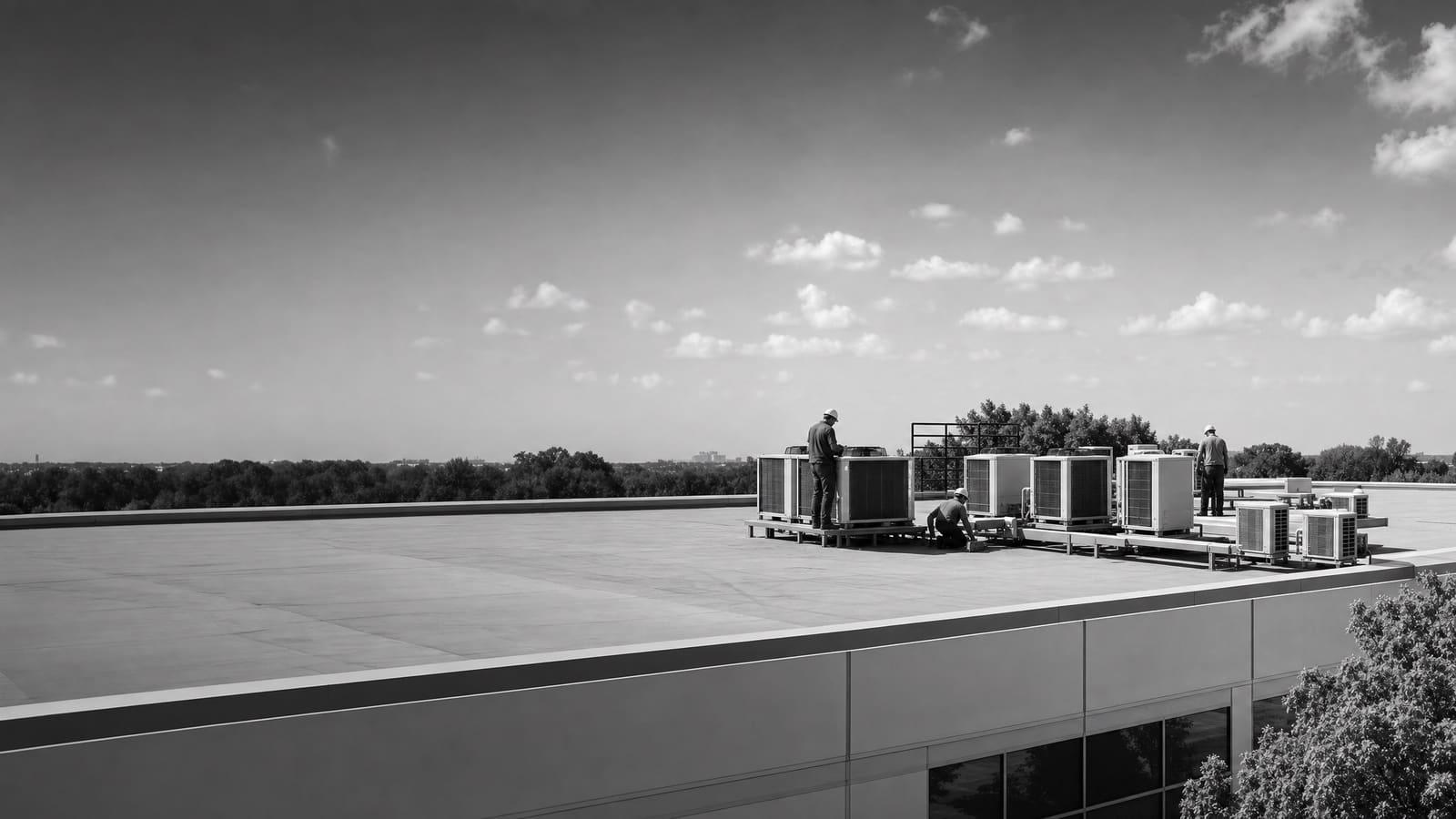
A commercial HVAC replacement covers the load calculation, equipment selection, permits, rigging and set, the curb, gas and electrical connections, controls integration, and commissioning. Replacement usually beats another repair once the unit passes 15 years and the repairs start stacking. Age is expensive on its own: a single old, inefficient rooftop unit wastes roughly $900 to $3,700 a year in energy.
A site review still has to confirm the actual load, the curb and roof structure, available electrical capacity, and crane access before any of that becomes a firm number.
THREE WAYS TO GO
Three replacement paths worth pricing
Most commercial replacements come down to three choices, and the right one depends on how much the building has changed since the last unit went in.
Rooftop units condition close to half of all commercial floor space in the country, so this decision repeats across most portfolios. The cheapest path is not always the one with the smallest invoice. A like-for-like swap gets cooling back fastest and carries the least engineering. A high-efficiency replacement costs more up front and pays back through the meter, since the federal high-performance specification targets up to 50% less energy use than the older standard. A heat pump unit changes the heating side of the building along with the cooling side, which pulls electrical capacity, gas service, and winter performance into the conversation.
Price all three while the unit is still running. You price one when it has already failed, because failure removes the option to wait for the better piece of equipment.
WHAT MOVES THE NUMBER
Where a commercial HVAC quote actually varies
There is no single installed price for commercial equipment, and any number offered before a roof visit is a guess. These are the lines that move a real quote the most, roughly in the order they surprise people.
HOW TO BUY IT
Buy the equipment, not just the install
The habit worth breaking is waiting for failure. Facility managers commonly delay a rooftop replacement until the unit can no longer hold the space, needs constant service calls, or dies outright. Replacing proactively usually beats replacing on failure, and it often beats a like-for-like swap at the end of service life, because a planned project lets you choose the equipment instead of taking whatever is on a truck.
Age is the cleanest trigger. Units past 15 years waste substantial energy and money compared with newer models, and that waste runs every hour the building is open. Put the annual energy waste next to the service spend from the last two years, then compare that total to the installed cost of a replacement. That arithmetic makes the decision better than any rule of thumb about repair cost as a share of new.
The efficiency question is largely settled at the market level. When the Department of Energy pushed for units that cut energy use by up to half, manufacturers delivered, and more than twenty models now exceed that specification. Organizations that upgraded more than 43,000 rooftop units through the resulting campaign save a combined $37 million a year on energy bills. For a single building, the takeaway is simple: high-efficiency equipment is ordinary and available, not a special order.
SCOPE CHECK
What makes this project simple or hard
Two buildings can buy the same tonnage and get very different numbers. The gap is almost always the infrastructure around the unit — the curb, the roof, the service, the access — rather than the equipment itself.
LOWER COMPLEXITY
Straight replacement
Same tonnage on an existing curb, gas and electric already sized, clear crane access from the lot, and simple controls. Permits are typically mechanical and electrical, and the set happens in a morning.
HIGHER COMPLEXITY
Conversion or upsize
A larger footprint, added electrical capacity for electric heat, structural review on the roof, tight or shared access, or a building automation system that has to keep talking to the new unit. Each one adds design time before anything gets lifted.
THE SITE REVIEW
What the walkthrough has to settle
A quote is only as good as the roof visit behind it. The infrastructure checks that decide a commercial replacement are electrical capacity, physical constraints, and gas service — in that order, because the first two are the ones that quietly kill a heat pump conversion after the equipment is already ordered.
Electrical capacity is the honest gate. All-electric and cold-climate heat pump units carry electric resistance backup heat, and that backup draws current the old gas unit never did. If the panel and the service cannot carry it, the project turns into an electrical upgrade with an HVAC unit attached. Physical constraints come next, since heat pump units can be larger and heavier than the air conditioning unit they replace, which puts the curb and the roof structure in play. Gas service matters in both directions: a dual-fuel unit keeps the line, an all-electric unit leaves dead pipe someone still has to handle.
Two more items belong on the walkthrough. Equipment availability, because the model that pencils out on paper may not be the model that ships this quarter. And installer familiarity with that specific equipment, because a unit commissioned by someone learning it on your roof rarely performs the way the submittal said it would.
Get the electrical answer in writing
Before signing on any electric or dual-fuel option, ask for the available service capacity, the unit's full-load draw including backup heat, and whether panel or feeder work is inside the quoted price. That one answer moves more budgets than the equipment choice does.
OWNERSHIP
Two things that outlast the install
The install takes a week or two. Ownership runs fifteen years or more, and two items decide how those years go. Both are easy to skip at signing and expensive to revisit later. One is refrigerant, which is regulated work with real paperwork attached and an industry-wide transition underway. The other is controls, which decide whether the efficiency on the submittal ever shows up on a bill. Neither changes how the unit runs on day one. Both change what the next decade costs, and both belong in the conversation before the purchase order goes out.
REFRIGERANT
Handling is regulated
EPA rules under Section 608 of the Clean Air Act govern how refrigerant is handled and recycled in stationary air conditioning and heat pump equipment. Recovery from the old unit is required work. Across a portfolio, newer equipment means a mixed fleet to plan parts and service around.
CONTROLS
Retrofit is a real option
Owners can replace an aging unit or retrofit it with advanced controls, depending on which makes better financial sense. On units with life left, controls can buy time and savings without a crane day.
PHASING AND PROCUREMENT
Sequence a fleet, not a unit
Most buildings do not have one unit. They have six of different ages, and the temptation is to handle each one when it fails. That is the most expensive possible schedule: emergency pricing, whatever equipment happens to be available, and no leverage on lead time.
A better sequence starts with an age and condition list for every unit on the roof. Anything past fifteen years goes on the near-term list whether or not it is currently limping. Rank by age, service history, and the hours the space actually runs, because the unit serving the longest operating schedule is burning the most money while it waits.
Then group the work. Two or three units replaced on the same crane day share the mobilization, the lot closure, and the permit coordination. Order early enough that lead time is a plan instead of a problem, and lock equipment availability before the season you cannot afford to be down in.
Lifetime cost is where the sequencing pays off. Efficiency is not a one-time line on an invoice. It is an operating number that repeats every year the building is open, which is why the annual waste on an aging unit belongs in the same spreadsheet as the installed price of its replacement.
THE QUOTE
Five things a comparable quote has to show
Two quotes are only comparable when both spell out the same five items. If one leaves a line blank, it is not cheaper. It is less complete, and the difference tends to reappear as a change order.
01
Equipment, tonnage, and efficiency tier
Make, model, and rated efficiency — not just "new rooftop unit, same size."
02
Confirmed lead time
The availability date for the specific model quoted, in writing, next to the price.
03
Curb, structural, and rigging scope
Who supplies the curb adapter, what structural work is included, and how long the lot is closed.
04
Electrical, gas, and controls work
Every service change and the building automation integration, either priced in or called out as excluded.
05
Permits, refrigerant recovery, and commissioning
Permits and inspections, recovery of the old charge, and documented startup of charge, airflow, and controls.
Get a defensible number
Price the equipment and the building together.
Send the address, operating target, and target opening date. Flux will identify what must be verified before the project can be priced.
Get a free estimateQuestions
Straight answers.
When does replacement beat another repair?
Once a unit is past fifteen years and repairs are recurring, replacement usually wins. An old, inefficient rooftop unit wastes roughly $900 to $3,700 a year in energy before a single repair invoice. Add the last two years of service spend and compare that total to an installed replacement price.
Is a heat pump rooftop unit the right choice?
It comes down to three checks: available electrical capacity, physical room on the curb and roof, and what happens to the gas line. Heat pump heating efficiency drops as outdoor temperatures fall and trends toward parity with electric resistance, so the heating side deserves as much scrutiny as the cooling side.
How much does commercial HVAC installation cost?
There is no honest universal number. Tonnage, efficiency tier, curb and structural work, crane access, and service changes move the price more than anything else. A quote built from a real look at the roof is worth more than a range built from an average.
Should the whole roof be replaced at once?
Rarely all at once, but rarely one-at-a-failure either. List every unit by age and service history, put anything past fifteen years on the near-term list, and group two or three replacements onto one crane day so they share mobilization and lot closure.
What happens to the refrigerant in the old unit?
It has to be recovered, not vented. EPA rules under Section 608 of the Clean Air Act govern how refrigerant is handled and recycled in stationary air conditioning and heat pump equipment. Recovery and disposal should appear as a line on the quote.
Sources used for this guide
- [1]betterbuildingssolutioncenter.energy.gov — DOE Advanced Rooftop Unit Replacement Guidance
- [2]betterbuildingssolutioncenter.energy.gov — DOE Commercial Heat Pump Rooftop Unit Replacement Guidance
- [3]betterbuildingssolutioncenter.energy.gov — DOE High-Efficiency Commercial Rooftop Unit Toolkit
- [4]energy.gov — DOE Efficient Commercial Rooftop Air Conditioner Program
- [5]epa.gov — EPA Stationary HVAC Refrigerant Management