THE SHORT ANSWER
Commercial HVAC replacement and installation in Cedar Rapids.
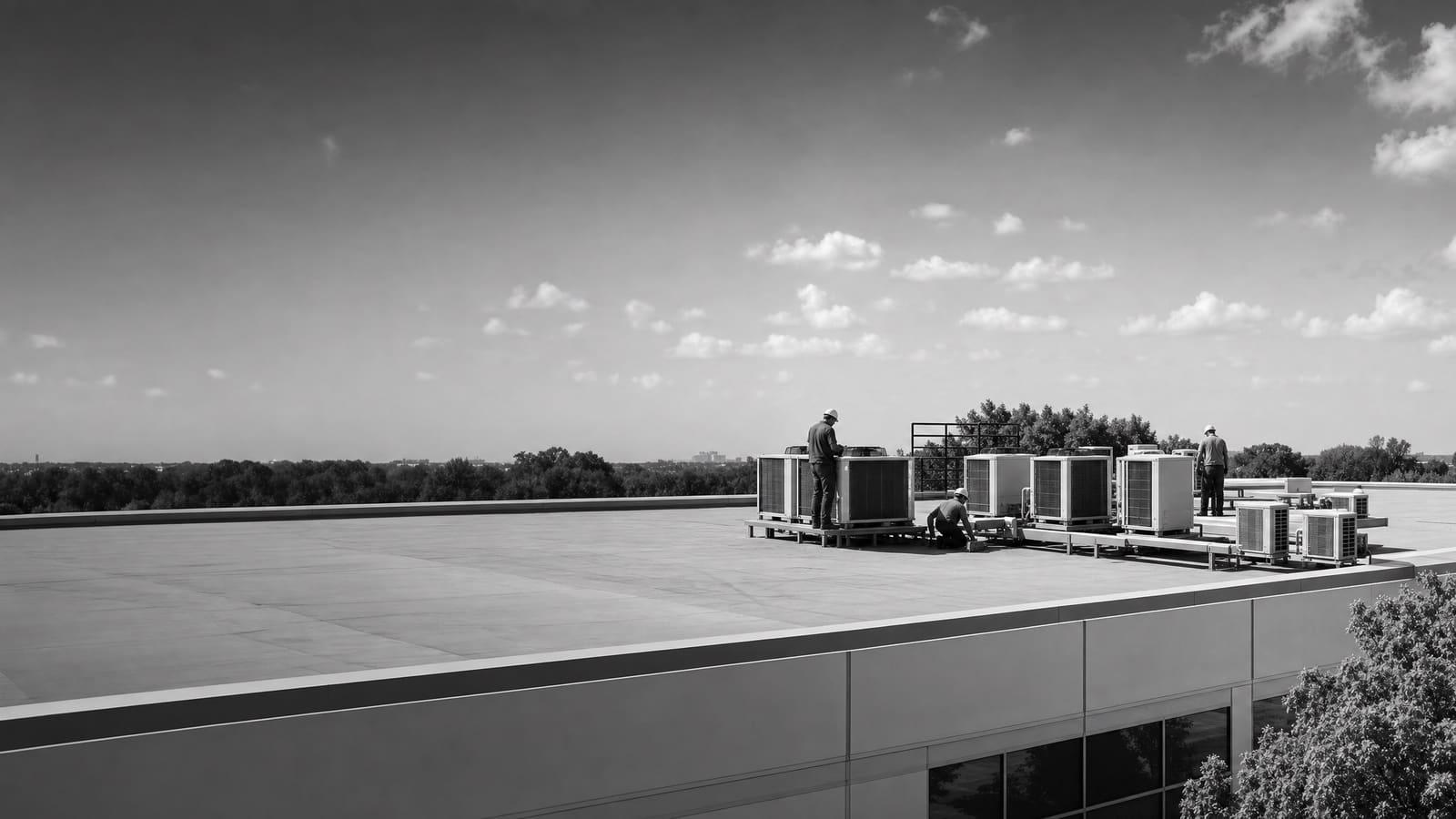
A complete commercial HVAC replacement covers sizing, equipment selection, removal, rigging, connections, controls, startup, testing, and owner handoff. Replacement is usually more useful than another repair when an older unit needs frequent service, cannot hold the space conditions, or creates a growing risk of an unplanned shutdown.
A site review must confirm the load, equipment access, curb or pad, electrical service, fuel connections, ventilation needs, controls, and shutdown plan.
THREE OPERATING CHOICES
Choose the project path before choosing the unit
Start with the business problem. A failed unit may demand the quickest workable replacement. An operating but unreliable unit gives you time to compare efficiency, controls, and heating choices. A changed building may need new load work instead of a copy of the old nameplate.
DOE guidance says rooftop units more than 15 years old can waste substantial energy compared with newer models. Age alone does not settle the decision, but age paired with frequent repairs, weak comfort, or poor reliability is a strong reason to price replacement. A planned project also gives the owner time to check electrical capacity, physical constraints, gas service, equipment availability, and expected utility effects.
Ask each bidder to price the same project path. Otherwise, a low quote may represent a basic swap while another includes controls, curb work, electrical changes, testing, and a better shutdown plan.
BUDGET STRUCTURE
What moves the installed price
The supplied research does not support a universal installed price. Build the budget from visible scope lines so equipment quotes can be compared on equal terms.
EQUIPMENT CHOICES
Compare systems by how the building operates
A packaged rooftop unit combines major heating, cooling, and ventilation functions in one cabinet. It can be a practical replacement when the building already uses rooftop equipment and the existing distribution system remains useful. Do not assume the old capacity is correct. Occupancy, internal equipment, schedules, envelope work, and space use may have changed since the original system was selected.
A high-efficiency air-conditioning rooftop unit can reduce energy use compared with an older unit while retaining a familiar heating arrangement. DOE has documented broad commercial use of rooftop units and verified that high-efficiency models can produce meaningful real-world savings. Those findings support comparison, not a promise for one building. Savings depend on the old equipment, load, schedule, controls, weather, and utility rates.
A heat-pump rooftop unit provides cooling and reverse-cycle heating. Options include all-electric, dual-fuel, and cold-climate designs. The choice should follow a review of heating demand, electrical capacity, physical space, fuel service, equipment availability, and modeled utility effects. If electrification is part of the goal, review commercial heat pump conversion before treating an electric replacement as a simple box swap.
PROJECT COMPLEXITY
A direct swap and a system change are different jobs
Both projects need planning and startup. The difference is how many existing conditions can remain and how much engineering or field adaptation the new equipment requires.
LOWER COMPLEXITY
Compatible replacement
The load remains suitable, the roof opening or pad works, connections are compatible, controls are simple, and access is clear. The quote should still include removal, rigging, connections, testing, and closeout.
HIGHER COMPLEXITY
Changed capacity or system type
New loads, electrified heating, limited electrical capacity, altered ventilation, difficult access, or automation integration can add design, coordination, equipment, and shutdown work.
SITE REVIEW
Scope what the nameplate cannot show
The old nameplate is a useful starting point. It gives the model, capacity, voltage, and other equipment data. It does not prove that the old unit was sized correctly or that a new unit will fit without changes.
The site review should trace the full installation path. Confirm how equipment reaches the work area, where lifting or staging can occur, and which occupied areas sit below or beside the work. Inspect the curb, pad, supports, duct transitions, drainage, disconnects, wiring, fuel connections, outside-air path, filters, thermostats, sensors, and control network. Record roof or wall penetrations that must stay weather-tight.
The review should also connect the mechanical scope to business operations. Identify acceptable outage windows, spaces that need temporary conditioning, tenant or staff notices, delivery restrictions, noise limits, and areas that must stay open. When several units serve the property, document which zones each unit supports. That makes phased replacement safer and helps the team avoid taking down two systems that protect the same critical area.
Bring operating evidence
Share service records, recurring alarms, comfort complaints, utility history, occupancy schedules, space changes, and any plans for added equipment. These details can change the replacement choice.
OWNERSHIP VIEW
Balance first cost with operating risk
The lowest bid is not always the lowest-cost project. A quote can look smaller because it excludes controls, electrical changes, curb adaptation, testing, or after-hours work. Those needs do not disappear after award. They return as change orders, delays, or performance problems.
At the same time, the most efficient unit is not automatically the best investment. Compare expected runtime, maintenance needs, parts support, controls, heating energy, electrical demand, and the value of reliable space conditions. DOE guidance recommends evaluating utility bill effects and emissions with site-specific inputs when considering heat-pump rooftop units. Use a consistent operating model across all options.
OWNER-OCCUPIED
Look beyond the installation day
Long holding periods make service access, energy use, controls, warranties, and replacement planning more important to the ownership decision.
LEASED OR MULTITENANT
Define who carries each effect
Clarify shutdown notices, access, comfort obligations, utility responsibility, operating schedules, and how work will be phased around occupied spaces.
PROJECT DELIVERY
Plan procurement, shutdowns, and commissioning together
Procurement should begin only after the basis of design is clear enough to compare equipment. Record required capacity, heating type, efficiency level, electrical data, ventilation functions, controls, physical limits, accessories, and acceptable substitutions. Ask for current availability and identify which selections could change if the preferred unit cannot be secured.
Build the field plan while equipment is being procured. Confirm measurements before fabrication. Coordinate delivery, lifting, access control, roof protection, weather exposure, removal, recycling, connection work, and temporary service. For a phased project, use the equipment condition and zone importance to set the order. Planned replacement can reduce the pressure to accept whatever unit is available after a failure.
Commissioning is the proof step. Startup should verify that the unit is installed as designed and that heating, cooling, fans, ventilation, safeties, sensors, and controls respond correctly. Record settings and test results. Train the operating team on filters, schedules, alarms, normal modes, and warranty duties. A unit that merely starts is not the same as a system that performs.
QUOTE CHECKLIST
Five things every comparable quote should show
Use one written scope for every bidder. Require inclusions, exclusions, assumptions, and alternates to appear beside the price instead of being left for later.
01
Exact equipment selection
List capacity, heating type, efficiency, voltage, refrigerant, accessories, controls, warranty, and proposed substitutions.
02
Complete removal and setting scope
Show delivery, rigging, removal, disposal, curb or pad work, supports, duct transitions, drainage, and weather sealing.
03
Connection and integration work
Define electrical, fuel, refrigerant, ventilation, thermostat, sensor, alarm, and building automation responsibilities.
04
Schedule and operating plan
State equipment availability, work sequence, outage window, access limits, temporary conditioning, and responsibility for coordination.
05
Testing and closeout
Include startup, functional checks, balancing when required, training, manuals, settings, warranty registration, and final documentation.
REFRIGERANT RESPONSIBILITY
Include refrigerant handling in the replacement scope
Commercial air-conditioning and heat-pump work includes refrigerant responsibilities that should not be buried in a general disposal line. EPA rules under Section 608 address refrigerant handling and recycling for stationary air-conditioning, refrigeration, and heat-pump equipment.
The quote should identify who will recover refrigerant from removed equipment, how the old unit will be handled, and what records or closeout documents will be supplied. It should also name the refrigerant used by the proposed equipment. This helps the owner plan service tools, technician support, parts, and fleet strategy when older and newer systems remain at the same property.
Do not accept a vague promise that the old unit will simply be hauled away. Recovery, removal, and disposal responsibilities should be written before work begins. The operating team should also receive the new equipment data and service requirements at handoff. Clear records make later maintenance easier and reduce confusion about what is installed on each roof, pad, or mechanical level.
Keep a simple equipment register
Record each unit's location, model, serial number, capacity, refrigerant, filters, controls, startup date, warranty details, and service contact after installation.
Get a defensible number
Price the equipment and the building together.
Send the address, operating target, and target opening date. Flux will identify what must be verified before the project can be priced.
Get a free estimateQuestions
Straight answers.
When should a commercial rooftop unit be replaced instead of repaired?
Price replacement when an older unit needs frequent service, cannot maintain the required space conditions, or puts operations at risk. DOE guidance notes that rooftop units more than 15 years old can waste substantial energy compared with newer models. Age should be reviewed with condition, repair history, runtime, parts support, and the effect of failure.
Should the new HVAC unit match the old capacity?
Not automatically. The old nameplate is a starting point, not a load calculation. Confirm current occupancy, schedules, internal equipment, ventilation, envelope conditions, and space use. A compatible replacement may be appropriate when these conditions remain stable, but changed buildings deserve a fresh sizing review.
Is a commercial heat-pump rooftop unit a good replacement choice?
It can be, but the decision is site-specific. Compare all-electric, dual-fuel, and cold-climate options against heating demand, electrical capacity, physical limits, gas service, equipment availability, utility effects, and operating goals. Model the choices with the same assumptions before comparing lifetime cost.
What should be included in a commercial HVAC installation quote?
The quote should identify exact equipment, removal, rigging, curb or pad work, duct changes, electrical and fuel connections, drainage, controls, ventilation, startup, testing, training, warranties, schedule, and exclusions. It should also state equipment availability and who coordinates shutdowns and access.
How long does commercial HVAC replacement take?
The supplied research does not establish one dependable project duration. Timing depends on equipment availability, design needs, access, rigging, field changes, controls, electrical work, shutdown limits, and testing. Ask for separate procurement and field schedules so a short installation window is not confused with the full project timeline.
How much does commercial HVAC replacement cost in Cedar Rapids?
The supplied research does not support a reliable universal installed range. Cost depends on equipment capacity and type, efficiency, access, rigging, curb or structural work, electrical capacity, fuel changes, controls, ventilation, and commissioning. A useful price follows a site review and a written scope shared by every bidder.
What happens to refrigerant in the old commercial HVAC unit?
The replacement scope should assign refrigerant recovery and equipment disposal to qualified parties. EPA Section 608 rules address refrigerant handling and recycling for stationary air-conditioning, refrigeration, and heat-pump equipment. Ask for the recovery and closeout responsibilities in writing.
Sources used for this guide
- [1]betterbuildingssolutioncenter.energy.gov — DOE Advanced Rooftop Unit Replacement Guidance
- [2]betterbuildingssolutioncenter.energy.gov — DOE Commercial Heat Pump Rooftop Unit Replacement Guidance
- [3]betterbuildingssolutioncenter.energy.gov — DOE High-Efficiency Commercial Rooftop Unit Toolkit
- [4]energy.gov — DOE Efficient Commercial Rooftop Air Conditioner Program
- [5]epa.gov — EPA Stationary HVAC Refrigerant Management