THE DIRECT ANSWER
When replacement beats one more repair
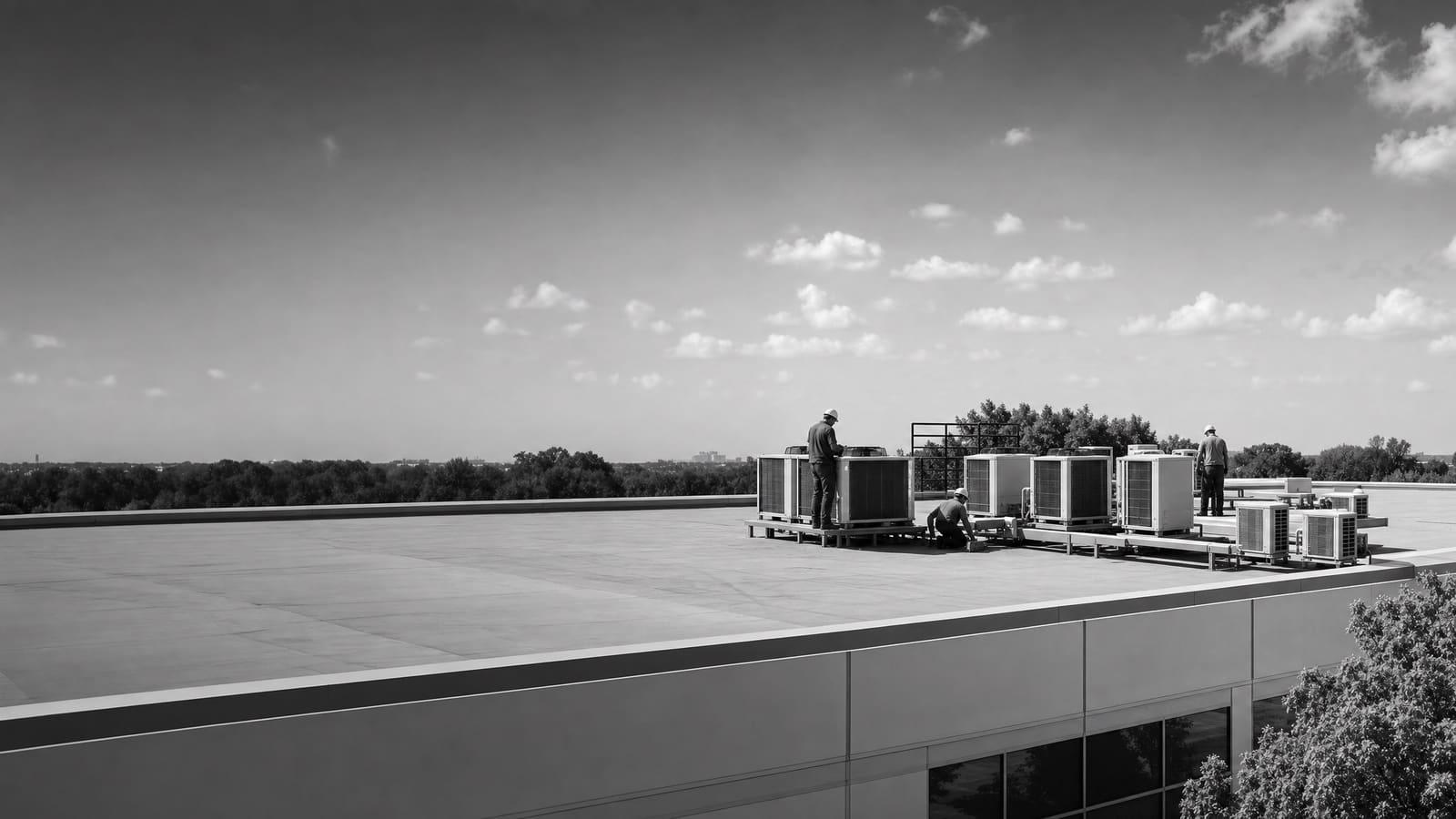
A commercial HVAC replacement covers the load calculation, the equipment, the curb and connection work, the crane set, the electrical and gas tie-ins, refrigerant recovery from the old unit, permits, and commissioning. Replacement usually beats another repair once a unit passes fifteen years, once service calls start repeating, or once the space stops holding setpoint. Old, inefficient rooftop units waste roughly $900 to $3,700 each per year, so waiting for failure carries its own running cost.
A site review still has to confirm the real load, the curb and roof condition, available electrical capacity, and crane access before any of that becomes a number.
THREE WAYS THIS GOES
Choose the replacement, or let the equipment choose for you
Most rooftop units get replaced the day they quit. That is a choice, not a rule, and it is the most expensive version of the decision. You take whatever equipment is available, on whatever day it ships, while the space is uncomfortable and tenants are calling.
The other two paths are planned. A like-for-like swap keeps the same size and the same fuel and gets the building back to normal fast. A planned efficiency upgrade treats the replacement as the one chance in fifteen years to fix sizing, heating strategy, and operating cost at the same time. There is also a fourth path worth pricing before you commit: leave a unit in place and retrofit advanced controls when it still has real service life left.
Pick the row that matches how much runway your equipment actually has, not how the last repair invoice felt.
WHAT MOVES THE NUMBER
Where replacement quotes actually differ
The equipment is rarely the line that separates two bids. These are the places a replacement quote either tells you the truth or quietly leaves the difference for a change order.
CHOOSING EQUIPMENT
Gas heat, heat pump, or both
Rooftop units cool close to half of all commercial floor space in the country, so most replacement decisions start from the same fork: another gas-heat unit, or a heat pump. Heat pump rooftop units are mechanically similar to standard air-conditioning rooftops. The difference is that they run the refrigerant cycle in reverse to heat the building instead of burning fuel.
There are three shapes to choose from. Dual-fuel units heat with the heat pump most of the time and fall back to gas when it gets cold. All-electric units drop the gas connection and use electric resistance as backup. Cold-climate units hold heating capacity further down the temperature scale. This matters because heat pump efficiency falls as outdoor temperature drops, and at the bottom of the range it lands close to plain electric resistance heat. The backup strategy deserves more attention than the headline rating.
The list that decides it is short: the building's heating load, local electricity and gas prices, the electrical capacity you already have, physical room on the roof, whether the gas line stays, what equipment you can actually get on your timeline, and whether your service contractor works on heat pump units regularly.
COMPLEXITY
What makes a replacement simple or hard
Two buildings can buy the identical unit and get quotes that sit far apart. The difference is almost never the equipment. It is what the building makes the crew do to get that unit installed, connected, and running right.
LOWER COMPLEXITY
Straight swap conditions
Same tonnage and same fuel, an existing curb the adapter fits, a roof that carries the weight without structural review, electrical service with room to spare, open lot for the crane, and a unit that is genuinely in stock.
HIGHER COMPLEXITY
What adds scope and time
A fuel switch that needs new electrical capacity, a larger footprint that triggers structural review, tight access that limits crane reach or forces off-hours work, controls that must tie into an existing building system, and long-lead equipment.
SITE REVIEW
What a walk on the roof has to settle
The old nameplate is a starting point, not an answer. Twenty years changes occupancy, plug loads, lighting heat, and sometimes the envelope itself, so the honest first step is confirming what the space needs now. A unit sized for a building that no longer exists short-cycles, runs humid, and produces the comfort complaints nobody can ever trace.
After the load, the review is physical. Does the existing curb match the new footprint, or are an adapter and a roof patch in play? Will the structure carry the weight? Is there electrical capacity and breaker space for an all-electric unit, or does the panel come first? Does the gas line stay or get capped? Is there room on the roof once screen walls, adjacent units, and service clearances are respected? Can a crane reach the set point, and what does the lot closure cost your tenants?
Last comes availability. Equipment lead time is part of the decision, not a footnote to it. A unit that fits perfectly and arrives in twelve weeks is a different plan than one that ships next week.
The question that saves the most money
Ask what the load calculation says before anyone quotes a tonnage. If a bidder sizes from the old nameplate alone, you are buying the previous owner's assumptions for another fifteen years.
OWNERSHIP AND OPERATIONS
What you own after the crane leaves
A replacement is a fifteen-year operating decision made inside a two-day window. The unit you pick sets your energy bill, your service contract, and what happens the next time a compressor fails. Two of those consequences are worth deciding on purpose instead of by default.
The first is scope. If you have five aging units on one roof, the real question is not the one that quit. It is the order you replace the rest in, and whether the fleet ends up matched or mixed.
The second is service. Every unit up there has to be worked on by someone, and refrigerant handling in commercial cooling and heat pump equipment is federally regulated. A mixed fleet with several refrigerants and two heating strategies is perfectly workable, but it should be a plan you chose rather than one that accumulated.
SCOPE
One unit or the whole roof
Rank every unit by age and condition before you sign for the one that failed. Replacing the worst three across two budget years usually beats five emergencies spread over five summers.
SERVICE
The fleet you have to maintain
Refrigerant handling and recovery in commercial cooling and heat pump equipment is regulated federally. Standardizing equipment keeps parts, technician training, and service contracts simpler as the roof turns over.
PHASING AND LIFETIME COST
Spread the spend, keep the savings
Almost nobody replaces an entire roof at once, and almost nobody should. The workable version is a ranked list: every unit with its age, condition, repair history, and rough replacement cost, so you know which one goes next year and which one can wait. That same list lets you order ahead of the season instead of paying for whatever happens to be on the truck.
The savings side is real, and it compounds. High-efficiency rooftop specifications were written to cut unit energy use by up to half against the older standard, and more than 200 organizations have upgraded over 43,000 rooftop units through a national campaign, trimming a combined $37 million a year from their energy bills. Set against $900 to $3,700 wasted per old unit per year, a planned replacement pays back part of its own cost every season it runs.
Confirm incentive eligibility before the purchase order, not after. Programs set their own rules about timing and qualifying equipment, and that paperwork is far easier to satisfy while the specification is still on paper.
BEFORE YOU SIGN
Five things a comparable quote shows
Two bids on the same roof are usually not the same job. Make every bidder show these five lines, and the difference between them stops being a mystery.
01
Equipment and availability
Make, model, tonnage, efficiency tier, heating type, and the date the unit can actually be on site.
02
Curb, structure, and roof
Adapter or new curb, any structural review, membrane patching, and who warranties the roof penetration afterward.
03
The crane day
Rigging plan, lot closure hours, crane reach, and who coordinates with tenants and the property manager.
04
Electrical, gas, and refrigerant
Service or panel work, gas line disposition, and certified recovery of the refrigerant in the removed unit.
05
Permits and commissioning
Permits and inspections included, plus documented startup: charge, airflow, and control settings verified against spec.
Get a defensible number
Price the equipment and the building together.
Send the address, operating target, and target opening date. Flux will identify what must be verified before the project can be priced.
Get a free estimateQuestions
Straight answers.
How do I know it's time to replace instead of repair again?
Three signals matter more than the last invoice: the unit is past fifteen years, service calls are repeating, or the space no longer holds setpoint on design days. Old, inefficient rooftop units waste roughly $900 to $3,700 each per year, so a unit that limps along is already spending money you don't see on the repair ticket.
Should the replacement be a heat pump or another gas unit?
It depends on your heating load, local electricity and gas prices, the electrical capacity already at the building, and whether your service contractor regularly works on heat pump rooftops. Dual-fuel units keep gas as the cold-weather backup, all-electric units drop the gas line and back up with electric resistance, and cold-climate units hold heating capacity further down the temperature range.
What happens to the refrigerant in the old unit?
It has to be recovered and handled properly. Refrigerant in stationary commercial air-conditioning and heat pump equipment is regulated federally, covering how it is handled and recycled when equipment is serviced or removed. Recovery and disposal belong as a visible line on the quote, not as an assumption.
Can I replace rooftop units one at a time?
Yes, and most owners should. Rank every unit by age, condition, and repair history, then replace the worst first and order ahead of the cooling season. Phasing spreads the capital cost and lets you standardize equipment, which keeps parts and service simpler as the rest of the fleet turns over.
Is replacing the unit always the right move?
Not always. When a unit still has real service life left, retrofitting advanced controls is a recognized alternative that can capture part of the savings for less capital. The comparison worth running is proactive replacement, like-for-like replacement at end of life, and a controls retrofit — priced side by side before the equipment forces the decision.
Sources used for this guide
- [1]betterbuildingssolutioncenter.energy.gov — DOE Advanced Rooftop Unit Replacement Guidance
- [2]betterbuildingssolutioncenter.energy.gov — DOE Commercial Heat Pump Rooftop Unit Replacement Guidance
- [3]betterbuildingssolutioncenter.energy.gov — DOE High-Efficiency Commercial Rooftop Unit Toolkit
- [4]energy.gov — DOE Efficient Commercial Rooftop Air Conditioner Program
- [5]epa.gov — EPA Stationary HVAC Refrigerant Management