THE SHORT ANSWER
What a commercial HVAC replacement actually includes
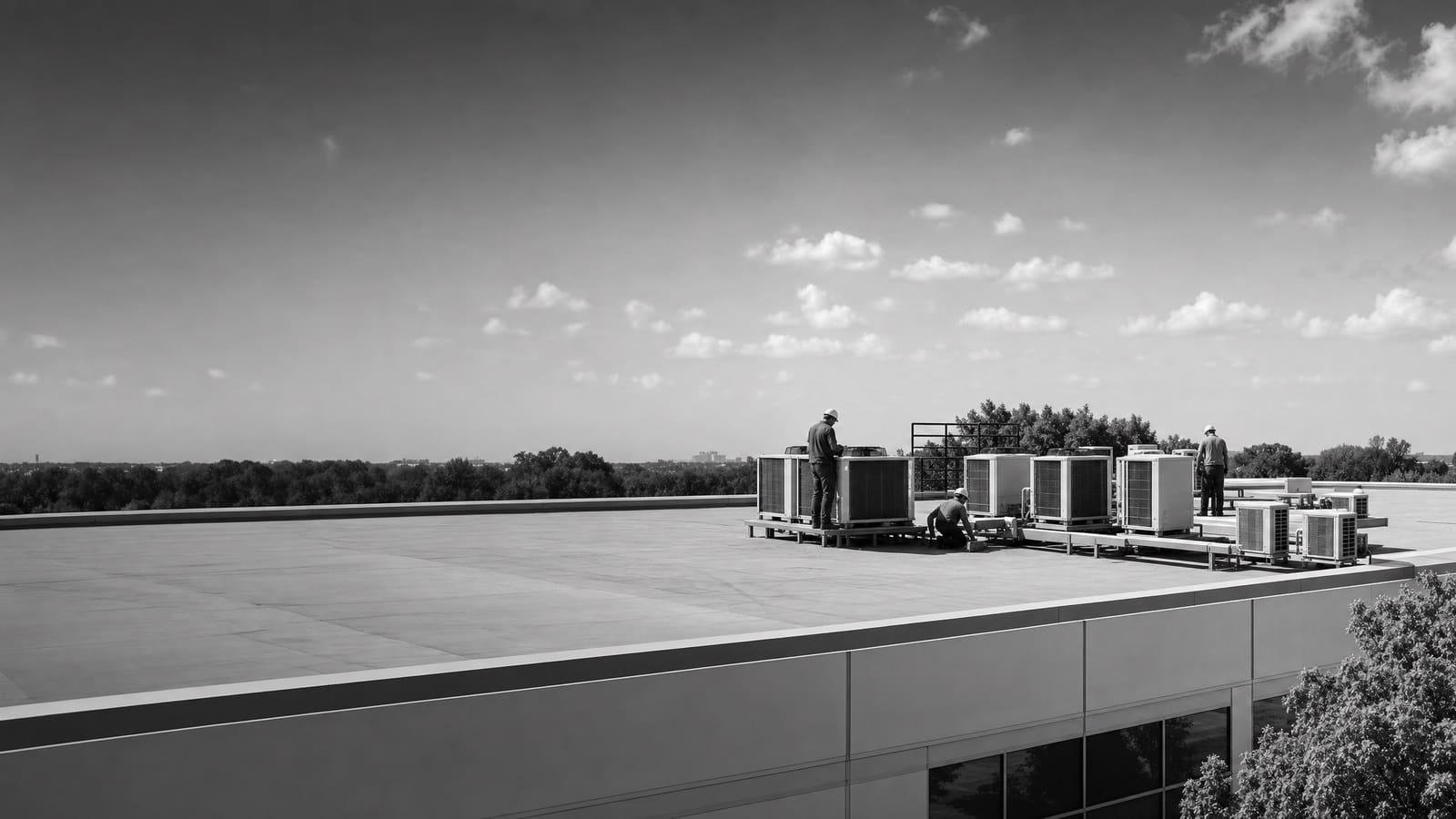
A commercial HVAC replacement covers a confirmed load calculation, equipment selection, permits, rigging and the crane set, a new curb or curb adapter, gas and electrical and refrigerant connections, controls integration, and commissioning. Replacement beats another repair once a unit is past roughly fifteen years. DOE finds rooftop units that old waste substantial energy against current models — commonly $900 to $3,700 per unit each year on inefficient equipment.
A site review has to verify the roof framing and curb condition, crane reach and lot access, electrical capacity at the panel, gas line sizing, and what the existing unit does and does not already have.
THE REAL CHOICE
Three ways to handle a rooftop unit at end of life
Most commercial buildings face the same three-way choice when a rooftop unit gets old or fails. DOE frames it the same way: replace on failure, replace proactively with a higher-efficiency unit, or retrofit the existing unit with advanced controls when the cabinet still has life in it.
Replace-on-failure is the default most facility teams fall into, and it is the most expensive version of the same project. Emergency work removes your choice of equipment, your choice of timing, and most of your negotiating room. Proactive replacement lets you compare efficiency tiers, line up the crane on a slow day, and pursue incentives that need approval before equipment is ordered.
Retrofit sits in the middle. If the cabinet, coil, and heat section are sound, advanced controls can capture part of the savings for a fraction of a full replacement. DOE's Advanced RTU Campaign counts both paths, letting owners commit to replacing old units or retrofitting them with advanced controls, depending on which makes better financial sense.
WHAT MOVES THE NUMBER
The lines where quotes diverge
No two roofs price the same, so treat these as the items to ask about rather than a menu. These are where quotes diverge most, and where a low bid usually turns out to have left something for a change order later.
IN PRACTICE
Choose the equipment before you argue about the price
The equipment decision comes first, because it sets everything downstream: the electrical work, the curb, the lead time, and the operating cost you live with for the rest of the unit's life. Rooftop units cool close to half of all commercial floor area in the country, which is why DOE has spent years pushing the efficiency of that one product category. Units built to the high-performance specification were designed to cut energy use by up to half against the older standard, and more than twenty models now exceed that spec.
The gap between a code-minimum unit and a high-efficiency one shows up every month rather than once. DOE's Advanced RTU Campaign tracked more than 43,000 upgraded units across over 200 organizations and counted $37 million in combined annual energy savings. Spread across a fleet, that is the difference between a building that runs cheaply and one that quietly bleeds.
The honest caution is that efficiency ratings are lab numbers. A high-efficiency unit that is oversized, poorly commissioned, or fighting a bad controls schedule will not deliver what the label promises. Selection and commissioning are really one decision.
SIDE BY SIDE
What makes one replacement simple and another complicated
Two projects with the same tonnage can be weeks apart on schedule and far apart on price. The difference is almost never the unit itself. It is what the building asks the installer to work around.
LOWER COMPLEXITY
Same footprint, same fuel
The new unit lands on the existing curb or a stock adapter. The electrical feed and gas line are already sized for it, the space is used the way it was when the old unit was specified, and the crane has a clear shot at the roof from the lot.
HIGHER COMPLEXITY
New fuel, new size, or a tight site
Switching to an all-electric heat pump, growing tonnage, or relocating the unit changes the scope. DOE lists electrical capacity, physical constraints, and existing gas lines as the infrastructure checks that decide feasibility, and a crowded site can push the crane to a weekend.
BEFORE YOU BUY
What the site review has to settle
A quote written from a nameplate photo is a starting number, not a commitment. Before anyone can stand behind an installed price, somebody has to be on the roof and in the electrical room.
DOE's own checklist for rooftop equipment decisions runs through the same items in order: climate and heating load, cost and utility bill impact, building type, equipment availability, and infrastructure. Infrastructure breaks into three parts that derail more projects than anything else — electrical capacity at the panel, physical constraints on the roof and the path to it, and existing gas lines. DOE also names contractor availability and familiarity with the technology as a genuine consideration, which is a polite way of saying a good unit installed poorly is still a bad project.
The other item worth settling early is incentives. Programs frequently require approval before equipment is ordered, so the sequence matters. A replacement that starts the week the unit dies rarely captures them.
Get these five answers on paper
A confirmed load for how the space is used today, panel capacity and available breaker space, curb condition and roof framing, crane reach and how long the lot can be closed, and whether the unit you want is actually available on your timeline.
OWNERSHIP
Two decisions that outlive the install
The install takes a week of your attention. The consequences run for the whole service life of the equipment, and they land on whoever pays the utility bill and whoever answers the comfort calls. Two of those consequences are worth settling before the crane shows up, because neither is cheap to change afterward: what the unit burns for heat, and what refrigerant it runs on. Replace-on-failure projects tend to answer both by accident, taking whatever is available that week. A planned replacement lets you answer both on purpose, with the utility math and the service plan in front of you instead of behind you.
FUEL
Gas, dual fuel, or all-electric
DOE reports that today's heat pump rooftop units are fully capable of handling most or all winter heating demand across the U.S. South and West, where they run most efficiently. The same guidance notes that even southern climates see sharp cold snaps, pointing to the February 2021 Texas freeze. That is why dual fuel stays on the table.
REFRIGERANT
What the fleet runs on
EPA Section 608 governs how refrigerant is handled, recovered, and recycled in stationary air conditioning and heat pump equipment. On a roof with mixed vintages, that shapes service contracts and spare-parts planning long after the new unit is running.
PLANNING AHEAD
Phasing a roof full of units
Most commercial buildings do not have one rooftop unit. They have six, or fourteen, installed within a few years of each other, which means they will reach the end of their useful life within a few years of each other too. That is the argument for phasing rather than waiting.
A phased plan starts with an inventory: age, tonnage, condition, and how critical the space under each unit is. Units past fifteen years move to the front, because DOE identifies that age as the point where a rooftop unit begins wasting substantial energy and money compared with a current model. Anything serving a space you cannot afford to lose moves up as well, regardless of age.
Then the money question gets easier. Instead of one capital request at a bad moment, you have a two- or three-year replacement schedule you can budget against, order equipment for in advance, and line up with whatever incentive cycles apply. Crane mobilization also costs less per unit when two or three are set on the same day, and that alone often pays for the planning.
The buildings that handle this well are not the ones with the newest equipment. They are the ones that know what they have and what order it is going in.
APPLES TO APPLES
Five things a comparable quote shows
Two quotes for the same roof can differ by a wide margin and both be honest. Usually one of them included something the other left for a change order. These five lines make them comparable.
01
Equipment, spelled out
Make, model, tonnage, efficiency tier, and heating type. A tonnage-only line hides the decision that matters most.
02
Availability, not just price
The lead time for the specific unit quoted, and what the alternate is if that lead time slips.
03
Curb, rigging, and access
Curb adapter or new curb, the rigging plan, crane size, and how long the lot is closed.
04
Connections and controls
Electrical, gas, and refrigerant work included, plus integration into the existing building automation system.
05
Commissioning and documentation
Startup readings, airflow and charge verification, refrigerant recovery under Section 608, and the paperwork the warranty needs.
Get a defensible number
Price the equipment and the building together.
Send the address, operating target, and target opening date. Flux will identify what must be verified before the project can be priced.
Get a free estimateQuestions
Straight answers.
When does replacing a rooftop unit beat repairing it again?
Once a unit is past about fifteen years, DOE finds it wastes substantial energy and money against a current model, commonly $900 to $3,700 per unit each year on inefficient equipment. At that point a second major repair is usually money spent on a unit you are going to replace anyway.
How much does a commercial HVAC installation cost?
There is no honest universal number, because tonnage, curb work, crane access, electrical scope, and controls all move it, which is why a real price follows a look at the roof. What you can pin down early is the operating side: DOE puts the annual waste of an old, inefficient rooftop unit at $900 to $3,700, and that is the figure a higher-efficiency replacement is working against.
Is a heat pump rooftop unit a real option for a commercial building?
DOE's guidance says today's heat pump rooftop units are fully capable of handling most or all winter heating demand across the U.S. South and West. The checks that decide it are electrical capacity, physical constraints on the roof, and existing gas lines, plus whether you want dual fuel backup for the occasional deep cold snap.
What happens to the refrigerant in the old unit?
EPA Section 608 governs the handling, recovery, and recycling of refrigerant in stationary air conditioning and heat pump equipment. Recovery from the removed unit is the installer's responsibility, and it should appear as a line on the quote rather than a verbal assurance.
Should we replace units one at a time or phase the whole roof?
If several units are close in age, phasing usually wins. You budget across years instead of reacting, order equipment ahead of lead times, and share crane mobilization across two or three sets in a single day.
Sources used for this guide
- [1]betterbuildingssolutioncenter.energy.gov — DOE Advanced Rooftop Unit Replacement Guidance
- [2]betterbuildingssolutioncenter.energy.gov — DOE Commercial Heat Pump Rooftop Unit Replacement Guidance
- [3]betterbuildingssolutioncenter.energy.gov — DOE High-Efficiency Commercial Rooftop Unit Toolkit
- [4]energy.gov — DOE Efficient Commercial Rooftop Air Conditioner Program
- [5]epa.gov — EPA Stationary HVAC Refrigerant Management