THE DIRECT ANSWER
What a commercial HVAC replacement actually covers
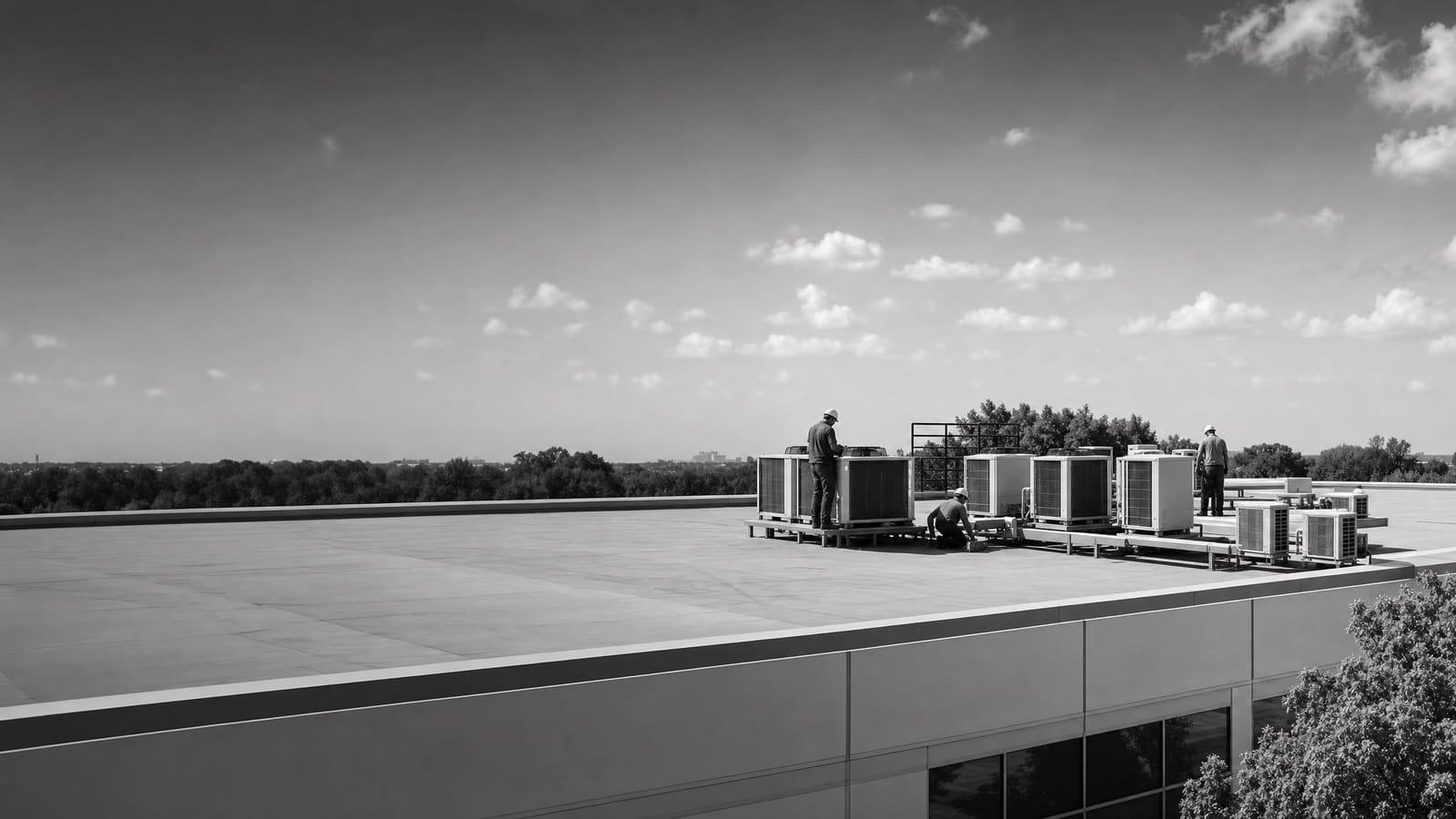
A commercial HVAC replacement covers a confirmed load, equipment selection, certified recovery of refrigerant from the old unit, curb and roof structural work, gas or electrical changes, the crane set, controls, permits, and commissioning. Replacement beats one more repair once a unit is past fifteen years and wasting energy every hour it runs. Old, inefficient rooftop units commonly waste $900 to $3,700 per unit each year, which is money that keeps leaving whether the unit is running well or not.
A site review has to verify the actual load, the curb size and roof structure, available electrical capacity, crane reach and lot access, and any code items that replacement triggers.
THE REAL CHOICE
Three ways to replace a rooftop unit
Most replacements come down to what the new unit burns. A like-for-like gas or air-conditioning rooftop unit is the quickest way back to conditioned space, and it is the honest answer when the space, the schedule, and the load have not changed. A heat pump rooftop unit adds reverse-cycle heating, and the choice among dual-fuel, all-electric, and cold-climate versions is driven by winter heating load, electrical capacity at the panel, physical room on the roof, and whether the gas line stays. Heat pump heating efficiency falls as outdoor temperature drops, trending toward electric resistance in the coldest hours, so New England heating hours belong in the model rather than in a brochure. Infrastructure usually settles it: if the service cannot carry backup electric heat, dual fuel is the practical path.
WHAT MOVES THE NUMBER
The budget lines that actually swing
Two quotes for the same building can differ by a wide margin without either one being wrong. The difference almost always sits in these lines, not in the equipment brand. Ask which of them are priced and which are carried as allowances.
IN PRACTICE
Buy the load, not the nameplate
The most expensive mistake in a rooftop replacement is copying the old nameplate. A unit installed fifteen or twenty years ago was sized for occupancy, lighting, plug loads, and an envelope that may no longer exist. Copying it forward locks in whatever was wrong the first time, and it usually shows up as the same comfort complaint you have been living with, only under warranty.
The second mistake is waiting for failure. Facility teams routinely delay a purchase until the unit stops holding setpoint, needs constant attention, or dies outright. Replacing proactively tends to be the better business decision, because a failure in season removes every option that saves money: you take whatever is available, at whatever price, on whatever schedule the crane and the crew can manage.
Efficiency tier is the third decision, and it is worth real attention. High-performance rooftop units were developed to cut energy use by up to half against the older baseline, and more than twenty models now exceed that specification. Against a fifteen-year-old unit burning $900 to $3,700 a year in waste, the tier you select is not a preference. It is the operating budget for the next two decades.
SCOPE CHECK
What makes this project simple or hard
Before you compare prices, figure out which project you actually have. The two versions below can sit on the same street and differ by weeks of schedule.
LOWER COMPLEXITY
Same size, same fuel, same curb
The load still matches, the existing curb accepts an adapter, the roof carries the weight, power and gas are already right-sized, and the crane can set up in your own lot without closing anything public.
HIGHER COMPLEXITY
New fuel, new footprint, tight access
A fuel switch, added tonnage, structural review, a longer boom reaching over an occupied street, tenant-critical spaces that cannot lose conditioning, or controls that have to be rebuilt rather than reconnected.
THE SITE REVIEW
What a real walk-through has to settle
A quote written from a photo is a guess with a number attached. The walk-through exists to close the questions that cost money later, and there are only a handful of them.
First, the load: what the space is used for now, how many people are in it, what equipment runs, and when the building is actually occupied. Second, the roof: curb dimensions, structural capacity, drainage, clearance around the unit, and whether service access will still work once the new equipment lands. Third, infrastructure: available electrical capacity, the condition and future of the gas line, and where new conduit or piping would have to run. Fourth, access: where a crane can set up, what it has to reach over, and how long the lot or an entrance is out of service.
Last, code items triggered by replacement. Older equipment was often installed under earlier requirements, and swapping the unit can bring economizer, ventilation, or control provisions into play that the original never had to satisfy.
The one question that changes the price most
Ask what electrical capacity is actually available at the panel. That single answer decides whether an all-electric unit, a dual-fuel unit, or a like-for-like replacement is realistic, and it is the item most often assumed rather than measured.
CAMBRIDGE SPECIFICS
Permitting and noise in Cambridge
Mechanical work in Cambridge is permitted through the Inspectional Services Department, which publishes a mechanical fee schedule alongside the separate electrical and gas fees a replacement often pulls in. Budget for more than one permit when the project touches power or fuel, not just the unit itself.
The item that catches owners here is noise. Cambridge publishes installation guidance specifically warning that an HVAC or AC installation must not violate the city's noise ordinance, and that applies to the equipment you are about to buy. Buildings sit close together and close to residences, so a unit that would disappear on a suburban roof can become a complaint, an enforcement issue, and a second mobilization to add screening or relocate equipment.
Settle sound before the order goes in
Get the manufacturer's sound data and the proposed placement reviewed against the noise ordinance while equipment selection is still open. Choosing a quieter unit or shifting its location is a line item on paper and a rework project once it is set.
OWNERSHIP AND OPERATIONS
Two things that outlive the install
The install is a week. The consequences run fifteen to twenty-five years, and two of them are decided before anyone touches the roof. The first is who actually benefits from efficiency, which is a lease question more than an engineering one. The second is what your roof looks like as a fleet rather than as one unit, because every choice you make now sets the parts, controls, and training picture for whatever gets replaced next.
WHO PAYS, WHO BENEFITS
Lease structure drives the tier
If the owner buys the equipment and the tenant pays the utility bill, the efficiency decision has a split incentive built into it. Sort out who captures the savings before you choose a tier, or the cheapest unit wins by default.
ROOF AS A FLEET
Standardize what you can
Matching equipment across a roof keeps spare parts, control sequences, and technician familiarity simple. It also makes the next replacement a repeat rather than a new project, which is where portfolio-level planning pays off.
PHASING AND LIFETIME COST
Plan the replacements you can still schedule
If you have several aging units, treat them as a program instead of a series of emergencies. Rank them by age, condition, and what they serve, then move the worst one on your schedule while the others stay on maintenance. That sequencing is the difference between paying a planned price and paying a failure price, and it keeps the crane, the permits, and the tenant disruption grouped into fewer events.
Lifetime cost is where the argument for acting early gets easy. Rooftop units condition close to half of all commercial floor space in the country, and the old ones are the reason that matters: a single inefficient unit can waste $900 to $3,700 a year. Across a roof with four of them, that is a recurring number large enough to fund the replacement it is delaying.
Incentives belong in the same conversation, and they belong in it early. Program eligibility usually depends on the efficiency level you select, so confirm what qualifies before equipment is ordered rather than after it is on the roof. A unit that would have qualified, ordered a week too soon, is a straightforward way to leave money behind.
COMPARING QUOTES
Five things a comparable quote shows
Any two bids can be read side by side once they answer the same five questions. If one of them leaves an item blank, that is not a lower price. It is a change order with a delay attached.
01
Equipment, tier, and availability
Model, tonnage, efficiency level, and honest lead time, because a price without availability is not a schedule.
02
Curb, roof, and structural scope
Curb adapter, any structural work, and who confirmed the roof can carry the new unit.
03
Crane plan and site closure
Rigging plan, staging location, how long the lot or entrance is out of service, and who owns that coordination.
04
Electrical, gas, and refrigerant work
Circuit and capacity changes, gas line disposition, and certified recovery of refrigerant from the removed unit.
05
Permits, inspection, and commissioning
Which permits are included, who schedules inspection, and what commissioning documentation you receive at handoff.
Get a defensible number
Price the equipment and the building together.
Send the address, operating target, and target opening date. Flux will identify what must be verified before the project can be priced.
Get a free estimateQuestions
Straight answers.
When is replacement better than another repair?
Once a unit passes fifteen years, the math usually turns. Older rooftop units waste meaningful energy every hour they run, commonly $900 to $3,700 a year each, and that loss continues between repairs. Repeated service calls on top of that waste is the signal to replace.
Does a heat pump rooftop unit work in Cambridge winters?
It can, but the version matters. Heat pump heating efficiency drops as outdoor temperature falls, moving toward electric resistance in the coldest hours. Dual-fuel and cold-climate units exist for that reason, and the deciding factor is usually whether your electrical service can carry backup heat.
What permits does a commercial HVAC replacement need in Cambridge?
Mechanical permitting runs through the Inspectional Services Department, which publishes its mechanical fee schedule separately from electrical and gas fees. A replacement that touches power or fuel typically involves more than one permit, so confirm which ones the contractor is filing.
Can noise rules affect which unit I buy?
Yes. The city's installation guidance is explicit that an HVAC or AC installation must not violate the noise ordinance. Review sound data and placement while selection is still open, because relocating or screening equipment after it is set costs far more than choosing differently.
Should I replace like-for-like or resize?
Confirm the load either way. If occupancy, equipment, and the envelope are unchanged, like-for-like is often correct and fastest. If the space is used differently than it was fifteen years ago, resizing fixes comfort problems the old unit was never able to solve.
Sources used for this guide
- [1]betterbuildingssolutioncenter.energy.gov — DOE Advanced Rooftop Unit Replacement Guidance
- [2]betterbuildingssolutioncenter.energy.gov — DOE Commercial Heat Pump Rooftop Unit Replacement Guidance
- [3]betterbuildingssolutioncenter.energy.gov — DOE High-Efficiency Commercial Rooftop Unit Toolkit
- [4]energy.gov — DOE Efficient Commercial Rooftop Air Conditioner Program
- [5]epa.gov — EPA Stationary HVAC Refrigerant Management
- [6]cambridgema.gov — Mechanical Fees - Inspectional Services - City of Cambridge, Massachusetts