THE SHORT VERSION
What a commercial HVAC replacement includes
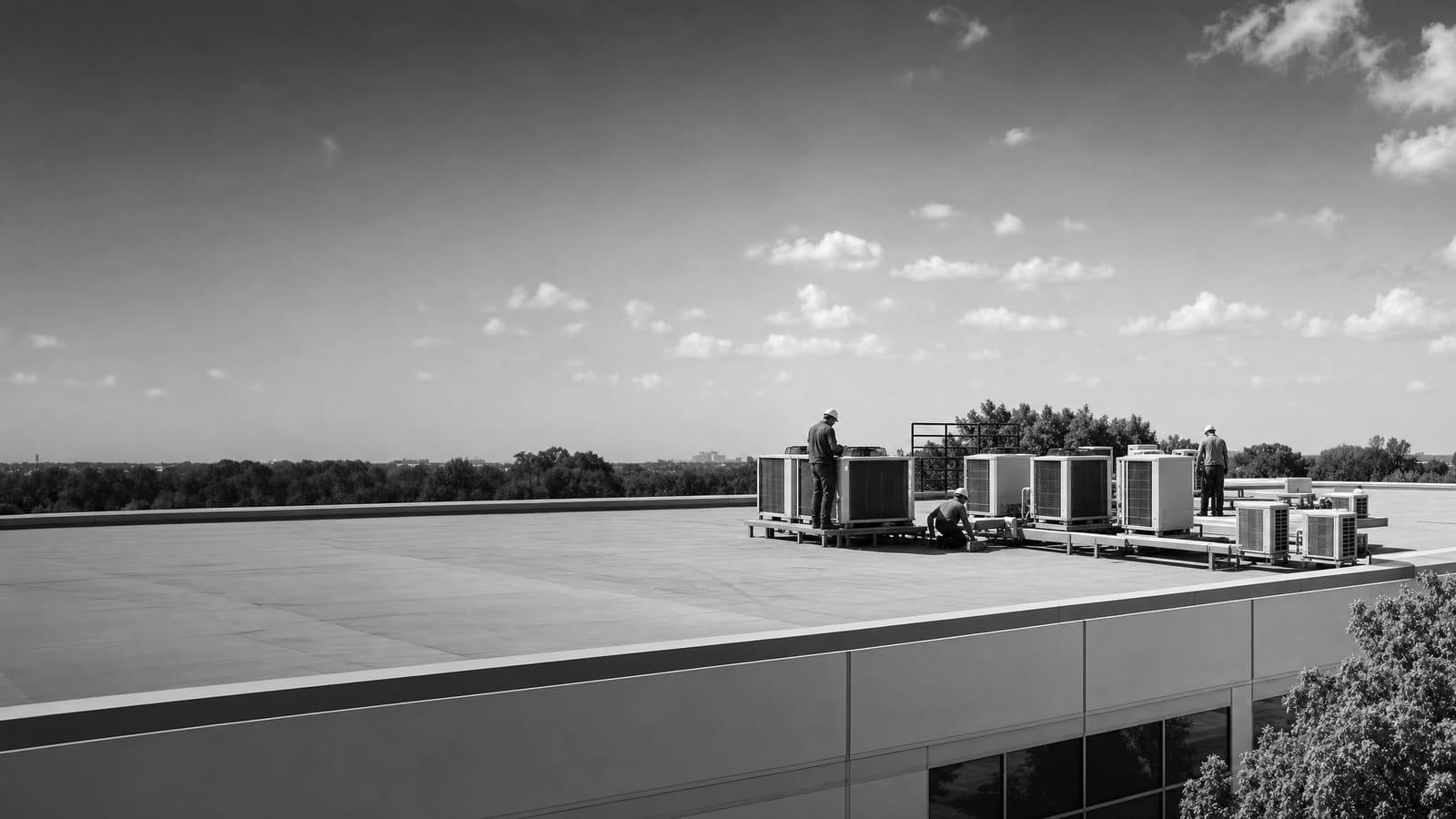
A commercial HVAC replacement is five things: a load check, equipment selected against real lead times, a permit and rigging plan, the swap itself, and commissioning that proves the unit performs to spec. Replacement beats one more repair once a rooftop unit passes fifteen years. Units that old waste energy every hour they run — commonly $900 to $3,700 per unit each year, which is money you spend whether the unit is working well or not.
A site review still has to confirm the real load, the curb and the roof structure under it, available electrical capacity, and crane reach before any of that holds for your building.
THE THREE PATHS
Three ways to handle an aging rooftop unit
Most buildings drift into the first option without ever choosing it. A unit runs until it stops cooling, and then the decision gets made in a heat wave with whatever is available. That is the most expensive version of this project, because you lose the ability to shop equipment, schedule the crane around your tenants, or take a rebate that requires approval before the work starts.
The other two paths are decisions you make on your own calendar. A planned like-for-like swap is right when the space is used the way it was designed and the current unit basically keeps up. A planned upgrade is right when bills have crept, comfort complaints never really resolved, or you have a portfolio-level decision to make about gas heat. The high-efficiency specification that reshaped this equipment market cuts unit energy use by up to half against the older baseline, so the upgrade case is real money rather than a talking point.
WHAT MOVES THE NUMBER
The budget lines that actually swing
Two quotes for the same roof can differ by a wide margin and both be honest. The difference is almost always sitting in these lines. Ask which ones your quote carries and which ones are excluded, because exclusions are where change orders come from.
IN PRACTICE
Buying the unit versus buying the install
The equipment is the part buyers compare, and it is the part that varies least. Two contractors quoting the same tonnage and the same efficiency tier are quoting nearly the same box. What separates their numbers is the install: who owns the rigging plan, who pulls the permits, who handles controls integration, and who comes back when the north side of the building is warm in month two.
So the useful comparison is not price per ton. It is scope per dollar. A quote that looks low usually got there by leaving something out — the curb adapter, the structural check, the crane, the commissioning, or the permit and inspection time. None of those items disappear. They reappear later as a change order, at a worse moment, with less leverage on your side of the table.
Rooftop units condition close to half of all commercial floor space in the country. This is a well-worn project with well-understood costs, not a custom engineering exercise. Anyone who cannot tell you what their number covers, line by line, is either guessing or hoping you will not ask. Ask for the exclusions list before you ask for a discount.
SCOPE CHECK
What makes this job simple, and what makes it hard
Before you budget, work out which version of this project you actually have. The gap between the two is weeks of schedule and a meaningful share of the price, and you can usually tell from the roof and the electrical room in a single visit.
STRAIGHTFORWARD
Same size, same fuel, same curb
The replacement matches the original tonnage and heat source, the curb adapter is a stock part, the crane has clear reach from the lot, and the electrical service already carries the load. Permits are routine and the unit lands in a morning.
MORE INVOLVED
New footprint, new fuel, or new capacity
Tonnage grows, the unit goes electric, or the footprint changes. Now you have structural review, possible service and panel work, gas line abandonment, controls reprogramming, and a longer permit path. Sequence this months ahead, not in July.
BEFORE YOU BUY
What a real site review has to confirm
A quote written from a nameplate photo is a starting number, not a price. The nameplate tells you what somebody installed twenty years ago. It does not tell you whether that sizing was ever correct, whether the roof still carries the load comfortably, or whether the building's electrical service has room for what you want next.
A proper walk covers five things. The load, calculated from how the space is used today — occupancy, plug loads, lighting, envelope, operating hours. The curb and the structure underneath it. The electrical capacity at the panel, which is the most common surprise on any project that adds tonnage or drops gas heat. The physical constraints: crane reach, staging space, roof access, and whatever is in the way. And the gas service, whether it is staying or going.
Those five categories decide whether an electric option is even on the table for your building. They are also the five that quietly turn a clean quote into a change order when nobody checked. Half a day on site is cheap insurance against a number that moves after you have signed.
Get the panel opened during the walk
Electrical capacity is where these projects stall. If you are considering an electric unit or more tonnage, have someone open the panel during the site visit rather than discovering the problem after the equipment is ordered.
IN BURBANK
Permit timing and a mild-winter advantage
Two local realities shape a Burbank replacement. The first is permitting. In California, mechanical work like a rooftop unit replacement is permitted work — and so is re-roofing. If the roof is within a few years of its own replacement, sequencing the two jobs together saves a second crane mobilization and a second round of roof penetrations. Decide that before you order equipment, not after it lands.
The second is climate. Heat pump rooftop units lose efficiency as outdoor temperatures fall, which is why they suit mild-to-moderate winter heating best. Across most of the U.S. South and West, today's heat pump rooftop units can carry most or all of the winter heating load on their own. Southern California sits squarely in that band, so an all-electric replacement here is a genuine option rather than a compromise you tolerate.
Ask the permit question first
Confirm with the city's building division which permits your scope actually triggers — mechanical, electrical, and structural review if the footprint grows — and put that review time in the schedule before the crane gets booked.
OWNERSHIP MATH
Two things to settle before you sign
A rooftop replacement is a fifteen-to-twenty-five-year decision usually made in about two weeks. Price gets all the attention, but two other questions decide whether you are still happy with it in year three.
The first is who owns the asset and who owns the bill. In a leased building, the lease language on capital equipment decides whether this is your project or the landlord's, and whether an efficiency upgrade you fund shows up on your utility statement or on theirs. Settle that before you spec the unit, because it changes which option is worth the premium.
The second is what happens after handoff. Refrigerant work on both the old unit and the new one is regulated: certified technicians, documented recovery, no venting. That obligation does not end at commissioning. It follows the equipment for its whole service life, which is worth planning across a fleet rather than one roof at a time.
WHO PAYS
Lease language beats good intentions
A tenant-funded efficiency upgrade in a building where the landlord holds the meter is a donation. Read the capital equipment and utility clauses before you start comparing efficiency tiers.
WHO MAINTAINS
The obligation outlives the install
Refrigerant handling requires certified technicians and documented recovery for the life of the equipment. Confirm your service contractor's coverage as part of the purchase, not six months after it.
PLANNING AHEAD
Phasing a fleet instead of reacting to it
If you own more than one unit, the highest-value move is not picking a better box. It is getting ahead of the failure curve. More than two hundred organizations have run planned rooftop upgrade programs across more than forty-three thousand units, and the combined result was thirty-seven million dollars a year off their energy bills. That did not come from emergency replacements. It came from replacing units before they quit, on a schedule, with time to shop.
The practical version for a single building is simple. Inventory every unit with its age, tonnage, and refrigerant. Rank them by age and by how much trouble each one has caused. Replace the worst one this year on your terms, and put the next two into the following budget cycles. Anything past fifteen years is a candidate rather than an emergency — but treat it as a candidate now, while you still control the timing and the price.
The alternative is a phone call in August and a multi-week lead time on the only unit that fits your curb.
APPLES TO APPLES
Five things a comparable quote shows
If two quotes do not both show these five items, you are not comparing them — you are guessing at the difference. Ask for all five in writing before any equipment is ordered.
01
Equipment, spelled out
Make, model, tonnage, efficiency tier, heat source, and the quoted lead time in weeks.
02
Curb and structural scope
Adapter or new curb, and whether structural review is included or explicitly excluded.
03
Crane and access plan
Rigging, how long the lot is closed, staging location, and who coordinates with tenants.
04
Permits and inspections
Which permits get pulled, by whom, and how much review time is built into the schedule.
05
Commissioning and documentation
Charge, airflow, and controls verified against spec, with a startup report that supports the warranty.
Get a defensible number
Price the equipment and the building together.
Send the address, operating target, and target opening date. Flux will identify what must be verified before the project can be priced.
Get a free estimateQuestions
Straight answers.
When is replacement smarter than another repair?
Once a rooftop unit passes about fifteen years, the arithmetic usually flips. Units that old waste substantial energy every hour they run — commonly $900 to $3,700 per unit each year. A repair buys you time on equipment that is already costing you money quietly, and it does it at the worst possible moment for scheduling.
How long does a rooftop unit replacement take?
The on-site work for a straightforward like-for-like swap is short. The crane sets the unit and the connections follow. What drives your calendar is equipment lead time and permit review, not labor hours. Ask for both in weeks before you promise anyone a date.
Does a heat pump rooftop unit make sense in Burbank?
Often, yes. Heat pump rooftop units are most efficient with mild-to-moderate winter heating, and across most of the U.S. South and West they can handle most or all of the winter heating load. The deciding factor is usually not climate here — it is electrical capacity, physical constraints on the roof, and equipment availability.
What does a commercial HVAC installation cost?
There is no honest universal number. Tonnage, curb and structural work, electrical capacity, and crane access each move it substantially, which is why a real price follows a real look at the roof. The figure worth anchoring on is the other side of the ledger: an inefficient unit past fifteen years commonly wastes $900 to $3,700 a year.
What happens to the refrigerant in the old unit?
It has to be recovered by a certified technician and handled under federal refrigerant rules — venting it is not permitted. This is required scope on every replacement, so it should appear on the quote rather than surfacing later as an add. Ask to see the recovery documentation at closeout.
Sources used for this guide
- [1]betterbuildingssolutioncenter.energy.gov — DOE Advanced Rooftop Unit Replacement Guidance
- [2]betterbuildingssolutioncenter.energy.gov — DOE Commercial Heat Pump Rooftop Unit Replacement Guidance
- [3]betterbuildingssolutioncenter.energy.gov — DOE High-Efficiency Commercial Rooftop Unit Toolkit
- [4]energy.gov — DOE Efficient Commercial Rooftop Air Conditioner Program
- [5]epa.gov — EPA Stationary HVAC Refrigerant Management
- [6]californiacity-ca.gov — HVAC Permits