THE DIRECT ANSWER
What a commercial HVAC replacement actually includes
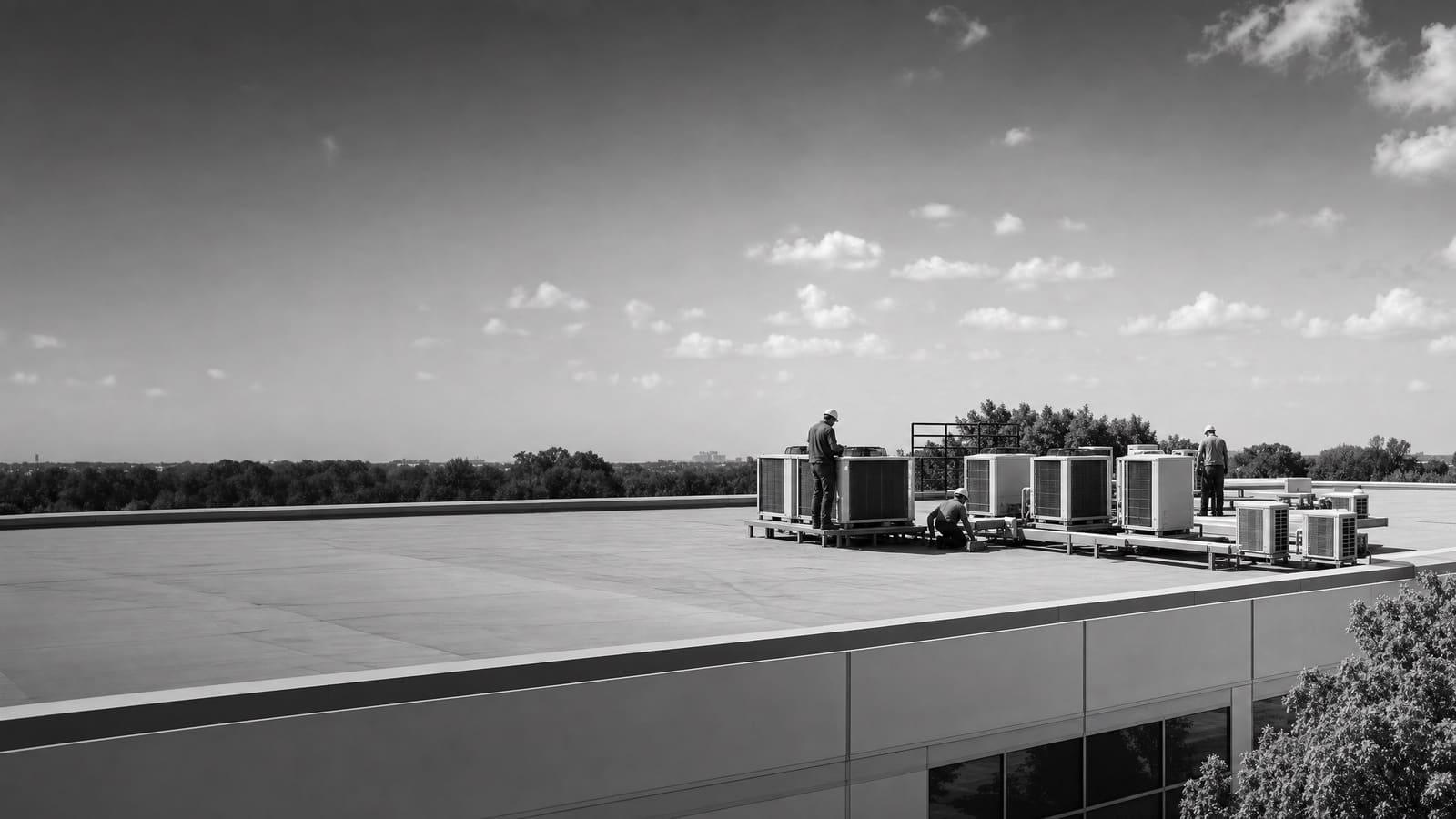
A commercial HVAC replacement covers the load check, equipment selection, certified recovery of the old refrigerant, the crane set, curb and adapter work, electrical and gas connections, controls, and a documented startup. Replacement wins over another repair when the unit is old enough that it wastes money every hour it runs. Old, inefficient rooftop units burn through $900 to $3,700 per unit each year, and units past fifteen years are the usual offenders.
A site review still has to confirm tonnage against current occupancy, roof and curb condition, available electrical capacity, and crane access before any of that becomes a real price.
THREE PATHS
Three ways to handle an aging rooftop unit
Most buildings default to the first option without ever choosing it. The unit runs until it stops, and the decision gets made during a heat wave with whatever is on the truck. Replacing an inefficient unit proactively is usually the better business move than replacement-on-failure, and it often beats a like-for-like swap at the end of the unit's service life.
The middle path is real too. If the cabinet and coil still have life in them, advanced controls can cut runtime waste without a crane day, and the capital goes to the units that are actually failing. Owners generally choose per unit between replacing with more efficient equipment and retrofitting controls, based on which one makes financial sense.
Make that choice unit by unit, on your calendar. A short walk of the roof with nameplate dates tells you which bucket each unit belongs in.
WHERE THE MONEY GOES
The budget lines that actually move
Two quotes for the same tonnage can land far apart, and it is almost never the box. It is the work around the box. Compare these lines side by side before you compare bottom numbers.
IN PRACTICE
Buying the unit versus buying the install
The equipment line is the easiest part of a quote to compare. It is also the part that varies least. Two contractors quoting the same tonnage usually land within a narrow band on the box itself, then diverge on everything that makes it work: the curb adapter, the structural check, the crane day, the electrical, the controls, and the startup.
That is why the cheapest number on the page is often the one with the most missing from it. A quote showing a unit price and one lump sum for labor is not comparable to a quote that lists curb work, rigging, permit handling, and commissioning separately. You cannot tell whether the gap is efficiency or scope.
So make every bidder price the same defined scope. Give them the same nameplate photo, the same roof access notes, and the same honest answer about what the space is used for today. When the scope is identical, the spread between bids tells you something real. When it is not, you are comparing two different projects that happen to share a tonnage.
COMPLEXITY CHECK
What makes this project simple or hard
Before you budget, work out which side of this line your building sits on. The gap between the two is measured in weeks and in engineering, not in equipment.
LOWER COMPLEXITY
Straight swap territory
Same tonnage on an existing curb, clear crane access from the lot, adequate power already at the unit, and a space whose use has not changed since the original install. Permits are usually mechanical and electrical only.
HIGHER COMPLEXITY
Engineered replacement
A change in tonnage or footprint, a curb that needs structural review, tight or occupied crane access, a fuel switch that adds electrical capacity, or controls that must tie into an existing building automation system.
THE SITE REVIEW
What a real scoping visit confirms
A quote written from a nameplate photo is a starting point, not a price. The visit turns it into one. Someone has to stand on the roof, open the panels, and check the things that decide the number.
Load comes first. Sizing off the old nameplate carries forward whatever the last contractor got wrong, and twenty years changes occupancy, plug loads, lighting, and envelope. Then the physical constraints: curb condition and dimensions, the roof structure under it, and whether the new footprint lands where the old one did.
Infrastructure is the line that surprises people. Electrical capacity at the unit and back at the panel, the condition and future of the gas line, and how refrigerant lines are routed all belong in the same conversation. If a heat pump is on the table, that conversation moves to the front, because capacity and gas decisions are expensive to reverse after the order is placed.
Access closes it out. Where the crane sets, which stalls close, and how long the lot is down.
Ask for this before you sign
A scope that names the tonnage, the efficiency tier, the curb adapter, the rigging plan, the permits being pulled, and the commissioning steps. If any of those is a lump sum labeled miscellaneous, that is the line that grows after the crane leaves.
OWNERSHIP QUESTIONS
Two decisions that outlive the install
Two questions tend to get deferred during a replacement and then quietly set the cost of the next ten years. The first is fuel. The second is what happens to the rest of the roof.
Neither has a universal answer, and both are cheaper to settle now than after the equipment is sitting on the curb. A gas unit replaced like-for-like keeps the gas service, the flue, and the fuel exposure that comes with them. An electric unit sheds all three, but only after it passes an electrical capacity check. On a multi-unit roof, replacing one unit at a time with no plan leaves you carrying mixed refrigerants, mixed controls, and a service contract that has to cover both.
FUEL PATH
Gas, dual fuel, or all electric
Heat pump rooftop units are technically similar to air conditioning units but add reverse-cycle heating. Across most of the U.S. South and West they cover most or all of the winter heating load. The call hinges on electricity price, electrical capacity, and the gas line.
FLEET PLAN
One unit or the whole roof
Rooftop units condition close to half of all U.S. commercial floor area, and most roofs carry several. Sequencing replacements by age and condition keeps refrigerants, controls, and spare parts from fragmenting across the fleet.
THE LONG VIEW
Phasing, lead times, and lifetime cost
The strongest argument for planning replacements is that planning removes the two worst variables: freight and choice. A unit that fails in August gets replaced with whatever is available, at whatever it costs that week, by whoever can get a crane. A unit replaced on a plan gets the efficiency tier you chose, at a price you negotiated, on a day the building can absorb.
Phasing should follow condition and age, not the budget calendar. Walk the roof, write down nameplate dates, and rank by which units are both old and running hardest. That is where the waste concentrates, and fifteen years is a reasonable trigger for a serious look rather than another patch.
Lifetime cost is the honest comparison. Organizations that upgraded more than 43,000 rooftop units through a national campaign report a combined $37 million a year in energy savings. That is an average hiding a wide spread, but the direction is not in dispute. Run the math on your own units at your own rates before you accept a bid that wins only on first cost.
THE QUOTE CHECKLIST
Five things a comparable quote shows
If two quotes do not show these five, you are not comparing them. You are guessing. Ask for the missing lines in writing before you decide anything.
01
Unit, tonnage, and efficiency tier
Model number and rated capacity, not just a brand name and a size.
02
Curb and structural scope
Adapter or new curb, plus who carries the cost if the roof structure needs review.
03
Rigging and lot plan
Crane size, set location, stalls closed, and how many hours the lot is affected.
04
Permits, inspections, and refrigerant handling
Who pulls them, who schedules them, and how the old charge gets recovered and recycled.
05
Commissioning and warranty terms
Documented startup, charge and airflow verification, controls setup, and what the warranty requires.
Get a defensible number
Price the equipment and the building together.
Send the address, operating target, and target opening date. Flux will identify what must be verified before the project can be priced.
Get a free estimateQuestions
Straight answers.
When does replacing beat repairing one more time?
When the running cost is the real expense. Old, inefficient rooftop units waste $900 to $3,700 per unit every year, and units past fifteen years are usually the ones doing it. If a second major repair is on the table for a unit in that range, replacement is normally the better place to put the money.
Should we switch from gas to a heat pump rooftop unit?
Heat pump rooftop units work like standard AC units but add reverse-cycle heating, and across most of the South and West they handle most or all of the winter heating load. The decision comes down to electricity price, electrical capacity at the building, and whether the gas line stays. Confirm capacity before you order, not after.
Is there a cheaper way to cut rooftop energy waste?
Advanced controls. On a unit with cabinet and coil life left, a controls retrofit cuts runtime waste without a crane day or a curb adapter. Owners generally decide unit by unit between replacing with higher-efficiency equipment and retrofitting controls, based on which one actually pencils out.
Who handles the old refrigerant?
The installing contractor, under federal rules. EPA regulations govern how refrigerant is handled, recovered, and recycled in stationary air conditioning and heat pump equipment. Recovery and disposal should appear as a line on the quote rather than as an assumption.
How much does a commercial HVAC installation cost?
There is no single installed price, and a number offered before anyone sees the roof is a guess. Tonnage and efficiency tier set the base. Curb and structural work, crane access, electrical capacity, and controls integration move it. Price one defined scope with every bidder and the spread will tell you something useful.
Sources used for this guide
- [1]betterbuildingssolutioncenter.energy.gov — DOE Advanced Rooftop Unit Replacement Guidance
- [2]betterbuildingssolutioncenter.energy.gov — DOE Commercial Heat Pump Rooftop Unit Replacement Guidance
- [3]betterbuildingssolutioncenter.energy.gov — DOE High-Efficiency Commercial Rooftop Unit Toolkit
- [4]energy.gov — DOE Efficient Commercial Rooftop Air Conditioner Program
- [5]epa.gov — EPA Stationary HVAC Refrigerant Management