THE DIRECT ANSWER
What a commercial HVAC replacement includes
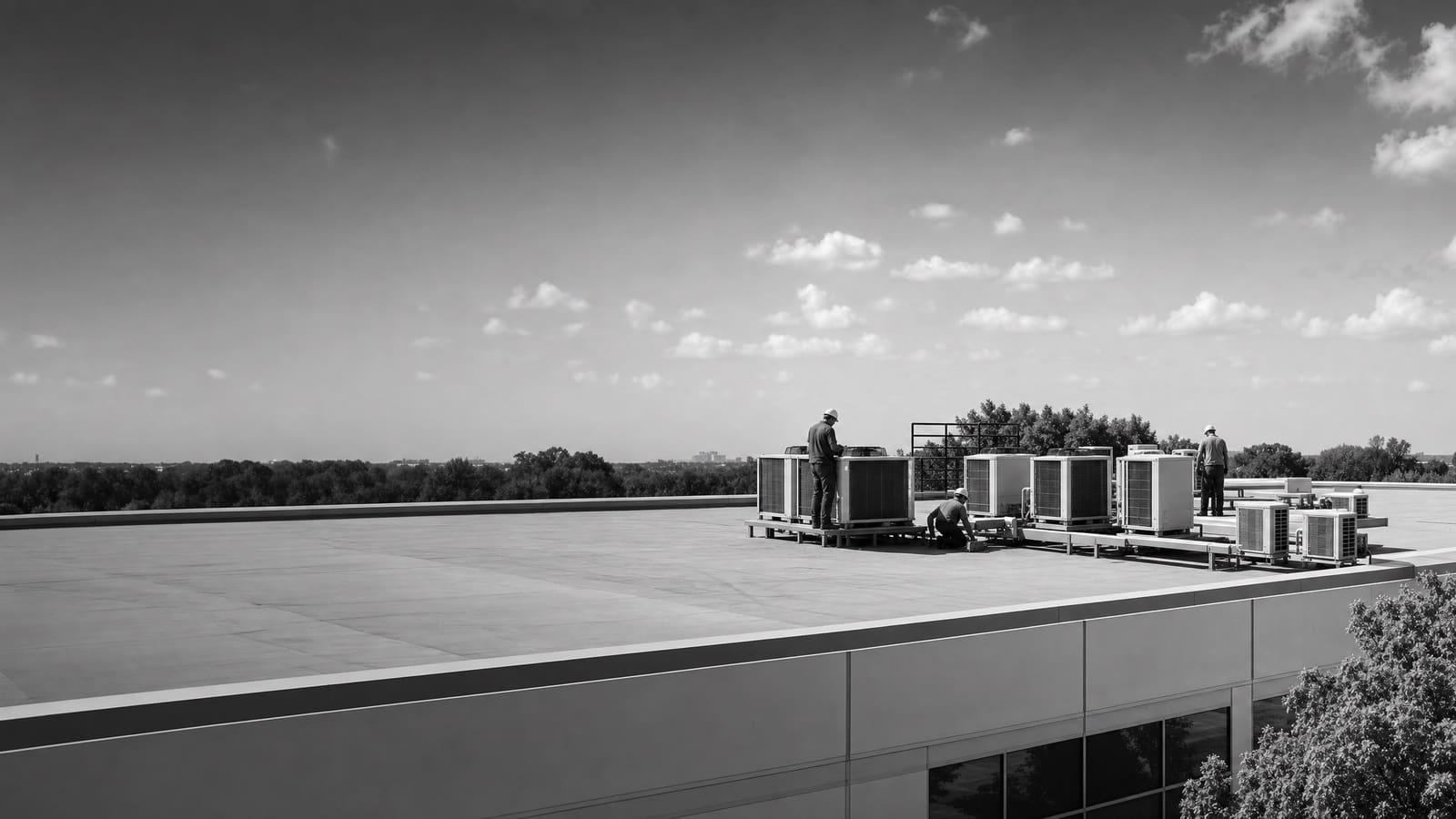
A commercial HVAC replacement is a scoped project, not a swap. The load is confirmed against how the building is used now, equipment is selected against real availability, the old unit is removed and the new one set, and the system is commissioned before handoff. Replacement usually beats another repair once a rooftop unit passes about fifteen years, because DOE puts the annual waste from an old, inefficient unit at $900 to $3,700.
A site review still has to verify the curb and roof structure, the electrical service at the unit, gas line condition, crane access across the lot, and whether the current tonnage still matches the space.
THREE REAL CHOICES
The three ways this project usually goes
Almost every commercial replacement lands in one of three places, and the right one depends on how much the building has changed since the last unit went in. Rooftop units cool close to half of all commercial floor area in the country, so this decision repeats across a lot of buildings, and most owners face it under time pressure. The cheapest choice on paper is rarely the cheapest choice over the life of the equipment. What separates them is not brand or badge. It is whether the tonnage still matches the load, what fuel the heating side uses, and how much electrical and gas work the change pulls in. Decide this before anyone orders equipment, because switching paths after the purchase order costs weeks.
WHAT MOVES THE NUMBER
The lines that separate two bids
No two roofs price the same, so compare quotes line by line instead of by the bottom number. These are the items that move most between two contractors looking at the same building on the same day.
IN PRACTICE
Let the building pick the unit, not the nameplate
The most common mistake in commercial replacement is letting the old nameplate choose the new unit. Twenty years changes occupancy, plug loads, lighting, and sometimes the walls themselves. A unit sized for the building that existed then will either short-cycle or run flat out in the building that exists now, and both show up as comfort complaints that no amount of service visits will fix.
The second mistake is waiting for failure to force the decision. DOE's own guidance is blunt about the pattern: facility managers often delay until the unit no longer conditions the space, needs constant service, or dies outright. By then the choice is whatever is on a truck, at whatever price, on whatever schedule the season allows. Replacing on a plan usually beats replacing on failure, and it often beats a like-for-like swap made at the end of service life.
So the useful order is load first, equipment second, schedule third. Confirm what the space needs today. Then look at what is actually available in that tonnage and tier. Then build the install around your operating hours instead of the other way around.
SCOPE CHECK
Simple job or complicated one
Before you read a price, figure out which kind of project you have. The gap between these two is weeks of schedule and a meaningful share of the total cost.
LOWER COMPLEXITY
Straight replacement in kind
Same tonnage, same fuel, curb matches or takes a standard adapter. Electrical service at the roof is already sufficient. The crane has room to set up and the lot can lose a few stalls for a morning. This is a short, predictable job.
HIGHER COMPLEXITY
Tonnage, fuel, or footprint changes
New size or weight brings structural review. Going all-electric can require more electrical capacity at the unit. Gas has to be capped or rerouted. Tight access, long crane reach, or a building that cannot close means phased or after-hours work. Scope this before you price it.
THE SITE REVIEW
What has to be verified on the roof
A quote written from a nameplate photo is a starting number, not a price. Someone has to stand on the roof and confirm the parts of the job that cannot be seen from the ground.
Start with physical constraints. Will the replacement fit the existing curb, and can the roof carry the new weight? Is there clearance for service access once the unit is set? Then infrastructure. What electrical service is actually at the unit today, and does the option you are considering need more? Where does gas enter, and does it stay, get capped, or get resized? DOE's heat pump guidance treats electrical capacity, physical constraints, and gas lines as the three infrastructure questions that decide whether a site can change fuel at all.
Then access and schedule. Where does the crane set up, how many stalls close, and for how long? Does the building need conditioning during the swap, or can it ride through a morning? Answer these before equipment is ordered. Every one of them is cheap to solve on paper and expensive to solve on the day of the lift.
Ask for the constraint list in writing
A contractor who has been on your roof can name the curb condition, the service size at the unit, the crane setup location, and the closure time. If a bid cannot state those four things, it has not been scoped and the number will move.
OWNERSHIP
Two things that outlast the install
The install ends in a day or two. The decisions inside it stay with you for fifteen or twenty years, and two of them shape how the building runs long after the crane leaves. Both are easier to handle at purchase than to retrofit later, and both belong in the conversation before a purchase order goes out.
REFRIGERANT
It is a fleet decision, not a unit decision
EPA rules under Section 608 govern how refrigerant is handled and recycled in stationary equipment, so certified recovery off the old unit is part of the job. New equipment ships on newer refrigerants, which means a mixed roof needs a service and spare-parts plan, not just a new warranty.
HEATING SOURCE
Heat pump economics depend on the winter
Heat pump efficiency falls as outdoor temperature drops, trending toward electric resistance at the bottom. DOE points to the February 2021 Texas freeze as proof that southern buildings still see sharp heating demand, which is why dual-fuel exists alongside all-electric.
PLANNING AHEAD
Phasing, procurement, and what it costs to own
If you have more than one aging unit, treat them as a fleet instead of a series of emergencies. Rank them by age, service history, and how much each one costs to run, then replace worst-first over a budget cycle you control. Standardizing on one manufacturer and a narrow set of tonnages makes parts, controls, and training simpler for every year after.
On procurement, put availability next to price on every option. A unit that costs less but lands six weeks later is not cheaper if the space is unusable in the meantime. Ask whether any utility or manufacturer incentive applies to the efficiency tier you are considering, and confirm approval before the order goes in rather than after, since program terms and funding change.
On lifetime cost, the spread is larger than most owners expect. An old, inefficient rooftop unit can waste between $900 and $3,700 a year on its own, and federal minimum efficiency standards have risen since, so even a baseline new unit outperforms a twenty-year-old one. The high-efficiency tier is where the operating savings actually live, and it is the tier most often cut to make a bid look better.
COMPARING BIDS
Five things a comparable quote shows
Two quotes are only comparable when both show the same scope. Ask every bidder for these five items so you are reading equipment against equipment instead of guessing what got left out.
01
Tonnage, model, and efficiency tier
The exact unit being proposed, not a category. Tier is where operating cost is won or lost for the next fifteen years.
02
Lead time with the price
Real availability for that specific model, dated. Availability belongs on the quote, right next to the number.
03
Curb, structural, and roof work
Adapter or new curb, any structural review triggered, and how the roof is patched and sealed after the set.
04
Crane, rigging, and lot closure
Who owns the lift plan, where the crane sets up, how many stalls close, and for how long.
05
Commissioning and documentation
Charge, airflow, and control settings verified against spec, documented at handoff so the warranty holds up.
Get a defensible number
Price the equipment and the building together.
Send the address, operating target, and target opening date. Flux will identify what must be verified before the project can be priced.
Get a free estimateQuestions
Straight answers.
When does replacement beat one more repair?
Age and running cost decide it. Once a rooftop unit is past about fifteen years, it can waste substantial energy compared with a current model, and DOE puts that waste at $900 to $3,700 per unit per year. Add repeat service calls and the repair stops being the cheaper option.
How long does a rooftop replacement take on site?
The visible work is short. The honest variable is equipment lead time for the specific model and tonnage you need, which is why availability should appear on the quote next to the price rather than after you sign.
Should we switch to a heat pump rooftop unit?
It depends on the winter load and your electrical service. DOE says today's heat pump units handle most or all winter demand across the South and West, but efficiency drops as temperatures fall, and all-electric units can need more electrical capacity at the roof than the old unit used.
Will a new unit use a different refrigerant?
New commercial equipment ships on newer refrigerants, and EPA Section 608 rules govern how refrigerant is recovered and handled when the old unit comes off. Day-one operation does not change, but a roof with mixed vintages needs a service and spare-parts plan.
Is right-sizing worth the extra step?
If occupancy, equipment, or the envelope changed since the last unit went in, yes. A replacement matched to the old nameplate carries forward whatever sizing mistake was already there, and that shows up as comfort complaints no service visit can fix.
What should we do before calling for quotes?
Photograph the nameplate, note the unit's age and recent service history, and know your operating hours and how much lot access you can give up. Those four facts let a contractor scope the roof visit instead of guessing.
Sources used for this guide
- [1]betterbuildingssolutioncenter.energy.gov — DOE Advanced Rooftop Unit Replacement Guidance
- [2]betterbuildingssolutioncenter.energy.gov — DOE Commercial Heat Pump Rooftop Unit Replacement Guidance
- [3]betterbuildingssolutioncenter.energy.gov — DOE High-Efficiency Commercial Rooftop Unit Toolkit
- [4]energy.gov — DOE Efficient Commercial Rooftop Air Conditioner Program
- [5]epa.gov — EPA Stationary HVAC Refrigerant Management