THE SHORT VERSION
What a commercial HVAC replacement actually includes
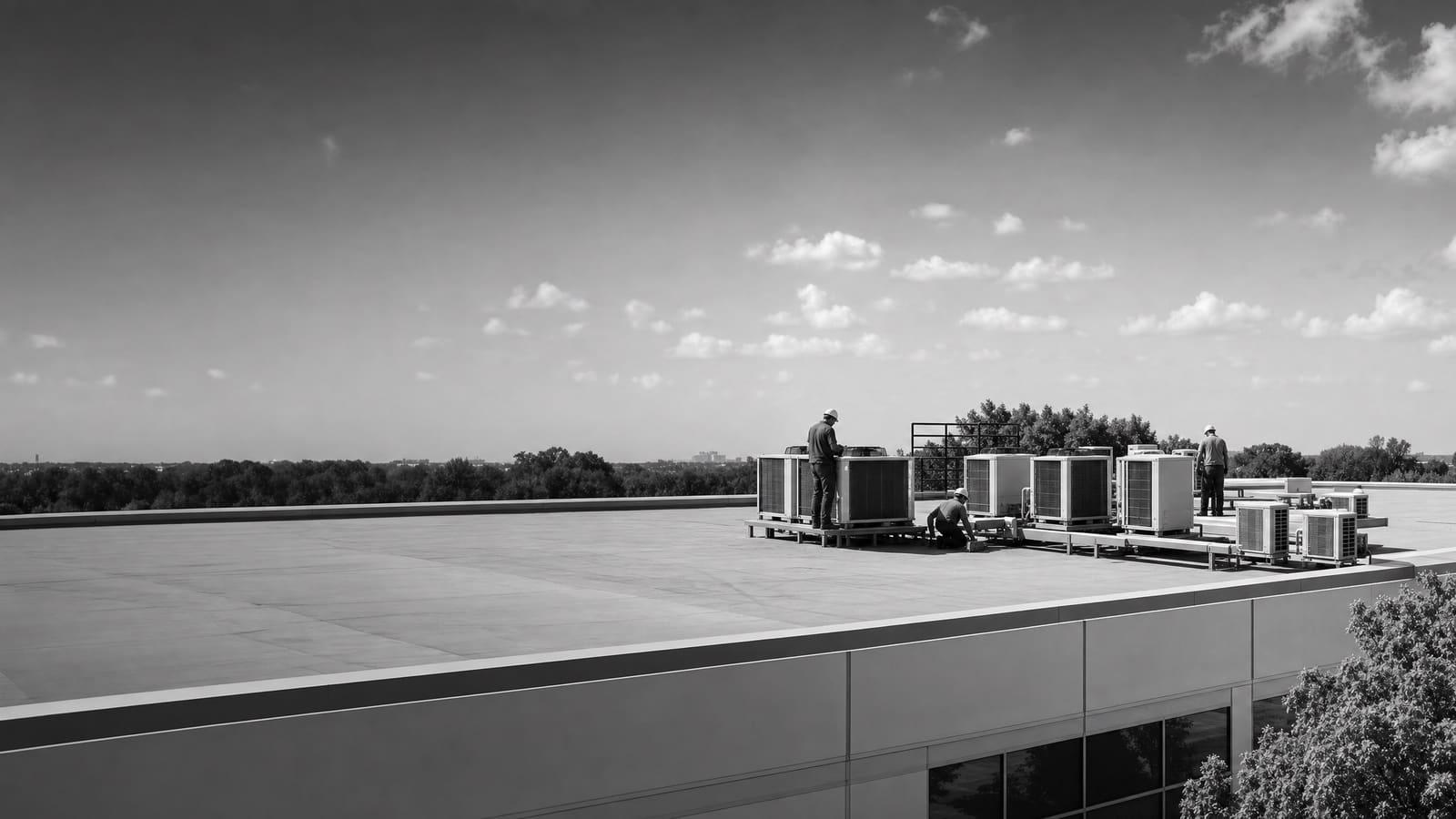
A commercial HVAC replacement covers the load calculation, the equipment itself, curb and rigging work, electrical and gas or refrigerant connections, controls, and commissioning. Replacement stops being a repair question once a unit is past roughly 15 years: DOE reports that old, inefficient rooftop units waste somewhere between $900 and $3,700 per unit every year in energy alone. Rooftop units condition close to half of all U.S. commercial floor area, so most buildings face this same decision.
A site review has to verify the actual load, the roof curb and the structure under it, available electrical capacity, and crane access before any tonnage or price is committed.
THREE WAYS TO PLAY IT
Replace on failure, swap in kind, or upgrade on purpose
Most buildings pick one of three postures, usually without naming it. DOE's guidance is blunt about the default: facility teams often delay buying a new rooftop unit until the old one stops holding the space, needs constant service, or fails outright. That is still a choice, and it is the expensive one. Replacing proactively with a more efficient unit is often the smarter business move than replacement-on-failure, and often better than a like-for-like swap at the end of service life.
The middle path still has a place. If the space, the occupancy, and the operating hours have not changed, a matched unit on the existing curb is the fastest way back to conditioned air with the least engineering attached. The third path treats the replacement as the one chance you get to change the equipment class, the efficiency tier, or the fuel. Every one of those doors closes the morning the crane leaves.
WHAT MOVES THE NUMBER
The lines that separate two identical-looking quotes
Nobody can price a rooftop replacement from a nameplate photo alone. These are the lines that actually move the number, ordered roughly by how much they vary between two buildings that look the same from the parking lot.
BUYING GUIDANCE
Size the unit for the building you have now
The nameplate on a twenty-year-old rooftop unit describes a building that may not exist anymore. Occupancy changes, plug loads change, lighting gets replaced, walls move. Sizing the new unit off the old label carries every one of those decisions forward for another two decades. A real load calculation, run against how the space is used today, is one of the cheapest line items on the project and the one that decides whether the next unit holds the space.
Efficiency is the second decision, and the ground has moved. DOE's High-Performance Rooftop Unit Challenge asked manufacturers to build units that cut energy use by up to 50% compared with the standard of the time. Two manufacturers hit the spec first; today more than 20 models exceed it. You do not have to take that on faith either — DOE funded third-party verification of the winning units in real buildings before pushing wider adoption.
The scale of the response is worth knowing when you are deciding whether to bother. Through DOE's Advanced RTU Campaign, more than 200 public and private organizations upgraded over 43,000 rooftop units, and those upgrades save a combined $37 million a year on energy bills. The point is not the total. It is that the math held up across thousands of ordinary commercial buildings.
SIDE BY SIDE
Simple swap versus a project
Two replacements with the same tonnage on the quote can differ by weeks of schedule and a large share of the price. The difference is almost always what surrounds the unit, not the unit.
LOWER COMPLEXITY
Matched swap on a clean roof
Same tonnage, an existing curb that takes an adapter, clear crane reach from the lot, power and gas already sized, no controls migration. Equipment availability is usually the only real schedule risk.
HIGHER COMPLEXITY
Changed load or changed fuel
Tonnage or footprint grows, the curb needs framing, the panel needs capacity for an all-electric unit, or the crane has to reach past an occupied entrance. DOE lists electrical capacity, physical constraints, and gas lines as the infrastructure checks that decide these projects.
BEFORE THE PRICE
What a site review has to settle
A site review is not a formality ahead of the price. It is the thing that makes the price real. Start on the roof. The reviewer should confirm the existing curb dimensions and whether an adapter will land cleanly, look at how the deck is framed underneath it, and note the condition of the roofing a crane and a crew will be working across.
Then the connections. Electrical service and panel capacity matter most when the new unit is a different class than the old one. DOE lists electrical capacity, physical constraints, and gas lines together as the infrastructure that decides whether a site is a candidate for a change in equipment type. If the answer is yes, that work belongs in the quote, not in a change order later.
Last, the parts nobody photographs. Where does the crane set up, and what does it close while it works? Which hours can the building actually give up? Is the unit you want available on a schedule the building can live with, and does the crew have real experience with that equipment class? DOE names both equipment availability and contractor knowledge as make-or-break considerations, and they are the two most often missing from a quote.
Ask for the checklist, not just the number
DOE's heat pump rooftop guidance is built around a checklist: climate, utility bill impact, emissions, building type, equipment availability, infrastructure, contractor knowledge, and incentives. Anyone scoping your replacement should be able to walk that same list with you before quoting.
OWNERSHIP
Two decisions that outlive the install
Two things outlive the crane day and belong in the decision now, while you still have leverage: what refrigerant the new unit runs on, and whether it burns anything at all.
Both are cheap to plan and expensive to retrofit. A unit set this year will be on your roof well into the 2040s, and the service market around it will keep moving the whole time. Neither question changes how the building feels on day one. Both change what the next ten service calls cost and who is able to make them.
SERVICE
Refrigerant is a compliance item
EPA rules under Section 608 of the Clean Air Act govern how refrigerant is handled, recovered, and recycled in stationary air conditioning and heat pump equipment. That applies to the old unit coming down, not only the new one going up, and it belongs in the written scope of work.
FUEL
Electric heat or gas heat
DOE's guidance says today's heat pump rooftop units can cover most or all winter heating demand across most of the U.S. South and West, while noting that heat pump efficiency falls as temperatures drop. Southern buildings have still seen sharp cold snaps, so backup heat and dual-fuel options stay part of the conversation.
PLANNING AHEAD
Sequence a fleet instead of reacting to one unit
If you own more than one unit, the replacement question is really a sequencing question. DOE's campaign framed it as a fork: commit to replacing old rooftop units with more efficient models, or retrofit the existing ones with advanced controls, depending on which option makes better financial sense for that building. Both are legitimate answers. The mistake is answering neither and letting failure pick the order for you.
A workable sequence starts with age and waste rather than complaints. Units past 15 years go on the list first, because that is where the annual energy waste concentrates. From there, the ones with easy crane access and no structural or electrical work attached are the cheapest to move, so they clear quickly and free budget for the hard ones. The unit sitting over a tenant who cannot lose a day gets planned furthest out, when a weekend window and a staged curb adapter can absorb it.
Procurement follows the same logic. Ordering two or three units together buys schedule certainty and usually a better price than three separate emergencies. Check incentives before you order rather than after — DOE maintains guidance on rooftop unit incentives, and eligibility is often tied to the efficiency tier you specify at the time of purchase.
COMPARING QUOTES
Five things a real quote shows
Two quotes are only comparable when both show the same five things. If one is a single line with a price at the bottom, it is not a quote. It is a guess you will renegotiate on the roof.
01
Equipment, spelled out
Make, model, tonnage, efficiency tier, refrigerant, and the current availability window for that exact unit.
02
Curb and structure
Adapter or new curb, any roof framing, opening changes, and who carries the roofing repair.
03
Rigging and access plan
Crane size, staging area, the hours the lot or entrance is closed, and the weather contingency.
04
Connections and removal
Electrical and gas scope, certified refrigerant recovery, and disposal of the old unit.
05
Commissioning and documents
Startup, charge, airflow, and controls verified against spec, then documented so the warranty holds.
Get a defensible number
Price the equipment and the building together.
Send the address, operating target, and target opening date. Flux will identify what must be verified before the project can be priced.
Get a free estimateQuestions
Straight answers.
What does a commercial HVAC installation cost?
There is no honest universal installed price, because tonnage, curb work, crane access, electrical scope, and controls all move independently. What is knowable is the cost of waiting: DOE puts the annual energy waste of an old, inefficient rooftop unit at roughly $900 to $3,700 per unit. Ask for the price broken into those lines instead of a single number.
When does replacement beat one more repair?
DOE points to units over 15 years old as the ones wasting substantial energy and money, and warns that waiting until a unit fails outright is usually worse than replacing proactively. If the unit is past 15 years, needs frequent service, or no longer holds the space, you are already paying for a replacement in installments.
Should you replace like-for-like or resize?
Confirm the load either way. If the space, occupancy, and hours have not changed, a matched unit on the existing curb is often right and is the least complicated path. If the use changed or comfort complaints never went away, right-sizing fixes a problem a like-for-like swap would carry forward another two decades.
Is an all-electric heat pump rooftop unit a real option?
For most of the U.S. South and West, DOE says today's heat pump rooftop units are an appropriate solution and can handle most or all of the winter heating demand. The gating items are electrical capacity, physical constraints, gas line changes, equipment availability, and whether the crew knows the equipment class.
Who handles the crane, permits, and the old refrigerant?
The installing contractor should own the rigging plan, lot coordination, permitting, inspections, and certified refrigerant recovery from the removed unit as part of the installed price. EPA Section 608 rules cover how that refrigerant is handled and recycled, so make sure the quote says who is responsible before you sign.
Sources used for this guide
- [1]betterbuildingssolutioncenter.energy.gov — DOE Advanced Rooftop Unit Replacement Guidance
- [2]betterbuildingssolutioncenter.energy.gov — DOE Commercial Heat Pump Rooftop Unit Replacement Guidance
- [3]betterbuildingssolutioncenter.energy.gov — DOE High-Efficiency Commercial Rooftop Unit Toolkit
- [4]energy.gov — DOE Efficient Commercial Rooftop Air Conditioner Program
- [5]epa.gov — EPA Stationary HVAC Refrigerant Management