THE DIRECT ANSWER
What a commercial HVAC replacement actually includes
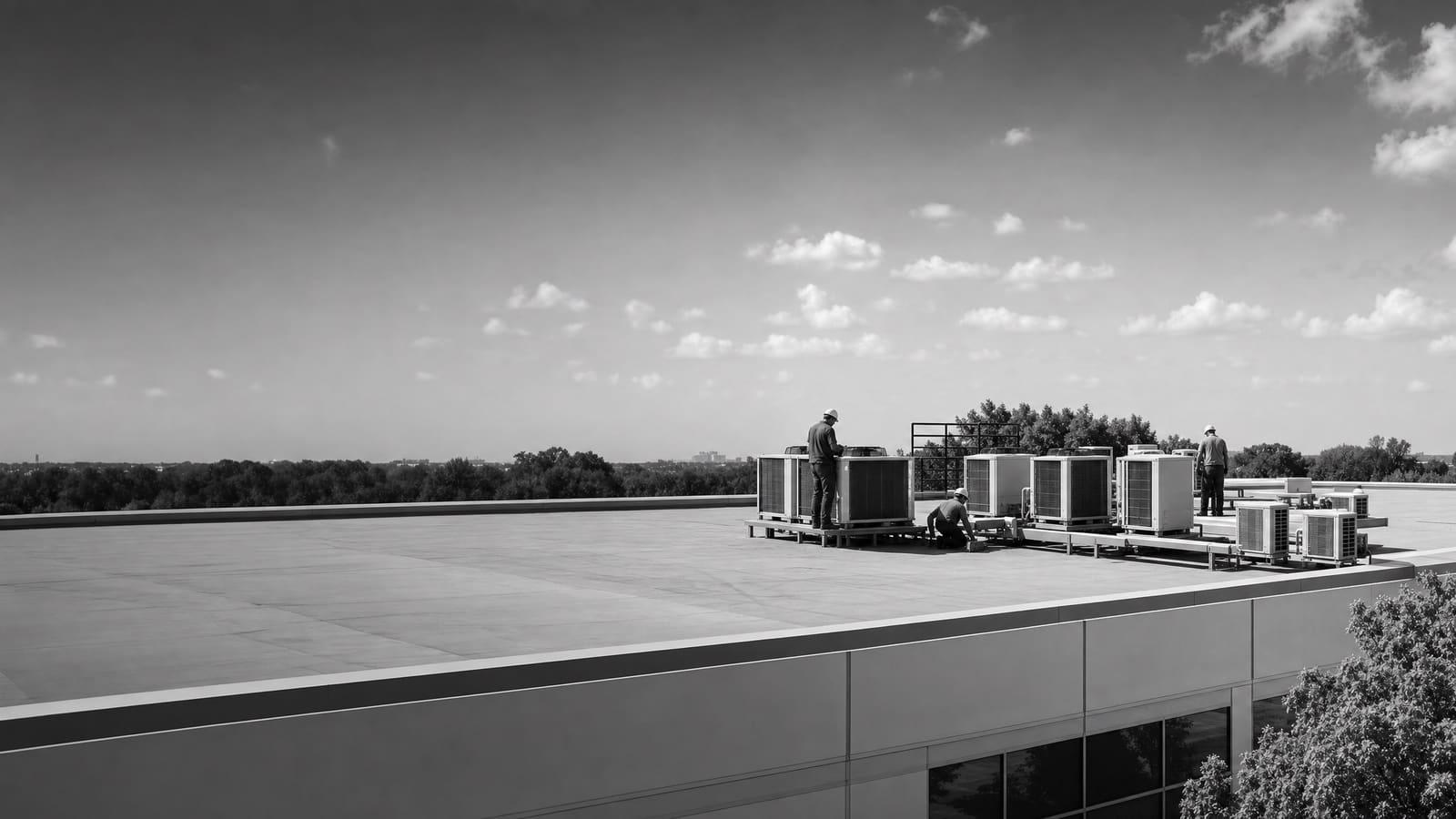
A commercial HVAC replacement covers load verification, equipment selection, removal with certified refrigerant recovery, curb or structural work, gas and electrical connections, controls, permits, and commissioning. Replacement beats another repair once a unit is past roughly 15 years, because older rooftop units can waste substantial energy and money. Federal estimates put that waste at $900 to $3,700 per unit each year, and repair spending buys none of it back.
A site review has to verify the actual load against current use, the curb and roof structure, available electrical capacity, crane access, and whether existing controls can carry a new unit.
THE REAL CHOICE
Three ways to handle a failing rooftop unit
Most buildings reach this decision one of two ways: the unit fails in season, or it limps through another summer while the energy bill quietly grows. Rooftop units cool close to half of all commercial floor space in the country, so this is the most common capital decision a facility owner faces. Federal guidance is blunt about the second path. Waiting for failure often costs more than planning the replacement, because an aging unit keeps spending money every month it runs.
Before choosing equipment, decide which of these three paths fits the unit in front of you. The answer depends on the unit's age, its condition, and whether the space is still used the way it was when the unit was originally sized.
WHAT MOVES THE NUMBER
The lines that separate a firm quote from a growing one
No two roofs price the same, but the variables are predictable. These are the lines that decide whether a quote holds or grows after the crane leaves.
CHOOSING EQUIPMENT
Like-for-like, high efficiency, or heat pump
The simplest replacement puts the same tonnage back on the same curb. It is fast, permitting is straightforward, and nothing about the building has to change. It also carries the old sizing forward, which is the wrong move if occupancy, plug load, or operating hours have shifted since the unit was installed.
A high-efficiency unit is the middle path. Federal work with manufacturers produced a performance specification aimed at cutting rooftop energy use by up to half compared with the standard in place at the time, and manufacturers responded with more than twenty models that exceed it. That efficiency does nothing for you if the unit is oversized, which is why the load calculation comes before the model number.
Heat pump rooftop units are the third option. They are technically close cousins of standard air-conditioning units, with reverse-cycle heating added. Federal guidance says they suit mild to moderate winter heating best, because heating efficiency drops as outdoor temperatures fall. Even southern states see stretches of sharp winter heating demand, so the practical choice in Oklahoma is often a dual-fuel unit that keeps gas heat for the coldest hours, or an all-electric unit whose electric resistance backup the panel has been confirmed to carry.
COMPLEXITY
What makes one replacement simple and another a project
Two buildings can order the same tonnage and land in very different price ranges. The difference is almost always what surrounds the unit rather than the unit itself.
LOWER COMPLEXITY
Straight swap conditions
Same tonnage, the curb adapter fits the existing opening, the panel has capacity, gas and electric land where they already are, the crane can set up in the lot, and controls are a simple thermostat.
HIGHER COMPLEXITY
Project conditions
Tonnage changes, structure needs review, an all-electric conversion needs feeder or panel work, access is tight or over occupied space, several units are phased, or the unit ties into a building automation system.
SCOPING
What the site review has to settle before anyone quotes
Start with load, not the nameplate. The old tag tells you what someone selected years ago, under an occupancy and equipment list that may no longer exist. A current load calculation is what tells you whether the replacement should match, shrink, or grow.
Then work outward from the unit. The curb and the structure under it decide whether a simple adapter works or the roof opening has to change. Federal heat pump guidance treats infrastructure as a make-or-break item, and it names the same three things a good site review checks: electrical capacity, physical constraints, and gas lines. Measured capacity at the panel matters more than a rated service size, especially if the unit being considered carries electric resistance backup heat.
The rest is logistics that quietly price the job. Crane reach and staging, how long parking stalls close, the path across the roof, the refrigerant in the old unit and how it will be recovered, and whether the controls in the building will accept the new unit without a workaround. Federal guidance also flags contractor familiarity with the equipment type, which is worth asking about directly when heat pump units are on the table.
Verify before ordering, not after
Confirm the calculated load, the curb and structural detail, measured electrical capacity, gas line adequacy, crane staging, and the controls interface. Every one of those can change the model number, and changing it after the order is placed is the expensive version.
IN BROKEN ARROW
What Oklahoma's mechanical code changes about your install
Commercial mechanical work in Broken Arrow sits under a statewide minimum code. Oklahoma's Uniform Building Code Commission adopted the 2018 edition of the International Mechanical Code as the statewide minimum for commercial mechanical construction, and other jurisdictions may amend or alter it only through the process state law and the Commission's rules set out.
Two details matter when planning a rooftop replacement here. The state did not adopt the code's appendices as part of the statewide minimum, although a local jurisdiction may adopt them on its own, so confirm which apply before design. The state also modified the wind resistance provision to allow equipment exposed to wind to be designed and installed under SMACNA standards or other approved methods. On an Oklahoma roof, that makes the anchoring and attachment detail part of the submittal rather than a field decision.
Confirm the edition and the anchoring detail
Ask the city which code edition and local amendments are in force today, and get the wind anchoring and attachment detail for the curb and unit into the submittal package before the equipment order goes in.
OWNERSHIP
Two facts that change the answer more than the equipment does
The equipment decision gets all the attention, but two ownership facts decide whether the better unit is actually the better buy. One is who captures the savings. The other is what happens to the rest of your roof after the new unit lands.
A single building with one aging unit is a straightforward purchase. A portfolio with several units at different ages is a schedule, and the first replacement sets the standard the rest will follow. Settle both before comparing quotes, because they change which tier makes sense rather than just which price looks lower.
LEASE STRUCTURE
Who pays, who benefits
If the tenant pays the utility bill and the owner buys the equipment, an efficiency upgrade saves money for someone who did not spend it. Settle that split before you pick an efficiency tier, not after.
MIXED FLEETS
Refrigerant and parts planning
New equipment arrives on newer refrigerants while older units keep running on what they were charged with. Federal rules govern handling and recovery, so service contracts and spare parts have to cover both.
PLANNING
Phasing, procurement, and lifetime cost
The cheapest version of this project is the one you schedule. Replacing on failure means paying for whatever is available in the middle of a heat wave, on whatever timeline the supply chain allows. Planning the replacement lets you order ahead of the season, stage the curb adapter, and choose the crane day instead of accepting it.
For a portfolio, rank by waste rather than by age alone. A unit running long hours over a busy retail floor or a kitchen is spending more every month than a lightly loaded unit of the same vintage, so it usually earns the first replacement. The federal campaign built around this approach counted more than 43,000 rooftop units upgraded and about $37 million in combined annual energy savings, so the pattern is well documented rather than theoretical.
Incentives belong in the procurement conversation, and federal guidance lists them as a key consideration when weighing equipment types. Check them before you order rather than after, because program terms and availability change, and a rebate assumed in a spreadsheet is not the same as one confirmed in writing. If a unit still has usable life, advanced controls can be the better financial move for now, with full replacement scheduled for a year you picked.
THE QUOTE
Five things a comparable quote has to show
Quotes that look different usually are different. Ask every bidder for these five items so you are comparing the same project instead of just the same number.
01
Equipment and efficiency tier
Make, model, tonnage, heating type, and the efficiency rating, so two bids can actually be set side by side.
02
Equipment availability
The quoted lead time for that specific model, dated, rather than a general estimate.
03
Curb, structure, and roofing
Whether a curb adapter is included, what structural review is assumed, and who patches the roof.
04
Rigging, permits, and inspections
Crane, lot closure hours, permit fees, and inspection coordination named as included or excluded.
05
Commissioning and documentation
Charge, airflow, and control settings verified against spec, with a startup report that supports the warranty.
Get a defensible number
Price the equipment and the building together.
Send the address, operating target, and target opening date. Flux will identify what must be verified before the project can be priced.
Get a free estimateQuestions
Straight answers.
When is replacement better than another repair?
Once a rooftop unit is past about 15 years, it can waste substantial energy compared with newer models, with federal estimates putting that waste at $900 to $3,700 per unit a year. Repair spending recovers none of it, so repeated failures at that age point toward replacement.
Is a heat pump rooftop unit right for a building here?
Heat pump units work best where winter heating is mild to moderate, since heating efficiency falls as outdoor temperatures drop. Because Oklahoma still sees hard cold snaps, dual-fuel units are often the practical answer, and all-electric units need confirmed panel capacity for electric resistance backup.
What code applies to commercial mechanical work in Broken Arrow?
Oklahoma adopted the 2018 edition of the International Mechanical Code as the statewide minimum for commercial mechanical construction, with state amendments. The appendices were not adopted statewide, though a local jurisdiction may adopt them, so confirm the current edition and local amendments with the city.
What happens to the refrigerant in the old unit?
Federal rules under Section 608 of the Clean Air Act govern how refrigerant is handled and recycled in stationary air-conditioning and heat pump equipment. Recovery from the old unit is regulated work performed by qualified technicians, and it should appear as a line on the quote.
Can controls buy time instead of replacing the unit now?
Sometimes. Federal guidance treats it as a real choice: owners can replace old units with efficient ones or retrofit them with advanced controls, depending on which makes better financial sense. Controls fit units with usable life left. They do not fix a unit that is failing.
Sources used for this guide
- [1]betterbuildingssolutioncenter.energy.gov — DOE Advanced Rooftop Unit Replacement Guidance
- [2]betterbuildingssolutioncenter.energy.gov — DOE Commercial Heat Pump Rooftop Unit Replacement Guidance
- [3]betterbuildingssolutioncenter.energy.gov — DOE High-Efficiency Commercial Rooftop Unit Toolkit
- [4]energy.gov — DOE Efficient Commercial Rooftop Air Conditioner Program
- [5]epa.gov — EPA Stationary HVAC Refrigerant Management
- [6]oklahoma.gov — Oklahoma Uniform Building Code Commission - IMC 2018