THE DIRECT ANSWER
Commercial HVAC replacement and installation in Brockton.
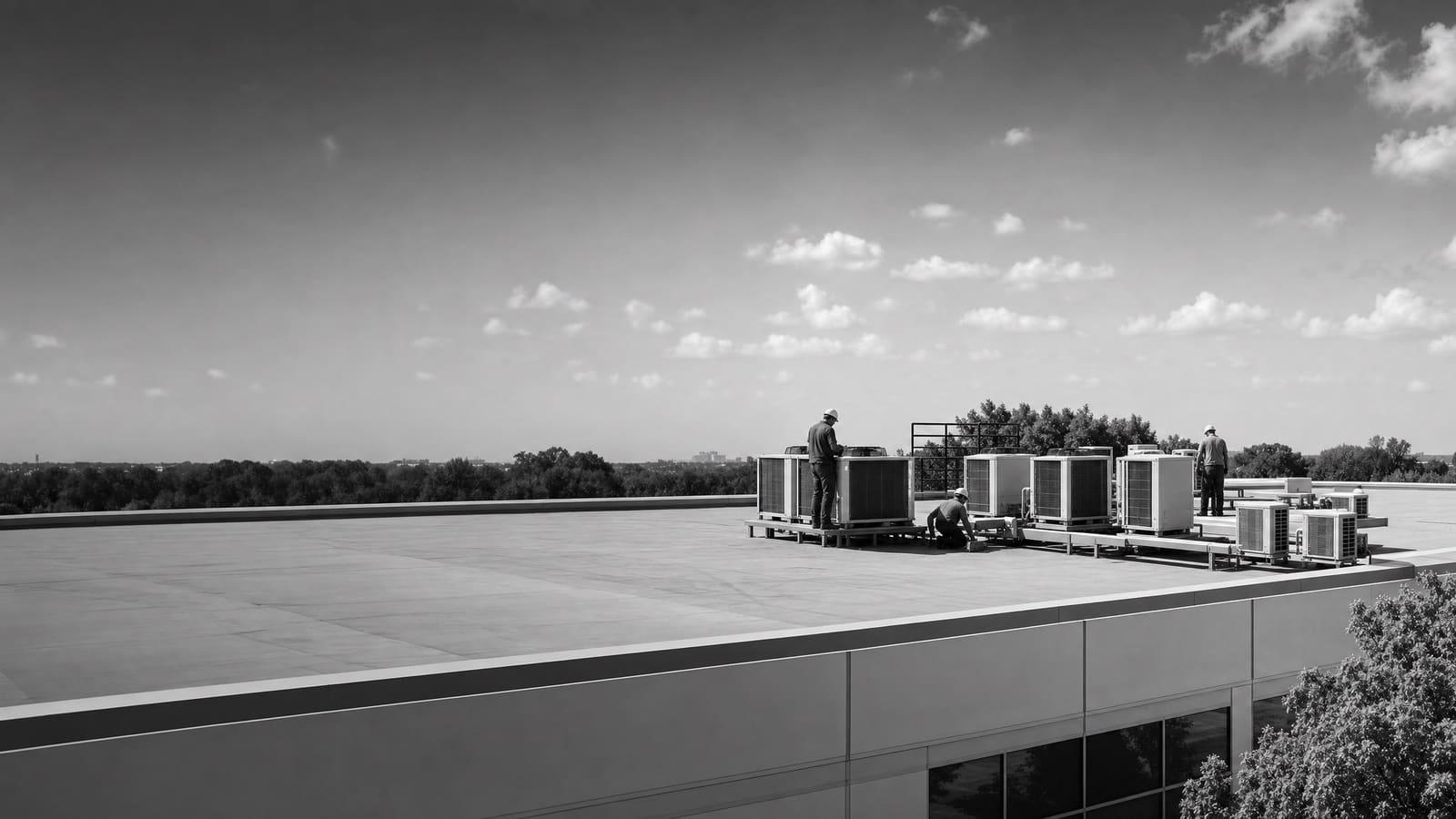
A commercial HVAC replacement should include load review, equipment selection, removal, rigging, connections, controls, startup, refrigerant handling, testing, and documented handoff. Replacement is usually more useful than another repair when an older unit no longer holds comfort, needs frequent service, or puts operations at risk. DOE guidance notes that rooftop units over 15 years old can waste substantial energy compared with newer models.
A site review must confirm capacity, curb fit, roof access, power, fuel, ventilation, controls, drainage, and the work needed to keep occupied areas running.
START WITH THE OPERATING DECISION
Choose the replacement path before choosing a model
The lowest equipment price does not always create the lowest project cost. Start with the reason for replacement. A failed unit may make speed the first concern. A working but unreliable unit gives you time to compare efficiency, heating method, electrical needs, and expected service. A building with changed occupancy or internal equipment may need a fresh load review instead of a nameplate match.
Also decide what the system must improve. That could be fewer emergency calls, steadier temperatures, better ventilation, simpler controls, lower energy use, or progress toward an emissions goal. Put those results in the request for quote. Vendors can then price the same outcome instead of offering different interpretations of a basic equipment swap.
BUILD THE REAL BUDGET
What moves an installed HVAC quote
No supplied source supports a universal installed price. A useful budget separates the equipment from the work required to make it fit, operate, and pass a complete startup.
EQUIPMENT CHOICES
Compare systems by how the building actually operates
Packaged rooftop units combine major heating, cooling, and air-moving parts in one cabinet. They are common across commercial buildings and condition nearly half of U.S. commercial floor area. A compatible packaged replacement may simplify construction, but the old model number should be a starting point, not the whole design. Confirm the present load, airflow, outside-air need, operating schedule, and space use.
A high-efficiency conventional rooftop unit can reduce energy use while keeping a familiar system layout. Advanced controls may also improve a unit that still has useful life. DOE guidance treats replacement and control retrofits as separate choices that should be tested against financial and operating needs.
A heat-pump rooftop unit adds reverse-cycle heating. The main choices include all-electric, dual-fuel, and cold-climate configurations. DOE says the decision should consider geography, utility costs, emissions goals, equipment availability, contractor knowledge, electrical capacity, physical constraints, and existing gas service. Do not assume electrification is a box-for-box change. Ask for the heating performance at design conditions, supplemental heat strategy, electrical demand, control sequence, and utility-impact model. This makes the comparison useful for both operations and ownership.
PROJECT COMPLEXITY
A simple swap and a system change need different plans
Complexity depends on how closely the selected equipment matches the existing opening, utilities, controls, and operating needs. Define those conditions before comparing totals.
LOWER COMPLEXITY
Compatible replacement
The verified load is similar, the curb can be reused with a planned adapter, utilities are adequate, and the control sequence stays simple. The quote still needs rigging, connections, startup, and closeout.
HIGHER COMPLEXITY
Capacity or system change
A larger load, heat-pump conversion, electrical upgrade, duct correction, structural work, or automation integration adds design and coordination. Price these dependencies before equipment is released.
OWNERSHIP VIEW
Balance first cost with operating risk
A commercial HVAC purchase affects more than the construction budget. It sets future maintenance needs, comfort performance, energy use, parts planning, and exposure to unexpected downtime. Compare options over the expected ownership period, using the same operating assumptions for each.
Include the cost of electrical or structural enabling work, controls support, filters, planned service, and likely repairs. Also consider the cost of disruption if a critical unit fails. A proactive replacement may carry more schedule flexibility than replacement after failure. DOE guidance specifically notes that planned replacement of inefficient or underperforming rooftop units can make better business sense than waiting for a complete failure.
Portfolio owners should also consider standardization. Repeating compatible equipment, controls, filters, and service procedures can simplify training and inventory. However, standardization should not override a building-specific load or infrastructure limit.
KEEP AND REPAIR
Useful when performance remains stable
Continue service when the unit reliably meets the load, repair frequency is acceptable, parts remain practical, and a control retrofit can address the main operating issue.
PLAN REPLACEMENT
Useful when risk is growing
Move toward replacement when comfort is slipping, service is frequent, efficiency is poor, or a failure would disrupt tenants, customers, inventory, or critical work.
PROCUREMENT AND PHASING
Make the installation predictable before equipment arrives
Procurement should start with an approved technical scope, not just a purchase order for a model number. Confirm availability, substitutions, accessories, voltage, heat configuration, curb requirements, controls, warranty terms, and who checks the order before release. A proposed substitute should be reviewed against capacity, efficiency, dimensions, weight, sound, ventilation, electrical demand, heating performance, and service access.
For several units, phasing can reduce operating risk. Prioritize equipment by condition, space importance, repair history, and consequence of failure. Replacing units in groups may simplify rigging and supervision, while smaller phases may protect cash flow and keep more of the building conditioned. The right plan depends on which areas can be offline together.
Commission each phase before moving on. Verify rotation, airflow, temperature response, refrigerant condition, safety devices, sensors, outside-air operation, schedules, alarms, and control sequences. Record final settings rather than leaving them only in a technician's notes. EPA rules govern refrigerant handling and recycling for stationary air-conditioning and heat-pump equipment, so the quote should assign recovery and disposal responsibilities. Closeout should also include equipment data, warranties, startup reports, control information, training, and a practical maintenance schedule.
COMPARE QUOTES
Five items every comparable proposal should show
Put each bidder on the same scope. If one proposal omits a required task, its lower total may only move that cost back to the owner.
01
Equipment and design basis
List model, capacity, efficiency, heating method, ventilation options, electrical data, and load assumptions.
02
Complete installation scope
Identify removal, rigging, curb, structural, duct, drain, power, fuel, controls, roofing, and protection work.
03
Schedule and outage plan
Show equipment availability, work sequence, shutdowns, occupied-area limits, weather conditions, and phasing.
04
Testing and handoff
Define startup checks, airflow verification, control testing, reports, training, warranties, and final documents.
05
Allowances and exclusions
State uncertain quantities, owner responsibilities, substitution rules, change pricing, and conditions that can alter cost.
Get a defensible number
Price the equipment and the building together.
Send the address, operating target, and target opening date. Flux will identify what must be verified before the project can be priced.
Get a free estimateQuestions
Straight answers.
When should a commercial rooftop unit be replaced instead of repaired?
Consider replacement when the unit no longer maintains comfort, needs frequent service, wastes energy, or creates unacceptable failure risk. DOE notes that units over 15 years old can waste substantial energy compared with newer models. Age alone is not the decision; condition, repair history, load fit, parts, and operational impact matter too.
Should the new HVAC unit match the old unit's capacity?
Not automatically. Confirm how the space is used today and review the present heating, cooling, airflow, and ventilation loads. A direct capacity match may be reasonable when conditions are unchanged, but it can also repeat an old sizing error.
Is a heat-pump rooftop unit a good replacement option?
It can be, but the choice needs a site-specific review. Compare all-electric, dual-fuel, and cold-climate configurations against heating demand, electrical capacity, utility costs, existing gas service, physical fit, emissions goals, equipment availability, and contractor support.
What should happen during commissioning?
The team should verify safe operation, airflow, temperature response, refrigerant condition, ventilation, sensors, schedules, alarms, and control sequences. The owner should receive the final settings, startup records, warranty information, and training.
How can owners compare commercial HVAC installation quotes?
Give every bidder the same design basis and require an itemized scope. Compare equipment, rigging, curb and structural work, utilities, ductwork, controls, startup, schedule, warranties, allowances, and exclusions. Do not compare totals until the included work matches.
Who should handle refrigerant from the removed equipment?
The proposal should assign refrigerant recovery and equipment disposal to qualified parties. EPA Section 608 rules address refrigerant handling and recycling for stationary air-conditioning and heat-pump systems, so this work should not be left as an unstated assumption.
Sources used for this guide
- [1]betterbuildingssolutioncenter.energy.gov — DOE Advanced Rooftop Unit Replacement Guidance
- [2]betterbuildingssolutioncenter.energy.gov — DOE Commercial Heat Pump Rooftop Unit Replacement Guidance
- [3]betterbuildingssolutioncenter.energy.gov — DOE High-Efficiency Commercial Rooftop Unit Toolkit
- [4]energy.gov — DOE Efficient Commercial Rooftop Air Conditioner Program
- [5]epa.gov — EPA Stationary HVAC Refrigerant Management