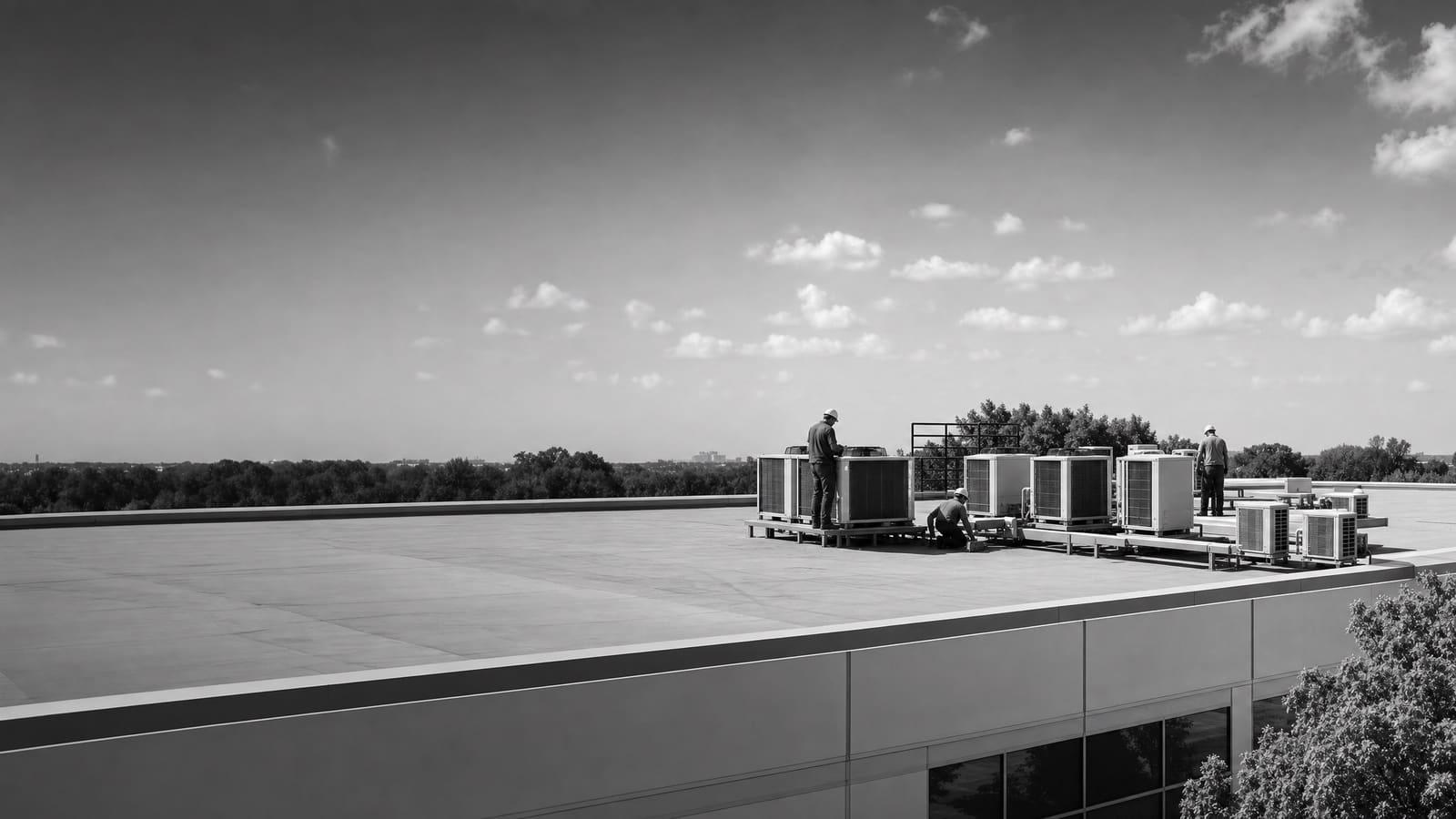
Direct answer
A commercial HVAC replacement is a system project, not a box swap.
A commercial HVAC replacement covers load verification, equipment selection, rigging and curb work, gas and electrical connections, controls, permits, and commissioning. Replacement beats another repair once the unit is past about 15 years, because aging rooftop units waste roughly $900 to $3,700 each per year in energy. That money keeps leaving whether or not the compressor fails this season.
There is no honest installed price before a site review. It has to confirm tonnage against current use, curb and structural condition, crane access, available electrical capacity, and gas service.
Choose the system, then the box
Three replacement paths, and what each one actually decides
Most replacements come down to three paths. Like-for-like keeps the same fuel and roughly the same efficiency, reuses the curb where it can, and returns the building to service fastest. A high-efficiency unit costs more up front and needs the same site work. The federal effort that created this equipment class aimed to cut rooftop energy use by as much as half against the standard in force at the time, and the minimum standard has since moved up, so the real question is how far above today's floor the tier you pick actually sits.
The third path changes the fuel. A heat pump rooftop unit is mechanically close to an air-conditioning unit and heats by running the refrigerant cycle in reverse. Federal guidance is direct about where that works best: mild-to-moderate winters. As outdoor temperature falls, heat pump heating efficiency drops toward electric resistance. A Connecticut winter is not the easy case, which is why dual-fuel and cold-climate versions exist, and why this decision belongs to the heating load, the electrical capacity, and the gas service rather than to preference.
Build the whole number
What belongs in a commercial HVAC replacement budget
A low equipment price hides where these projects actually move. Separate the unit from the work required to land it, power it, and prove it runs.
Size it for the building you have now
The old nameplate is a record, not a load calculation
The unit on the roof was sized for the building as it existed when it went up there. If that was fifteen or twenty years ago, almost everything that drives the load has moved since: occupancy, plug load, lighting heat, partition layout, hours of operation, and often the envelope itself. Copying the nameplate carries every one of those changes forward as an error, and it carries forward whatever the original sizing got wrong.
Oversizing is the more common outcome and the more expensive one. A unit that is too large satisfies the thermostat quickly, shuts off, and starts again. That is hard on the compressor, poor at removing humidity, and obvious to anyone sitting under the diffuser. Undersizing shows up differently: it is the unit that never catches up during the worst week of the year.
A real load calculation is not a long delay. It is a few hours of work that changes the tonnage decision, the efficiency tier that makes sense, and sometimes whether one large unit or two smaller ones fits a building running split schedules. Do it before equipment is ordered. After the order it becomes an argument about restocking fees.
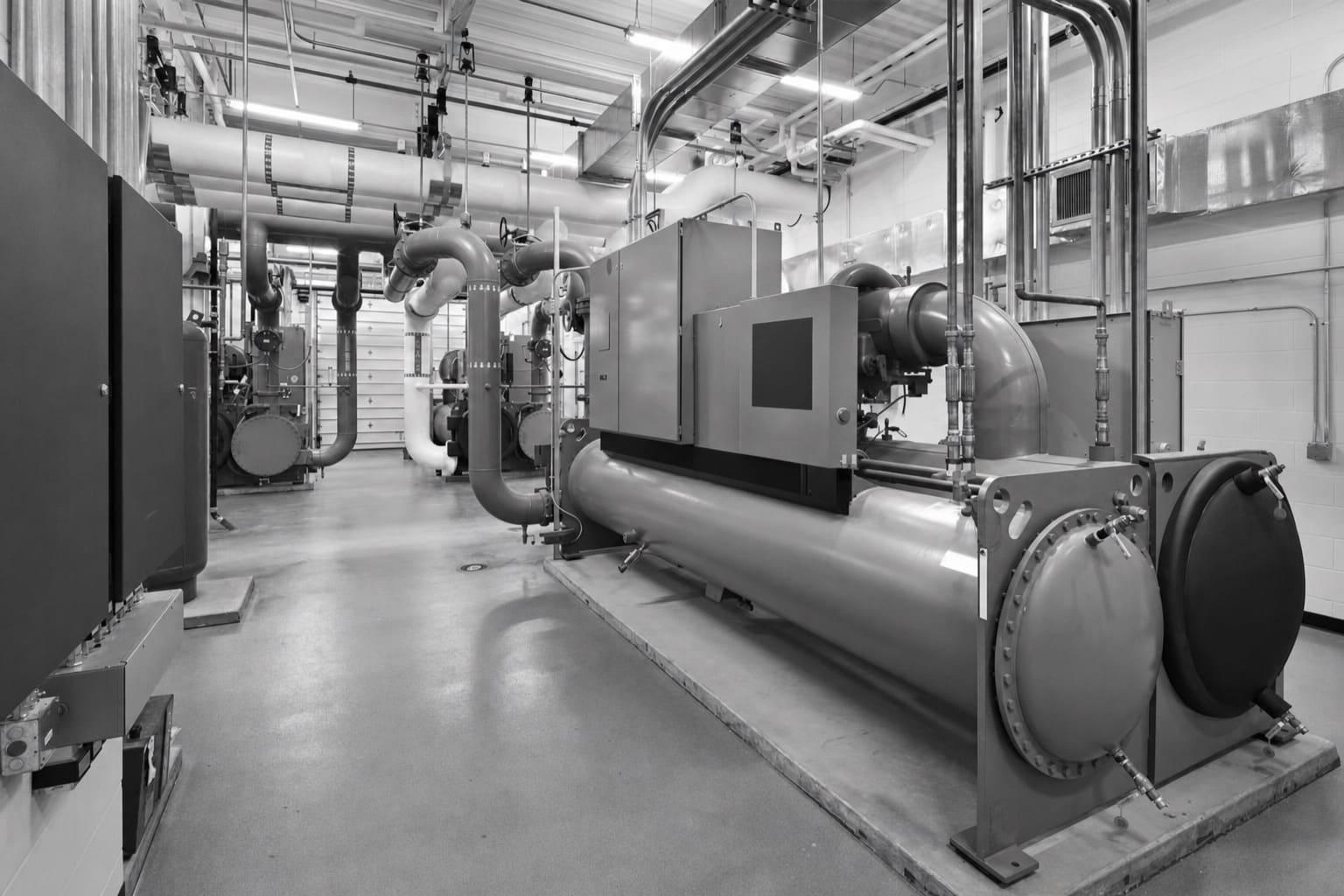
Two roofs, two prices
What makes one replacement simple and the next one complicated
Two buildings with the same tonnage can price very differently. The equipment is close to a commodity. The roof, the access, and the connections are not. Most of the spread between quotes lives in the conditions below, not in the unit itself.
Lower complexity
The unit does most of the work
• Same tonnage and fuel, existing curb fits with an adapter
• Clear crane setup inside your own lot
• Electrical capacity and gas service already adequate
• Straightforward controls, no new integration
Higher complexity
The building does most of the work
• Tonnage or footprint change that triggers structural review
• Crane setup needing a street closure or long reach
• Electrical service upgrade or a new gas run
• Controls, ventilation, or metering scope the old unit never had
Replace guesses with roof facts
What a site review has to settle before anyone prices the job
The visit is not a formality. It should come back with the existing unit's nameplate data, the curb dimensions and condition, the roof structure underneath it, the state of the membrane where work will happen, and the actual routes for power, gas, condensate, and refrigerant. Federal guidance on rooftop replacement puts infrastructure at the center of the decision — electrical capacity, physical constraints, and gas lines — because those three items decide whether a promising equipment choice is even installable on your roof.
The access review is separate, and it is where schedules break. Where does the crane set up, what does it have to reach over, which stalls or lanes close, and for how long? Which tenants or shifts are affected, and who tells them? A replacement that is technically simple can still be operationally difficult if the only workable crane position sits in the drive aisle a delivery truck needs at seven in the morning.
The last piece is the operating interview. Hours, seasonal load, complaint history, and any zone that has never been comfortable. Those complaints are evidence. They often point at a sizing or distribution problem that a new unit by itself will not fix.
A photo of the nameplate is a starting point, not a scope.
It gets you a realistic range and a lead-time answer. A firm number needs measured curb dimensions, verified electrical capacity, a confirmed crane position, and a decision on whether the load is being recalculated or carried forward.
Bridgeport and Connecticut
Assume the replacement needs a permit, because the state code says it does
Connecticut runs a statewide building code that local building departments enforce, so the mechanical permit rule for a Bridgeport rooftop replacement comes from the state rather than a city ordinance. That code requires a permit to install, alter, repair, remove, convert, or replace a mechanical system. The exemptions are narrow and clearly aimed at small equipment: replacing a minor part that does not change the equipment's approval or make it unsafe, or a self-contained refrigeration system holding ten pounds or less of refrigerant or driven by motors of one horsepower or less. No commercial rooftop unit comes near those limits. The adopted code edition is updated on a cycle, so confirm the current edition and the local submittal and inspection process with the Bridgeport building official early.
The Bridgeport takeaway
Put the permit and inspection on the schedule when you place the equipment order, not after the crane is booked. A like-for-like swap is still a permitted mechanical alteration, and inspection timing is a real constraint on when the building goes back into service.
After the crane leaves
Two things that outlive the installation
The install is one morning. The consequences run for as long as the unit stays on the roof, and two of them are worth deciding on purpose instead of discovering later.
The first is refrigerant. New commercial equipment ships on lower-global-warming-potential refrigerants, and federal rules under the Clean Air Act govern how refrigerant in stationary air-conditioning and heat pump equipment is handled, recovered, and recycled. That applies during this replacement and on every service call after it. For a building with several rooftop units of different ages, it means a mixed fleet: different refrigerants, different parts, and a service contract that has to cover both.
The second is what the industry has already learned about waiting. Federal guidance is blunt that facility managers tend to defer replacement until a unit fails outright, and that planned replacement usually beats replacement-on-failure. Failure picks the timing, the equipment that happens to be available, and the overtime rate.
Plan for it
Mixed-refrigerant fleets
Record what each unit runs on, who services it, and where parts come from. Recovery and handling requirements apply to every unit on the roof, not just the new one.
Decide before it decides for you
Planned versus emergency replacement
A unit past fifteen years is a budget item, not a surprise. Scheduling the swap in a shoulder season buys equipment choice, normal labor rates, and a crane date you picked.
One roof, several units
Sequencing a roof full of aging units without doing it all at once
Most commercial buildings do not have one rooftop unit. They have four, or nine, or twenty, installed at different times and aging on different schedules. Replacing all of them at once is rarely fundable and rarely necessary. Replacing them one emergency at a time is how a portfolio ends up with a different manufacturer, a different control platform, and a different refrigerant on every curb.
The middle path is a written sequence. Rank the units by age, service history, and the operating cost each one is carrying. Federal work on rooftop replacement puts the waste from an old, inefficient unit at roughly $900 to $3,700 per year, so the worst performers are usually easy to identify once someone looks. Then set a replacement order and a standard: one controls platform, one preferred efficiency tier, one set of parts.
That standard is worth more than it looks. It shortens future lead times, keeps spare parts usable across units, and lets a technician work on anything on the roof without a learning curve. It also turns each year's capital request into a routine line item instead of an argument about an emergency.
Before you compare bids
Five things every quote needs before the totals mean anything
Quotes are only comparable when they price the same scope. If one includes the curb adapter, the permit, and the crane and another does not, the cheaper number is not the cheaper project. Ask each bidder to show these five.
01
Tonnage, efficiency tier, heating type, and refrigerant, plus whether the load was recalculated or carried forward
02
Curb adapter, structural review, and any roof or membrane work included
03
Rigging plan: crane position, lot or lane closure, duration, and weather contingency
04
Electrical, gas, condensate, and controls work at the unit, with assumptions marked separately from verified conditions
05
Permits, inspections, commissioning documentation, and equipment lead time in writing
Get a defensible number
Price the equipment and the building together.
Send the address, operating target, and target opening date. Flux will identify what must be verified before the project can be priced.
Get a free estimateQuestions
Straight answers.
When is replacement a better call than another repair?
Once the unit is past about fifteen years and the repairs are repeating. Federal rooftop guidance points to that age as the line where units start wasting real money, roughly $900 to $3,700 per unit each year. At that point the repair invoice is only part of the cost, because the operating penalty runs every day whether the unit is broken or not.
Does a Bridgeport rooftop replacement need a permit?
Assume yes. Connecticut's statewide building code, enforced by the local building department, requires a permit to install, replace, alter, or remove a mechanical system. The exemptions cover minor parts and very small self-contained equipment, ten pounds or less of refrigerant or motors of one horsepower or less, which no commercial rooftop unit meets. Confirm the current adopted code edition and the submittal process with the Bridgeport building official.
Should you replace like-for-like or resize?
Confirm the load first, then decide. If the space, occupancy, and hours have not changed, like-for-like is often right and it is the fastest path back into service. If use has changed, and after fifteen or twenty years it usually has, carrying the old nameplate forward repeats a sizing decision made for a building that no longer exists.
Is a heat pump rooftop unit a fit in Connecticut?
It depends on the winter heating load, the electrical capacity, and the gas service. Heat pump rooftop units are mechanically similar to air-conditioning units and heat by reversing the refrigerant cycle, but federal guidance is clear that heating efficiency falls as outdoor temperature drops, trending toward electric resistance in cold weather. That is why dual-fuel and cold-climate versions exist. It is a real option here, but it is an engineering decision rather than a default.
Will a new unit use a different refrigerant?
Usually. New commercial equipment ships on lower-GWP refrigerants, which changes nothing about day-one operation but matters on a roof with mixed-age units. EPA rules under the Clean Air Act govern how refrigerant in stationary air-conditioning and heat pump equipment is handled and recovered, so both the old unit's removal and the new unit's service life need a contractor set up for it. Make sure the service contract covers both.
Why do two quotes for the same tonnage come back so far apart?
Because of the building, not the box. Equipment at the same tonnage and efficiency tier prices within a fairly narrow band. The spread comes from curb and structural work, crane access, whether electrical capacity and gas service are adequate, controls integration, and permit scope. A quote with no rigging plan and no statement about electrical capacity is a range wearing a total.
Sources used for this guide
- [1]betterbuildingssolutioncenter.energy.gov — DOE Advanced Rooftop Unit Replacement Guidance
- [2]betterbuildingssolutioncenter.energy.gov — DOE Commercial Heat Pump Rooftop Unit Replacement Guidance
- [3]betterbuildingssolutioncenter.energy.gov — DOE High-Efficiency Commercial Rooftop Unit Toolkit
- [4]energy.gov — DOE Efficient Commercial Rooftop Air Conditioner Program
- [5]epa.gov — EPA Stationary HVAC Refrigerant Management
- [6]cga.ct.gov — Building Permit Requirements for Devices Installed in a Home