THE DIRECT ANSWER
Commercial HVAC replacement and installation in Boynton Beach.
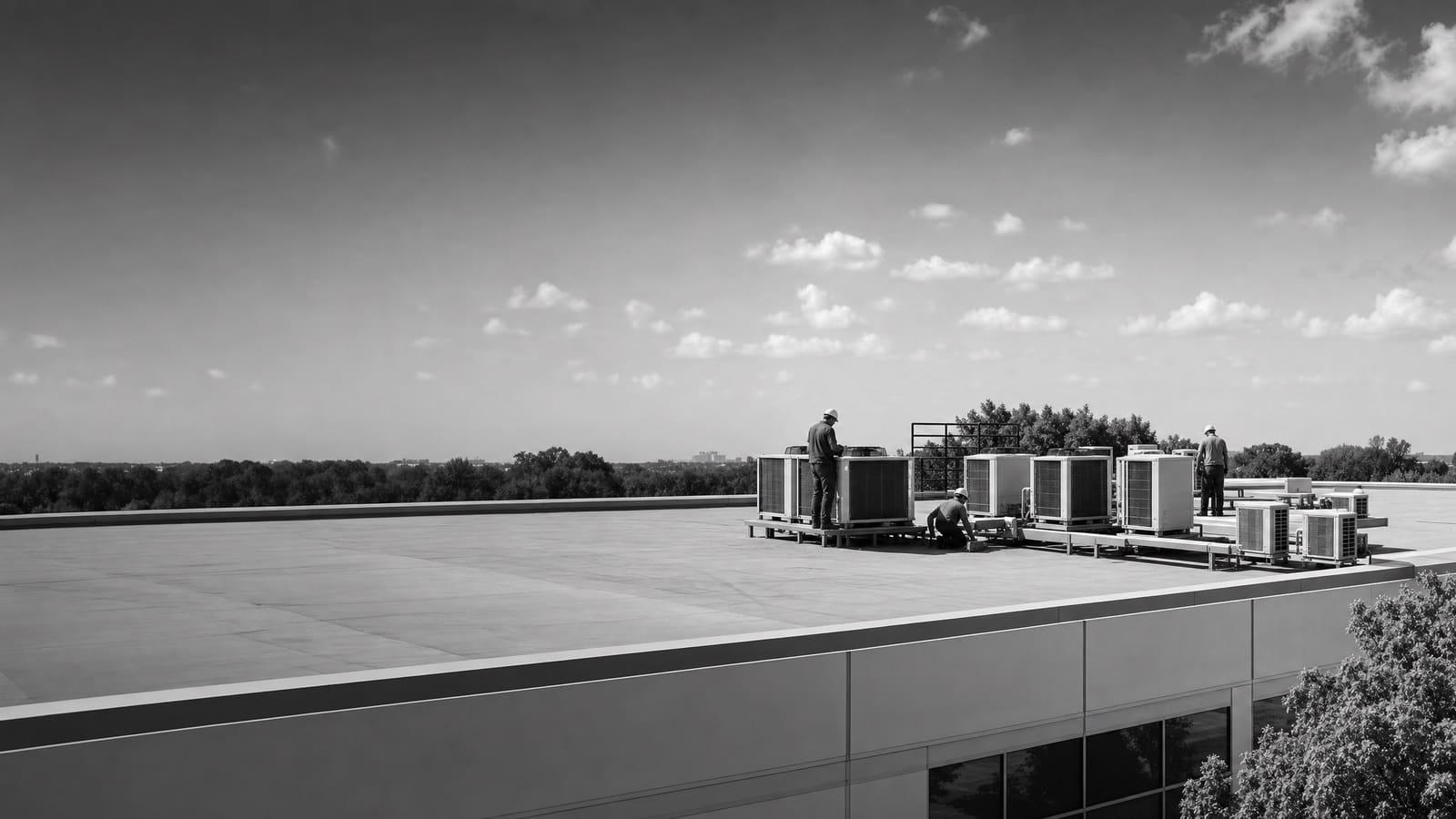
A commercial HVAC replacement includes load review, equipment selection, permit planning, removal, rigging, connections, controls, startup, and commissioning. Replacement becomes more useful than another repair when an older unit no longer holds comfort, fails often, wastes energy, or puts the business at risk of an unplanned shutdown.
A site review must confirm the real load, equipment condition, curb, structure, power, heating source, drainage, controls, access, and required approvals.
THREE OPERATING CHOICES
Decide what the new system should solve
Start with the business need, not a model number. A failed unit may call for the fastest sound replacement. A working but unreliable unit gives you time to compare efficiency, heating type, and controls. A building with uneven temperatures or changed occupancy needs a deeper sizing review.
DOE guidance says rooftop units older than 15 years can waste substantial energy compared with newer equipment. It also notes that owners often wait until comfort falls, repairs become frequent, or the unit fails. That delay can narrow the available choices. A planned project gives the buyer more control over equipment, timing, tenant notice, and roof access.
Age alone does not settle the choice. Look at failure history, refrigerant leaks, compressor condition, utility use, parts support, and the cost of downtime. Then decide whether to repair, replace in kind, or improve the system.
BUDGET STRUCTURE
What moves the installed price
The supplied research does not support one universal installed price. Build the budget from visible scope lines so bidders price the same job.
EQUIPMENT CHOICE
Compare systems by operation, not labels
A packaged rooftop unit can keep equipment and major service work outside the occupied space. A split or applied system may fit a building with separate zones, limited roof capacity, or an existing indoor distribution plan. The right answer depends on load, layout, outside-air needs, hours, maintenance access, and how much shutdown the operation can accept.
For a rooftop replacement, compare a standard air-conditioning unit with its current heating arrangement against an all-electric or dual-fuel heat-pump rooftop unit. DOE says heat-pump rooftop units are similar to air-conditioning rooftop units but also provide reverse-cycle heating. Its guidance identifies climate, utility rates, emissions goals, electrical capacity, physical constraints, gas lines, availability, and contractor knowledge as core checks. It also says today’s heat-pump rooftop units can address most or all winter heating demand in much of the South and West. That supports serious review in a warm climate, but it does not prove that every Boynton Beach building should convert.
Ask each bidder to state the proposed heating method, electrical demand, backup heat, ventilation method, control sequence, and expected service needs. Compare those facts across the same operating schedule. A higher-efficiency nameplate has limited value if airflow, zoning, or controls keep the system from working as designed.
PROJECT COMPLEXITY
Know whether this is a simple swap or a redesign
Two units with the same stated capacity can lead to very different projects. The quote should show which conditions were verified and which remain allowances.
LOWER COMPLEXITY
A close replacement
The use and load are stable. The new unit fits the curb strategy, roof capacity, utilities, ductwork, drainage, and controls with limited change.
HIGHER COMPLEXITY
A changed building
New occupancy, longer hours, comfort complaints, added equipment, ventilation changes, electrical limits, structural work, or automation integration call for more design.
SITE REVIEW
Measure before equipment is ordered
Begin with the nameplate, model, age, service records, and failure history. Then inspect the whole path around the equipment. On a roof, that includes the curb, supports, flashing, access route, service clearances, drain path, duct connections, electrical service, disconnect, gas connection when present, controls, and a safe rigging approach. Inside, check supply and return conditions, sensors, occupied zones, noise concerns, and known hot or cold areas.
The load review should reflect the space today. Confirm hours, occupancy, lighting, process loads, doors, windows, outside-air demand, and any planned use change. Reusing the old capacity without this check can preserve an old sizing error. Oversizing can cause short cycling and weak moisture control. Undersizing can leave the building unable to hold its setpoint during demanding periods.
The review should also identify what must remain running during the project. Separate critical rooms, server loads, tenant areas, production needs, and customer-facing zones. This information drives temporary cooling, phasing, lift timing, and the acceptable outage window. The final scope should turn every observed condition into included work, an exclusion, or a clearly priced allowance.
Useful information for the first review
Provide equipment photos, nameplates, roof access details, service records, utility history, control information, operating hours, comfort complaints, and any planned change in space use.
LOCAL PROJECT CONTROL
Confirm Boynton Beach submittals before ordering
Do not assume a rooftop box swap is free of design or permit work. One Florida municipal commercial-alteration guide requires mechanical plans for HVAC installation or relocation, energy calculations when HVAC is in scope, and equipment locations. It also calls for mechanical plans to be signed and sealed by a Florida-licensed architect or engineer. Those are requirements from another Florida jurisdiction, not proof of Boynton Beach’s exact process.
Use them as an early planning warning. Before releasing equipment, confirm the current Boynton Beach authority, permit path, plan requirements, energy documentation, inspections, and whether changes to weight, curb, framing, electrical service, or fuel trigger added review. Put responsibility for submittals and corrections in the contract.
Treat permit details as time-sensitive
Ask the bidder to verify current Boynton Beach requirements for this exact address and scope. A proposal should name who prepares, submits, pays for, and closes each approval.
OWNERSHIP DECISIONS
Plan for refrigerant and energy over the unit’s life
A replacement changes more than the next cooling season. It affects service tools, technician training, parts, utility use, heating strategy, controls, and the equipment mix across the property or portfolio.
EPA Section 608 rules address refrigerant handling and recycling for stationary air-conditioning and heat-pump equipment. The owner should know who recovers refrigerant, how the removed unit is documented, and whether the service provider is prepared for the refrigerant used by the new equipment.
Energy comparisons need equal assumptions. Ask bidders to compare the same operating hours, indoor targets, ventilation load, utility rates, and heating method. DOE reported that older commercial rooftop units can waste energy, and its earlier high-efficiency program showed that advanced rooftop equipment can produce meaningful savings in real buildings. Those findings support analysis, not a promised result for one site.
REFRIGERANT PLAN
Keep service practical
Record the new refrigerant, required service practices, warranty terms, parts plan, and recovery responsibility for the removed equipment.
ENERGY PLAN
Compare complete operation
Include cooling, heating, fans, ventilation, controls, schedules, and expected maintenance instead of comparing one efficiency rating alone.
PROCUREMENT AND PHASING
Make the installation predictable
Set the sequence before equipment arrives. A typical plan covers field verification, engineering where needed, equipment approval, permit work, curb or adapter fabrication, controls preparation, delivery, rigging, removal, installation, utility connections, startup, commissioning, inspection, and closeout. Each step needs an owner and a condition for moving forward.
For an occupied facility, phase the work around what the business cannot lose. Group units only when the building can accept the combined outage. Protect entrances and customer routes. Define parking closures, roof access, noise windows, weather limits, and the backup plan if a lift cannot proceed. Temporary cooling should be a scoped decision, not an assumption made after a delay.
Do not release the order from a model number alone. Approve a submittal that identifies capacity, efficiency, heating method, electrical data, dimensions, weight, curb approach, ventilation features, filters, controls, accessories, warranty, and stated availability. Record approved substitutions. If availability drives a change, review fit, power, controls, and performance again.
At handoff, require more than proof that the compressor starts. Commission airflow, fan operation, temperature response, refrigerant setup, drainage, heating, ventilation, safeties, sensors, schedules, and control sequences. Keep startup reports, inspection results, warranties, manuals, final settings, and training records with the facility files.
COMPARE QUOTES
Five items every comparable proposal should show
Normalize the bids before choosing. If one proposal hides design, controls, rigging, or closeout, its lower total may not represent a lower final cost.
01
One defined equipment selection
List model, capacity, efficiency, heating method, refrigerant, electrical data, accessories, warranty, and availability.
02
One complete field scope
Show removal, recovery, disposal, curb, duct, drain, electrical, gas, roof, rigging, protection, and cleanup work.
03
One controls and ventilation plan
Name sensors, sequences, schedules, outside-air operation, automation integration, programming, testing, and operator training.
04
One approval and schedule plan
Assign engineering, permits, fees, inspections, lead time, shutdown, crane day, weather delay, phasing, and temporary cooling.
05
One commissioning and closeout package
Require startup data, airflow checks, functional testing, deficiencies, warranties, manuals, final settings, and acceptance.
Get a defensible number
Price the equipment and the building together.
Send the address, operating target, and target opening date. Flux will identify what must be verified before the project can be priced.
Get a free estimateQuestions
Straight answers.
When should a commercial rooftop unit be replaced instead of repaired?
Replacement deserves serious review when an older unit fails often, cannot hold comfort, has recurring refrigerant or compressor problems, lacks practical parts support, wastes energy, or creates costly shutdown risk. DOE notes that rooftop units over 15 years old can waste substantial energy compared with newer models. Age is a signal, not the only test.
Should we install the same capacity as the old HVAC unit?
Not until the present load is checked. The old capacity may still fit a space whose use, occupancy, hours, ventilation, and internal loads remain stable. If those conditions changed, a load review can prevent the new system from carrying forward an old sizing problem.
Is a commercial heat-pump rooftop unit worth considering in Boynton Beach?
Yes, it is worth comparing. DOE says modern heat-pump rooftop units are well suited to mild-to-moderate winter heating and can meet most or all winter heating demand in much of the South. The site decision still depends on electrical capacity, utility costs, backup heat, available equipment, physical fit, and operating goals.
How much does commercial HVAC installation cost in Boynton Beach?
The supplied research does not establish a reliable universal installed range. The total depends on capacity, configuration, efficiency, curb and structural work, crane access, electrical or gas changes, duct and drain work, controls, design, permits, phasing, and commissioning. Ask for those lines separately so proposals can be compared.
What should commissioning include?
Commissioning should verify airflow, fan operation, refrigerant setup, heating and cooling response, drainage, ventilation, safeties, sensors, schedules, and control sequences. The contractor should correct deficiencies and provide startup records, final settings, warranties, manuals, and operator training.
Who should handle permits, refrigerant recovery, and the crane?
The contract should assign each task by name. It should state who verifies current Boynton Beach requirements, prepares plans, submits permits, schedules inspections, recovers refrigerant, disposes of the old unit, plans the lift, controls the site, and closes the permit. Do not rely on an unwritten assumption.
Sources used for this guide
- [1]betterbuildingssolutioncenter.energy.gov — DOE Advanced Rooftop Unit Replacement Guidance
- [2]betterbuildingssolutioncenter.energy.gov — DOE Commercial Heat Pump Rooftop Unit Replacement Guidance
- [3]betterbuildingssolutioncenter.energy.gov — DOE High-Efficiency Commercial Rooftop Unit Toolkit
- [4]energy.gov — DOE Efficient Commercial Rooftop Air Conditioner Program
- [5]epa.gov — EPA Stationary HVAC Refrigerant Management
- [6]tampa.gov — Permit Application Guide Commercial Alteration