Direct answer
A commercial HVAC replacement is a system project, not a unit swap.
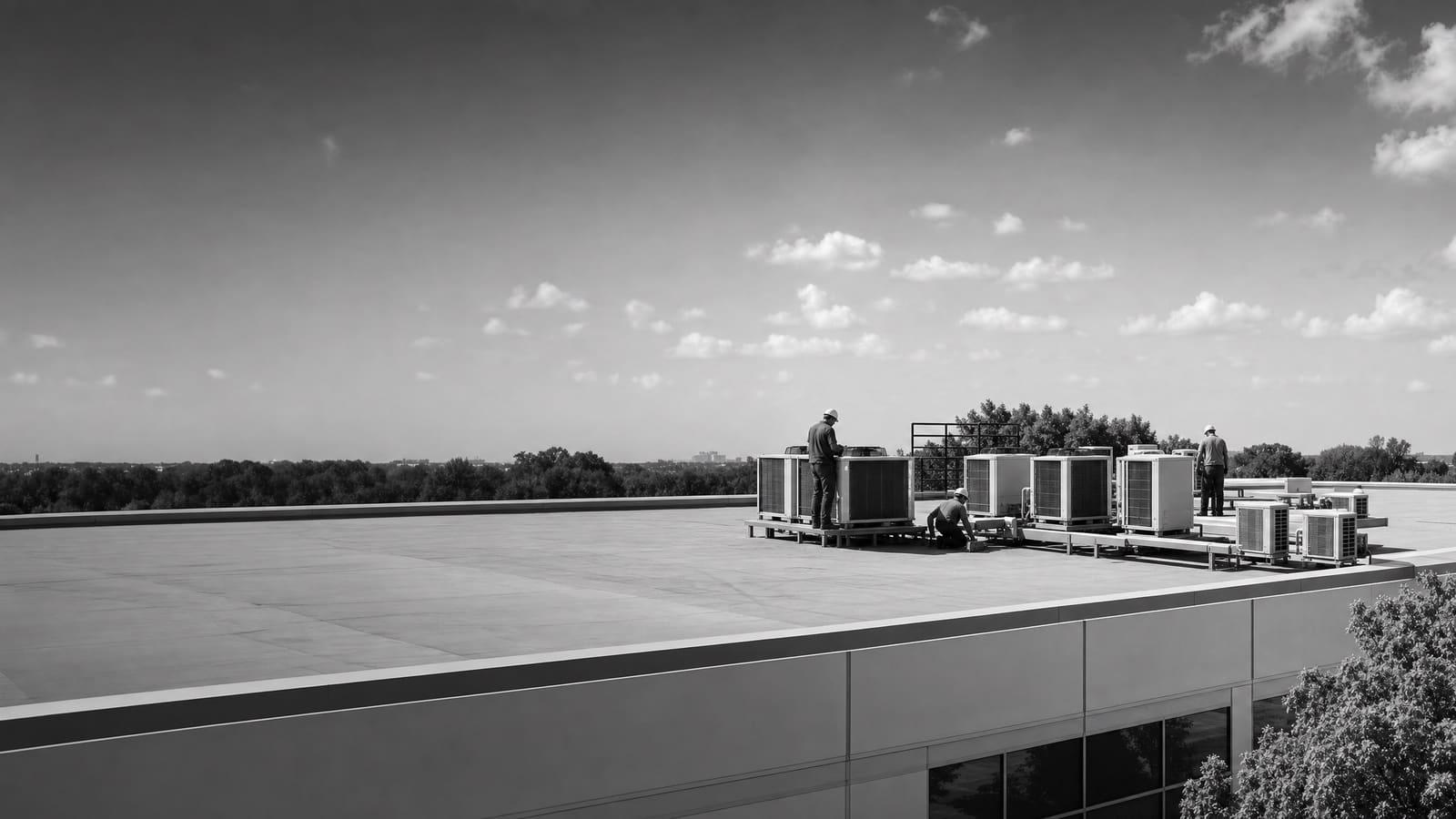
The work covers confirming the load the building actually carries today, selecting equipment against real availability, rigging and setting the unit, reconnecting power, gas, and controls, then commissioning it to spec. Replacement beats another repair once a unit needs frequent service or no longer holds the space. The Department of Energy reports that old, inefficient rooftop units waste roughly $900 to $3,700 per unit each year, and that units over 15 years old can waste substantial energy compared with newer models.
Those figures describe wasted operating cost, not an installed price. A site review still has to confirm tonnage against current use, curb and structural condition, roof and crane access, and the electrical and gas service already at the unit.
Choose from the building
Three replacement paths, and the problem each one solves
Like-for-like replacement puts the same class of unit back on the same curb. It is the fastest path back to conditioned space and the simplest to scope, and it is usually right when the space, the occupancy, and the equipment inside have not changed. It also carries forward whatever the old unit got wrong, including sizing.
A high-efficiency replacement changes the efficiency tier instead of just the age. The Department of Energy's high-performance rooftop specification targeted units that cut energy use by up to 50 percent against the standard in place at the time, and manufacturers now offer more than 20 models that exceed it. DOE later finalized a minimum efficiency standard for commercial rooftop units, so today's baseline unit is not the one you are replacing.
A heat pump rooftop unit adds reverse-cycle heating to equipment that is otherwise similar to a cooling unit, in dual-fuel, all-electric, and cold-climate versions. Heat pump heating efficiency falls as outdoor temperatures drop and trends toward parity with electric resistance heat, so winter design conditions, electricity and gas prices, and the electrical capacity at the roof decide which version fits.
Build the whole number
What belongs in a commercial HVAC replacement budget?
A useful budget separates the equipment from the work required to land it, connect it, and prove it runs. A low unit price hides very little on a simple curb swap and a great deal on a roof that needs structural work or added electrical service.
Do not order the box first
Confirm the load and the roof before the model number is chosen
The nameplate on a twenty-year-old unit records a decision someone made about a building that no longer exists in the same form. Occupancy changes, lighting changes, plug load changes, and envelope work all move the real load. Sizing the replacement from current use is what turns a swap into a fix, and it decides whether the chronic comfort complaints leave the roof with the old unit.
The Department of Energy's framing is worth borrowing: facility teams often wait until a unit fails completely, needs frequent maintenance, or stops conditioning the space adequately before they buy. Replacing proactively usually beats replacement-on-failure, and it often beats a like-for-like swap at end of life, because the planned version lets you compare efficiency tiers, heating type, and availability instead of taking whatever can be on a truck this week.
Infrastructure is the other half of selection. DOE's heat pump guidance names electrical capacity, physical constraints, and existing gas lines as the conditions that decide whether a site can change heating approach at all. A panel with no spare capacity, a curb that cannot carry a heavier unit, or a roof opening that does not match the new footprint narrows the equipment list long before efficiency or brand enters the conversation.
Why two quotes diverge
The same tonnage can price very differently
One unit lands on an adapter over an existing curb with adequate power already at the roof. The other needs structural review, new feeders, a longer crane reach, and a closed drive lane on a weekend. The equipment did not change. The site did.
Lower-complexity replacement
The existing curb does the work
• Same tonnage and footprint on an existing curb
• Adequate electrical service already at the unit
• Clear crane setup with a short reach
• Controls that carry over without redesign
Higher-complexity replacement
The building has to change
• Larger or heavier unit triggering structural review
• New feeders, disconnects, or added service capacity
• Long crane reach, lot or street closure, night work
• Fuel switching: gas abandonment plus electrical build-out
Replace guesses with roof facts
What a site review should settle before design starts
A useful site visit does more than photograph the nameplate. The reviewer should measure the curb and the unit footprint, check the roof structure and the roofing condition around the opening, and confirm how the unit is actually powered: breaker size, feeder condition, disconnect location, and how much spare capacity the panel really holds. Gas service, where present, gets the same treatment, because extending it or abandoning it is scope either way.
Access comes next. The crane needs a setup pad, a reach to the unit, and a path clear of live overhead lines. Someone has to decide which parking stalls or dock doors close, for how long, and on which day. That call belongs to operations, not to the crew that arrives on the morning of the lift.
The operating interview matters as much as the measurements. Ask what the space is used for now, when it is occupied, which complaints are chronic, what the unit costs to keep running, and what happens to the business if the space is warm for a day. Those answers decide whether this is a fast like-for-like swap or a planned upgrade worth scheduling around, and how much interim cooling belongs in the budget.
A photo estimate is a range, not a scope.
Nameplate data and an aerial view can narrow the options, but a firm number needs measured curb dimensions, verified electrical capacity, a structural opinion on the roof, and a crane plan. The estimate should name every assumption still waiting on field confirmation.
After the crane leaves
The install price is not what the unit costs you
Two things follow the equipment for its whole service life: what it costs to run and what it costs to service. The operating side is easier to see. DOE's rooftop campaign reports that more than 200 organizations upgraded over 43,000 units and saved a combined $37 million a year on energy bills, which is the scale of the gap between aging equipment and current equipment across a portfolio.
The service side is where mixed fleets get expensive. New commercial equipment ships on newer low-GWP refrigerants, and EPA rules under Section 608 of the Clean Air Act govern how refrigerant is handled, recovered, and recycled in stationary air-conditioning and heat pump equipment. That shapes who can work on the unit, what gets documented, and how spare parts and service agreements should be planned when one roof carries units from different refrigerant generations.
Contractor availability belongs in the decision too. DOE's heat pump guidance names it directly: equipment that few nearby technicians are set up to commission or service is a different ownership proposition than equipment everyone stocks parts for.
Year one
Commissioning and documentation
Startup, refrigerant charge, airflow verification, controls setup, and the documentation that keeps the warranty intact. Comfort complaints in month two are usually commissioning problems nobody caught at handoff.
Years two and beyond
Service, parts, and refrigerant
Preventive maintenance, filter and belt schedules, refrigerant handling under EPA rules, parts availability for the specific model, and a service plan for a roof carrying more than one refrigerant type.
Buy the fleet, not the emergency
Sequencing replacements beats replacing on failure
Most buildings do not have one unit. They have several, bought at different times, aging on different schedules. Treating them as a fleet changes the math. A written replacement sequence, ordered by condition, age, and how much each space matters to the business, lets you buy on your calendar instead of on the hottest day of the year. Emergency replacement pays for expedited equipment, overtime rigging, and whatever unit happens to be available, and it usually forecloses the efficiency and heating-type decisions entirely.
Procurement follows the same logic. Ask for the installed price, the availability of the specific model, and at least one alternate at a different efficiency tier, so ownership can see what the upgrade costs against what it saves. Availability belongs on the quote next to the price. A cheaper unit that lands eight weeks later is not cheaper if the space is unusable in the meantime.
Lifetime cost is the last filter. DOE's point about units over 15 years old is really a point about how long a purchasing decision keeps costing. Compare the tiers on operating cost, include a heat pump option where the electrical service and winter conditions support it, and let the operating model rather than the low bid decide.
Before you compare bids
Five things a comparable quote has to show
Ask every bidder to price the same tonnage, the same efficiency tier, the same curb and structural assumption, the same crane plan, and the same commissioning scope. If one quote excludes rigging or roofing and another includes it, the totals are not comparable.
01
Tonnage, efficiency tier, heating type, and refrigerant of the exact model proposed
02
Whether the load was confirmed from current use or carried over from the old nameplate
03
Curb adapter, structural, and roofing work, each stated as included or excluded
04
The rigging plan: crane size, closure time, day of the lift, and who coordinates access
05
Commissioning deliverables, permits and inspections, and the equipment lead time in writing
Get a defensible number
Price the equipment and the building together.
Send the address, operating target, and target opening date. Flux will identify what must be verified before the project can be priced.
Get a free estimateQuestions
Straight answers.
When is replacement better than another repair?
When repairs are becoming frequent, the unit no longer conditions the space adequately, or the equipment is old enough that its operating cost is the real expense. The Department of Energy notes that rooftop units over 15 years old can waste substantial energy, and that planning the replacement usually beats waiting for a failure.
Should a heat pump rooftop unit replace a gas unit?
Sometimes. Heat pump rooftop units are technically similar to cooling units but add reverse-cycle heating, in dual-fuel, all-electric, and cold-climate versions. Heating efficiency drops as outdoor temperatures fall, so winter conditions, electricity and gas prices, and the electrical capacity at the roof decide the answer.
How much does commercial HVAC installation cost?
There is no honest universal per-unit price. Tonnage, efficiency tier, curb and structural work, crane access, and electrical or gas changes each move the number, so a real figure follows a look at the roof. What DOE does quantify is the running cost: old, inefficient rooftop units waste roughly $900 to $3,700 per unit each year.
Should the replacement be like-for-like or resized?
Confirm the load either way. If the space and how it is used have not changed, like-for-like is often right and is the fastest path back to service. If occupancy, internal equipment, or the envelope changed, sizing from current use fixes complaints the old unit could never solve.
Does new equipment change refrigerant service?
New commercial equipment ships on newer low-GWP refrigerants. EPA rules under Section 608 of the Clean Air Act govern how refrigerant is handled and recovered in stationary air-conditioning and heat pump equipment, so a roof carrying units from different refrigerant generations needs a service and spare-parts plan that covers both.
Sources used for this guide
- [1]betterbuildingssolutioncenter.energy.gov — DOE Advanced Rooftop Unit Replacement Guidance
- [2]betterbuildingssolutioncenter.energy.gov — DOE Commercial Heat Pump Rooftop Unit Replacement Guidance
- [3]betterbuildingssolutioncenter.energy.gov — DOE High-Efficiency Commercial Rooftop Unit Toolkit
- [4]energy.gov — DOE Efficient Commercial Rooftop Air Conditioner Program
- [5]epa.gov — EPA Stationary HVAC Refrigerant Management