THE DIRECT ANSWER
What a commercial HVAC replacement actually includes
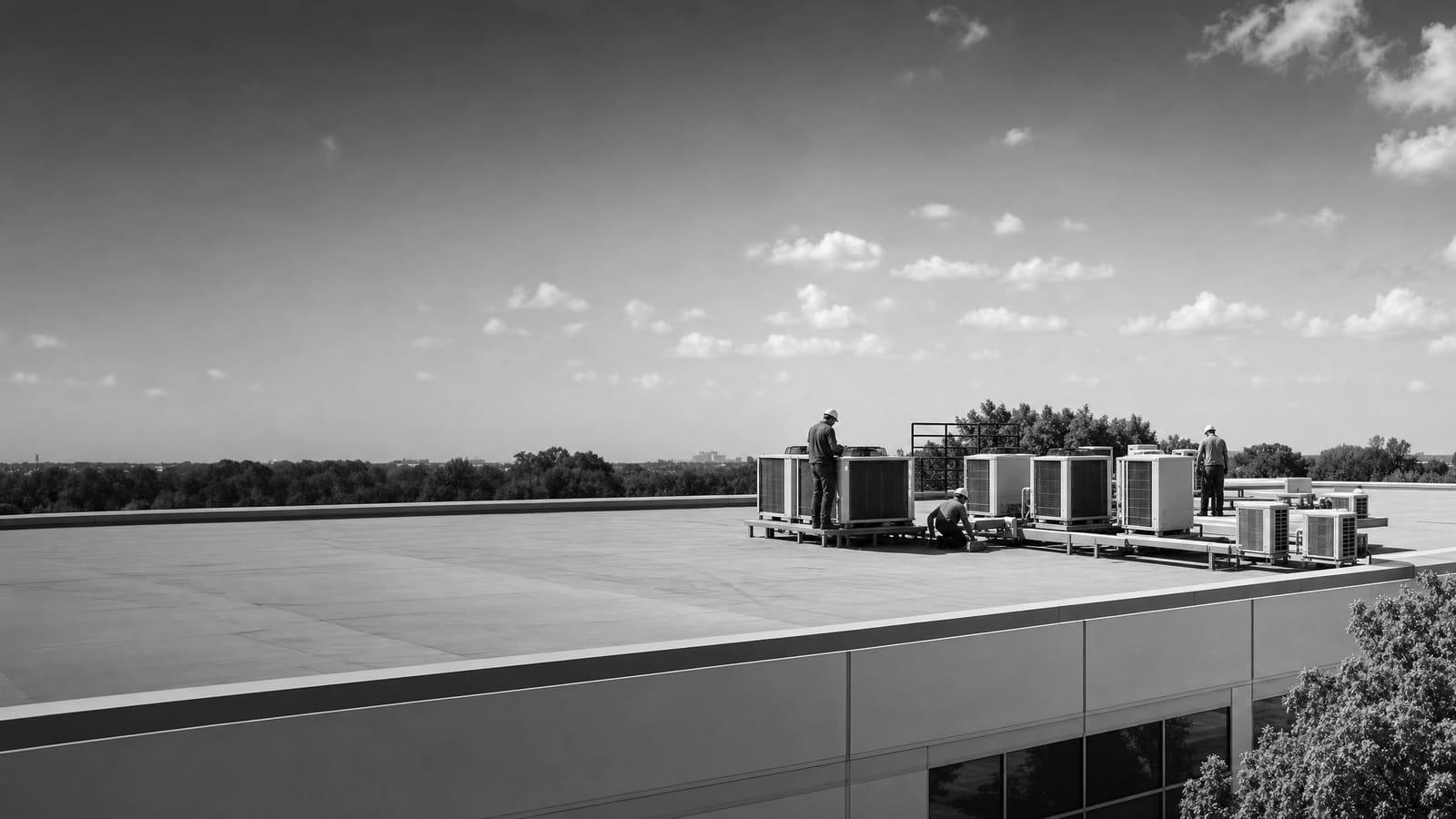
A commercial HVAC replacement means confirming the load for how the building is used now, selecting equipment against real lead times, handling the curb and rigging, recovering the old refrigerant, and commissioning the new unit. Replacement beats another repair once a rooftop unit is past 15 years and burning energy. DOE puts the waste from old, inefficient units at $900 to $3,700 per unit each year, which often exceeds the repair bill you keep paying.
A site review still has to confirm tonnage against current occupancy, whether the existing curb and roof structure carry the new unit, and what electrical capacity is available at the panel.
THREE WAYS TO PLAY IT
Replace on failure, replace like-for-like, or upgrade
Most facility teams delay a rooftop replacement until the unit stops holding the space, needs constant service, or dies outright. DOE's guidance is blunt about that tradeoff: replacing an underperforming unit on purpose usually beats waiting for failure, and it often beats a like-for-like swap at the end of service life too. The reason is timing. When you choose the date, you get equipment selection, a real bid, a scheduled crane, and a shot at any incentive. When the unit chooses the date, you take whatever is on the truck in August.
That does not make like-for-like wrong. If the space is used the same way it was when the last unit went in, matching the existing curb and connections is the fastest and cheapest path back to cooling. The upgrade case turns on three things: how old the current unit is, what it costs to run every year, and whether the building has the electrical capacity for a different kind of unit.
WHAT MOVES THE NUMBER
Where commercial HVAC installation money actually goes
No two roofs price the same, so the honest way to read a quote is line by line. These are the lines that move most between a simple swap and a real project, and the ones worth pushing a bidder to price rather than bury in an allowance.
HOW TO BUY IT
Sizing the unit for the building you have now
The most expensive assumption in a rooftop replacement is that the old nameplate was right. Rooftop units cool close to half of all commercial floor space in the country, and plenty of them were sized for a building that has since changed. Occupancy shifts, lighting gets swapped, a server closet appears, a tenant reconfigures the floor plate. Any of those moves the load in one direction or the other, and an oversized unit in a humid climate short-cycles, controls humidity poorly, and still costs more to buy.
So the first thing to ask a bidder is where the number came from. A load calculation based on current use, or the tag on the unit coming off? Both answers can be defensible. Only one of them tells you the new unit will fix the comfort complaints you have been logging for two summers.
The second question is efficiency tier. DOE's high-performance specification pushed manufacturers to build rooftop units that cut energy use by up to half against the older baseline standard, and more than twenty models have been offered that exceed it. When an aging unit can waste thousands of dollars a year on its own, the tier you pick is an operating decision, not a spec-sheet detail.
SIMPLE OR COMPLICATED
What makes one replacement easy and the next one a project
Two replacements on the same block can price very differently. The gap is rarely the unit itself. It is what the roof, the panel, and the parking lot make you do to get it up there.
LOWER COMPLEXITY
Same size, same curb, easy reach
The replacement matches tonnage and heating type, the existing curb takes an adapter, the panel already carries the load, and a crane sets up in the lot without closing the entrance. One morning of visible work.
HIGHER COMPLEXITY
New size, new fuel, or a hard roof
Upsizing brings structural review. Going all-electric brings panel capacity into it. Add tight street access, an occupied tenant below, or a group of units to phase, and both the schedule and the price move before anyone lifts anything.
BEFORE THE BID
What a site review has to come back with
A bid that arrives without anyone standing on the roof is a guess with a number attached. DOE's checklist for rooftop replacement decisions is a good scope for the visit, and it is short enough to hold a contractor to.
Start with infrastructure. What electrical capacity is available at the panel, and does it support the unit under consideration, especially if that unit is all-electric? What are the physical constraints on the roof: curb size and condition, structural capacity, clearances, service access, and whether a crane can actually reach the spot? If the current unit heats with gas, decide now what happens to that line.
Then availability. Which units are genuinely obtainable in the size and configuration you need, and how long is the lead? A specification nobody can deliver until spring is not a plan, it is a delay with a model number.
Last, the people. Rooftop replacement is routine work, but heat pump equipment and modern controls are not universally familiar. Ask who performs the startup and what they have commissioned before.
Four written answers before pricing
The review should produce four answers in writing: available panel capacity, curb and structural condition, the crane's staging and reach plan, and a real delivery date for the exact unit being quoted.
IN BOCA RATON
Plan for a sealed Florida permit set, not a same-week start
Boca Raton sits in a cooling-dominated part of the country with mild winters, and that matters twice. First, DOE's guidance is direct that today's heat pump rooftop units are fully capable of covering most or all of the winter heating demand across the U.S. South, so an all-electric replacement is genuinely on the table here in a way it is not everywhere. Second, the permit path is a Florida path. Florida commercial alteration guidance is consistent: when the scope includes installing or relocating HVAC equipment, the submittal needs mechanical plans signed and sealed by a Florida-licensed architect or engineer, equipment locations shown, and energy calculations for the HVAC work. That is design time, and it happens before the crane, not around it.
Confirm the submittal list first
Requirements and review times are set by the building department with jurisdiction over your address, so confirm the current submittal list before you promise a tenant a date. Ask your contractor who seals the plans and who pulls the permit.
OWNERSHIP AND OPERATIONS
Who pays, and how many of these you really own
Two questions shape a replacement budget more than the equipment does: who owns the outcome, and how many more of these units sit on your roofs.
If you occupy a building you own, the math is clean. The capital cost and the utility savings land in the same place, so a higher efficiency tier pays back to you directly. In a leased building, capital and operating costs often sit with different parties, which is worth reading the lease over before you assume who decides and who benefits.
The fleet question is separate. Rooftop replacement becomes a portfolio decision once you own more than a couple of units, and standardizing on a make and configuration across your roofs simplifies parts, service, and every bid after this one.
OWNED AND OCCUPIED
Efficiency pays back to you
You carry the capital cost and you keep the utility savings, so a higher efficiency tier is a straightforward return calculation rather than a negotiation with a landlord or a tenant.
LEASED OR MULTI-TENANT
Check who benefits before you spec
When one party buys the unit and another pays the power bill, the efficiency argument has to be made in the lease, not on the roof. Sort that out before the scope goes to bidders.
PHASING AND PROCUREMENT
Buying replacements on your schedule instead of theirs
The cheapest rooftop unit you will ever buy is the one you order in a quiet month. Emergency replacement compresses every decision at once. You take the tonnage sitting in the regional warehouse, you pay for a crane on short notice, and you skip the incentive paperwork because there is no time for it. Planning the same job three months earlier changes none of the physical work and much of the price.
For anyone with more than one unit, that argues for a simple rolling plan. Walk the roofs, write down the age and condition of each unit, and put the oldest ones into next year's capital budget instead of next year's emergency fund. Utility incentive programs exist for high-efficiency rooftop equipment, so ask what is available before equipment is ordered rather than after the unit is set.
Lifetime cost is then the real comparison. Purchase price, installed cost, the energy the unit burns every year it runs, and the service it needs along the way. An old, inefficient unit can waste thousands of dollars annually by itself. Across the years a new unit will run, that figure, not the spread between two bids, is usually the larger number.
THE QUOTE
Five things a comparable quote shows
Bids that look different often are not. They are describing different scopes. Ask every bidder to show these five, and the comparison gets easy.
01
The equipment, fully identified
Make, model, tonnage, heating type, efficiency tier, and which refrigerant the unit uses.
02
Where the size came from
A load calculation based on current use, or a carryover of the old nameplate. Stated either way.
03
Roof, curb, and rigging scope
Curb adapter or new curb, any structural work, the crane day, and how long the lot is closed.
04
Permits and design
Who prepares and seals the mechanical plans and energy calculations, who pulls the permit, and who meets the inspector.
05
Startup, closeout, and dates
Commissioning results, refrigerant recovery handled under EPA rules, controls setup, warranty registration, and a real delivery date.
Get a defensible number
Price the equipment and the building together.
Send the address, operating target, and target opening date. Flux will identify what must be verified before the project can be priced.
Get a free estimateQuestions
Straight answers.
When does replacement beat one more repair?
Once a rooftop unit is past 15 years, the math usually shifts. Old, inefficient units waste anywhere from $900 to $3,700 each per year, which can quietly exceed what you are spending on service calls. Add a failed compressor or a unit that no longer holds the space, and replacement is the cheaper answer.
Should you replace like-for-like or resize?
Confirm the load either way. If the space is used the way it was when the old unit went in, matching the existing curb and connections is fast and cheap. If occupancy, layout, or internal equipment changed, a load calculation is what keeps you from buying the same problem twice.
Does a heat pump rooftop unit make sense in South Florida?
It is a real option here. DOE's guidance says heat pump rooftop units are best suited to mild-to-moderate winter heating, and that across the U.S. South today's units can cover most or all of the winter heating demand. The limits are practical ones: electrical capacity, equipment availability, and installer familiarity.
What does permitting add to the schedule?
In Florida, commercial alteration work that installs or relocates HVAC equipment generally calls for mechanical plans signed and sealed by a licensed architect or engineer, plus energy calculations for the HVAC scope. That is design work before submittal and review time after. Confirm current requirements with the building department for your address.
What happens to the refrigerant in the old unit?
It gets recovered, not vented. EPA rules under Section 608 govern how refrigerant is handled and recycled in stationary air-conditioning equipment, and that recovery belongs in the installer's scope. Ask which refrigerant the new unit uses as well, since it affects parts and service planning on a mixed fleet.
Sources used for this guide
- [1]betterbuildingssolutioncenter.energy.gov — DOE Advanced Rooftop Unit Replacement Guidance
- [2]betterbuildingssolutioncenter.energy.gov — DOE Commercial Heat Pump Rooftop Unit Replacement Guidance
- [3]betterbuildingssolutioncenter.energy.gov — DOE High-Efficiency Commercial Rooftop Unit Toolkit
- [4]energy.gov — DOE Efficient Commercial Rooftop Air Conditioner Program
- [5]epa.gov — EPA Stationary HVAC Refrigerant Management
- [6]tampa.gov — Permit Application Guide Commercial Alteration