THE SHORT ANSWER
What a commercial HVAC replacement actually covers
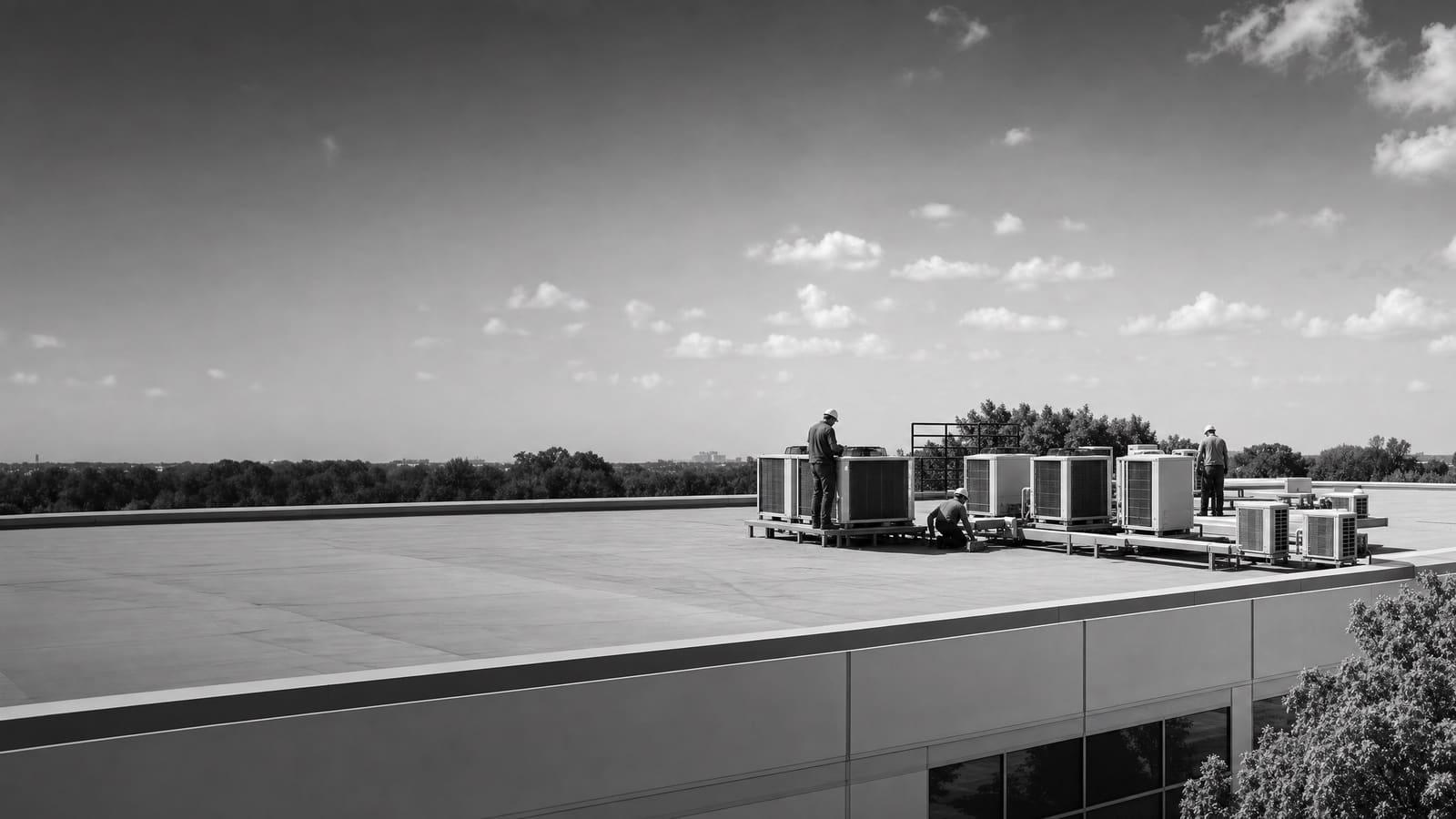
A commercial HVAC replacement covers the load calculation, the equipment selection, the rigging and set, the gas and electrical and duct connections, the controls, and the commissioning that proves the system performs. Replacement beats one more repair once a unit is past roughly 15 years and the service calls are stacking up. Federal work on rooftop units found old, inefficient equipment can waste $900 to $3,700 per unit every year, which often exceeds what the next compressor costs.
A site review still has to confirm the real load, the curb and roof structure, the available electrical capacity, and crane access before any of that becomes a number.
THREE PATHS
Three ways to replace a rooftop unit
Most commercial replacements land on one of three paths, and the right one depends on how the building runs, not on what is cheapest to buy.
Like-for-like keeps the same curb, the same connections, and the same fuel. It is the fastest way back to conditioned space and the simplest to permit.
A high-efficiency unit uses the same footprint but a better machine. Federal testing behind the High-Performance Rooftop Unit Challenge targeted units that cut energy use by up to 50% against the standard of the time, and more than 20 models now exceed that specification.
A heat pump rooftop unit adds reverse-cycle heating and removes gas at that unit. Federal guidance treats the West as a region where today's heat pump rooftop units can carry most or all of the winter heating demand, which makes the option a real one here rather than a stretch. The catch is capacity at the electrical panel.
WHAT MOVES THE NUMBER
Where the installed price actually comes from
No two roofs price the same, and the spread usually comes from the work around the unit rather than the unit itself. These are the lines worth seeing broken out before you compare one quote to another.
HOW TO BUY IT
Choose the equipment before you chase the price
The most expensive mistake in a commercial replacement is buying the old nameplate again without asking whether it was ever right. Twenty years changes occupancy, plug load, lighting, and often the envelope. A unit sized for a building that no longer exists short-cycles, holds humidity, and produces the comfort complaints that no service call ever fixes.
Start with how the space is used now. Confirm the load, then decide which of the three paths fits. Federal guidance for rooftop replacement puts that decision on a short list of questions: climate and heating load, the effect on the utility bill, emissions goals, building type, equipment availability, and the infrastructure already on site — electrical capacity, physical constraints on the roof, and existing gas lines. How familiar your contractor is with the equipment belongs on the list too.
Timing matters as much as selection. Rooftop units condition close to half of the commercial floor area in the country, so when a heat wave takes out a fleet of them, everyone calls the same week. A unit replaced on your schedule gets competitive pricing, a planned crane day, and a real commissioning window. A unit replaced on failure gets whatever is on the truck.
SIDE BY SIDE
What keeps a job simple, and what complicates it
The same tonnage can be a one-morning job or a multi-week project. The difference is almost never the unit itself. It is what the replacement touches on the way in, and how much of that was known before the quote was written.
LOWER COMPLEXITY
Straight swap on a sound roof
Same fuel, same tonnage, a curb in good condition, an open lot for the crane, and adequate electrical already at the unit. Permits are routine and the schedule holds.
HIGHER COMPLEXITY
Fuel switch or a changed building
Gas to electric, a tonnage increase, a curb that needs structural work, or tight access with no staging room. Each one adds a trade, a review, and calendar time.
BEFORE THE QUOTE
What a real site review has to confirm
A price quoted over the phone from a nameplate photo is a starting range, not a quote. It can tell you roughly what the equipment costs. It cannot tell you what the installation costs, and on commercial work the installation is where the money moves.
A serious site review walks the roof and the mechanical room. It confirms the load against how the space is used today rather than the old nameplate. It checks curb dimensions and whether the structure carries the new weight. It reads the electrical panel and records available capacity, because that single number decides whether an electric option is a real conversation. It looks at the gas piping if gas is staying. It measures crane reach from wherever a truck can actually set up, and counts the stalls that close for the day.
It should also ask about your calendar. A retail tenant and a lab have very different tolerance for a warm afternoon, and the phasing plan should reflect that before it turns into a surprise.
The number that decides the most
Available capacity at the panel serving the unit. If an electric replacement needs service work the building cannot support, the equipment premium stops being the real cost and the electrical upgrade becomes the project.
IN BERKELEY
Permits and the electric question
Two local realities shape a Berkeley replacement more than anything else.
The first is paperwork. California municipal permit rules treat any mechanical or electrical upgrade or repair as permitted work, and a rooftop replacement is both at once. Confirm the current requirements with the Berkeley building department before the crane is booked, and make sure the quote names who pulls the permits and who closes them out after inspection.
The second is fuel. Federal rooftop guidance identifies the West as a region where today's heat pump rooftop units are an appropriate solution and can handle most or all of the winter heating demand. That puts an all-electric replacement genuinely on the table here rather than in the experimental column. Whether it pencils depends on your electricity and gas rates, your emissions goals, and the electrical capacity already at the building.
Ask this before you shortlist equipment
What is the spare capacity at the panel serving this unit, and what do your rates do to a winter heating load that moves from gas to electricity? Both answers should exist before anyone specifies a model.
OWNING IT
Two things that outlive the install
The installation takes a week of your attention. The decisions inside it set your operating cost and your service exposure for the next fifteen to twenty years, so they deserve more thought than the crane day does.
Refrigerant is the quiet one. EPA rules under Section 608 of the Clean Air Act govern how refrigerant is handled, recovered, and recycled in stationary air conditioning and heat pump equipment, and removing the old unit properly follows them. New equipment also ships on newer refrigerants, which matters most to anyone maintaining a mixed fleet across several buildings.
The other is fleet strategy. One roof with six units of the same age is not six independent decisions.
REFRIGERANT
Recovery is regulated, not optional
Federal rules cover how refrigerant is recovered from the unit being removed. A quote should account for that work, and a mixed fleet needs a parts and service plan as refrigerants change.
FLEET PLANNING
Sequence the roof, do not react to it
When several units share an install date, replacing them one failure at a time costs more than a staged plan. Group the work and both the pricing and the scheduling improve.
THE LONGER VIEW
Phasing, procurement, and what the unit costs to run
Lifetime cost is where replacement decisions actually get settled. Federal work on rooftop units found that old, inefficient equipment wastes somewhere between $900 and $3,700 per unit each year. Multiply that across a roof carrying several aging units and the annual waste starts to look like a down payment on replacing them properly.
The scale of that gap is why the Advanced Rooftop Unit Campaign exists. More than 200 public and private organizations upgraded over 43,000 rooftop units through it, with reported savings of roughly $37 million a year across the group. That is not a promise about your building. It is evidence that the efficiency gap on old equipment is often large enough to help fund its own replacement.
For procurement, that argues for two habits. Ask for an operating cost estimate next to the installed price, not instead of it. And put availability on the quote, because a unit you cannot get in August is not a real option no matter what it costs. Where a fleet is involved, phase it: replace the worst performer first, check the savings against actual bills, and let that result set the pace for the rest.
COMPARING QUOTES
Five things a comparable quote shows
Two quotes for the same roof are only comparable if they scope the same work. These five lines make the difference visible, and they are the ones most often left off.
01
Equipment, tonnage, and efficiency tier
The exact model, its capacity, and its rating — not a brand name and a total.
02
Confirmed load basis
Whether the size came from a current load calculation or from the old nameplate.
03
Curb, structure, and roof work
Adapter, any structural work, and who carries it if the curb opens up worse than expected.
04
Rigging, permits, and inspections
Crane, lot closure, permit fees, and who pulls the permits and closes them out.
05
Commissioning and lead time
Charge, airflow, and controls verified and documented, plus a real delivery date.
Get a defensible number
Price the equipment and the building together.
Send the address, operating target, and target opening date. Flux will identify what must be verified before the project can be priced.
Get a free estimateQuestions
Straight answers.
When is replacement better than one more repair?
Once a rooftop unit is past about 15 years, federal guidance notes it can waste substantial energy compared with newer equipment, and old inefficient units have been measured wasting $900 to $3,700 per unit annually. When the next repair is a compressor or a coil on a unit in that age range, replacement usually wins on math alone.
Should you replace like-for-like or resize?
Confirm the load either way. If the space and how it is used have not changed, like-for-like is often the right call and the fastest one. If occupancy, plug load, or the envelope changed, right-sizing fixes comfort problems the old unit was never able to solve.
Does a heat pump rooftop unit make sense in Berkeley?
It is a real option here. Federal rooftop guidance treats the West as a region where current heat pump rooftop units can handle most or all of the winter heating demand. Whether it pencils for your building depends on your electricity and gas rates, your emissions goals, and how much spare capacity sits at the electrical panel.
Who handles the crane, permits, and inspections?
The installing contractor should own the rigging plan, lot coordination, permits, and inspections inside the installed price. California permit rules treat mechanical and electrical work as permitted, so confirm the quote names who pulls and closes each permit before you sign.
What happens to the refrigerant in the old unit?
It has to be recovered under EPA Section 608 rules, which govern handling, recovery, and recycling of refrigerant in stationary air conditioning and heat pump equipment. That work belongs on the quote rather than showing up as a line item later.
What most often makes the final number differ from the estimate?
Two things: what the curb and roof structure look like once they are opened up, and how much electrical capacity is actually available. Both are knowable before the quote, which is why a site review is worth more than a fast phone number.
Sources used for this guide
- [1]betterbuildingssolutioncenter.energy.gov — DOE Advanced Rooftop Unit Replacement Guidance
- [2]betterbuildingssolutioncenter.energy.gov — DOE Commercial Heat Pump Rooftop Unit Replacement Guidance
- [3]betterbuildingssolutioncenter.energy.gov — DOE High-Efficiency Commercial Rooftop Unit Toolkit
- [4]energy.gov — DOE Efficient Commercial Rooftop Air Conditioner Program
- [5]epa.gov — EPA Stationary HVAC Refrigerant Management
- [6]californiacity-ca.gov — HVAC Permits