THE DIRECT ANSWER
What a commercial HVAC replacement actually covers
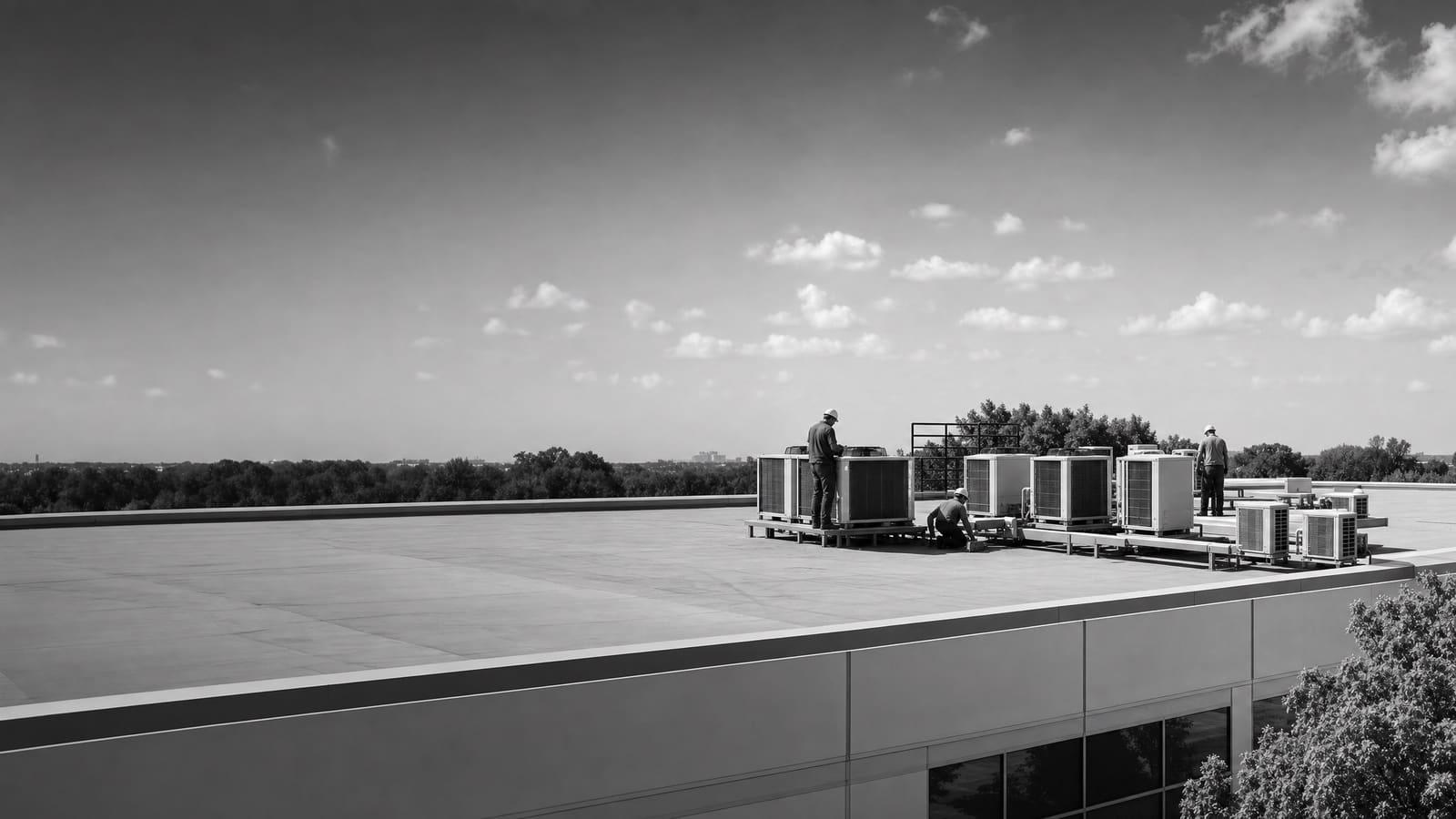
A commercial HVAC replacement covers load verification, equipment selection, rigging and set, mechanical and electrical connections, permits and inspection, and commissioning. Replacement beats another repair once the unit is past roughly 15 years and the failures start repeating. DOE puts the annual energy waste of an old, inefficient rooftop unit at roughly $900 to $3,700 per unit, so a tired unit keeps charging you between service calls.
A site review still has to confirm curb size and condition, roof structure at the opening, crane reach and setup room, available gas and electrical capacity, and which code items the replacement triggers.
THE FIRST DECISION
Three ways to replace a rooftop unit
Most replacements come down to what the new unit burns, and that decision belongs before tonnage or brand. DOE's guidance for commercial rooftop units treats climate zone, electrical capacity, and existing gas service as the first screen. It matters here because heat pump heating efficiency falls as outdoor temperature drops, trending toward parity with electric resistance heat in the coldest hours. That is why the guidance separates standard heat pump units from dual-fuel and cold-climate versions rather than treating heat pumps as one product.
None of the three options is automatically right for a Central Oregon building. The answer depends on your heating hours, what your electrical panel can carry, and whether you want to keep a gas appliance on the roof at all. Settle it early, because the choice changes the permit path and the electrical scope, not just the equipment price.
WHAT MOVES THE NUMBER
The budget lines that decide your price
Commercial HVAC is quoted per unit, not per square foot. These are the lines that move the total, and the ones worth asking each bidder to break out separately so two quotes can actually be compared.
PLANNED VERSUS FORCED
Why the timing of the decision costs more than the equipment
The strongest argument for planning a replacement instead of waiting for one is that a tired rooftop unit is already spending your money. DOE's guidance notes that units past 15 years waste substantial energy against current models, and its rooftop work put that waste at roughly $900 to $3,700 per unit each year. Most facility teams still wait until the unit fails outright, stops holding the space, or needs service every month.
Waiting costs more than the energy. An emergency swap takes whatever equipment is available that week, at whatever efficiency tier arrives with it, and leaves no room to evaluate a heat pump option or to right-size against how the building is actually used today. A planned swap lets you choose from the twenty-plus models that exceed DOE's high-efficiency specification, some of which cut energy use by up to half against the older standard.
The scale of that difference is not theoretical. More than 200 organizations working through DOE's rooftop campaign upgraded over 43,000 units and cut a combined $37 million a year from their energy bills. That is the case for treating rooftop replacement as a budget line you schedule rather than an emergency you absorb.
SCOPE CHECK
Routine swap or real project
Not every replacement carries the same risk. Two sets of conditions separate a routine swap from a project, and knowing which one you have tells you whether to budget weeks or months.
LOWER COMPLEXITY
Same size, same fuel, same spot
The new unit matches the old one closely, sits on the existing curb in the same location, and keeps the same fuel type. Crane access is clear and the roof opening is untouched. The permit path stays simple, and equipment lead time drives the schedule.
HIGHER COMPLEXITY
Fuel change, bigger footprint, tight access
Switching fuel type, growing capacity or dimensions past the state's review thresholds, relocating the unit, or reframing the roof opening all pull the job into mechanical plan review. Add an electrical service upgrade and the calendar stretches further still.
BEFORE THE QUOTE
What a real site review settles
A useful quote starts on the roof, not on the phone. The nameplate tells a contractor what was installed years ago. It does not tell anyone whether that size still matches the building. Occupancy changes, added plug load, lighting retrofits, and envelope work all move the load, sometimes downward. Carrying an oversized unit forward means short cycling, weak humidity control, and comfort complaints that no amount of service will fix.
The review should also settle the physical questions before equipment is ordered: curb dimensions and condition, roof structure at the opening, the reach a crane needs from where it can actually set up, which stalls come out of service, and the routing of gas, electrical, and condensate. On an all-electric option, available panel capacity is the first thing to confirm, because a service upgrade can outweigh the equipment difference entirely.
Finally, the review should name the code items the replacement triggers. Economizer requirements, controls, and ventilation rates follow the code in force when the permit is pulled, not the specification the old unit was built to.
What to have ready before the visit
Nameplate photos of every unit, a rough floor plan, your operating hours, last year's utility bills, and whatever service history you have. Five minutes of gathering usually removes a week of back-and-forth from the quote.
OREGON PERMITTING
The 10 percent rule that decides your schedule
Oregon runs commercial mechanical work under the state mechanical specialty code, where a plan review is generally required for a commercial mechanical permit. The state's own plan review checklist is unusually specific about what turns a rooftop replacement into a reviewed project. Review is required when the new appliance's Btu rating differs from the existing one by more than 10 percent, when the fuel type changes, when the unit's size or shape falls outside 10 percent of the original, when it is not set in the same location, or when any dimension of the new equipment — including transition curbs and economizers — grows by more than 6 inches or more than 10 percent, whichever is less. Structural changes, including reframing an existing opening, trigger it as well. Confirm which office reviews permits for your address before you commit to a date.
Ask this before you approve a model
If schedule matters more than upgrade scope, ask whether the candidate unit stays inside those windows. Staying in keeps the permit simple. Stepping outside is often still the right call, but budget the review time up front instead of discovering it later.
AFTER THE CRANE LEAVES
Two things that outlive the install
Two items belong in the decision rather than in a footnote after the equipment lands.
Refrigerant is the first. New commercial equipment ships on newer refrigerants, and EPA rules under Section 608 of the Clean Air Act govern how refrigerant is handled and recycled in stationary air conditioning and heat pump equipment, including recovery from the unit coming off your roof. That is a compliance step with paperwork, not a courtesy.
The second is fleet planning. The moment one unit changes refrigerant or fuel type, the building runs a mixed fleet, and the service agreement, spare parts, and technician skills have to cover both. That is entirely manageable, but only if it is decided on purpose.
REFRIGERANT
Recovery is regulated work
Section 608 rules cover the handling and recycling of refrigerant in stationary air conditioning and heat pump equipment. Confirm the quote includes certified recovery and documentation for the unit being removed.
FLEET
One swap changes the whole roof
A single replacement leaves you supporting two generations of equipment. Update the service agreement and parts plan the month the unit lands, not after the first mixed-fleet callout.
SEQUENCING AND PROCUREMENT
How to phase a roof and buy the equipment
If you run more than one unit, sequence matters more than any single price. Rank the roof by age, service history, and the spaces each unit serves. The oldest unit over the most sensitive space goes first. The unit with three good years left waits, and waiting is a legitimate choice as long as it is an actual decision with a date attached.
Procurement is where schedules break. Equipment availability, not labor, sets most replacement calendars. Ask for lead time in writing next to the price, and ask what changes if the specified unit slips. A contractor who quotes a model without an availability date has quoted half the job.
Lifetime cost is the last filter. Compare bids on installed price plus the energy the unit will use across fifteen-plus years of operation, plus what the platform costs to maintain. A higher-efficiency unit that costs more on day one can be the cheaper unit well before it is paid off, which is the arithmetic behind DOE's entire rooftop program. Ask each bidder to state the efficiency tier they specified and what the next tier up would add. When that delta is small, the decision usually makes itself.
QUOTE CHECKLIST
Five things a comparable quote shows
Two bids are only comparable when both show the same lines. Ask for these five in writing before anything gets signed.
01
Verified load and tonnage
The calculated load rather than the old nameplate, plus the assumptions behind it: occupancy, operating hours, and equipment.
02
Model, efficiency tier, and lead time
A specific model, the efficiency tier specified, a written availability date, and the stated fallback if it slips.
03
Curb, structure, and roof work
Curb adapter or new curb, any reframing at the opening, and who patches and warranties the roof penetration.
04
Crane day and site impact
Rigging plan, stalls closed, hours of closure, and who notifies tenants ahead of the lift.
05
Permits, inspection, and commissioning
Permit and plan review path, inspection scheduling, and a startup report covering charge, airflow, and control settings.
Get a defensible number
Price the equipment and the building together.
Send the address, operating target, and target opening date. Flux will identify what must be verified before the project can be priced.
Get a free estimateQuestions
Straight answers.
How do I know replacement beats one more repair?
Age plus repeat failures is the honest test. DOE notes that rooftop units past 15 years waste substantial energy against current models, with old inefficient units running roughly $900 to $3,700 per unit a year in waste. When a unit that old needs service every month or can no longer hold the space, the repair is buying time on an asset that is already costing you every day it runs.
Does a heat pump rooftop unit make sense for a Bend building?
It depends on your heating hours and your electrical capacity. Heat pump heating efficiency drops as outdoor temperature falls, which is why DOE's guidance separates standard heat pump units from dual-fuel and cold-climate designs. In a climate with real winter heating demand, dual-fuel and cold-climate units are the versions worth pricing. Confirm panel capacity before committing to an all-electric option.
Will my replacement need a mechanical plan review in Oregon?
Often, yes. Oregon generally requires plan review for a commercial mechanical permit, and the state checklist flags a replacement when the Btu rating differs by more than 10 percent, the fuel type changes, the unit's size or shape falls outside 10 percent of the original, the unit moves location, or any dimension grows by more than 6 inches or 10 percent, whichever is less. Structural reframing triggers it too.
What does a commercial HVAC installation cost?
It is priced per unit, and there is no honest universal number. Tonnage and efficiency tier, curb and structural work, crane access, electrical capacity, and code-triggered items like economizers each move the total independently. Ask for those as separate lines so two bids can be compared. The clearer figure is the operating side: an old inefficient unit wastes roughly $900 to $3,700 a year while you decide.
How long will the whole project take?
Two clocks run at once. Equipment availability usually dominates, and the permit path is the other, since a replacement that falls outside the state's review thresholds adds review time before anyone schedules a crane. The on-site portion of a single packaged unit swap is short next to the wait. Get both the availability date and the review path in writing rather than accepting a general estimate.
Sources used for this guide
- [1]betterbuildingssolutioncenter.energy.gov — DOE Advanced Rooftop Unit Replacement Guidance
- [2]betterbuildingssolutioncenter.energy.gov — DOE Commercial Heat Pump Rooftop Unit Replacement Guidance
- [3]betterbuildingssolutioncenter.energy.gov — DOE High-Efficiency Commercial Rooftop Unit Toolkit
- [4]energy.gov — DOE Efficient Commercial Rooftop Air Conditioner Program
- [5]epa.gov — EPA Stationary HVAC Refrigerant Management
- [6]oregon.gov — Inspector Training Program Registration