THE SHORT VERSION
What a commercial HVAC replacement actually includes
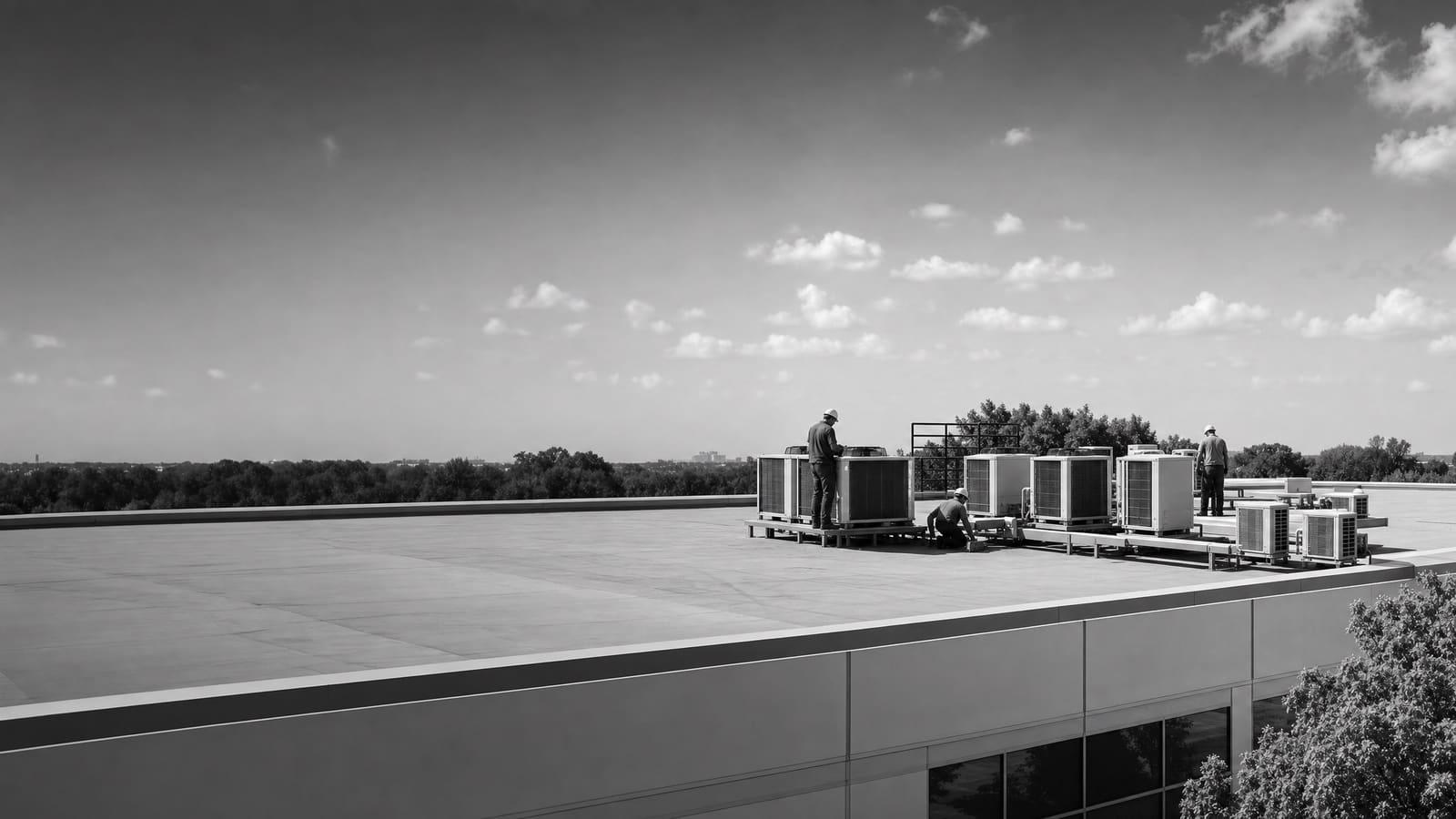
Commercial HVAC replacement is four things: a load check against how the building is used now, an equipment selection made against real lead times, a rigging and connection day, and commissioning that proves the unit performs. Replacement beats one more repair when the unit is past about fifteen years and the failures are stacking up. Old, inefficient rooftop units waste roughly $900 to $3,700 each per year, which is money a new unit starts recovering on day one.
A site review has to confirm the real load, the curb and roof structure, available electrical capacity at the panel, the gas line status, and crane access before any number on a quote means anything.
THE MAIN CHOICE
Three ways to replace a rooftop unit
Most replacement decisions now come down to what the new unit burns. Rooftop units condition close to half of all commercial floor space in the country, so this is the choice most buildings actually face. A heat pump rooftop unit is mechanically similar to an air conditioning unit; it just runs the cycle in reverse to produce heat. The deciding factors are your winter heating load, electricity and gas prices at your meter, the electrical capacity already in the building, and whether a gas service is staying or going. Heat pump heating efficiency drops as outdoor temperatures fall, trending toward plain electric resistance at the bottom end, so the design temperature at your site should pick the path rather than a general preference. Availability matters too: some configurations and tonnages are stocked, and others are ordered.
WHAT MOVES THE NUMBER
The lines that decide the price
No one can price a rooftop replacement from a photo, but the line items that move the number are predictable. These are the ones worth asking about before you compare two quotes, because a low bid usually means one of them was left out.
IN PRACTICE
Buy the replacement instead of reacting to it
The most expensive way to buy a rooftop unit is to buy it the week it dies. Facility teams commonly wait until a unit no longer holds the space, needs constant attention, or fails outright, and at that point the choice narrows to whatever is on a truck. Planning the replacement a season ahead reopens the options that actually save money.
The savings are documented. When the Department of Energy pushed manufacturers to build rooftop units that cut energy use by up to half against the prevailing standard, two models met the specification first and more than twenty now exceed it. Third-party testing confirmed the savings in occupied buildings, not just in labs. Through the campaign that followed, more than 200 organizations upgraded over 43,000 rooftop units and cut a combined $37 million a year from their energy bills.
That is the case for treating a replacement as a purchase rather than an emergency. Ask for two or three equipment options with installed prices and honest availability next to each. Ask what each one does to the monthly utility line. Then decide on your schedule, with tenants notified, instead of on the day the compressor gives up.
SCOPE CHECK
What makes this simple, and what makes it complicated
Two replacements of the same tonnage can differ by weeks of schedule and a wide margin of cost. The difference is almost never the unit itself. It is what the building asks the crew to do around it.
LOWER COMPLEXITY
Same size, same fuel, clear roof
The use of the space has not changed, the new unit matches the existing curb and connections, gas and electric stay as they are, and the crane has a straight shot from the lot. This is a plan-it-once, set-it-in-a-morning job.
HIGHER COMPLEXITY
New fuel, new footprint, tight access
Occupancy or equipment loads changed, the unit is going all-electric, the panel is near capacity, or the only crane position sits across an active drive. Each of those adds a verification step before anyone can commit to a date.
BEFORE THE QUOTE
What a real site review checks
A quote written from a nameplate photo is a starting point, not a price. The site review is where the number becomes real, and it follows a short list.
First, the load. Twenty years changes occupancy, plug loads, lighting heat, and sometimes the envelope. Sizing to the old nameplate copies forward a decision someone made about a different building.
Second, the infrastructure. That means electrical capacity at the panel and the service, the physical constraints of the curb and the roof, and the status of the gas line. Those three decide whether a heat pump option is even on the table, and they are the items most often discovered late.
Third, access and timing. Where the crane sets up, how long the lot is closed, whether the lift has to happen before the building opens, and what weather window the season allows.
Fourth, availability. The most efficient unit on paper is the wrong answer if it lands eleven weeks out while the building runs on portable cooling. Ask for lead times in writing, per option, at the same time as prices.
Ask for this in writing
Before signing, get the tonnage and efficiency tier, the curb and structural scope, the electrical and gas work included, the crane plan with lot closure hours, and the equipment lead time. A quote missing one of those is hiding a change order.
OWNERSHIP
Two decisions that outlive the install
The install ends in a morning. What you chose lives on the utility bill and in the service contract for the rest of the unit's life, so two decisions deserve attention before the crane is booked.
One is operating cost, which is the entire reason efficiency tiers exist and the reason payback should be run per option rather than assumed. The other is what the new unit does to the rest of your equipment picture: refrigerants, parts, and the technicians who have to work on all of it. Neither shows up in the installed price, and both show up in the five-year number.
OPERATING COST
Run the utility math per option
Electricity and gas prices at your own meter, not national averages, decide whether a heat pump lowers the bill. Ask for the projected monthly impact of each option and check it against a real year of usage data.
SERVICE PLANNING
Plan for a mixed fleet
New equipment ships on newer refrigerants, and recovering refrigerant from the unit coming off is federally regulated. If the roof will carry old and new units for a few years, make sure the service contract and spare-parts plan cover both.
PHASING
Replacing several units without replacing them all at once
Buildings rarely have one aging unit. They have five, installed the same year, aging at the same rate. Replacing all of them at once is clean but capital-heavy. Replacing them one emergency at a time is the most expensive version of the same project, spread over five years.
The middle path is a ranked plan. Rank by age, by run hours, by service history, and by what each unit serves, because the one over the server closet or the dining room is not the same priority as the one over a storage mezzanine. Then replace on a schedule, in the shoulder seasons, with equipment ordered ahead of the season it has to survive.
Phasing also lets you learn. Put the first heat pump unit on a zone whose load is well understood, run it through a full heating season, and use the actual bill data to decide the rest of the fleet. That is a better basis than a spreadsheet estimate. Procurement improves too: a multi-unit plan is a stronger conversation with a supplier than a single emergency order, and it gives lead times somewhere to live besides your downtime.
COMPARE APPLES TO APPLES
Five things every quote should show
Two quotes for the same roof can differ by a wide margin and still both be honest, because they are pricing different scopes. Line these five up before you compare the totals.
01
Tonnage, efficiency tier, and fuel
The exact model, its efficiency rating, and whether it is air conditioning only, dual fuel, or an all-electric heat pump.
02
Curb, structural, and roof scope
Adapter or new curb, any framing or roofing work, and who patches the penetrations.
03
Electrical and gas work included
Panel, feeder, or disconnect changes, and whether the gas line is capped, reused, or extended.
04
Crane plan and lot impact
Set date, lift position, hours the lot is closed, and whether off-hours work is priced in.
05
Lead time and commissioning
Equipment availability in writing, plus documented startup: charge, airflow, and controls verified against spec.
Get a defensible number
Price the equipment and the building together.
Send the address, operating target, and target opening date. Flux will identify what must be verified before the project can be priced.
Get a free estimateQuestions
Straight answers.
When does replacing a rooftop unit beat repairing it again?
Once a unit is past about fifteen years, its inefficiency is a monthly cost rather than just a risk. Old, inefficient rooftop units waste roughly $900 to $3,700 each per year. A single component failure on an otherwise sound unit is still worth repairing.
Should the replacement be a heat pump or a like-for-like unit?
Heat pump rooftop units are mechanically similar to air conditioning units and heat by running the cycle in reverse. Their heating efficiency drops as outdoor temperatures fall, so the winter design temperature at your site, your electricity and gas prices, and the panel capacity in the building should decide it.
What most often causes a surprise change order?
Electrical capacity and physical constraints. All-electric conversions can require panel or service work, and a curb that does not match the new footprint pulls in structural scope. Both are findable during a site review and expensive to find on crane day.
How should the new unit be sized?
From how the space is used today. Occupancy, plug loads, and equipment change over twenty years, and sizing to the old nameplate carries someone else's decision forward. Confirm the load either way, even when like-for-like turns out to be the right answer.
Does the old refrigerant need special handling?
Yes. EPA rules under the Clean Air Act govern how refrigerant is handled and recycled when stationary air conditioning and heat pump equipment is serviced or removed. It belongs on the quote as scope, not as an assumption.
Sources used for this guide
- [1]betterbuildingssolutioncenter.energy.gov — DOE Advanced Rooftop Unit Replacement Guidance
- [2]betterbuildingssolutioncenter.energy.gov — DOE Commercial Heat Pump Rooftop Unit Replacement Guidance
- [3]betterbuildingssolutioncenter.energy.gov — DOE High-Efficiency Commercial Rooftop Unit Toolkit
- [4]energy.gov — DOE Efficient Commercial Rooftop Air Conditioner Program
- [5]epa.gov — EPA Stationary HVAC Refrigerant Management