THE DIRECT ANSWER
What a commercial HVAC replacement actually covers
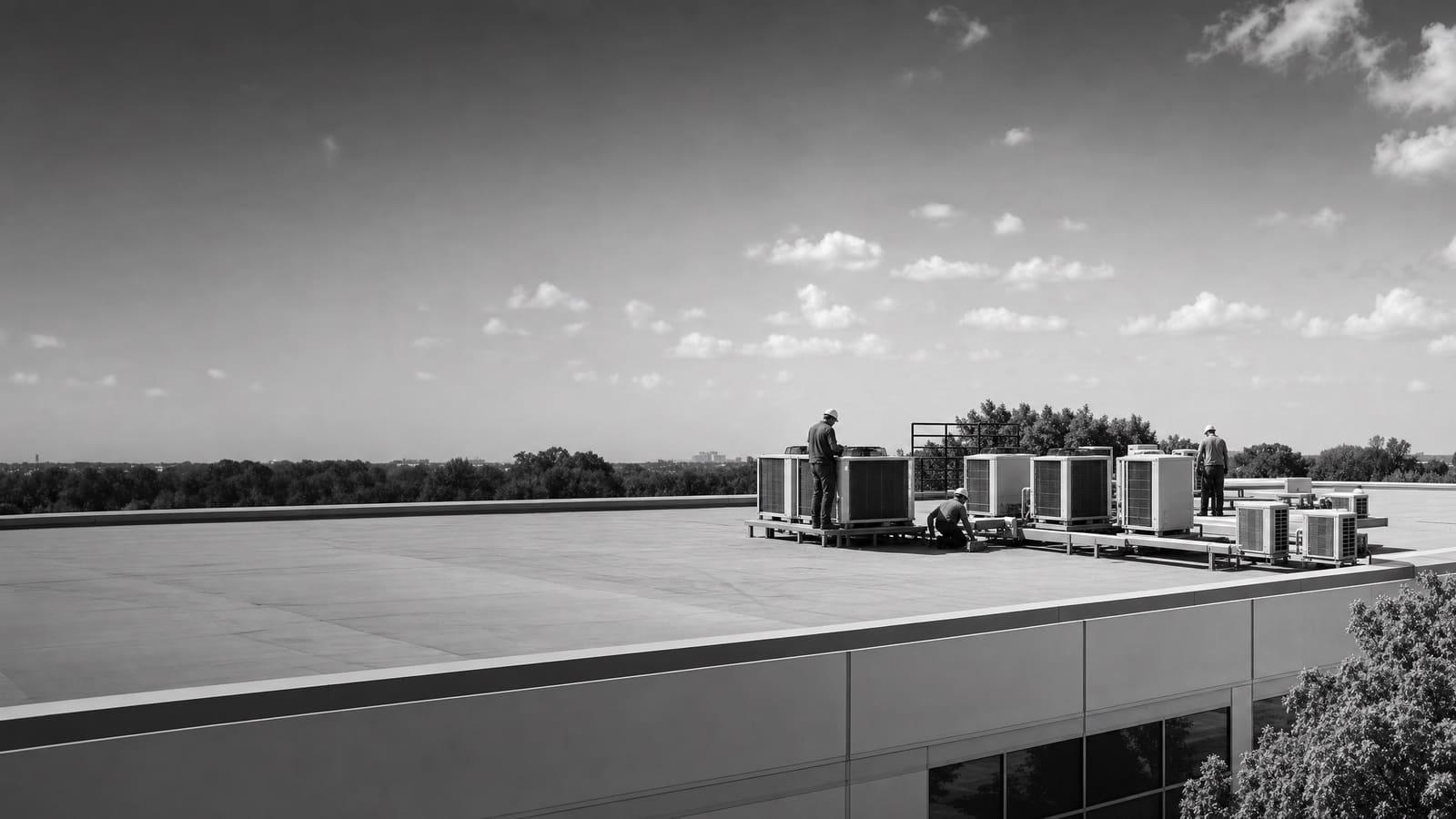
A commercial HVAC replacement covers load verification, equipment selection, rigging and setting the unit, electrical and gas or refrigerant connections, controls integration, and commissioning before handoff. Replacement beats one more repair once a unit can no longer condition the space or needs frequent service to hold setpoint. Federal guidance puts the waste from an old, inefficient rooftop unit at $900 to $3,700 per unit each year in energy alone. A repair recovers none of that.
A site review has to confirm the actual load, the curb and structural fit, available electrical capacity, and whether a crane can reach. Those four answers move the price more than tonnage does.
THREE PATHS
Three ways to replace a commercial rooftop unit
Most commercial replacements land on one of three heating paths, and that choice gets made before equipment is ordered. Federal guidance treats heat pump rooftop units as technically similar to air-conditioning units, with one added ability: they run the refrigerant cycle in reverse to heat. So the real question is about heating fuel, electrical capacity, and winter load rather than about cooling. As outdoor air gets colder, heat pump heating efficiency falls and trends toward parity with electric resistance heat, which is why the guidance points heat pump units at mild-to-moderate winter heating and keeps a backup heat source in the picture where winters bite harder. Pick the path first, then size the unit. Each path asks a different question of your service panel and your gas line.
WHAT MOVES THE NUMBER
Where the money actually goes
Nobody can price a rooftop replacement from a tonnage number alone. These are the lines that separate a clean swap from a project, listed roughly in the order they surprise owners.
BUYING GUIDANCE
Replace on your schedule, not the equipment's
Most owners wait, and federal guidance describes the pattern plainly: facility managers delay a new rooftop unit until the current one can no longer condition the space, needs frequent maintenance, or fails outright. The problem is that failure picks the date. A unit that dies in season forces whatever equipment is available that week, at whatever crane slot the calendar allows, with no time to weigh a heat pump against a like-for-like box.
Planned replacement flips that. The same guidance makes the case that proactively replacing inefficient, underperforming units with more efficient ones is often the smarter business move — better than replacement on failure, and often better than a like-for-like swap at the end of a unit's service life. The savings are not theoretical. Old, inefficient rooftop units waste $900 to $3,700 per unit annually, and the federal high-performance specification targeted units built to cut energy use by up to half against the standard in place at the time.
That is why the efficiency tier belongs in the conversation early, not as an upsell at signing. The premium is paid once. The utility bill arrives every month for the life of the unit.
SCOPE CHECK
What makes this simple, and what makes it a project
Two replacements with identical tonnage can differ by weeks of schedule and a wide margin of cost. The dividing line is almost never the unit itself. It is the infrastructure around it and how the building runs.
LOWER COMPLEXITY
Same duty, same connections
The use of the space has not changed, the existing curb accepts an adapter, the panel already carries the load, and the roof has clear crane reach. Off-hours access is available, so tenants see traffic cones and nothing else.
HIGHER COMPLEXITY
Fuel switch or changed load
Occupancy or equipment changed, the unit is being resized, or gas heat is coming out in favor of electric. Now electrical capacity, physical clearances, and gas line work all have to be verified before anything is ordered, and lead times stretch.
SCOPING
What a real site review checks before anything is ordered
Federal guidance for commercial heat pump rooftop units lists the factors that decide whether a site is a fit, and that list works as a scoping checklist for any replacement. Climate and geography drive the heating load. Local electricity and gas prices drive whether the new unit lowers the bill. Building type matters, because a warehouse and a clinic ask different things of the same tonnage. Then come the hard constraints: available electrical capacity, physical constraints on and around the unit, and existing gas lines. Equipment availability, contractor familiarity with the technology, and any incentives round it out.
Read that list again as questions about your building. Does the panel have room? Will the new footprint clear the walkway and the neighboring unit? Is the gas line staying or going? Can the crane reach without closing a drive aisle during business hours? Every one of those answers moves either the price or the schedule, and none of them can be answered from a nameplate photo alone.
Send these four things with your request
A photo of the nameplate, a photo of the roof showing the unit and its surroundings, your electrical panel schedule, and your operating hours. That is enough to scope the job and flag the expensive unknowns before a truck rolls.
OWNERSHIP
Two things to settle before the order goes in
A replacement is a capital decision with a long service tail. Two items get decided at purchase and then stay with you for the life of the unit, so they are worth a conversation now instead of a surprise later. One is regulated. The other is contractual, and it quietly determines which unit you end up buying.
REFRIGERANT
The old unit's charge is regulated
EPA rules under Section 608 of the Clean Air Act govern how refrigerant is handled and recycled in stationary refrigeration, air-conditioning, and heat pump equipment. Recovery and documentation belong in the installed price, and a mixed fleet means planning service around more than one refrigerant.
WHO BENEFITS
Capital cost and savings can sit in different pockets
If the tenant pays the utility bill and the owner buys the unit, the efficiency upgrade has a split payoff. Settle that before specifying, or the cheapest box wins by default and the building carries the operating cost for years.
PROCUREMENT
Phasing, lead times, and the cost you actually pay
If you run more than one roof, treat replacement as a schedule rather than a series of emergencies. Rank units by age and service history, and give the ones already past fifteen years a planned date. Federal guidance frames this as a portfolio decision for exactly that reason: some buildings in a portfolio suit an all-electric path and others do not, and knowing which is which before a unit fails is what keeps the choice open.
Procurement follows the same logic. Equipment availability is one of the listed considerations, and it earns its place — the specification you want may not be the one sitting in a regional warehouse the week your unit quits. Ordering against a planned date is how you get the unit you chose instead of the unit that happened to be available.
Then look at lifetime cost honestly. The purchase price is one number on one day. Energy, service calls, refrigerant handling, and the eventual next replacement are the rest of it. Confirm any incentive in writing before the order, because eligibility rules and program deadlines move.
QUOTE CHECKLIST
Five things a comparable quote has to show
Two quotes are only comparable when both spell out the same scope. If a line is missing from one of them, it is not cheaper. It is unpriced, and it comes back as a change order.
01
Unit model, tonnage, and efficiency tier
Model number and rated efficiency, not just "high efficiency." Heating type stated: gas, dual-fuel, or heat pump.
02
The load basis
Whether sizing came from a load calculation on current use, or from the old unit's nameplate.
03
Curb, structural, and connection work
The adapter, any framing, and the electrical, gas, and refrigerant work included in the price.
04
Rigging, permits, and inspections
Crane, lot coordination, permit fees, and inspection follow-through, carried inside the total.
05
Startup and commissioning deliverables
Charge, airflow, and control settings verified against spec, with documentation you keep.
Get a defensible number
Price the equipment and the building together.
Send the address, operating target, and target opening date. Flux will identify what must be verified before the project can be priced.
Get a free estimateQuestions
Straight answers.
When does replacement beat one more repair?
Once the unit needs frequent maintenance to hold setpoint, or can no longer condition the space, a repair is buying time at a rising price. Units over fifteen years old are also the ones federal guidance flags as wasting substantial energy against newer models, and no repair recovers that.
How much does a commercial HVAC installation cost?
There is no honest single number, and a price quoted before a look at the roof is a guess. Tonnage, curb and structural work, crane access, and electrical capacity each move the total on their own. What can be priced precisely is your unit, once we see the nameplate, the roof, and the panel.
Should we switch from gas to a heat pump rooftop unit?
It depends on the winter heating load, local electricity and gas prices, and whether your electrical service has capacity. Heat pump efficiency drops as outdoor temperatures fall and trends toward parity with electric resistance heat, so federal guidance aims all-electric units at mild-to-moderate winter heating and dual-fuel where winters run colder.
Do we have to replace like-for-like?
No, and you should confirm the load either way. Years of use change occupancy, plug loads, and operating hours. If the use of the space is genuinely the same, like-for-like is often right. If it changed, carrying the old nameplate forward carries the old sizing mistake forward with it.
What happens to the refrigerant in the old unit?
It is recovered by a certified technician. EPA rules under Section 608 of the Clean Air Act cover the handling and recycling of refrigerant in stationary refrigeration, air-conditioning, and heat pump equipment, so recovery and its documentation are part of the job and belong in the installed price.
Sources used for this guide
- [1]betterbuildingssolutioncenter.energy.gov — DOE Advanced Rooftop Unit Replacement Guidance
- [2]betterbuildingssolutioncenter.energy.gov — DOE Commercial Heat Pump Rooftop Unit Replacement Guidance
- [3]betterbuildingssolutioncenter.energy.gov — DOE High-Efficiency Commercial Rooftop Unit Toolkit
- [4]energy.gov — DOE Efficient Commercial Rooftop Air Conditioner Program
- [5]epa.gov — EPA Stationary HVAC Refrigerant Management