THE SHORT ANSWER
What a commercial HVAC replacement actually covers
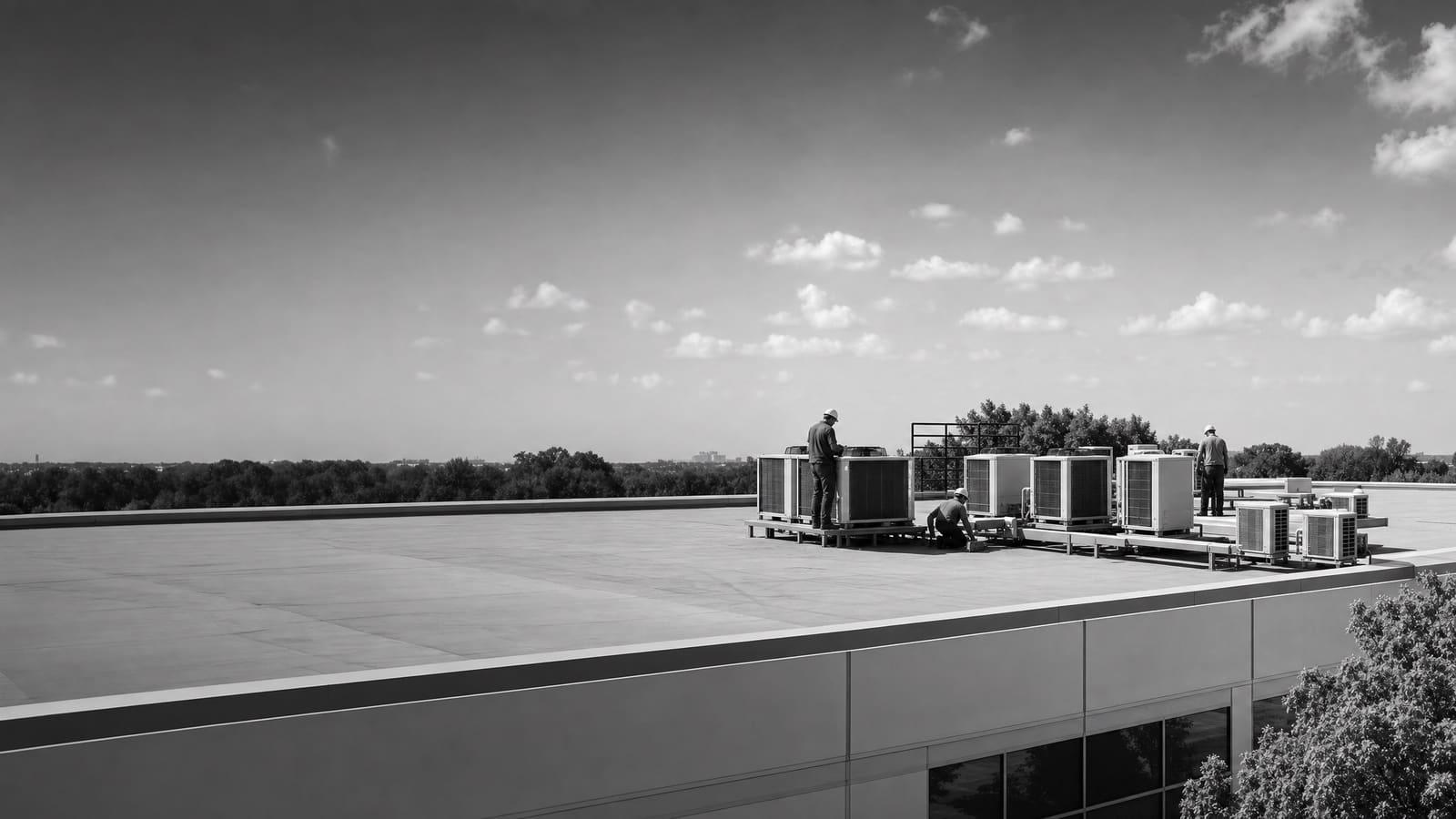
A commercial HVAC replacement covers the load calculation, equipment selection, removal and rigging of the old unit, curb and duct transitions, gas, electrical and control connections, permits, and startup commissioning. Replacement beats another repair once a unit is past roughly fifteen years and no longer holds the space, because old rooftop units waste an estimated $900 to $3,700 per unit each year in energy alone — money that keeps leaving after every repair invoice is paid.
A site review still has to confirm tonnage against how the space is used now, roof and curb condition, electrical capacity at the panel, and whether the existing unit meets current code as installed.
THREE PATHS
Three ways to handle a failing rooftop unit
Most buyers are choosing between three real options, and the right one depends on how much life the rest of the system has left and how much disruption the building can absorb.
Repair is the right call when a single component failed on a unit that still holds temperature and is still inside a reasonable service life. It stops being the right call when the repairs cluster, because each one buys time on a machine that is already the most expensive thing on the roof to run.
A controls retrofit sits between repair and replacement. Federal guidance treats advanced controls as a legitimate alternative: owners are encouraged to compare replacing an old unit against retrofitting it with advanced controls, then pick whichever makes better financial sense on that specific unit.
Replacement is the option that resets the clock. It is also the only one of the three that lets you correct sizing, choose the efficiency tier you actually want, and clear code items in a single visit.
WHAT MOVES THE NUMBER
The budget lines that actually swing
No two roofs price the same, so read a quote as a set of line items rather than one number. These are the lines that move most between two bids on the same building, and the ones worth asking about before you compare totals.
BUYING GUIDANCE
Choose the equipment before you choose a price
The equipment decision comes before the price decision, and it is mostly a decision about heating. A packaged rooftop unit with mechanical cooling and gas heat is still the default on most commercial roofs. A heat pump rooftop unit is technologically similar — same cabinet, same ductwork, same crane day — but it heats by running the refrigerant cycle in reverse instead of burning fuel.
The tradeoff is temperature. Heat pump heating efficiency falls as outdoor temperature drops, and at the low end it trends toward parity with plain electric resistance heat. That makes heat pump rooftop units strongest where winter heating is mild to moderate, which covers most of the West. Where sustained cold is a real risk, a dual-fuel unit that leans on the heat pump most of the year and hands off to gas in a cold snap protects both comfort and the bill.
Efficiency tier is the second decision. DOE's high-performance rooftop specification targeted units that cut energy use by up to half against the standard in place at the time, and more than twenty models now exceed it. That tier costs more on the equipment line. Whether it pays back depends on runtime hours, energy prices, and whether an incentive covers part of the gap — which is exactly why the tier belongs on the quote as its own line instead of buried in a lump sum.
SCOPE CHECK
What makes one replacement simple and another complicated
Two buildings on the same street can be a one-morning swap and a six-week project. The difference is rarely the unit itself. It is what the replacement touches on the way in.
LOWER COMPLEXITY
Like-for-like on a healthy curb
Same tonnage, same fuel, same footprint, and a curb that passes inspection. Connections land where they always did, the permit path is routine, and the visible disruption is a coned-off section of the lot for one morning.
HIGHER COMPLEXITY
Resized, re-fueled, or re-routed
Tonnage changes, the unit switches from gas heat to all-electric, or the footprint grows past the old curb. Now structural review, electrical capacity work, duct transitions, and a controls integration all have to be sequenced together.
BEFORE YOU BID IT
What a site review has to settle first
A quote is only as good as the walk that produced it. The first thing a site review should settle is load — not the nameplate on the failing unit, but what the space demands today. Occupancy, lighting, plug loads, and envelope work all move that number, and a twenty-year-old unit was sized for a building that no longer exists in the same form.
The second is infrastructure. Federal guidance on heat pump rooftop adoption is blunt about this: electrical capacity, physical constraints, and existing gas lines are make-or-break items, not details. If the panel cannot carry an all-electric unit, that is a service-side project with its own schedule and permit, and it has to be priced before anyone commits to equipment.
The third is availability. Lead time is part of the scope, not a footnote to it. A unit that is right on paper and twelve weeks out is a different decision in July than in October, and a contractor should say so at proposal time rather than after the deposit clears.
The last is the crane. Reach, staging, lot closure, and the weather call are the reason a swap feels like a parking inconvenience instead of a shutdown.
Four things to confirm on the walk
Calculated load against current use, not the old nameplate. Electrical capacity, gas line status, and physical constraints on the roof. Real lead times for every option quoted. Crane reach, staging, and how much of the lot closes, for how long.
OWNERSHIP MATH
Two things that decide the real cost of the unit
The purchase price is the part of the decision you see once. Operating cost is the part you see every month for the life of the equipment, and it is usually the larger number.
DOE puts the annual waste from an old, inefficient rooftop unit at roughly $900 to $3,700 per unit. The range is wide because runtime and rates differ, but the floor is high enough that a fleet of aging units is a real line on the P&L. Aggregate results back it up: more than 200 organizations upgrading over 43,000 rooftop units reported a combined $37 million in annual energy savings.
The second consideration is timing. Most facilities wait until a unit fails completely, needs constant service, or stops conditioning the space. Replacing proactively is often the smarter business move than replacement-on-failure, because a planned swap gets competitive bids, a chosen crane date, and an equipment option other than whatever happens to be in stock that week.
OPERATING COST
The unit you keep is not free
Rooftop units cool nearly half of all U.S. commercial floor space, and the ones past fifteen years old are where the waste concentrates. Every repair invoice buys time on a machine that is already expensive to run.
TIMING
Planned beats replacement-on-failure
A failure in season limits you to whatever is available and whoever can get a crane. A planned replacement lets you bid the work, pick the efficiency tier, and set a date that misses your busy season.
PHASING AND PROCUREMENT
Replacing a fleet without replacing it all at once
If you own more than one unit, the question stops being which unit to replace and becomes which order to replace them in. Age is the obvious sort, but runtime, repair history, and the load each unit serves matter more. The unit over a full kitchen or a server closet earns replacement ahead of the one over a storage bay, whatever the nameplates say.
Portfolio guidance from DOE treats this as a site-by-site evaluation rather than a blanket policy. Some buildings suit an all-electric conversion; others are better as dual-fuel or straight like-for-like, depending on climate, energy prices, building type, existing infrastructure, and whether qualified contractors and equipment are actually available in that market. Running that checklist per site keeps you from writing a standard your buildings cannot follow.
Procurement follows the same logic. Group replacements into one phase and you get better equipment pricing, one mobilization, and one permit cycle instead of three. Spread them across budget years and you protect cash flow but pay for the crane and the paperwork every time. There is no universally right answer, but the phasing call belongs in the conversation before the first quote, not after the second unit fails. Plan for the service side too: a mixed fleet ends up with more than one refrigerant in the building, and EPA rules govern handling and recovery on all of it.
QUOTE CHECKLIST
Five things a comparable quote has to show
Two bids are only comparable if they scope the same work. Before you line them up on price, make sure each one puts these five items in writing.
01
The load calculation behind the tonnage
Not the old nameplate. The sizing basis should be stated, so you can tell a right-sized replacement from a copied one.
02
Equipment model, efficiency tier, and lead time
A named model, a stated efficiency tier, and a real availability date for every option quoted.
03
Curb, structural, and duct transition work
Whether the new unit lands on the existing curb, what adapter it needs, and who signs off on the roof structure.
04
Rigging, permits, and inspections
The crane day, lot closure, mechanical and electrical permits, and inspections all inside the installed price.
05
Startup, commissioning, and documentation
Charge, airflow, and control settings verified against spec and documented, so the warranty and the comfort both hold.
Get a defensible number
Price the equipment and the building together.
Send the address, operating target, and target opening date. Flux will identify what must be verified before the project can be priced.
Get a free estimateQuestions
Straight answers.
How much does a commercial HVAC replacement cost?
There is no honest universal price, because tonnage, curb work, electrical scope, and crane access swing the number on the same building. What is well documented is the other side of the ledger: DOE estimates an old, inefficient rooftop unit wastes roughly $900 to $3,700 a year in energy. Price the replacement against that, not against the repair invoice alone.
When is replacement better than one more repair?
When repairs start clustering, when the unit is past about fifteen years, or when it no longer conditions the space adequately. DOE also treats an advanced controls retrofit as a legitimate middle option, which is worth comparing on a unit whose cabinet and coil still have real life left.
Should the replacement switch from gas heat to a heat pump?
It depends on your winter heating load, energy prices, and what the electrical service can carry. Heat pump rooftop units heat most efficiently in mild-to-moderate winters and are an appropriate solution across most of the West. Where sustained cold is a real risk, a dual-fuel unit keeps a gas backup behind the heat pump.
What usually sets the schedule on a replacement?
Equipment lead time, more often than the on-roof work. Ask for availability next to price on every option quoted, because the right unit twelve weeks out is a very different decision in July than it is in October.
What happens to the refrigerant in the old unit?
EPA Section 608 rules govern the handling and recycling of refrigerant in stationary air-conditioning and heat pump equipment. Recovery from the old unit before disposal is a compliance step, not an optional line item, and it should appear in the scope you are asked to approve.
Sources used for this guide
- [1]betterbuildingssolutioncenter.energy.gov — DOE Advanced Rooftop Unit Replacement Guidance
- [2]betterbuildingssolutioncenter.energy.gov — DOE Commercial Heat Pump Rooftop Unit Replacement Guidance
- [3]betterbuildingssolutioncenter.energy.gov — DOE High-Efficiency Commercial Rooftop Unit Toolkit
- [4]energy.gov — DOE Efficient Commercial Rooftop Air Conditioner Program
- [5]epa.gov — EPA Stationary HVAC Refrigerant Management