THE SHORT VERSION
What a commercial HVAC replacement actually includes
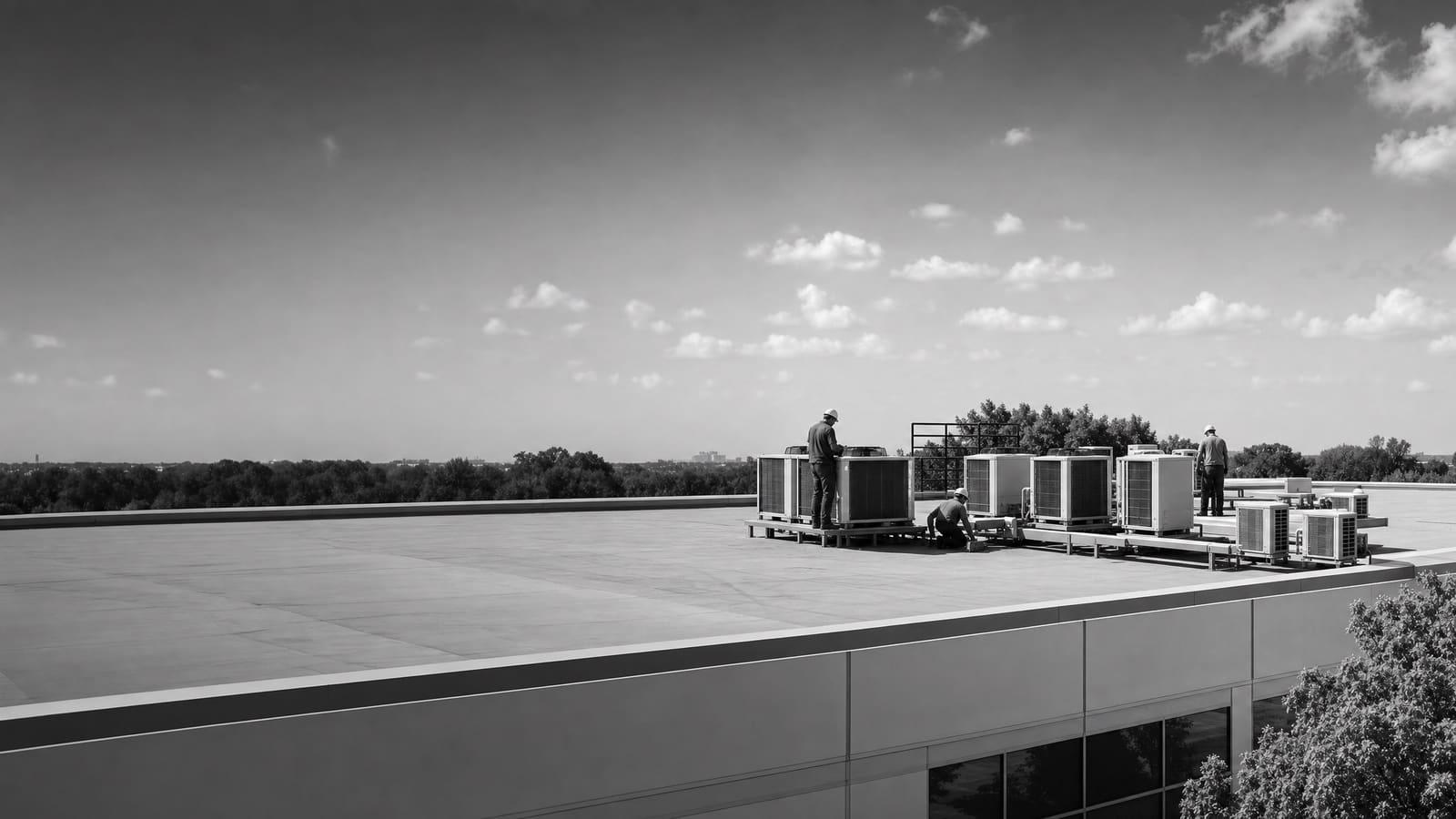
A commercial HVAC replacement covers a load check, equipment selection, the crane set, a curb adapter with new connections, and commissioning that proves the unit performs to spec. Replacement usually beats another repair once a unit is past about fifteen years and needs frequent service. Department of Energy work puts the annual waste from an old, inefficient rooftop unit at roughly $900 to $3,700 per unit, which is money that keeps compounding behind every patch.
A site review has to confirm tonnage against how the space is used now, roof and curb condition, electrical capacity at the panel, and whether the gas line stays or goes.
THREE PATHS
Three ways to handle a failing rooftop unit
Rooftop units condition close to half of all commercial floor area in the country, so this is the decision most facility owners face first. The right path depends on the age of the equipment, the heating load, and what the building's electrical service can carry.
Units past fifteen years are the usual candidates. Federal work with manufacturers produced high-efficiency rooftop models that cut energy use by up to half compared with the older standard, and more than twenty models now exceed that specification. That gap is why a proactive replacement often beats waiting for a failure, and sometimes beats a straight like-for-like swap at end of life.
The third path is real too. An owner can retrofit an existing unit with advanced controls instead of replacing it. When the cabinet and coil still have service life left, that can be the better financial call.
WHAT MOVES THE NUMBER
The lines that decide your installed price
These items move the installed number more than anything else on a proposal. Ask which ones your quote has actually priced and which are still assumptions waiting to become change orders.
EQUIPMENT CHOICE
Gas heat or a heat pump on the new unit
The clearest fork in a commercial replacement today is how the new unit heats. Heat pump rooftop units are close technical cousins of standard air-conditioning rooftops, with the added benefit of reverse-cycle heating. Federal guidance sorts them into dual-fuel, all-electric, and cold-climate versions, and the choice between them is a design decision, not a preference.
Climate drives it. As outdoor temperatures fall, heat pump heating efficiency drops toward parity with electric resistance heat, so heat pumps do their best work where winters are mild to moderate. Across most of the South and West, current units are capable of handling most or all of the winter heating demand. Southern buildings have still seen sharp cold snaps, including the Texas freeze of February 2021, so backup heat is something to size deliberately. Dual-fuel keeps a gas section for the coldest hours and lets the heat pump carry the rest of the season.
After climate comes infrastructure. Electrical capacity, physical constraints on the roof, and the existing gas lines all shape what is buildable. Equipment availability and contractor familiarity with the technology belong in the same conversation, because a design nobody can source or service on schedule is not really an option.
SIDE BY SIDE
What makes a job simple, and what makes it complicated
Two replacements with the same tonnage can land in very different places. The difference is almost never the unit itself.
LOWER COMPLEXITY
Straight swap on a healthy roof
The space is used the way it was when the unit was installed, the curb and structure are sound, the gas and electric stay as they are, and the crane has open lot to work from. Engineering is light and the scope is knowable before the quote.
HIGHER COMPLEXITY
New fuel, new footprint, new load
Occupancy or equipment changed, so the load has to be recalculated. Going all-electric puts the panel and service in play. A larger cabinet means structural review, and tight access turns the crane plan into the schedule driver for the whole project.
SCOPING
What a site review has to confirm
A quote is only comparable once someone has been on the roof. The load check comes first, and it should be built from how the space is used today: occupancy, plug loads, hours of operation, and what the envelope actually does. A twenty-year-old nameplate describes a building that may no longer exist.
Then the physical constraints. Roof structure and curb condition decide whether a curb adapter is enough or whether framing work is coming. Access decides the crane: where it sets up, what it has to reach over, and how many stalls come out of service for the morning.
The service side is where the surprises live. Electrical capacity at the panel matters most when the replacement drops gas heat, because the new unit may want more current than the old one ever pulled. Existing gas lines need a decision, not an assumption. Equipment availability belongs in the same conversation, because a unit that ships in weeks and a unit that ships in months are not the same purchase even at the same price.
Before the quote is real
Ask the contractor to write down what was verified on site and what is still an assumption. Assumptions are where change orders come from, and every one of them is cheaper to resolve before the crane is on the calendar.
OWNERSHIP
Two things owners underestimate
The install is one morning. The consequences run for the next fifteen or twenty years, and they show up in two places most often: how the new unit fits alongside everything else on the roof, and whether the replacement was chosen or forced. Both are worth thinking through before the purchase order, because neither is fixable afterward without spending again.
MIXED FLEETS
One new unit changes your service plan
New equipment does not always share refrigerant, parts, or controls with the units beside it. Refrigerant handling and recovery in stationary equipment is federally regulated, so a mixed roof needs a service contract and a spare-parts strategy that account for more than one generation of hardware.
TIMING
Chosen replacement beats forced replacement
Waiting until a unit fails completely removes every option that saves money: efficiency tier, fuel choice, scheduling around your operating hours, and competitive procurement. Proactively replacing an inefficient unit is often the better business move, and it is the only version of this project you get to plan.
PLANNING AHEAD
Phasing, procurement, and what the unit costs to own
If you have more than one aging unit, treat them as a program rather than a series of emergencies. Sequencing replacements lets you standardize on equipment your service team already knows, spread capital across budget years, and time each swap around the seasons when the space can tolerate the work. It also gives you leverage on price and lead time that a single panicked order never will.
The savings case is well documented at scale. More than two hundred public and private organizations working through the federal rooftop unit campaign have upgraded over forty-three thousand units, and those upgrades save a combined thirty-seven million dollars a year on energy bills. That is the argument for looking past the lowest installed price toward what the unit costs to run.
Incentives can improve the math, and they can also disappear. Utility and program offers change, and some have already expired. Confirm that any rebate or credit in your budget is open and funded as of today before you count it, and get the application requirements in writing, because many programs need paperwork filed before the equipment is ordered rather than after it is running.
THE CHECKLIST
Five things a comparable quote should show
If two proposals are hard to compare, it is usually because one of them is missing something on this list. Ask for all five in writing before you decide.
01
Tonnage, efficiency tier, and heating type
The exact model and how it heats, not just a capacity and a price.
02
Equipment availability
A real ship window for that specific unit, stated next to the number.
03
Curb, structural, and roof scope
Whether an adapter covers it, and what happens if the inspection says otherwise.
04
Rigging, permits, and inspections
Who owns the crane day, the closures, and the approvals, priced inside the total.
05
Commissioning and documentation
Charge, airflow, and controls verified against spec, with the results handed to you.
Get a defensible number
Price the equipment and the building together.
Send the address, operating target, and target opening date. Flux will identify what must be verified before the project can be priced.
Get a free estimateQuestions
Straight answers.
When is replacement better than one more repair?
The usual trigger is a unit past about fifteen years that no longer holds the space, needs frequent service, or has already failed once this season. Older units waste a meaningful amount of energy every year, so repeat repairs stack on top of a bill that keeps running.
Should you replace like-for-like or resize the unit?
Confirm the load either way. If the space is used the way it was when the old unit went in, like-for-like is often right. If occupancy, equipment, or hours changed, sizing to today's use fixes comfort problems the old unit could never solve.
Is a heat pump rooftop unit a good fit here?
Often, yes. Heat pumps are most efficient in mild to moderate winters, and across most of the South current units can carry most or all of the heating demand. The open questions are electrical capacity, backup heat for cold snaps, and whether dual fuel makes more sense than all-electric.
What does a controls retrofit do instead of replacement?
Advanced controls on an otherwise healthy unit improve how it runs without a crane day or new equipment. It is the lower-capital option, and it is worth pricing alongside replacement whenever the cabinet and coil still have service life.
Who handles the crane, permits, and refrigerant?
The installing contractor should own the rigging plan, lot coordination, permits, inspections, and recovery of refrigerant from the old unit, all inside the installed price. Refrigerant handling is federally regulated, so confirm it is in the scope before you sign.
Sources used for this guide
- [1]betterbuildingssolutioncenter.energy.gov — DOE Advanced Rooftop Unit Replacement Guidance
- [2]betterbuildingssolutioncenter.energy.gov — DOE Commercial Heat Pump Rooftop Unit Replacement Guidance
- [3]betterbuildingssolutioncenter.energy.gov — DOE High-Efficiency Commercial Rooftop Unit Toolkit
- [4]energy.gov — DOE Efficient Commercial Rooftop Air Conditioner Program
- [5]epa.gov — EPA Stationary HVAC Refrigerant Management