THE DIRECT ANSWER
What a commercial HVAC replacement actually includes
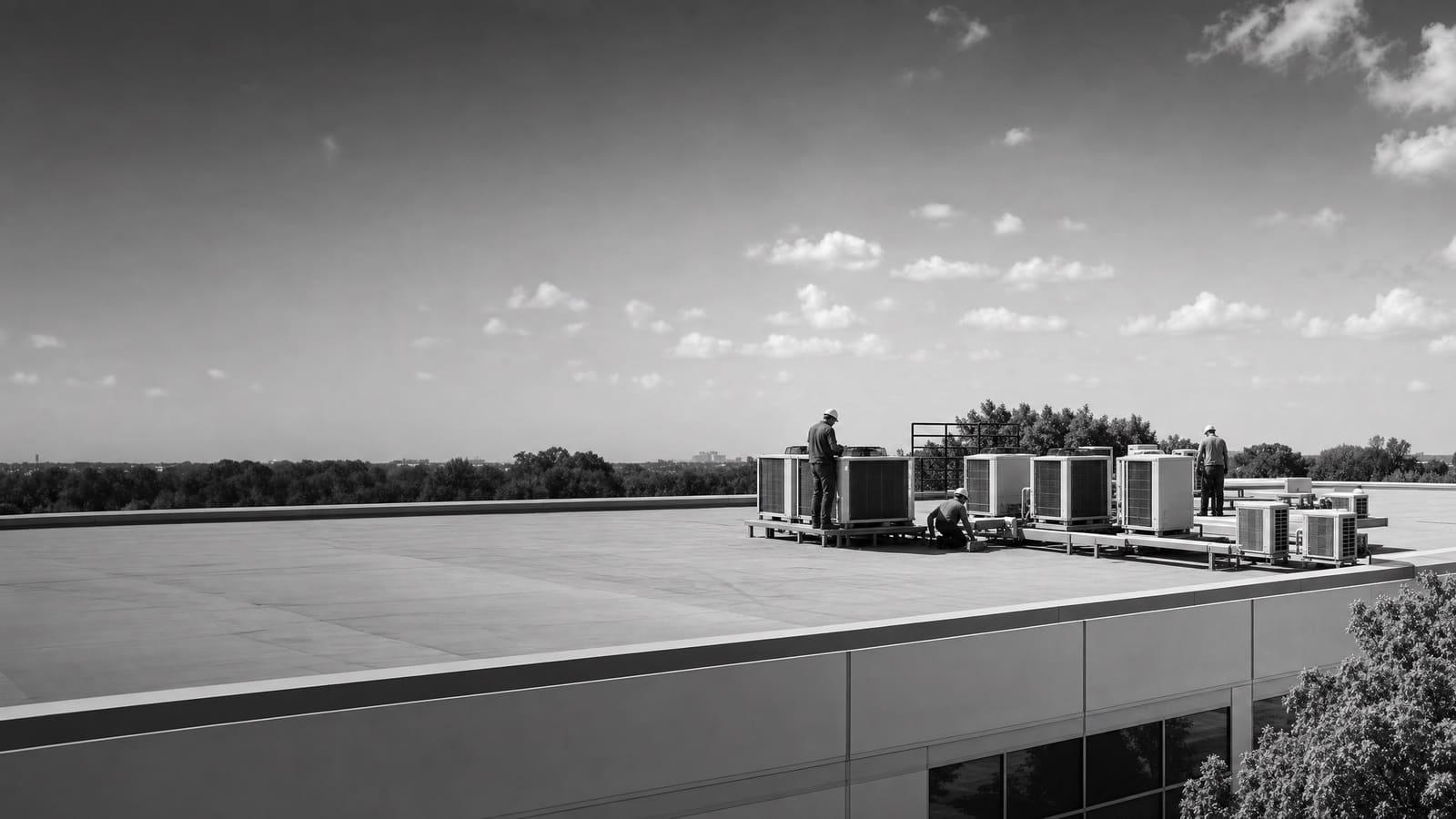
A commercial replacement covers a load check against how the building is used today, equipment selected against real availability, permits, rigging and the roof set, a new curb or curb adapter, gas and electrical and refrigerant connections, controls integration, and commissioning. Replacement usually beats another repair once a unit is past fifteen years and the invoices keep repeating. DOE puts the annual waste from an old, inefficient rooftop unit at $900 to $3,700.
A site review has to verify tonnage against current use, curb and structural condition, available electrical capacity, crane reach across the lot, and how the old unit's refrigerant will be recovered.
THREE WAYS TO GO
Three replacement paths worth pricing
Most buildings land on one of three paths, and the right one depends on how long you plan to hold the property and what the unit has to heat with.
A like-for-like swap is not automatically the cheap answer. DOE's High-Performance Rooftop Unit Challenge asked manufacturers for units that cut energy use by up to half against the standard of the time, and manufacturers responded with more than twenty models that exceeded it. A federal minimum-efficiency standard followed, so today's baseline equipment already sits well above what a twenty-year-old cabinet represents. Across DOE's Advanced RTU Campaign, more than 200 organizations upgraded over 43,000 rooftop units and now save a combined $37 million a year on energy bills.
There is a fourth option worth pricing when the cabinet itself is still sound: retrofitting the existing unit with advanced controls instead of replacing it. DOE treats that as a legitimate branch, decided unit by unit on which one makes better financial sense.
WHAT MOVES THE PRICE
The budget lines that actually swing
No two roofs price the same, so compare bids line by line instead of on the bottom number. These are the items that move most between two contractors looking at the same building.
IN PRACTICE
One more repair, or replace it now
The most expensive version of this project is the one nobody chooses. DOE's framing is blunt: facility managers often delay buying a new rooftop unit until the existing one no longer conditions the space, needs constant service, or fails outright. Replacing on failure removes every good option at once. You take whatever is on the shelf, at whatever the crane costs that week, in whatever weather August hands you.
Age is the cleanest first filter. Units past fifteen years waste substantial energy against current models, and DOE puts the annual bleed from an old, inefficient rooftop unit between $900 and $3,700 apiece. Set that against the repair invoices from the last two seasons. If a building carries six aging units, the arithmetic tends to decide for you before anyone argues about it.
The second filter is whether the space still matches the equipment. Twenty years changes occupancy, plug loads, lighting heat, and sometimes the envelope itself. A load calculated from today's use is the only way to know whether the nameplate on that roof is right, too big, or too small. Oversized units short-cycle, dehumidify poorly, and wear out faster. That is a comfort problem no service contract will ever fix.
COMPLEXITY CHECK
What keeps this simple and what makes it hard
Two Avondale buildings can need identical tonnage and price thousands apart. Before you compare bids, work out which side of this line your roof sits on, because it explains most of the spread.
LOWER COMPLEXITY
Straight swap conditions
Same tonnage landing on the existing curb, a lot with clear crane reach, electrical service already sized for the unit, no change of use in the space below, and a common cabinet that sits in regional stock.
HIGHER COMPLEXITY
Where scope and schedule grow
Growing tonnage, a curb needing structural review, a fuel switch that adds electrical work, occupied tenants with fixed hours, roof access blocked by parking or overhead lines, or a special-order cabinet with a long lead time.
BEFORE THE QUOTE
What a real site review checks
A quote written off a phone call is a guess with a number attached. The review that makes a bid trustworthy walks the roof and then walks the electrical room.
DOE's own checklist for rooftop decisions runs through the items that quietly control scope: available electrical capacity, physical constraints on the roof, existing gas lines, equipment availability in your market, and whether contractors nearby actually work on the technology you are considering. Any one of those can turn a simple replacement into a phased project. Electrical capacity is the usual surprise. If a gas-heat unit is being replaced with a heat pump, the panel and feeder now have to carry heating load that used to arrive through a pipe.
Refrigerant is the item people forget. EPA regulations under Section 608 of the Clean Air Act govern how refrigerant is handled and recovered from stationary air conditioning and heat pump equipment. Recovery from the removed unit is regulated work with documentation behind it, so it belongs on the quote as a named line rather than buried in labor hours.
Access is the third. Crane reach, staging space, and how long stalls close are schedule questions before they are price questions.
Five things to confirm before you sign
Panel capacity and feeder size at the unit. Curb condition and any structural review. Crane reach and the hours the lot is closed. Refrigerant recovery named as its own line. Equipment availability with a date on it, not a range.
OWNERSHIP MATH
Two questions that outlast the install
The installation is a week. The consequences run fifteen to twenty years. Two questions shape which unit you should actually buy, and neither one appears on a bid sheet.
The first is who pays the energy bill. In a triple-net lease, the owner buys the equipment while the tenant carries the operating cost, which quietly pushes every decision toward the cheapest cabinet that fits the curb. When the same party pays both, efficiency tier stops being a line item and starts being an investment with a return.
The second is fleet consistency. A building with six rooftop units and four different refrigerants is expensive to service and slow to repair, no matter how reasonable each individual purchase looked on the day it was made.
WHO PAYS THE BILL
Lease structure changes the right unit
If the tenant pays utilities and the owner buys the equipment, the incentive splits and efficiency loses. Settle that before the spec is written, not after the low bid arrives. DOE's $900 to $3,700 annual waste figure lands on whoever holds the meter.
FLEET STRATEGY
Replace on a plan, not on failure
Buildings with several units do better sequencing replacements across budget years than reacting to whichever one dies first. A plan buys real equipment selection, competitive bids, and off-hours crane time instead of emergency pricing.
PHASING AND PROCUREMENT
Sequencing a multi-unit roof
If a building carries more than two rooftop units, treat this as a program rather than a purchase. Rank the units by age, service history, and how much occupied space each one serves. The oldest unit over the busiest area is almost always the first to replace, even when a newer unit is the one complaining loudest right now. Ranking by nuisance instead of by exposure is how buildings end up replacing the wrong box.
Procurement is where schedule risk lives. Equipment availability is one of the factors DOE names in its rooftop decision guidance, and it is not a footnote. A unit that ships in two weeks and a unit that ships in ten produce completely different summers. Ask for availability in writing beside the price, and ask what the alternate model is if the first choice slips.
On lifetime cost, run the comparison across the life of the unit rather than the year you buy it. The organizations in DOE's Advanced RTU Campaign upgraded more than 43,000 rooftop units and together save $37 million a year on energy. Savings at that scale come from the efficiency tier chosen at purchase. Nothing done after the crane leaves recovers a decision made on the bid sheet.
QUOTE CHECKLIST
Five things every bid should state
Two quotes are only comparable when they describe the same job. Ask each contractor to put these five in writing, then compare. When one bid comes in dramatically cheaper, one of these five is usually the reason.
01
Model, tonnage, and efficiency tier
The exact unit, not a category. The efficiency rating belongs next to the model number so two bids can be read on the same basis.
02
Curb, structural, and roof scope
New curb or adapter, any structural review triggered by size, and how the penetration and flashing get handled.
03
Rigging and lot closure plan
Crane size, staging area, how many stalls close, and the hours the lot is affected.
04
Refrigerant recovery and disposal
Section 608 handling of the old unit's charge, documented, plus what happens to the removed equipment.
05
Commissioning and ship date
Verified startup with charge, airflow, and controls documented, and a written availability date for the unit.
Get a defensible number
Price the equipment and the building together.
Send the address, operating target, and target opening date. Flux will identify what must be verified before the project can be priced.
Get a free estimateQuestions
Straight answers.
When does replacing a rooftop unit beat one more repair?
Age is the first filter. DOE notes that rooftop units over fifteen years old waste substantial energy against current models, and puts the annual waste of an old, inefficient unit between $900 and $3,700. Compare that against two seasons of repair invoices and the answer usually stops being close.
Should we replace like-for-like or resize the unit?
Confirm the load either way. If the space and how it is used have not changed, like-for-like is often correct and is the fastest path back in service. If occupancy, plug loads, or the envelope changed, sizing to today's use fixes comfort problems the old unit created.
Is a heat pump rooftop unit a real option for a commercial building here?
DOE's guidance says today's heat pump rooftop units suit most of the U.S. South and West and can cover most or all winter heating demand. On a specific roof the deciding factors are electrical capacity, local electricity and gas prices, equipment availability, and whether contractors nearby service the technology.
Do we have to deal with the refrigerant in the old unit?
Yes. EPA regulations under Section 608 of the Clean Air Act govern the handling and recovery of refrigerant in stationary refrigeration, air conditioning, and heat pump equipment. Recovery from the removed unit is regulated work, so ask for it as a named line on the quote.
Is full replacement the only option?
No. DOE frames it as a choice: replace the old unit with a more efficient one, or retrofit the existing unit with advanced controls, depending on which makes better financial sense for that unit. A cabinet still in sound condition can justify the controls path.
What controls the schedule on a commercial installation?
Equipment availability, almost always. The on-roof work for a packaged unit is short and predictable once the crane is scheduled. What moves the date is the ship time on the unit you selected, which is why availability belongs next to the price rather than in a follow-up email.
Sources used for this guide
- [1]betterbuildingssolutioncenter.energy.gov — DOE Advanced Rooftop Unit Replacement Guidance
- [2]betterbuildingssolutioncenter.energy.gov — DOE Commercial Heat Pump Rooftop Unit Replacement Guidance
- [3]betterbuildingssolutioncenter.energy.gov — DOE High-Efficiency Commercial Rooftop Unit Toolkit
- [4]energy.gov — DOE Efficient Commercial Rooftop Air Conditioner Program
- [5]epa.gov — EPA Stationary HVAC Refrigerant Management