THE SHORT VERSION
What a commercial HVAC replacement actually covers
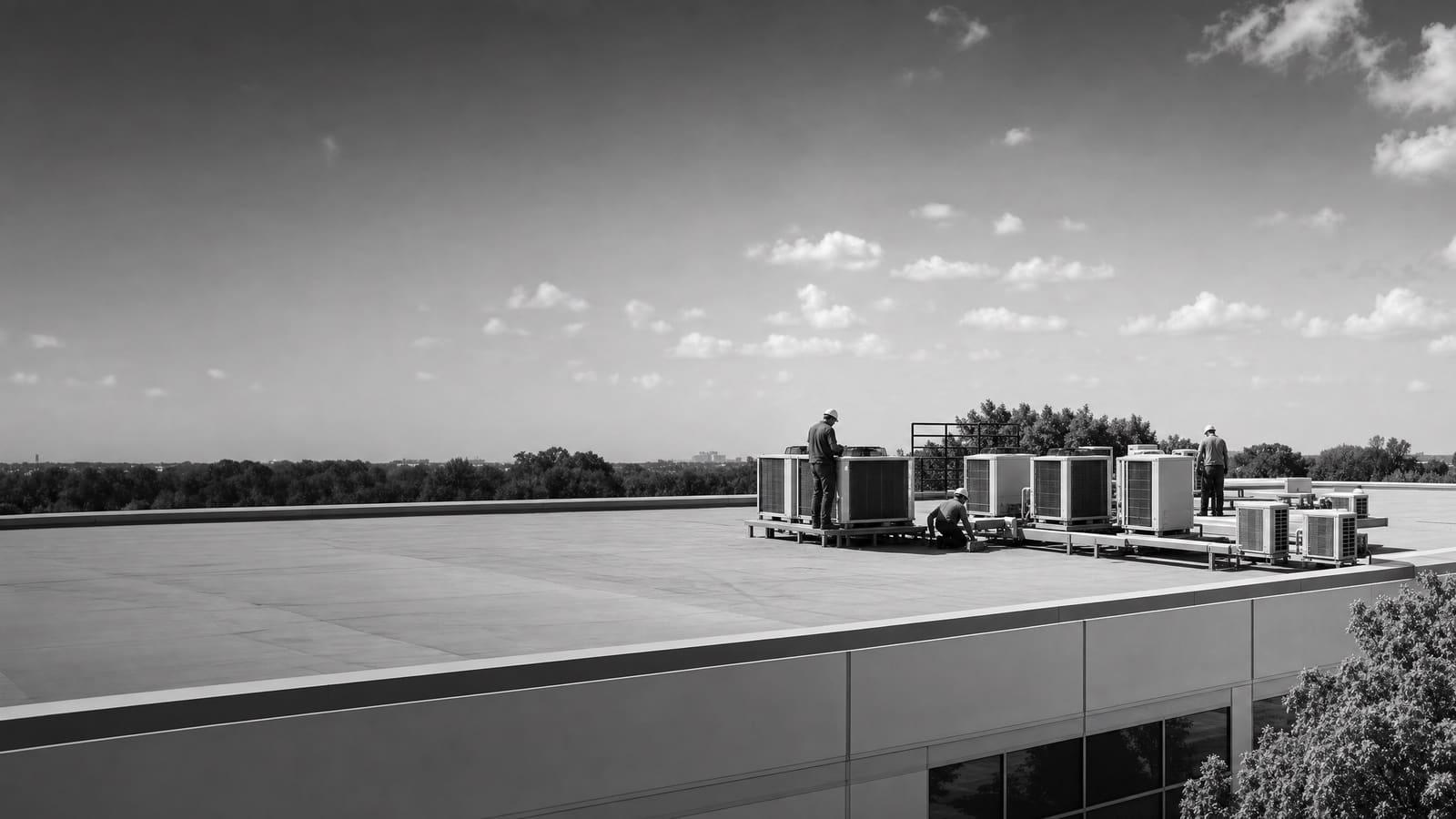
A commercial HVAC replacement is a confirmed load calculation, an equipment selection, a rigging and set day, curb or curb-adapter work, gas, power, and refrigerant connections, controls integration, permits, and commissioning. Replacing beats another repair once failures start clustering on an aging unit. Past roughly fifteen years, inefficient rooftop equipment wastes an estimated $900 to $3,700 per unit each year in energy alone — often more than the repair you were about to approve.
A site review still has to confirm tonnage against current occupancy, the curb and roof structure, available electrical capacity, and crane access before any price on that list is real.
THREE REAL OPTIONS
Replace like-for-like, right-size, or upgrade the controls
When a rooftop unit starts failing, the right move depends on how much of the system is actually worn out. A like-for-like swap is the fastest path back to conditioned space and the cheapest to engineer. A right-sized, high-efficiency replacement costs more on day one and pays back monthly; the high-performance specification developed for this class of equipment targeted units that cut energy use by up to half against the older standard. A controls retrofit leaves a sound unit in place and improves fan and economizer operation instead. Owners in the national rooftop upgrade campaign were given exactly that choice — replace the equipment or retrofit controls — based on which made better financial sense. The rule of thumb holds: replace when the equipment is spent, retrofit controls when it isn't.
WHAT MOVES THE NUMBER
The lines that decide what a replacement costs
These are the items that separate two quotes on the same building. Ask for each to be priced on its own line so you can see what is equipment and what is the work around it.
CHOOSING EQUIPMENT
Pick the machine before you pick the price
The equipment decision usually reduces to one question: replace with the same kind of unit, or move the heating to a heat pump. Both are legitimate. What settles it is the building, not a preference.
A heat pump rooftop unit is a close cousin of a standard air-conditioning unit — the difference is that it also heats by running the cycle in reverse. Federal guidance on adopting them points at a short list of checks: the heating load your climate zone actually creates, local electric and gas prices, building type, equipment availability, and the infrastructure already on the roof, meaning electrical capacity, physical space, and existing gas lines. Heat pump heating efficiency falls as outdoor temperature drops and eventually approaches electric resistance heat, which is why all-electric, dual-fuel, and cold-climate models exist as separate choices rather than one answer.
For a building that carries a real winter heating load, dual-fuel or a cold-climate model is the honest comparison against a like-for-like gas unit — not a basic heat pump. Have both priced with operating cost shown, and confirm the installer has actually put in the version you are considering.
SIDE BY SIDE
What makes one replacement simple and another complicated
Two replacements on the same street can price very differently. Complexity comes from what has to change around the unit, not from the unit itself.
STRAIGHTFORWARD
Lower-complexity replacement
Same tonnage on an existing curb, adequate electrical capacity already at the roof, open parking for the crane, and a building on a normal weekday schedule. Set in a morning, connected and commissioned the same day.
MORE INVOLVED
Higher-complexity replacement
A change in tonnage or fuel, a heavier unit that needs structural review, panel work for all-electric heating, tight crane access, or a facility that cannot lose conditioning during business hours and needs temporary cooling and night work.
SCOPING
What a site review has to confirm before the price is real
Almost everything that goes wrong on a rooftop replacement was knowable during the site visit. The load is the first item. Twenty-year-old tonnage reflects the occupancy, lighting, and equipment of twenty years ago, and a building that has been re-tenanted since then is often carrying a unit that is too large, not too small. Oversized equipment short cycles, handles humidity poorly, and produces the comfort complaints that later get blamed on the new install.
The second item is the roof. The visit should confirm curb dimensions, whether an adapter or a new curb is needed, and whether the structure supports a heavier unit. The third is power and fuel: available capacity at the panel, the condition of the existing gas run, and any disconnect work.
The fourth is access. Crane reach, staging area, which stalls close, and how long the lot is affected are scheduling questions that belong in the price rather than in a change order. Ask for photographs and measurements from the visit, not a number produced over the phone.
Settle this before the equipment is ordered
Get the load calculation, curb dimensions, electrical capacity, and rigging plan in writing. A quote produced without a roof visit is a placeholder, and the corrections almost always arrive as change orders after the unit has already shipped.
BEYOND THE INSTALL
Two decisions that outlive the crane day
Two questions outlast the install. The first is how the new unit fits the service plan you already have. The second is whether you keep replacing equipment when it dies or start replacing it on a schedule you control.
Both are cheaper to answer before the crane day than after. Federal guidance is direct that waiting for total failure is usually the most expensive path, because an emergency removes every option except whatever happens to be in stock. Neither question changes the price of this project much. Both change what the next five years cost.
OPERATING
Refrigerant and service planning
New equipment arrives on current refrigerants. Federal rules govern how refrigerant is handled, recovered, and recycled when the old unit comes off, and a mixed fleet means your service contract and spare-parts plan now cover more than one refrigerant.
OWNERSHIP
Planned replacement vs. replace on failure
Managers commonly delay until a unit fails outright or needs constant service. Replacing proactively at end of useful life is usually the better business decision, because you keep control of timing, equipment choice, and whether the efficiency upgrade is worth it.
PLANNING AHEAD
Phasing, procurement, and what the unit costs over its life
If you own more than one rooftop unit, sequence them instead of waiting for each to fail. Rank the fleet by age, repair history, and how much of the building each unit serves, then move the worst one or two per budget year. That turns an unpredictable emergency expense into a line you can plan, and it lets you buy equipment as a series rather than as a panic order.
Procurement is where schedule risk lives. Ask for availability next to price. A slightly less efficient unit sitting in a regional warehouse can beat a better unit that is months out when the building is uncooled in July. Order curb adapters at the same time as the equipment — they are frequently the item that holds up a set date.
Lifetime cost is what justifies the whole exercise. Inefficient rooftop units waste an estimated $900 to $3,700 each per year, and the high-efficiency specification written for this equipment aimed at cutting energy use by up to half against the older standard. Across the national upgrade campaign, more than 200 organizations replaced or retrofitted over 43,000 units and reported roughly $37 million in combined annual energy savings.
THE QUOTE
Five things a comparable quote should show
A quote you can hold next to another quote shows the work, not just a total. These five items are what make two proposals readable side by side.
01
The load calculation
Tonnage justified by current occupancy and use, not copied off the old nameplate.
02
Model, efficiency, and availability
The exact unit, its efficiency rating, the heating type, and the lead time it actually ships on.
03
Curb, structure, and rigging
Curb adapter or new curb, any structural work, crane size, and how long the lot is affected.
04
Connections and controls
Electrical, gas, and refrigerant work, plus integration with the controls you already run.
05
Permits, commissioning, and records
Who pulls permits, what startup verifies, and the commissioning documentation that keeps the warranty intact.
Get a defensible number
Price the equipment and the building together.
Send the address, operating target, and target opening date. Flux will identify what must be verified before the project can be priced.
Get a free estimateQuestions
Straight answers.
When does replacing a rooftop unit beat repairing it again?
When repairs start clustering and the unit is past roughly fifteen years. Old, inefficient rooftop equipment wastes an estimated $900 to $3,700 per unit each year in energy, which frequently exceeds the repair sitting in front of you. A failed compressor on a unit at end of life is a replacement decision, not a repair decision.
Should you replace like-for-like or resize the unit?
Confirm the load either way. If the space, occupancy, and the equipment inside it have not changed, like-for-like is often correct and simplest. If the building was re-tenanted or the use changed, a fresh load calculation usually shows the old unit was oversized, which is where humidity and comfort complaints come from.
Is a heat pump rooftop unit the right choice for a commercial building here?
It depends on your winter heating load, your electric and gas rates, and what is already on the roof. All-electric, dual-fuel, and cold-climate heat pump units are three different answers. Where winters run cold, dual-fuel or a cold-climate model is the fair comparison against a gas unit. Check electrical capacity before ordering.
What does the crane day actually involve?
The old unit is disconnected and its refrigerant recovered, the crane sets up in a coned section of the lot, the old unit comes off, and the new one lands on the curb or adapter. Connections, startup, and commissioning follow. The planning takes weeks; the visible disruption is usually one morning.
Do controls upgrades make sense instead of a full replacement?
Yes, on a unit with real service life left. Advanced fan and economizer controls capture part of the savings without the capital cost of new equipment. Owners in the national rooftop upgrade program were offered exactly that choice — replace the unit or retrofit controls — based on which made better financial sense.
Sources used for this guide
- [1]betterbuildingssolutioncenter.energy.gov — DOE Advanced Rooftop Unit Replacement Guidance
- [2]betterbuildingssolutioncenter.energy.gov — DOE Commercial Heat Pump Rooftop Unit Replacement Guidance
- [3]betterbuildingssolutioncenter.energy.gov — DOE High-Efficiency Commercial Rooftop Unit Toolkit
- [4]energy.gov — DOE Efficient Commercial Rooftop Air Conditioner Program
- [5]epa.gov — EPA Stationary HVAC Refrigerant Management