THE SHORT ANSWER
What a commercial HVAC replacement in Athens includes
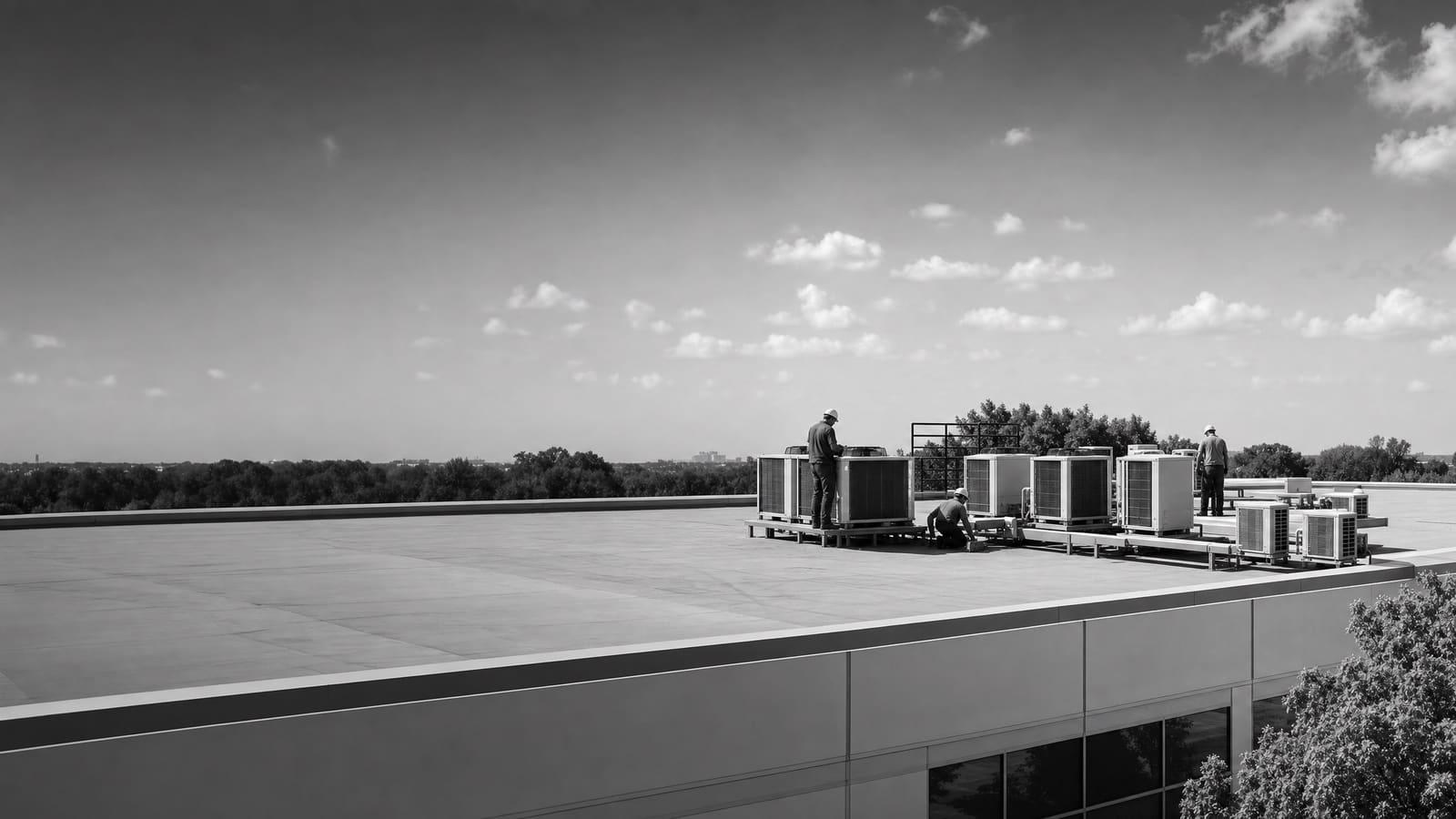
A commercial HVAC replacement covers the load check, equipment selection, permits, curb and rigging work, the swap, and commissioning. Replacement beats another repair once a unit passes about 15 years and starts stacking service calls. Department of Energy figures put the annual energy waste of an old, inefficient rooftop unit at roughly $900 to $3,700 — that number, not the last repair invoice, usually decides it.
A site review still has to confirm the curb and roof structure, electrical capacity at the unit, gas line status, and crane access before any of that price is real.
THREE WAYS TO GO
Three operating choices for the replacement
Most commercial replacements come down to three options, and they split well before the crane shows up. A like-for-like swap keeps the same fuel and roughly the same tonnage, often on the same curb, so it is the fastest path back to conditioned space. A high-efficiency upgrade uses the same footprint with a better machine; the federal high-performance rooftop specification was written around units that cut energy use by up to half against the older standard, and that class of equipment is now widely available. A heat pump rooftop unit replaces gas heat with reverse-cycle heating, and federal guidance treats today's units as a fit for most of the South, where winters stay mild to moderate. The catch is infrastructure. Heat pump units lean harder on electrical service, so panel capacity and feeder size get confirmed before a model is chosen, not after.
WHAT MOVES THE NUMBER
Budget lines that decide the installed price
No two roofs price the same, and the equipment is rarely the line that surprises people. These are the items that move a commercial HVAC installation quote up or down, ordered roughly by how often they change the total.
BUYING GUIDANCE
How to compare replacement options without guessing
Start by separating the two questions a quote actually answers: what the building needs, and what it costs to put it there. Sizing from the old nameplate carries forward every mistake the last twenty years built in. Occupancy changes, plug loads change, and envelopes get worked on. A load calculation against how the space is used today is what makes one quote comparable to another.
Then ask for options priced side by side rather than one number. A like-for-like replacement and a higher-efficiency or heat pump option on the same roof, each with an installed price and a real lead time, is a decision you can actually make. Federal guidance is blunt about the alternative: facility managers tend to wait until a unit fails or stops holding the space, and replacing on failure is usually the most expensive way to buy equipment.
The last thing to weigh is timing. A unit that is still running gives you leverage. You can order into a lead time, schedule the crane on a slow day, and choose the unit you want instead of the one on the shelf. A unit that already failed hands all of that to whatever happens to be available.
COMPLEXITY CHECK
What makes a replacement simple or hard
Two buildings with the same tonnage can be very different projects. The difference is almost always access, infrastructure, and how much the replacement is allowed to change.
LOWER COMPLEXITY
Same fuel, same footprint
The new unit matches the old curb, the electrical service already carries it, gas is staying, and the crane can reach from the lot. Permits are straightforward and the on-site work lands in a single day.
HIGHER COMPLEXITY
Bigger unit or a fuel change
Tonnage grows, the curb needs an adapter and a structural look, or a switch to electric heat needs panel and feeder work. Add a tight site with no crane staging and the project becomes a phased schedule, not a morning.
SITE REVIEW
What the site walk has to confirm
The site walk is where a rough number becomes an installed price. Four things get confirmed, and skipping any of them is how change orders happen.
Structure and curb come first. The roof has to carry the new unit and the curb has to accept it, which means measuring rather than trusting the old submittal. Electrical is next. Federal heat pump guidance names electrical capacity and physical constraints as the infrastructure issues that most often decide whether an all-electric unit is viable at a given site, and that check belongs before equipment selection, not after the order lands.
Then access. Where the crane sets up, how far it has to reach, which stalls close, and for how long. On a tight lot this can change the equipment decision itself, ruling out one large unit in favor of a different configuration.
Last is what leaves the roof. Refrigerant from the old unit has to be recovered and handled under federal rules by certified technicians, and that path should appear on the quote rather than as a line you discover later.
The four checks before a price is real
Roof structure and curb fit, electrical capacity at the unit, crane reach and lot closure time, and refrigerant recovery for the old equipment. A quote written without walking those four is an estimate wearing a price tag.
IN ATHENS
Permits and the Georgia replacement timeline
In Georgia, a commercial rooftop replacement is permitted work, not maintenance. Building departments require a permit before any mechanical system is replaced, altered, or relocated, and the electrical work usually rides on its own permit. Swapping a minor part that does not change the equipment's approval is exempt. Changing the unit is not.
Two timing rules shape the schedule. Emergency replacement can proceed: when equipment has to be replaced in an emergency, the permit application is filed the next business day rather than before the crew arrives. And a permit pulled too early can go stale — the adopted code treats an application as abandoned if work has not commenced within six months of filing. On a long-lead unit, that argues for pulling the permit against a confirmed ship date instead of the day you sign.
Ask before the order, not after
Confirm with the building department which permits your replacement needs and what the swap has to bring up to current requirements. Your contractor should carry both the permits and the inspections inside the installed price. Get that in writing.
OWNERSHIP VIEW
Two things owners weigh past the install
The install is one week of attention. The unit is on the roof for fifteen years or more, so two ownership questions deserve a decision at purchase rather than a discovery later.
The first is what the equipment costs to run. Rooftop units condition close to half of all commercial floor area in the country, and the aging ones are the reason so many buildings carry an energy bill nobody can explain. The second is what happens to the rest of the fleet. New equipment arrives on newer low-global-warming-potential refrigerants, which changes nothing about day-one operation but does change service planning for a building running a mix of old and new units.
OPERATING COST
The bill after handoff
An old, inefficient rooftop unit wastes roughly $900 to $3,700 a year on its own. Across several units, that recurring number is often larger than the gap between the cheap quote and the good one.
FLEET PLANNING
Mixed refrigerants on one roof
Refrigerant handling and recovery are federally regulated, and your service contract now spans two generations of equipment. Decide who stocks what before the first summer call, not during it.
PHASING AND PROCUREMENT
Replacing more than one unit
Buildings rarely have one aging unit. They have four, and three of them went in the same year. That is a procurement problem more than an engineering one, and it pays to treat it that way.
Phasing by condition beats phasing by calendar. Rank the units by age, repair history, and how much of the building each one actually serves, then replace in that order as budget allows. Units past fifteen years belong at the top of the list, because that is where the energy waste and the service calls concentrate. The unit over the space that cannot go down in August belongs near the top too, for a different reason.
Buying more than one at a time changes the economics. A single crane mobilization covering two or three units costs less than three separate crane days, and you get one permit cycle, one commissioning visit, and one set of controls work. The national upgrade campaign that has moved more than 43,000 rooftop units to high-efficiency equipment reports about $37 million in combined annual energy savings, and that math is built on portfolios, not single swaps.
Set the schedule against your slow season and your capital calendar. Both are more flexible than a failed compressor in July.
THE QUOTE
Five things a comparable quote shows
Two quotes are only comparable if both show the same five things. If one of them is missing, you are comparing a price to a guess. Ask for all five in writing before you sign anything.
01
The load calculation
Tonnage justified by how the space is used today, not copied off the old nameplate.
02
Equipment model and availability
Exact model, efficiency tier, and a real lead time sitting next to the price.
03
Curb, structural, and electrical scope
The adapter, any roof work, and every panel or feeder change the new unit requires.
04
Crane day and site plan
Rigging plan, which stalls close, how long they stay closed, and who notifies tenants.
05
Permits, commissioning, and documentation
Permits and inspections included, plus charge, airflow, and controls verified and documented at handoff.
Get a defensible number
Price the equipment and the building together.
Send the address, operating target, and target opening date. Flux will identify what must be verified before the project can be priced.
Get a free estimateQuestions
Straight answers.
When is replacement better than another repair?
Once a unit is past about fifteen years, the repair invoice stops being the real number. An aging rooftop unit can waste roughly $900 to $3,700 a year in energy on its own, and that cost runs every month whether or not the unit breaks again.
Does a commercial rooftop replacement need a permit in Athens?
Yes. In Georgia, replacing a commercial mechanical system requires a permit before work begins, usually with a separate electrical permit. If the unit fails and has to be replaced in an emergency, the application is filed the next business day.
Is a heat pump rooftop unit a real option here?
Often. Federal guidance treats today's heat pump rooftop units as capable of covering most or all winter heating demand across the South, where winters stay mild to moderate. The deciding factor is usually electrical capacity at the site, not the climate.
Should you replace like-for-like or resize?
Confirm the load either way. If the space and its use have not changed, like-for-like is often right. If occupancy, equipment, or operating hours changed, a like-for-like swap carries the old sizing mistake forward another fifteen years.
Will new equipment use a different refrigerant?
New commercial units ship on newer low-GWP refrigerants. Day-one operation is the same, but recovery and handling are federally regulated, and a mixed fleet means your service plan now covers two generations of equipment.
Sources used for this guide
- [1]betterbuildingssolutioncenter.energy.gov — DOE Advanced Rooftop Unit Replacement Guidance
- [2]betterbuildingssolutioncenter.energy.gov — DOE Commercial Heat Pump Rooftop Unit Replacement Guidance
- [3]betterbuildingssolutioncenter.energy.gov — DOE High-Efficiency Commercial Rooftop Unit Toolkit
- [4]energy.gov — DOE Efficient Commercial Rooftop Air Conditioner Program
- [5]epa.gov — EPA Stationary HVAC Refrigerant Management
- [6]augustaga.gov — FAQs - CivicPlus.CMS.FAQ