THE DIRECT ANSWER
What a commercial HVAC replacement includes
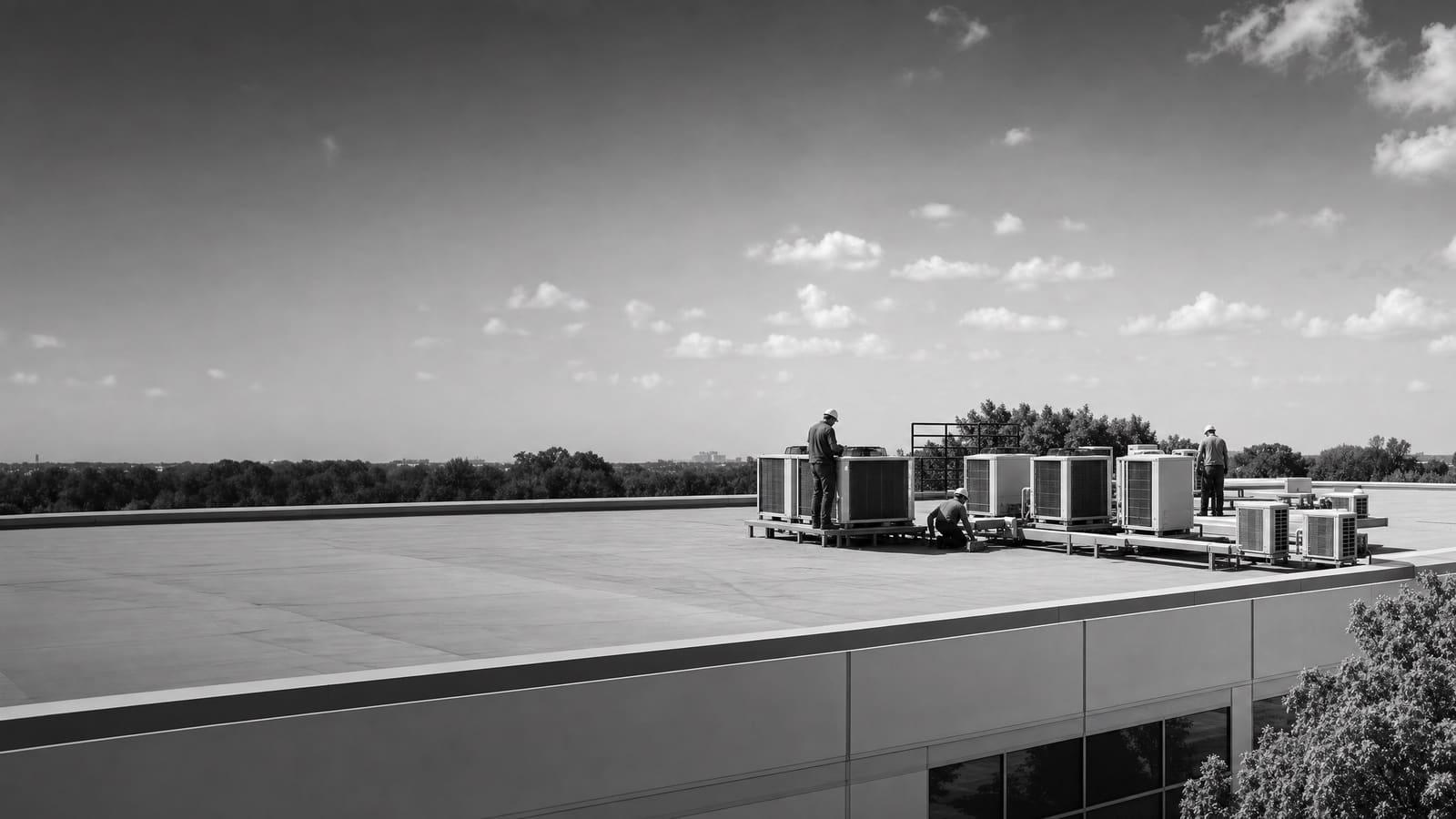
A commercial replacement covers a fresh load calculation, equipment selected against real lead times, curb and structural work, gas or electrical changes, controls integration, permits, and documented startup. Replacement beats another repair once a unit is past about fifteen years, needs frequent service, or no longer holds the space. DOE puts the annual energy waste of an old, inefficient rooftop unit at $900 to $3,700 each.
Before that price is real, a site review has to verify tonnage against how the space is used now, the curb and roof structure, available electrical capacity, gas service, and crane access.
THE THREE CHOICES
Three ways to replace a rooftop unit
Most commercial replacements come down to three choices, and the right one depends on what changed since the last unit went up.
Rooftop units cool close to half of all commercial floor area in the country, so this decision repeats across most buildings. A like-for-like swap is the fastest path back to conditioned space. A high-efficiency replacement costs more up front and earns it back through the life of the unit. A heat pump rooftop unit adds reverse-cycle heating and moves part or all of the heating load to electricity.
DOE's guidance is direct about that last one: climate and winter heating demand, electrical capacity, physical constraints on the roof, existing gas service, and contractor familiarity all decide whether an electric or dual-fuel unit fits a given site. Those are answers a site review produces, not assumptions a catalog makes.
WHAT MOVES THE NUMBER
The lines that decide the price
These are the items that move a rooftop replacement number the most. None of them can be priced from a photo alone, but knowing which ones apply to your roof tells you how firm a quote really is.
IN PRACTICE
Buying the replacement instead of reacting to it
The common pattern is waiting. DOE's own guidance says facility managers usually delay a new rooftop unit until the old one stops holding the space, needs constant service, or fails outright. That is the most expensive version of this project. Emergency replacement narrows your equipment options to whatever sits in a regional warehouse, puts the crane on someone else's calendar, and removes any chance to price a better efficiency tier.
Planning it a season ahead changes all three. You get to compare equipment, you get a real lead time instead of a promise, and you can put the crane day on a weekend or a slow week. DOE makes the same point about the money: proactively replacing an inefficient unit with an efficient one often beats both replacement-on-failure and a plain like-for-like swap at the end of service life.
The second habit worth breaking is buying to the old nameplate. That number reflects the load the building had when the last unit was bought. Occupancy, plug loads, lighting, and envelope work all move it. Confirm the load against how the building runs today, then choose equipment. Sizing from the sticker carries forward whatever the last engineer got wrong.
SIDE BY SIDE
Simple swap or a real project
Two replacements with the same tonnage can be very different jobs. What separates them is rarely the equipment. It is the roof, the electrical service, and how much of the building has to keep running while the work happens.
LOWER COMPLEXITY
Same curb, same fuel, open roof
The existing curb takes an adapter, the electrical service already has room, the crane has a clear staging area, and one unit serves the space. These jobs get scheduled, set, and commissioned inside a normal week.
HIGHER COMPLEXITY
New footprint, new fuel, tight access
Larger tonnage, an all-electric conversion that needs service capacity, gas lines to abandon, a tight lot with limited crane reach, or several units that must be phased so the building never fully loses conditioning.
SCOPING IT
What a real site review checks
A quote written from a nameplate photo is a starting point, not a price. The site review is where the number becomes real, and it is worth insisting on before you sign anything.
On the roof, that means measuring the existing curb, checking the structure under it, looking at the condition of the membrane around the unit, and confirming there is a clear path for rigging. Inside, it means tracing the electrical service and panel capacity, confirming gas service and what happens to the line if the unit goes electric, and finding out how the current unit talks to the building automation system.
DOE groups these as infrastructure checks, and they are the ones that most often surprise a heat pump conversion: electrical capacity first, then physical constraints, then gas. It also flags contractor familiarity with the equipment as its own risk, which is a fair thing to ask about directly.
The last piece is operational. Who works in the space, what hours the lot can be closed, and how long the area can go without conditioning. That answer shapes the schedule more than the equipment does.
Get these five answered before pricing
Measured curb dimensions, a structural note on the roof, panel and service capacity, the gas decision, and the controls path. With those five settled, one quote can actually be compared against another instead of guessed at.
OWNERSHIP
Who pays, and who saves
Who holds the building matters as much as what sits on it, because the payback window and the person paying for it are not always the same.
The efficiency tier is where this shows up. DOE's high-performance rooftop specification was written to cut unit energy use by as much as half against the older standard, and old inefficient units waste $900 to $3,700 a year each. That is money landing on whoever pays the utility bill, while the capital lands on whoever owns the asset. When those are two different parties, the tier decision belongs in the lease conversation, not on the roof.
OWNER-OCCUPIED
You keep the unit and the bill
The efficiency tier, the controls, and the service plan all pay back to the same account. Buying one tier up is the easier decision here, and it is worth pricing two tiers side by side.
LEASED SPACE
The cost and the savings split
Check the lease before scoping. Who owns the rooftop unit, who funds a capital replacement, and whether an efficiency upgrade can be recovered decide how much of this is a technical conversation at all.
OVER TIME
Phasing a fleet and the number at year ten
If you have more than one unit, treat them as a fleet rather than a series of emergencies. Build a simple list: age, tonnage, refrigerant, repair history, and what each unit serves. That list tells you which ones to replace this year, which ones can hold, and which ones are candidates for something other than replacement. DOE's guidance here is practical — owners can commit to replacing old units with efficient ones or retrofit them with advanced controls, whichever makes better financial sense for that unit.
The scale of that program is a useful reference point. More than 200 organizations upgraded over 43,000 rooftop units through the Advanced RTU Campaign, and those upgrades saved a combined $37 million a year on energy bills. That is a per-unit number you can reason from when the first quote looks high.
Phasing also buys procurement leverage. Two or three units ordered together on a known schedule usually get better pricing and better lead times than one unit ordered the week it dies. It also lets you standardize on a manufacturer and a control platform, which makes the service contract and the spare-parts shelf much simpler over the life of the fleet.
THE QUOTE
Five things a comparable quote shows
Two quotes are only comparable when both show the same things. If one of these is missing, that is where the surprise comes from later.
01
The unit, spelled out
Manufacturer, model, tonnage, fuel, and efficiency tier — not just "replace rooftop unit like for like."
02
Lead time and a hold
Real availability for that model, plus what holds the price and the crane slot if you approve next week.
03
Curb, structure, and roof
Adapter or new curb, any structural work, and who repairs the membrane around the opening.
04
Crane day and access
Rigging plan, hours the lot is closed, permits, inspections, and who coordinates all of it.
05
Startup and documentation
Charge, airflow, and control settings verified against spec, handed over in writing with warranty terms.
Get a defensible number
Price the equipment and the building together.
Send the address, operating target, and target opening date. Flux will identify what must be verified before the project can be priced.
Get a free estimateQuestions
Straight answers.
When does replacement beat one more repair?
Once a unit is past about fifteen years and needs frequent service, the math usually turns. DOE puts the annual energy waste of an old, inefficient rooftop unit at $900 to $3,700, and that runs every year you keep it. Repeat service calls on top of that make the repair the more expensive choice.
Should the new unit match the old nameplate?
Only if the space is used the same way it was. Occupancy, equipment, lighting, and envelope changes all move the load. Confirm the load first, then choose the unit. Like-for-like is often right, but it should be a finding rather than a default.
Is a heat pump rooftop unit the right choice?
DOE names the deciding factors directly: winter heating demand at the site, local electricity and gas prices, electrical service capacity, physical constraints on the roof, and whether contractors know the equipment. Heat pumps do their best work where winters are mild to moderate, and dual-fuel and cold-climate versions exist for sites with harder heating loads.
What happens to the refrigerant in the old unit?
It has to be recovered properly. EPA rules under Section 608 of the Clean Air Act govern how refrigerant is handled and recycled in stationary air conditioning and heat pump equipment, and that applies to the unit coming off your roof as well as the one going on.
What does a commercial HVAC installation cost?
There is no honest single number, because tonnage, efficiency tier, curb and structural work, electrical capacity, and crane access each move it. What you can pin down is the comparison. Get two quotes that both show the model, the lead time, the roof scope, the crane plan, and the commissioning, and the difference between them will mean something.
Sources used for this guide
- [1]betterbuildingssolutioncenter.energy.gov — DOE Advanced Rooftop Unit Replacement Guidance
- [2]betterbuildingssolutioncenter.energy.gov — DOE Commercial Heat Pump Rooftop Unit Replacement Guidance
- [3]betterbuildingssolutioncenter.energy.gov — DOE High-Efficiency Commercial Rooftop Unit Toolkit
- [4]energy.gov — DOE Efficient Commercial Rooftop Air Conditioner Program
- [5]epa.gov — EPA Stationary HVAC Refrigerant Management