THE SHORT VERSION
What a commercial HVAC replacement includes
A commercial HVAC replacement means confirming the load the building actually carries today, selecting equipment against real availability, setting the unit with a crane, tying in power, gas, ducts, and controls, then commissioning it so it performs to spec. Replacement beats one more repair once a unit is past roughly fifteen years and the failures start repeating. Federal analysis puts the annual energy waste of an old rooftop unit at roughly $900 to $3,700 each, before you count the service calls.
A site review has to confirm the tonnage the space needs now, curb size and roof structure, electrical capacity at the panel, crane reach across the lot, and whether the existing gas line stays or goes.
THREE PATHS
How owners usually decide
Three paths cover almost every commercial replacement, and the cheapest one on paper is not always the cheapest one to own. Rooftop units condition close to half of all commercial floor space in the country, so this decision repeats across most portfolios — and the right answer can differ roof by roof.
Start with what the building needs now. Occupancy, plug loads, and the envelope all change over twenty years, and the old nameplate only tells you what someone sized in a different decade. Then weigh what the unit will cost to run. The high-efficiency rooftop specification DOE set with manufacturers targeted equipment that cuts energy use by up to half against the older standard, which makes the efficiency tier an operating decision rather than a checkbox.
The third path is the electric one. Heat pump rooftop units are close cousins of standard air-conditioning units, with reverse-cycle heating added. They are most efficient in mild to moderate winter heating, and heating efficiency falls as outdoor temperatures drop. Where winter heating load is real, cold-climate or dual-fuel configurations are the honest versions to price.
WHAT MOVES THE NUMBER
The lines that decide your price
Nobody can price a rooftop replacement from a phone call. These are the items that move the number most, and the ones a walk of the roof settles fastest.
IN PRACTICE
Choosing equipment you can actually get
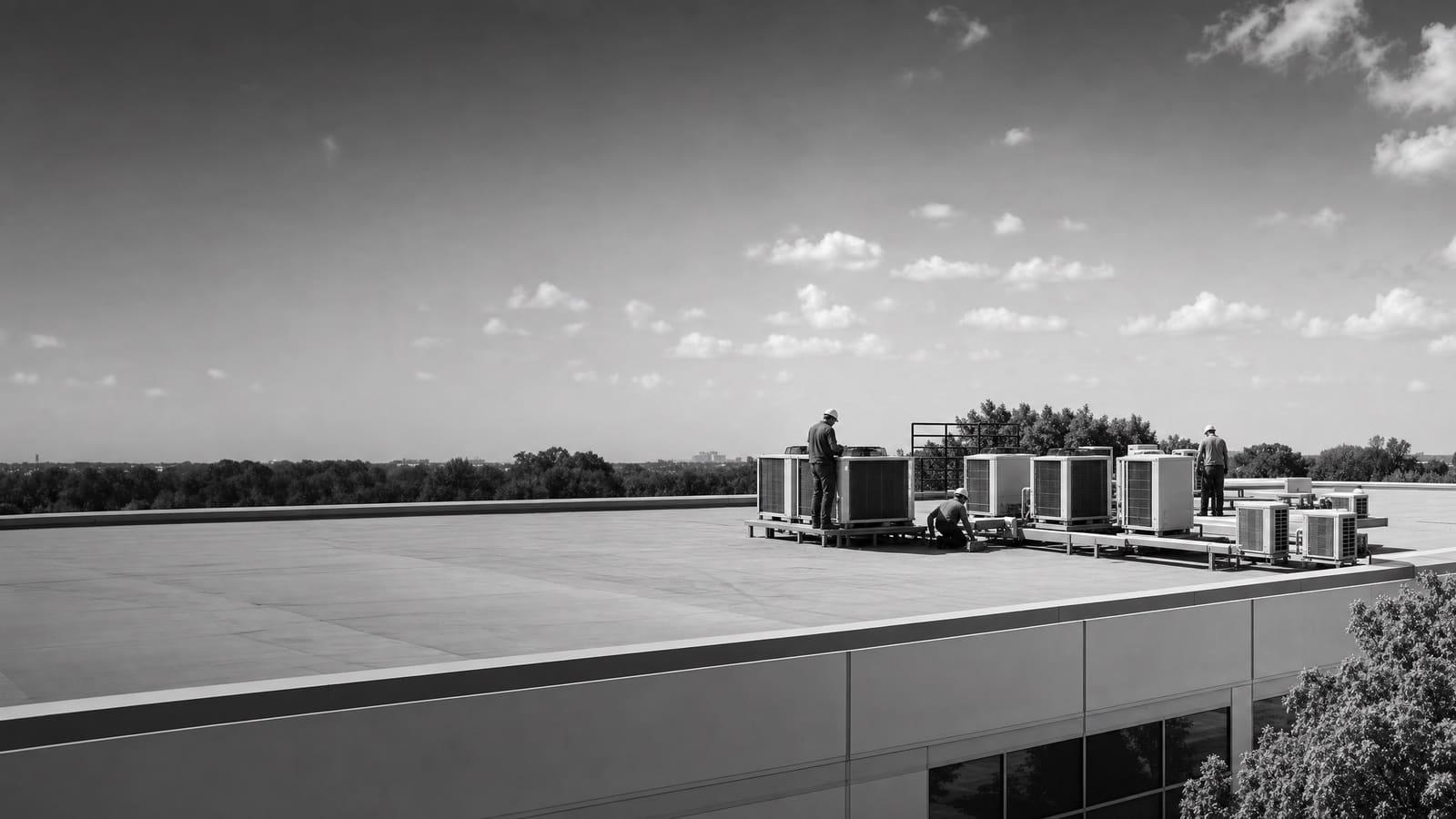
The visible part of a replacement is one morning. The crane shows up, stalls get coned, the old unit comes off, and the new one lands on an adapter that was measured weeks earlier. Everything that makes that morning boring happened in advance.
The part that surprises owners is availability. Lead time belongs on the quote next to the price, because a unit you cannot get in August is not really an option in August. That is also the strongest argument for planning replacements before failure. Federal guidance is blunt about the pattern: facility managers often wait until a unit no longer conditions the space, needs constant service, or quits entirely — and replacing proactively is usually the smarter business move than replacing on failure, or even than a like-for-like swap at the end of service life.
Efficiency is the other half of the selection, and the market has moved. High-efficiency rooftop units went from commercially unavailable to more than twenty models exceeding the DOE performance specification. Across the DOE campaign that followed, more than 200 organizations upgraded over 43,000 rooftop units and cut a combined $37 million a year from their energy bills. Those are averages across many buildings, not a promise for yours, but the direction has been consistent.
SIDE BY SIDE
What makes one job simple and another slow
Two replacements can carry the same tonnage and still land a month apart on the calendar. Complexity, not size, is usually what sets the schedule.
LOWER COMPLEXITY
Same size, same fuel, open roof
The existing curb fits, connections stay where they are, the load still matches the space, and the crane has an easy reach. Permitting is typically straightforward and the unit is set, connected, and running within a couple of days on site.
HIGHER COMPLEXITY
New size, new fuel, tight site
Tonnage or footprint changes, so the curb adapter and the structure under it get reviewed. Going all-electric adds an electrical capacity check. A tight lot or a tenant who cannot close means night work and a longer plan.
SCOPING
What a real site review settles
A quote written from a nameplate photo is a starting point, not a number you can sign. The site review is where the unknowns turn into line items.
Start on the roof. Confirm the curb dimensions and the structure under them, then check drainage, clearances, and how the crane will actually reach the spot. Then follow the utilities. Electrical capacity is the item that quietly kills electrification projects: an all-electric unit that leans on electric resistance backup can ask for more service than the building has, and learning that after the order is placed is expensive. Physical constraints and existing gas lines matter for the same reason.
Then look at the equipment coming out. Refrigerant handling is regulated. EPA rules under Section 608 of the Clean Air Act govern how refrigerant is recovered and handled in stationary air-conditioning, refrigeration, and heat pump equipment, so certified recovery and documentation are part of a legitimate removal, not an optional line.
Finally, ask about the bench doing the work. Federal guidance flags contractor availability and knowledge as a real consideration for heat pump rooftop projects, because the equipment is increasingly common but the commissioning habits around it are not yet universal.
Ask these before the order goes in
Does the panel have capacity for the unit as specified? Does the existing curb fit, or does this need an adapter and a structural look? Who recovers the refrigerant, and does that documentation arrive with the closeout package?
OWNING THE DECISION
Two things the spec sheet won't tell you
Equipment selection gets most of the attention. The two items below decide how the unit behaves for the next fifteen years, and neither one shows up in a model number.
The first is what the building will be doing later. Sizing to today's occupancy is correct, but if a tenant change or a build-out is already on the calendar, that belongs in the load conversation now rather than in a change order later.
The second is fleet consistency. Most owners do not replace everything at once. They replace one unit, then another two winters after that. Each choice either simplifies the roof or fragments it — across refrigerants, controls platforms, filter sizes, and the parts your service contractor keeps on the truck.
LEASE STRUCTURE
Who pays for what
A landlord buying equipment and a tenant paying the utility bill do not value efficiency the same way. Settle that before the tier gets chosen, or the cheapest unit wins by default and somebody pays for it every month.
MIXED FLEETS
What service looks like after
New equipment does not always run the same refrigerant as the unit it replaces. Day-one operation is unaffected, but a roof carrying three refrigerants and two controls platforms costs more to maintain than one standardized on purpose.
PHASING AND LIFETIME COST
Replacing on your schedule instead of the unit's
There are really two kinds of commercial HVAC installation. One is a unit that died in season and a building that needs it handled today. The other is planned: a build-out, an addition, or an end-of-life swap done on a calendar you control. The planned kind is cheaper almost every time, and the reason is not mysterious. You get to shop equipment, you get to book the crane on a slow day, and you are not paying a premium for whatever happens to be on the shelf.
Age is the cleanest trigger for that plan. Rooftop units past fifteen years can waste substantial energy and money compared with newer models, and the federal figure for an old unit's annual waste runs from roughly $900 to $3,700 each. Multiply that across the aging units on one roof and the case for phasing tends to make itself.
Phase by consequence, not only by nameplate date. The unit over the server room or the one carrying your busiest floor should move up the list ahead of the one serving a storage bay. Owners also have a middle option: the DOE campaign let participants either replace old units or retrofit them with advanced controls, depending on which made better financial sense. Not every unit on a roof has to be replaced the same year.
BEFORE YOU SIGN
Five things a comparable quote shows
Two quotes are only comparable when both show the same things. Ask for these five and the price differences usually start explaining themselves.
01
Equipment and efficiency tier
Make, model, tonnage, heating type, and the efficiency rating — not just "new rooftop unit."
02
Lead time, in writing
Real availability for the unit quoted, plus the alternate if that one slips.
03
Curb, structure, and rigging
Adapter, any roof work, crane size, lot closure hours, and who coordinates them.
04
Utility and controls scope
Electrical, gas, and refrigerant line work, plus the building automation tie-in and who owns it.
05
Commissioning and closeout
Charge, airflow, and control settings verified against spec and documented, with permits and inspections included.
Get a defensible number
Price the equipment and the building together.
Send the address, operating target, and target opening date. Flux will identify what must be verified before the project can be priced.
Get a free estimateQuestions
Straight answers.
When does replacement beat one more repair?
Once failures start repeating and the unit is past roughly fifteen years, repair money stops buying reliability. Federal guidance is direct about the pattern: waiting for a unit to fail completely usually costs more than replacing it proactively, and an aging rooftop unit can waste roughly $900 to $3,700 a year in energy on its own.
Should the replacement be like-for-like or right-sized?
Confirm the load either way. If the space and how it's used haven't changed, like-for-like is often the right call and the simplest permit path. If occupancy, internal equipment, or the envelope changed, right-sizing fixes comfort complaints the old unit was never able to solve.
Is a heat pump rooftop unit a good swap for a gas unit?
It depends on your winter heating load and the building's electrical capacity. Heat pump rooftop units heat most efficiently in mild to moderate winter conditions, and their heating efficiency drops as outdoor temperatures fall. Where winter heating demand is significant, cold-climate or dual-fuel configurations are the versions worth pricing.
How much does a commercial HVAC installation cost?
The installed price is built per unit. The drivers are tonnage, efficiency tier, curb and structural work, crane access, and any utility or controls changes. Anyone quoting a flat number before looking at the roof is guessing. Ask for the price and the lead time together, for the exact unit.
Who handles the crane, permits, and inspections?
The installing contractor should. The rigging plan, lot coordination, permits, and inspections belong inside the installed price rather than showing up as surprises afterward. Make sure the quote says so in writing before you sign it.
What happens to the old unit's refrigerant?
It gets recovered by a certified technician. EPA regulations under Section 608 of the Clean Air Act govern refrigerant handling in stationary refrigeration, air-conditioning, and heat pump equipment, and the recovery documentation should arrive with your closeout package.
Sources used for this guide
- [1]betterbuildingssolutioncenter.energy.gov — DOE Advanced Rooftop Unit Replacement Guidance
- [2]betterbuildingssolutioncenter.energy.gov — DOE Commercial Heat Pump Rooftop Unit Replacement Guidance
- [3]betterbuildingssolutioncenter.energy.gov — DOE High-Efficiency Commercial Rooftop Unit Toolkit
- [4]energy.gov — DOE Efficient Commercial Rooftop Air Conditioner Program
- [5]epa.gov — EPA Stationary HVAC Refrigerant Management