THE DIRECT ANSWER
What a commercial HVAC replacement actually includes
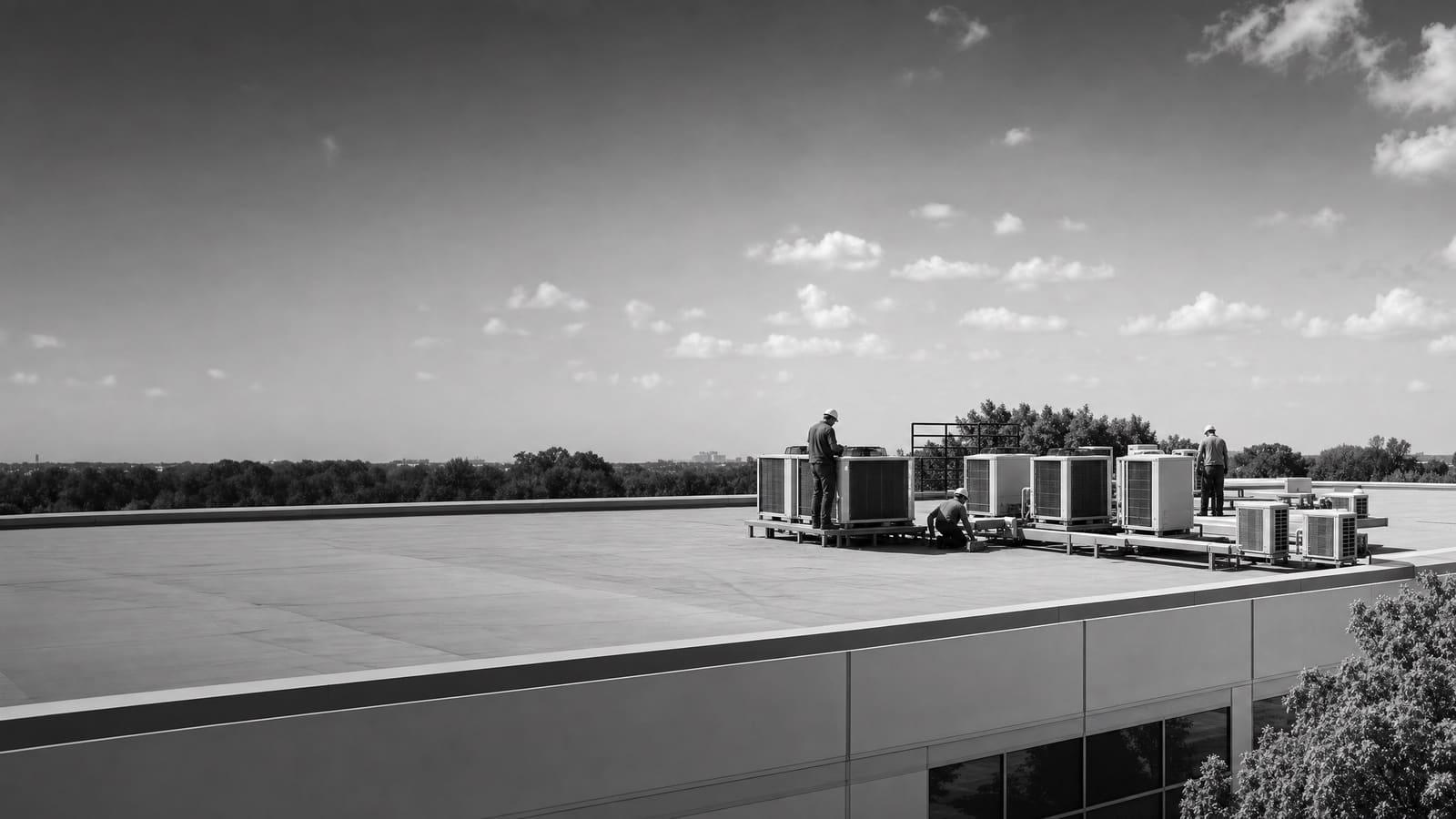
A commercial HVAC replacement covers load verification, equipment selection against real lead times, rigging and set, connections to power, gas, and controls, then commissioning and closeout. Replacement beats one more repair once a unit is past about 15 years and losing capacity. Units that old waste substantial energy, and a single old, inefficient rooftop unit can burn $900 to $3,700 a year on its own. Past that point, repair dollars buy runtime, not performance and not lower bills.
A site review still has to confirm today's load, curb and roof condition, available electrical capacity, gas service, and crane access before any of that applies to your roof.
THREE WAYS TO GO
Three replacement paths worth pricing
Most commercial replacements land in one of three lanes, and the right lane depends on what changed since the old unit went in.
Like-for-like keeps the same fuel and roughly the same capacity. It is the fastest path back to conditioned space and the cheapest to engineer, but it carries forward whatever sizing error the old unit had.
A right-sized, high-efficiency replacement recalculates the load against how the building is used now. High-efficiency rooftop specifications were written to cut unit energy use by up to half compared with the older standard, so the tier you pick shows up on every utility bill for the rest of the unit's life.
A heat pump rooftop unit adds reverse-cycle heating. These come as dual-fuel, all-electric, and cold-climate models, and the choice turns on winter heating load, electricity and gas prices, electrical capacity at the roof, and whether the gas line stays. Heat pump heating efficiency falls as outdoor temperatures drop, which is exactly why dual-fuel and cold-climate versions exist.
WHAT MOVES THE NUMBER
Where a replacement budget actually moves
Two quotes for the same tonnage can land far apart, and the gap is almost never the box. It is the work around the box. Compare these lines item by item before you compare totals.
IN PRACTICE
One more repair, or replace it now
The common pattern is to wait. Most facility teams keep a rooftop unit until it can no longer hold the space, needs constant service calls, or fails outright. That is understandable, because nothing in a capital budget rewards replacing equipment that still runs. It is also the most expensive way to buy a unit. Replacing on failure means taking whatever is available, at whatever price, on whatever schedule the supply chain allows.
Planned replacement flips all three. You choose the efficiency tier instead of accepting one. You order into a lead time instead of fighting it. You set the crane on a Saturday instead of a Tuesday in July. Replacing an aging, underperforming unit ahead of failure often beats both replacement-on-failure and a straight like-for-like swap at the end of service life.
The practical test is not age by itself. Look at whether the unit still holds setpoint on design days, how many service calls it took over the last two seasons, whether parts are still available for it, and what it costs to run. A unit past 15 years that fails two of those four is a replacement candidate. The repair you are about to approve is really a deposit on the same decision six months from now.
SCOPE CHECK
What makes a replacement simple or complicated
Before assuming a swap is routine, run your site against these two lists. The distance between them is usually weeks of schedule and a meaningful share of the budget.
LOWER COMPLEXITY
Straight rooftop swap
Same capacity and same fuel. The existing curb fits or takes a standard adapter. Roof access is open with room to stage the crane. Power and gas are already sized for the unit, and the permit path is straightforward mechanical and electrical.
HIGHER COMPLEXITY
Resize, fuel switch, or tight site
Capacity or footprint changes, so the curb and roof structure get reviewed. All-electric equipment may need added electrical capacity at the roof. Crane reach is limited by the building or the lot, which pushes the set to a night or weekend and lengthens the closure.
BEFORE YOU PRICE IT
What a site review has to settle
A quote written from a nameplate photo is a starting number, not a price. The nameplate tells you what was installed years ago. It does not tell you what the building needs now, and it says nothing about what the roof will allow.
A real site review answers four questions. What is the actual load, based on current occupancy, plug loads, and envelope rather than the old unit's tag? What condition are the curb, the deck around it, and the existing duct connection in? What infrastructure is already there, meaning electrical capacity at the roof, gas service, refrigerant line runs, and the controls the building already uses? And how does equipment get up there, meaning crane position, reach, staging, and how long a drive aisle or lot has to close?
Those four answers are what separate two bids that look identical on the cover page. If one contractor priced a curb adapter and a structural review and the other did not, the cheaper bid is not cheaper. It is incomplete, and the difference arrives as a change order after the old unit is already on the ground.
Installing crew experience belongs in the same conversation. Heat pump rooftop equipment in particular depends on the crew understanding controls and heating changeover, not just the refrigerant circuit.
Ask for the scoping notes, not just the total
A comparable quote shows the load basis, the curb and structural findings, the electrical and gas conditions, the rigging plan, and the commissioning scope. If a bid shows only tonnage and a price, ask what it assumed. The assumptions are where change orders live.
OWNERSHIP MATH
Two things that outlive the install
The install takes a week. The consequences run for the whole service life of the unit, and rooftop equipment routinely stays in place well past 15 years. Two of those consequences are worth deciding now rather than discovering later: what the unit costs to run every month, and how the refrigerant side gets handled for the rest of its life. Neither one shows up in the install price, and both are far easier to settle while you still have leverage with a bidder. A bid that wins on price and loses on efficiency tier is not a saving. It is a transfer from the capital budget to the operating budget, paid monthly for two decades.
RUNNING COST
The efficiency tier is the operating budget
Rooftop equipment conditions close to half of all U.S. commercial floor area, which makes it the largest energy line in many buildings. High-efficiency specifications were written to cut unit energy use by up to half, and more than 43,000 upgraded units have saved a combined $37 million a year.
REFRIGERANT
Settle the service side before handoff
Federal rules govern how refrigerant is handled and recycled in stationary air-conditioning and heat pump equipment. That covers the unit coming off your roof and the one going on. Confirm who performs recovery, how it is documented, and who owns leak service afterward.
PROCUREMENT
Phase a fleet instead of buying one unit at a time
Buildings rarely have one rooftop unit. They have four, or eleven, installed within a few years of each other, which means they will reach end of life within a few years of each other. Handling that as a series of emergencies is how a facility ends up with four brands, four control interfaces, and no leverage on price.
A phased plan works better. Rank the units by age, service history, and how much each one affects tenants or production. Replace the worst one or two on a planned schedule, standardize on a platform and a controls approach so the next replacement is a repeat instead of a new project, and hold the rest on maintenance until their number comes up. Buying two or three units together usually improves both pricing and delivery.
Order timing matters as much as order size. Commercial equipment is not a stock item, and larger tonnage or specified options take longer to arrive. Placing the order while the building can still tolerate a set date weeks out is the difference between choosing equipment and accepting whatever is available.
Incentives belong in the decision before equipment is ordered, alongside climate, utility cost, building type, availability, and infrastructure. Check what a program asks for and when it has to be filed, because timing can matter as much as eligibility.
QUOTE CHECKLIST
Five things a comparable quote should show
Bids only compare when they cover the same scope. Ask every bidder for these five in writing, then compare totals. If one bid is missing an item, that gap is not a discount.
01
Load basis
Tonnage and efficiency tier, and whether they came from a current load calculation or from the old nameplate.
02
Equipment and availability
The specific model, its lead time, and what happens to price and schedule if that model slips.
03
Roof and rigging scope
Curb adapter, any structural work, crane position and reach, and how long the lot or drive aisle closes.
04
Connections
Electrical capacity, gas, refrigerant lines, and controls integration, each priced rather than listed as by others.
05
Commissioning and closeout
Verified startup, permits and inspections, refrigerant recovery documentation, and warranty registration in your name.
Get a defensible number
Price the equipment and the building together.
Send the address, operating target, and target opening date. Flux will identify what must be verified before the project can be priced.
Get a free estimateQuestions
Straight answers.
When does replacement beat one more repair?
Age alone is not the test. Check whether the unit still holds setpoint on design days, how many service calls it took over the last two seasons, whether parts are still available, and what it costs to run. A unit past 15 years that fails two of those four is usually a replacement candidate, because the energy an old unit wastes keeps running whether you repair it or not.
Is a heat pump rooftop unit the right replacement?
It depends on winter heating load, electricity and gas prices, electrical capacity at the roof, and whether the gas line stays. Heat pump heating efficiency falls as outdoor temperatures drop and trends toward electric resistance performance in deep cold, which is why dual-fuel and cold-climate models exist. Where winter heating demand is real, those are the versions to price.
How long does a rooftop replacement take on site?
The set itself is a short, well-planned event once the curb adapter, rigging plan, and connections have been settled in advance. The honest variable is equipment lead time, not labor. That is why availability belongs on the quote right next to the price.
What happens to the refrigerant in the old unit?
It is recovered and handled under federal rules covering refrigerant handling and recycling in stationary refrigeration, air-conditioning, and heat pump equipment. Ask who performs the recovery, how it is documented, and whether that documentation comes to you at closeout with the rest of the project record.
Why do two quotes for the same tonnage differ so much?
Usually because they scoped different work around the unit. Curb adapters, structural review, electrical capacity, controls integration, refrigerant recovery, and lot closure time move the number more than the equipment does. Compare those lines first, then compare totals.
Sources used for this guide
- [1]betterbuildingssolutioncenter.energy.gov — DOE Advanced Rooftop Unit Replacement Guidance
- [2]betterbuildingssolutioncenter.energy.gov — DOE Commercial Heat Pump Rooftop Unit Replacement Guidance
- [3]betterbuildingssolutioncenter.energy.gov — DOE High-Efficiency Commercial Rooftop Unit Toolkit
- [4]energy.gov — DOE Efficient Commercial Rooftop Air Conditioner Program
- [5]epa.gov — EPA Stationary HVAC Refrigerant Management