THE DIRECT ANSWER
What a commercial HVAC replacement actually includes
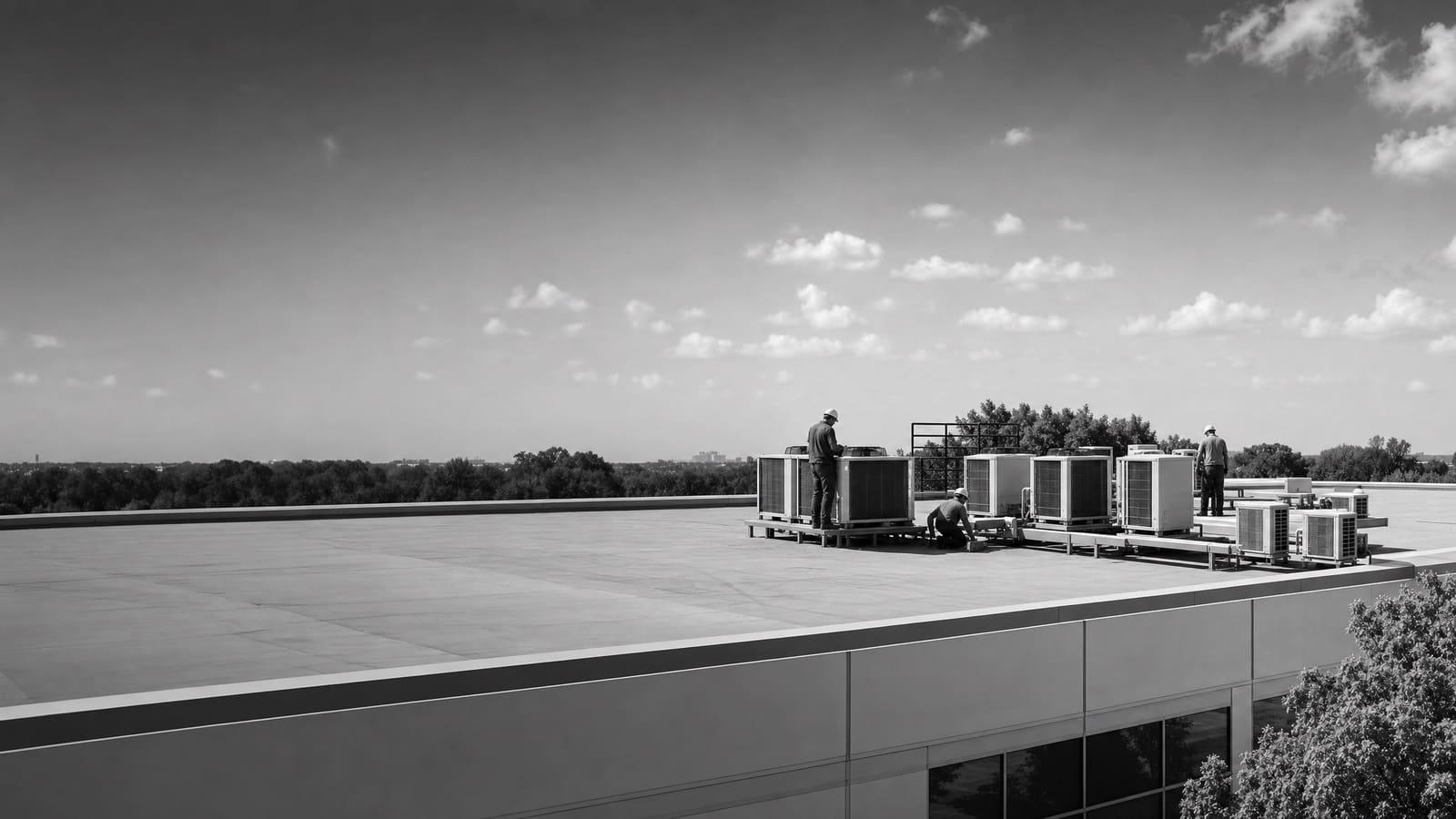
A commercial HVAC replacement covers a confirmed load calculation, equipment selected against real lead times, rigging and setting the unit, curb and duct connections, electrical and gas work, certified refrigerant recovery from the old unit, controls integration, and documented startup. Replacement beats another repair once a unit is past roughly 15 years. DOE reports that old, inefficient rooftop units waste anywhere from $900 to $3,700 per unit annually compared with newer models, which is usually more than the repair you are debating.
A site review still has to verify the actual load for how the space is used now, roof and curb condition, available electrical capacity, crane reach, and whether the existing gas service stays or goes.
THREE WAYS TO GO
Three replacement paths for a commercial rooftop unit
Most commercial buildings replace a rooftop unit one of three ways, and the right answer depends on how long you plan to hold the building and what your heating source is today. DOE's guidance frames the choice around climate and geography, utility bill impact, building type, equipment availability, electrical capacity, gas lines, and available incentives. Those same items decide the path on a single roof.
A like-for-like swap needs the least engineering, but it carries forward whatever the old unit got wrong. A high-efficiency unit costs more up front and pays back on the meter. DOE's High-Performance Rooftop Unit Challenge asked manufacturers for units that cut energy use up to 50 percent against the then-current standard, and manufacturers brought more than 20 models that exceed that specification to market. A heat pump rooftop unit changes the fuel picture entirely, and DOE says today's units are an appropriate solution across most of the U.S. South and West, where they can address most or all of the winter heating demand.
WHAT MOVES THE NUMBER
The line items that decide your installed price
Nobody can price a commercial rooftop replacement from a phone call, because these six items swing the total more than the equipment does. Ask for each one priced separately, so you can see where the money goes and which parts are actually firm.
IN PRACTICE
Choosing between one more repair and a real replacement
The honest test for repair versus replacement is not the price of the current part. It is how many more of these calls you expect. DOE notes that facility managers often delay buying a new rooftop unit until the old one no longer conditions the space, needs frequent maintenance, or fails completely, and that replacing inefficient units proactively is often the better business move than replacement-on-failure, or even than a like-for-like swap at the end of service life. The reason is practical. A failure replacement gets whatever unit is in stock, on whatever day the crane is free, in the season you can least afford the outage.
Once you accept that a unit is going to be replaced, the second question is what to put back. Rooftop units cool nearly half of all U.S. commercial floor area, so the equipment market is deep and the efficiency spread between the cheapest unit and the best one is wide. DOE's Advanced RTU Campaign tracked more than 200 organizations upgrading over 43,000 units, with combined reported savings of $37 million a year.
The move that makes the decision easy: price two options on the same roof, the cheapest compliant replacement and the tier above it, with the expected annual bill difference shown next to each.
COMPLEXITY CHECK
What makes this an easy project or a hard one
Two replacements at the same tonnage can differ by weeks of schedule and a large share of cost. Before you compare bids, work out which of these two your building actually is.
LOWER COMPLEXITY
Straight swap, same fuel
The new unit matches the existing curb and footprint, the space is used the way it was when the old unit went in, gas and electric service stay as they are, and the crane has clear reach from the lot. This is a one-morning set.
HIGHER COMPLEXITY
New footprint or new fuel
Tonnage or footprint changes, so the curb and roof structure need review. Or you are moving from gas heat to a heat pump, which puts electrical capacity, panel space, and the fate of the existing gas line on the critical path.
BEFORE YOU BUY
What a real site review has to answer
A quote written from a nameplate photo is a starting number, not a price. The nameplate records what someone installed years ago, under the occupancy and envelope of that year. It does not tell you what the space needs now. Two decades of tenant changes, added plug load, lighting retrofits, and envelope work all move the load, and usually they move it down.
DOE's heat pump guidance walks portfolio owners through roughly the same checklist a good contractor uses on a single roof: climate and geography, expected utility bill impact, emissions impact, building type, equipment availability, and infrastructure, which it breaks down into electrical capacity, physical constraints, and gas lines. Contractor availability and knowledge of the equipment is on that list too, and it matters more than buyers expect the first time a newer unit type lands on their roof.
So ask for the load calculation, not just its conclusion. Ask what the crane plan assumes about your lot. Ask what happens to the gas line if you go electric, and whether the panel has room for it. Anyone who has actually walked the roof can answer all four without hedging.
Five things to confirm before you sign
Actual load for today's occupancy and equipment, curb and structural condition, available electrical capacity and panel space, crane reach and lot closure window, and where the existing gas service ends up. Anything a quote assumes instead of verifies is a change order waiting to happen.
OWNING THE SYSTEM
Two decisions that outlive the install day
The install is one morning. What you signed for runs fifteen years or more, and two items on that list are easy to leave undecided until they cost you something. One is refrigerant, which is governed by federal rules and applies to the unit leaving your roof as much as the one arriving. The other is what happens to every other unit up there once one of them is new.
REFRIGERANT
Recovery and service planning
EPA regulations under Section 608 of the Clean Air Act cover how refrigerant is handled and recycled in stationary refrigeration, air conditioning, and heat pump equipment. Certified recovery from the old unit belongs in the written scope, and your service agreement should name who handles the new unit going forward.
MIXED FLEET
One new unit, five old ones
The first replacement makes the rest look worse, both on the bill and in the callout log. Decide now whether the others get replaced on a schedule you set, or on the afternoon they quit in July with the building full.
PLANNING AHEAD
Phasing a multi-unit roof without a capital shock
Most commercial roofs do not have one unit. They have four, or nine, and they were all installed the same year, which means they will all reach the end of their useful life inside the same short window. The buildings that handle this well stop treating each failure as an emergency and start treating the roof as a replacement schedule.
The mechanics are simple. Rank the units by age and by service history, then replace one or two per budget cycle, starting with whichever one serves the most occupied square footage. Each completed replacement hands you real numbers, an actual installed cost on your roof and an actual change on your meter, which makes next year's request far easier to defend.
DOE's work on this equipment class is worth knowing when you build that case. The federal efficiency standard finalized for commercial rooftop units in December 2015 was projected to save businesses $167 billion in utility bills over the lifetime of the products. That tells you the gap between an aging unit and a current one is wide enough to be a budget argument, not just an engineering preference. Put each old unit's annual operating cost next to its replacement cost, and the phasing order usually decides itself.
THE QUOTE
Five things a comparable quote has to show
If two bids do not present these five items the same way, you are not comparing them, you are guessing. Ask every bidder to break the price out this way before you read the total.
01
Load basis
The calculated load for how the space is used today, with the assumptions listed. Not simply the tonnage that was there before.
02
Equipment and lead time
Model, efficiency tier, and a real availability date. Availability belongs next to the price, not in a follow-up email.
03
Roof and curb scope
Curb adapter, any structural work, and what happens if the opening does not match once the old unit is off.
04
Rigging and site plan
Crane size, staging area, which stalls close, and for how long.
05
Startup and documentation
Charge, airflow, and controls verified against spec, with a commissioning record you keep for the warranty.
Get a defensible number
Price the equipment and the building together.
Send the address, operating target, and target opening date. Flux will identify what must be verified before the project can be priced.
Get a free estimateQuestions
Straight answers.
When does replacement beat one more repair?
Replace when the repairs stop being isolated events. DOE points to rooftop units over 15 years old as the ones wasting real money, and reports that old, inefficient units waste anywhere from $900 to $3,700 per unit annually against newer equipment. If a unit is in that age band and needs frequent service, another repair buys months, not years. Replacing proactively also means you pick the unit and the day, instead of taking whatever is in stock the week it fails.
How much does a commercial HVAC installation cost?
There is no honest universal number, because tonnage, curb condition, crane access, electrical work, and controls integration each move the total independently of the equipment price. What you can pin down before anyone quotes is the calculated load, whether the new unit fits the existing curb, and whether the electrical service supports what you are considering. Ask for those items priced as separate lines so two bids can actually be compared side by side.
Is a heat pump rooftop unit a good replacement for a gas unit?
Often, in southern regions. DOE's guidance says today's heat pump rooftop units are an appropriate solution for most of the U.S. South and West, and are capable of addressing most or all of the winter heating demand there. The decision turns on electrical capacity, local electricity and gas prices, physical constraints on the roof, and whether you keep the gas line. Dual-fuel units exist for buildings that want electric efficiency without giving up gas heat in a cold snap. DOE cites the February 2021 Texas freeze as the reason southern buildings still plan for sharp winter heating demand.
What happens to the refrigerant in the old unit?
It has to be recovered under certified handling. EPA regulations under Section 608 of the Clean Air Act govern how refrigerant is handled and recycled in stationary refrigeration, air conditioning, and heat pump equipment, and those rules cover the unit being removed as well as the one going in. Make sure recovery appears in the written scope of work rather than being assumed, and confirm who is responsible for the new unit's refrigerant under your ongoing service agreement.
Should the new unit be the same tonnage as the old one?
Only if the space is used the way it was when the old unit was installed. Nameplate tonnage records a decision made under a past occupancy, lighting load, and envelope. Tenant changes, lighting retrofits, and equipment turnover usually move the real load down. Ask for the load calculation and the assumptions behind it. If the space genuinely has not changed, a like-for-like swap is the fastest and least expensive path, and there is nothing wrong with taking it.
Sources used for this guide
- [1]betterbuildingssolutioncenter.energy.gov — DOE Advanced Rooftop Unit Replacement Guidance
- [2]betterbuildingssolutioncenter.energy.gov — DOE Commercial Heat Pump Rooftop Unit Replacement Guidance
- [3]betterbuildingssolutioncenter.energy.gov — DOE High-Efficiency Commercial Rooftop Unit Toolkit
- [4]energy.gov — DOE Efficient Commercial Rooftop Air Conditioner Program
- [5]epa.gov — EPA Stationary HVAC Refrigerant Management