THE SHORT VERSION
What a commercial HVAC replacement actually includes
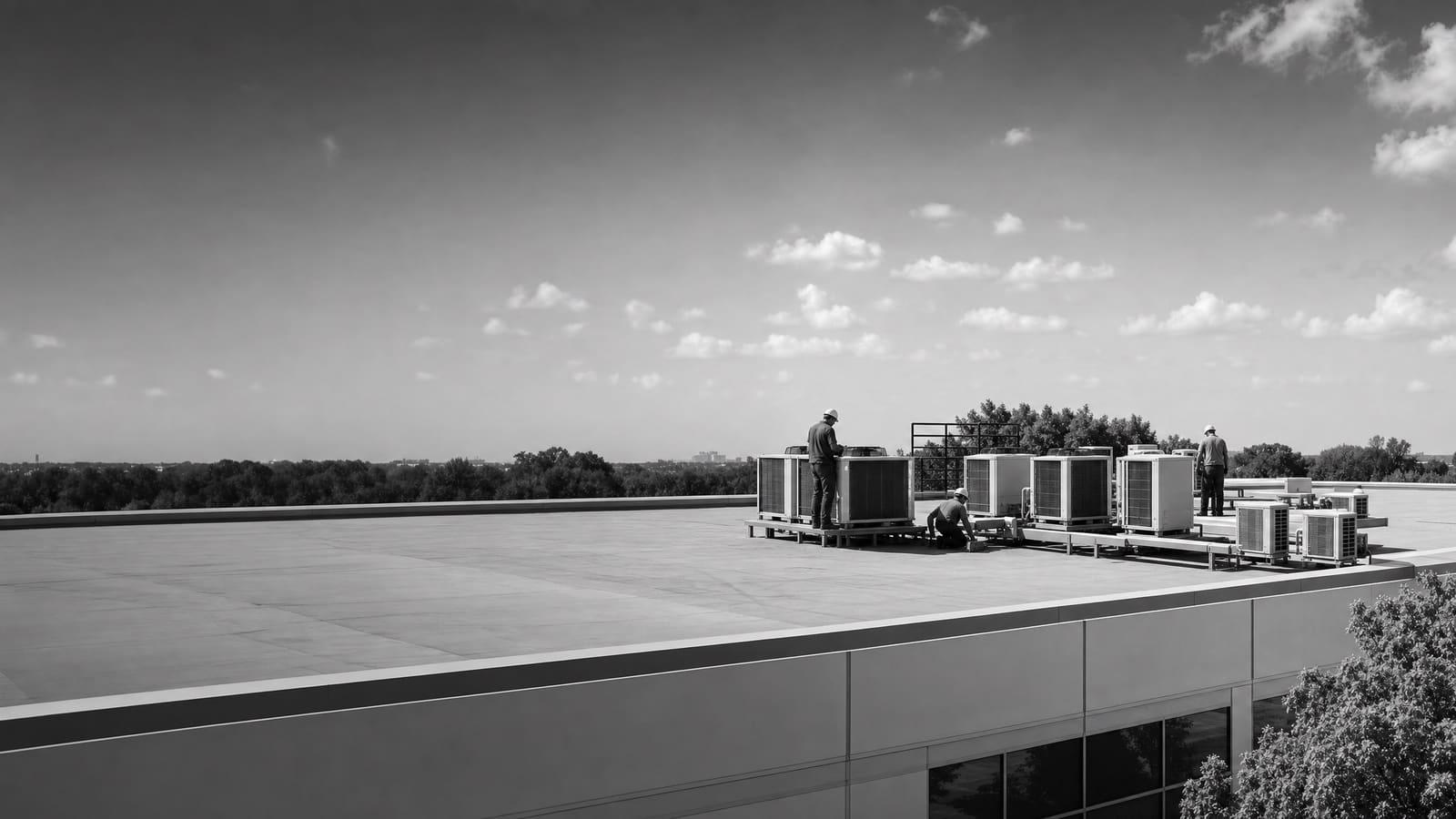
A commercial HVAC replacement means confirming the load the building carries today, selecting equipment against real availability, recovering refrigerant from the old unit under federal rules, setting the new unit, and commissioning it so it performs to spec. Replacement beats another repair once the unit is past its useful service life and repairs stop holding. Rooftop units older than 15 years waste substantial energy compared with current models — old, inefficient units waste roughly $900 to $3,700 each per year.
A site review has to verify the actual load, the roof curb and structure, electrical capacity at the unit, gas line status, and crane access before any of that pricing is real.
THREE PATHS
Three ways to handle a unit at end of life
Most owners fall into one of three patterns, and the pattern decides more about the final number than the brand does. Facility teams often delay buying a new unit until the old one stops holding temperature, needs constant service calls, or fails outright. That is the most expensive version of the same purchase, because the equipment gets chosen by what a distributor has on the shelf that week instead of by what the building needs. Replacing proactively is usually the smarter business move, whether that means an efficient unit ahead of failure or a like-for-like swap at the end of useful service life. The federal high-efficiency rooftop specification targeted up to 50 percent less energy use than the old standard, and more than twenty models now exceed it, so the efficient option is no longer a special order.
WHAT MOVES THE NUMBER
Where a commercial HVAC quote actually varies
Two quotes for the same building can differ by a wide margin without either one being wrong. The difference usually sits in these lines, so compare them item by item before you compare totals.
IN PRACTICE
Choosing the equipment, not just the price
The biggest fork in a modern replacement is not the brand. It is whether the new unit heats with gas, with a heat pump, or with both. Heat pump rooftop units are close cousins of standard cooling units — similar technology, similar install — but they add reverse-cycle heating, which changes your utility bill, your emissions, and sometimes your electrical service.
The honest way to decide is to work the same checklist a portfolio owner would. What are the building's real heating hours and winter design conditions? What do you pay for electricity against gas? Does the panel have capacity for an all-electric unit, or would the feeder need work? Is there a gas line you are keeping, abandoning, or rerouting? Heat pump heating efficiency drops as outdoor temperatures fall and trends toward parity with electric resistance heat, so the answer depends on how many hours a year your building sits at the cold end of that curve. Dual-fuel units exist for exactly that middle ground.
Two practical constraints matter as much as the math. Equipment availability decides your schedule, and a unit that ships in weeks is not the same option as one that ships in months, whatever the price sheet says. The crew matters too: heat pump rooftops reward installers who know how to set them up and commission them, and punish the ones who treat them like a cooling unit with a different label.
SCOPE CHECK
What makes one replacement simple and another complicated
Not every replacement is the same job. Before you compare prices, work out which of these two your building is, because the gap between them is measured in weeks and trades, not just dollars.
LOWER COMPLEXITY
Same size, same curb, same fuel
The space is used the way it always was, the load checks out at the existing tonnage, the new unit lands on the existing curb or a simple adapter, and power and gas stay where they are. Crane in the morning, running by afternoon, one round of inspections.
HIGHER COMPLEXITY
New size, new fuel, or a hard roof
Occupancy or equipment changed, so the load moves. A different footprint means curb work and possibly a structural review. Going all-electric can outrun the existing panel. Add limited crane reach, an occupied building, or a roof you cannot stage on, and it becomes a phased job with more than one trade.
BEFORE THE QUOTE
What a real site review has to confirm
A quote written from a phone call is a guess with a number attached. The site review is where the guess turns into a scope.
Start with load. Sizing should come from how the building is used now, not from the nameplate on a unit installed when the tenant mix, the plug loads, and the envelope were all different. A unit sized to the old label repeats the old mistake for another full service life.
Then the physical constraints, which is where budgets actually move. Someone measures the existing curb and confirms whether an adapter or framing is needed. Someone opens the panel and confirms there is capacity for the unit being proposed, especially if it is all-electric. Someone traces the gas line and decides whether it stays, gets capped, or moves. Someone walks the lot and the roof with rigging in mind: where the crane sets up, what it can reach, how many stalls close, and for how long.
Refrigerant belongs in the scope too. Federal rules govern how refrigerant is handled and recovered from stationary air-conditioning and heat pump equipment, and taking it out is the installer's job, not yours. Ask who is doing it and confirm it is priced.
Ask for the scope in writing
Before you sign, the proposal should name the load basis, the curb or adapter work, the electrical scope, the gas decision, the rigging plan, and who pulls permits and meets inspectors. Anything left verbal becomes a change order later.
OWNERSHIP MATH
Two things that outlast the install
The purchase decision gets all the attention and it is over in a day. What you live with afterward is the operating cost and the service story, and both are set the moment you pick the unit.
The scale here is not theoretical. Old, inefficient rooftop units waste somewhere between $900 and $3,700 per unit every year, which is why proactive replacement often pencils out even when the existing unit still limps along. Across one national upgrade campaign, more than 200 organizations upgraded over 43,000 rooftop units and cut a combined $37 million a year from their energy bills. Those are results across many buildings rather than a promise about yours, but they show where the money in this decision really sits.
IF YOU PAY THE UTILITY BILL
Efficiency is your line item
You carry the operating cost, so the higher-efficiency unit is a straightforward trade: more up front, less every month for the life of the equipment. Ask for the annual operating estimate next to the installed price so the two numbers can be compared honestly.
IF THE TENANT PAYS
Reliability is the currency
When the tenant carries the utility bill, efficiency argues for itself less loudly. Weigh service life, parts availability, and how the unit fits your maintenance contract. A mixed fleet on several refrigerants is harder to stock and service than one you standardize on.
PLANNING AHEAD
Buying on your schedule instead of the equipment's
There are two ways to buy a rooftop unit. One is the phone call at two in the afternoon in August, when the building is hot and the only real option is whatever can be on a truck tomorrow. The other is a plan.
If you own several units, walk the roof once and write down age, tonnage, fuel, and condition for each one. Anything past fifteen years is a candidate — not because it fails at fifteen, but because that is where wasted energy starts to compound and where a planned replacement gets cheaper than an emergency one. Rank the list, then replace on a schedule you control, in the shoulder seasons, one or two units a year.
Phasing helps a second way. Each replacement teaches you what the next one costs: what the curbs look like, what the panel can carry, how a crane fits your lot. By the third unit, the quote stops surprising you.
Procurement is the other half. Availability is part of the price, and a quote without a ship date on it is only half a quote. If the schedule is tight, ask what changes if you take a different model that is actually in stock. Ask as well whether any utility or manufacturer incentive applies to the efficiency tier you are considering, since those programs change and eligibility normally has to be confirmed before the equipment is ordered.
APPLES TO APPLES
Five things a comparable quote should show
When two proposals disagree by a lot, one of them is usually missing something rather than being cheaper. Make every bidder show these five things and the totals become comparable.
01
The load basis
Whether the tonnage came from a calculation of today's use or from the old nameplate, and what that calculation assumed.
02
Equipment and availability
Make, model, tonnage, efficiency tier, refrigerant, and a real ship date sitting next to the price.
03
Curb, structure, and rigging
Adapter or new curb, any framing or structural review, crane size, staging area, and how long the lot is closed.
04
Utility connections
Electrical scope including any panel or feeder work, plus the gas decision: keep it, cap it, or reroute it.
05
Startup, commissioning, and permits
Charge, airflow, and control settings verified against spec, documentation at handoff, and who pulls permits and meets inspectors.
Get a defensible number
Price the equipment and the building together.
Send the address, operating target, and target opening date. Flux will identify what must be verified before the project can be priced.
Get a free estimateQuestions
Straight answers.
When is replacing better than another repair?
When the unit is past its useful service life and repairs stop holding — frequent service calls, temperatures it can no longer hit, or a failure that takes a major component. Units older than fifteen years also waste substantial energy every year, so the repair-versus-replace math tips earlier than most owners expect.
Should the new unit be a heat pump or stay on gas?
It depends on your heating hours, your electric and gas rates, and whether the panel can carry an all-electric unit. Heat pump heating efficiency falls as outdoor temperatures drop and moves toward parity with electric resistance heat, which is why dual-fuel units exist for buildings that want shoulder-season savings without cold-snap risk.
Should you replace like-for-like or resize?
Confirm the load either way. If the space is used the way it always was, like-for-like is often right and it is the fastest path back to cooling. If occupancy, equipment, or operating hours changed, resizing fixes comfort complaints the old unit was never able to fix.
What happens to the refrigerant in the old unit?
It has to be recovered and handled under federal rules covering stationary refrigeration, air-conditioning, and heat pump equipment, and that is the installing contractor's job. New equipment also ships on newer refrigerants, which matters for parts and service planning if you run a mixed fleet.
How much does a commercial HVAC installation cost?
Installed price depends on tonnage, efficiency tier, curb and structural work, electrical scope, and crane access, so an honest number follows a look at the roof rather than a phone call. What you can weigh early is the operating side: an old, inefficient rooftop unit can waste $900 to $3,700 a year on its own.
Who handles the crane and the permits?
The installing contractor should own the rigging plan, lot coordination, permit applications, and inspections as part of the installed price. Confirm it in writing, because it is one of the most common gaps between two quotes that otherwise look identical.
Sources used for this guide
- [1]betterbuildingssolutioncenter.energy.gov — DOE Advanced Rooftop Unit Replacement Guidance
- [2]betterbuildingssolutioncenter.energy.gov — DOE Commercial Heat Pump Rooftop Unit Replacement Guidance
- [3]betterbuildingssolutioncenter.energy.gov — DOE High-Efficiency Commercial Rooftop Unit Toolkit
- [4]energy.gov — DOE Efficient Commercial Rooftop Air Conditioner Program
- [5]epa.gov — EPA Stationary HVAC Refrigerant Management