THE SHORT VERSION
What a commercial HVAC replacement actually includes
A commercial HVAC replacement is four jobs in one: confirm the load the building carries today, select equipment you can actually get, set and connect the unit safely, and commission it so it performs to spec. Replacement beats another repair once a unit is old enough to run inefficiently, needs frequent service calls, or can no longer hold the space. Aging rooftop units alone can waste roughly $900 to $3,700 each per year in energy.
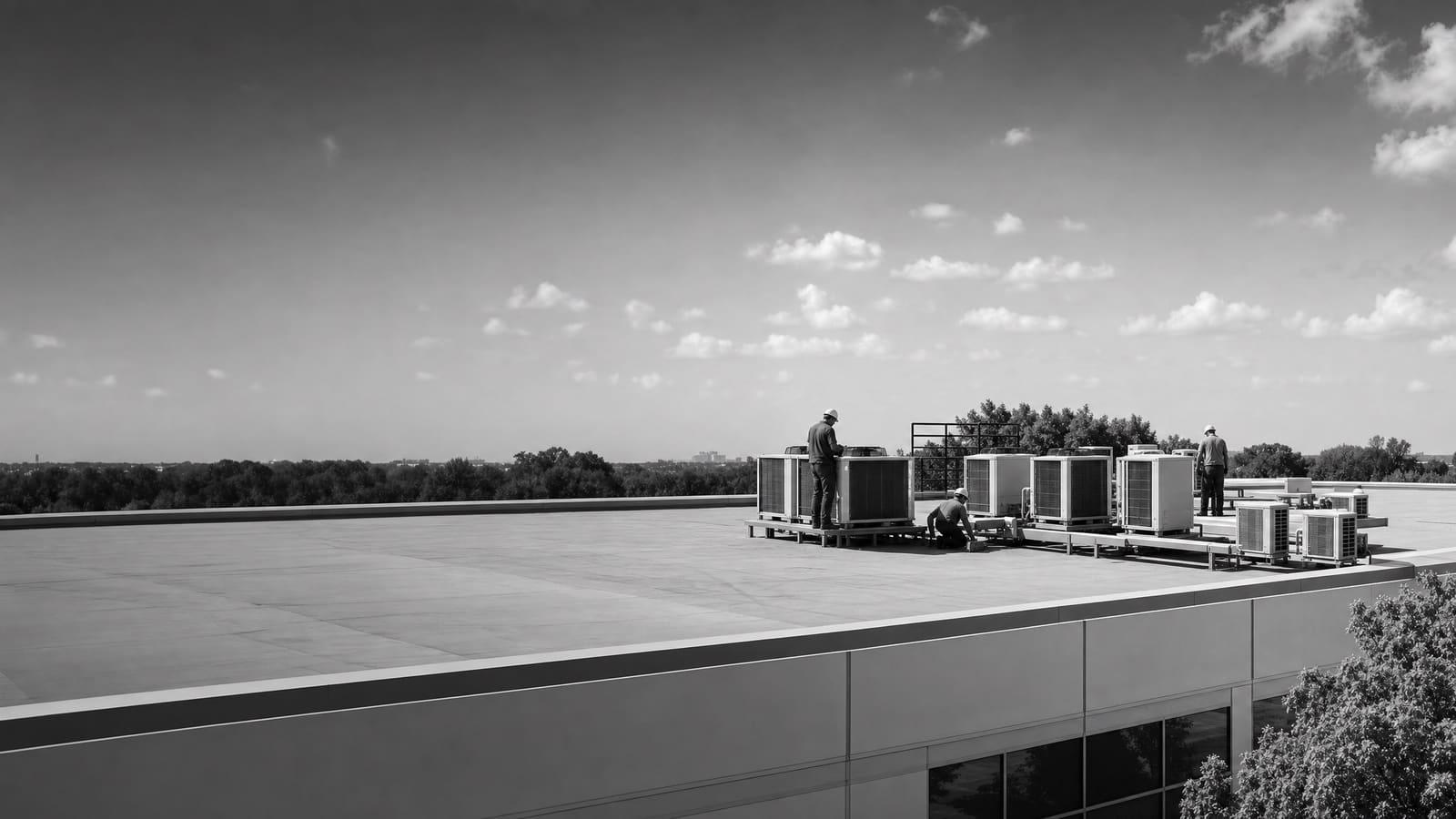
A site review has to verify the curb and roof structure, available electrical capacity, gas line status, crane access, and whether the current tonnage still matches how the space is used.
THREE WAYS TO GO
Three ways to handle an aging commercial unit
Most buyers are choosing between three paths, and the honest difference is timing and control. Waiting for failure is the default, not a plan: the unit picks the date, usually in the middle of a hot week, and you take whatever equipment is available that day. Planned like-for-like replacement puts the date back in your hands and keeps engineering cost low, but it carries forward whatever the old unit got wrong. A planned upgrade to higher-efficiency equipment costs more up front and takes more scoping, but it is the only path that changes what the unit costs to run every month it stays on the roof. The federal push behind high-efficiency rooftop equipment targeted cutting energy use by up to half compared with the older standard, and more than twenty models now exceed that specification. Two hundred-plus organizations that upgraded over 43,000 rooftop units have saved a combined $37 million a year on energy bills.
WHAT MOVES THE NUMBER
Where a commercial HVAC quote actually moves
No two roofs price the same, so read a quote as a set of line items rather than one number. These are the lines that swing hardest between two buildings carrying the same tonnage on paper.
IN PRACTICE
How to choose the equipment, not just the price
Start with the load, not the nameplate. A unit installed twenty years ago was sized for the occupancy, lighting, and equipment that building had then. Rooms got used differently, lighting retrofits cut heat gain, and envelopes got tightened. Sizing off the old plate just reprints an old assumption, and an oversized unit short-cycles its way through comfort complaints for the rest of its life.
Then decide what the unit burns. A like-for-like gas-heat rooftop unit is the low-friction answer when the gas line is there, the electrical service is tight, and the schedule is short. A heat pump rooftop unit is the same basic machine with reverse-cycle heating added, and across most of the South and West it can carry most or all of the winter heating demand on its own. Where it stops being simple is infrastructure: electrical capacity at the panel, physical space on the roof, and what happens to the existing gas line. Dual-fuel keeps gas heat as backup for the coldest hours; all-electric drops it entirely.
The third question is timing. Equipment availability and installer familiarity with the specific technology are real constraints, and both belong in the conversation before you pick a model. A unit you can get in three weeks and a unit you can get in twelve are not the same decision, even at the same price.
SCOPE CHECK
What makes this project simple or complicated
Before you budget, figure out which of these two projects you actually have. The gap between them is usually weeks of schedule and a meaningful share of the installed price.
LOWER COMPLEXITY
Same curb, same fuel, same load
The space is used the way it always was, the tonnage still fits, and the replacement lands on a curb adapter using the existing gas and electrical connections. Permits stay routine, engineering is light, and the visible work is a morning of crane time.
HIGHER COMPLEXITY
New load, new fuel, or new footprint
Occupancy changed, the tonnage moves, or the unit goes all-electric. Now you are checking roof structure, panel capacity, and gas line disposition, and the crane day depends on lot closures and reach. Expect engineering, longer lead time, and more inspection.
THE SITE REVIEW
What a walk of the roof has to settle
A quote that arrives without anyone looking at the roof is a guess wearing a number. The walk exists to answer specific questions, and each one has a price attached.
Structure and curb come first. The existing curb rarely matches a new unit exactly, so someone has to measure it and decide between an adapter and a new curb, then confirm the roof can carry the new weight. Utilities come next. For a gas unit, that means the line, the pressure, and the flue. For an electric or dual-fuel unit, it means panel capacity and whether the building has room for the new load without a service upgrade. Physical constraints matter too: clearance for airflow, room to service the unit, and whether a taller cabinet blocks something.
Then the crane day gets planned backwards. Where the truck sets up, how far it has to reach, which stalls close, and for how long. On a tenant building, that conversation happens weeks ahead, not the morning of.
Finally, refrigerant. The old unit's charge has to be recovered by certified technicians under federal rules, and new equipment ships on newer low-GWP refrigerants, so a mixed fleet needs a service and parts plan that accounts for both.
Ask for this before you sign
A photo of the existing curb and nameplate, the proposed model number with its efficiency rating and lead time, and a written statement of who owns permits, rigging, and commissioning. If any of the three is missing, the quote is not comparable to another one.
OWNING THE DECISION
Two things that outlive the install
The install is a week. The consequences run for the rest of the unit's service life, and two of them show up on every invoice after handoff.
The first is what the unit costs to run. Rooftop equipment conditions close to half of all U.S. commercial floor space, and units past fifteen years old are where the waste concentrates — enough that a single old unit can burn through hundreds to a few thousand dollars a year more than it needs to. That gap is the entire case for replacing before failure instead of after.
The second is who services it. Refrigerant work is federally regulated and has to be done by certified technicians, and newer equipment runs on refrigerants not every mixed fleet is set up for. If you own several buildings, decide early whether you are standardizing on one platform or accepting a split fleet, because that choice quietly sets your parts inventory and service contract for the next decade.
OPERATING COST
Replace before failure, not after
Waiting for a breakdown removes your leverage on equipment choice, price, and schedule at the same time. A planned replacement lets you shop efficiency tiers and lead times instead of taking whatever is on the truck.
SERVICE PLANNING
Decide your fleet standard early
New units arrive on newer refrigerants and require certified handling. Standardizing across buildings simplifies parts, training, and contracts. A split fleet is workable, but it should be a choice rather than a surprise.
PHASING AND PROCUREMENT
Replacing several units without one giant invoice
If you have more than one aging unit, the sequence matters as much as the specification. Rank the roof by condition and consequence, not by age alone. The unit over the server room or the busiest sales floor moves up the list; the one over storage can wait a season. Replacing the worst two this year and the next two after gives you real installed numbers to budget against, and it spreads crane mobilization across fewer trips than a one-at-a-time schedule.
Procurement follows the same logic. Pricing a group of units at once usually earns better equipment pricing and lets a single crane day cover more than one lift. It also forces the specification conversation early, which is where a standard efficiency tier and a standard control platform get chosen on purpose instead of accumulating by accident.
On lifetime cost, compare the whole picture rather than the sticker. A higher-efficiency unit costs more on day one and less every month afterward, and utility incentive programs exist in many territories that shift the math further. Confirm what your own utility offers before you finalize the tier, because that answer moves the payback more than a few points of negotiated equipment discount ever will.
Then write the replacement dates down. A unit installed this year has a known service life, and knowing when it comes due beats discovering it in July.
THE QUOTE CHECKLIST
Five things a comparable quote has to show
Two quotes are only comparable when both spell out the same five things. If one of them leaves an item blank, that is not a lower price. It is a line that shows up later as a change order.
01
Model number and efficiency tier
The exact unit, its efficiency rating, and its tonnage, not just the words like-for-like replacement.
02
Lead time in writing
The actual availability date for that model, and what happens to the schedule if it slips.
03
Curb, structural, and rigging scope
Adapter or new curb, any framing work, and who owns the crane and the lot closure.
04
Utility and controls work
Gas, electrical, and refrigerant line changes, plus integration with the existing building automation system.
05
Permits, startup, and commissioning
Which permits get pulled and by whom, and what is verified and documented at startup.
Get a defensible number
Price the equipment and the building together.
Send the address, operating target, and target opening date. Flux will identify what must be verified before the project can be priced.
Get a free estimateQuestions
Straight answers.
When does replacement beat one more repair?
When the unit is old enough to be running inefficiently, needs frequent service calls, or can no longer hold the space. Rooftop units past fifteen years waste real money every month, so a proactive replacement usually beats waiting for a failure you did not get to schedule.
Should a gas rooftop unit be replaced with a heat pump?
Often it should. Heat pump rooftop units are the same basic machine with reverse-cycle heating added, and across most of the South and West they can cover most or all of the winter heating load. The deciding factors are electrical capacity, physical space, and what happens to the existing gas line. Dual-fuel keeps gas heat as backup for the coldest hours.
How much does a commercial HVAC replacement cost?
Installed price depends on tonnage, efficiency tier, curb and structural work, crane access, and controls, so a credible number follows a real look at the roof. What is easier to pin down is the cost of waiting: an old, inefficient rooftop unit can waste roughly $900 to $3,700 a year in energy on its own.
Who handles permits, the crane, and refrigerant recovery?
The installing contractor should own all three inside the installed price. Refrigerant recovery from the old unit is federally regulated and has to be handled by certified technicians, so confirm in writing that it is included rather than billed to you later.
Will new equipment use a different refrigerant?
New commercial equipment ships on newer low-GWP refrigerants. It changes nothing about how the unit runs on day one, but on a mixed fleet it affects spare parts, technician certification, and what your service contract needs to cover.
Sources used for this guide
- [1]betterbuildingssolutioncenter.energy.gov — DOE Advanced Rooftop Unit Replacement Guidance
- [2]betterbuildingssolutioncenter.energy.gov — DOE Commercial Heat Pump Rooftop Unit Replacement Guidance
- [3]betterbuildingssolutioncenter.energy.gov — DOE High-Efficiency Commercial Rooftop Unit Toolkit
- [4]energy.gov — DOE Efficient Commercial Rooftop Air Conditioner Program
- [5]epa.gov — EPA Stationary HVAC Refrigerant Management