Direct answer
Commercial EV charging prices as equipment plus the electrical path to it.
Federal cost data puts single-connector equipment at roughly $400 to $6,500 for Level 2 and $10,000 to $40,000 for DC fast charging. Installation is a separate number, and distance drives it: past the first 25 feet, every additional 10 feet of conduit typically adds $75 to $150 in labor and material. Run that across a parking lot and the route can cost more than the chargers.
A site review still has to confirm three things: spare capacity in the panel, the measured route from switchgear to the stalls, and what that route crosses. Those move a Santa Fe budget far more than the charger model does.
Match power to the parking
Three operating patterns, three different budgets
Start with how long vehicles actually sit. Level 2 sends alternating current to the vehicle and lets the vehicle's onboard charger set the pace, so extra nameplate power buys nothing if the vehicle cannot accept it. When staff cars, service trucks, or guest vehicles park for hours, time does the work that expensive equipment would otherwise have to do. Federal guidance points workplaces and multifamily properties toward Level 1 and Level 2 for exactly that reason.
DC fast charging moves the conversion equipment outside the vehicle and delivers direct current straight to the battery. That is the right tool when a vehicle has to collect real energy during a short stop, which is why public charging and tight-turnaround fleets keep landing on it. It also asks far more of the property: larger service, more switchgear, and demand charges, which DC fast equipment triggers more readily than Level 1 or Level 2 does.
Level 1 still has a job. Federal fleet guidance notes that 120- or 240-volt receptacles paired with portable units can serve plug-in hybrids and light duty cycles for a fraction of what a pedestal at every stall costs, and a failed portable unit gets swapped rather than serviced in place.
Build the whole number
What belongs in a commercial charging budget
Separate the equipment from the work that powers it. A cheap charger price tells you almost nothing while the conduit run, the panel work, and the pavement restoration are still unpriced. Ask for these as separate lines so you can see which one is actually driving the total.
Do not order hardware first
Pick the equipment after the site and the schedule are settled
A spec sheet cannot tell you whether the building has spare amps, whether your vehicles will accept the advertised rate, or whether the stalls you want can be fed without opening the lot. Federal procurement guidance puts the sequence plainly: scope the site, size the need, talk to the utility, and only then select manufacturers, vendors, and a network provider. Buying the box first is how facilities end up with units too powerful for the available service or too slow for the shift.
Compare more than nameplate kilowatts. Connector type, cable reach, pedestal versus wall mount, weather rating, accessible placement, payment hardware, load-management support, and warranty terms all change what the unit costs to own. Warranty structure matters more than buyers expect. Plans can be fixed-term, renewable, or bundled into the equipment price, and once a term ends the owner absorbs repairs on a device that lives outdoors and gets handled by strangers.
Decide the networking question in the same pass. Networked units collect utilization data, process payment, and support remote diagnostics. Non-networked units cost less and can still collect fees through RFID, a mobile app, or an attendant. Neither answer is automatically right. Write down what the property actually needs to bill, measure, and report, then make vendors show how their equipment does it.
Two lots, two prices
What makes one site cheap and another expensive
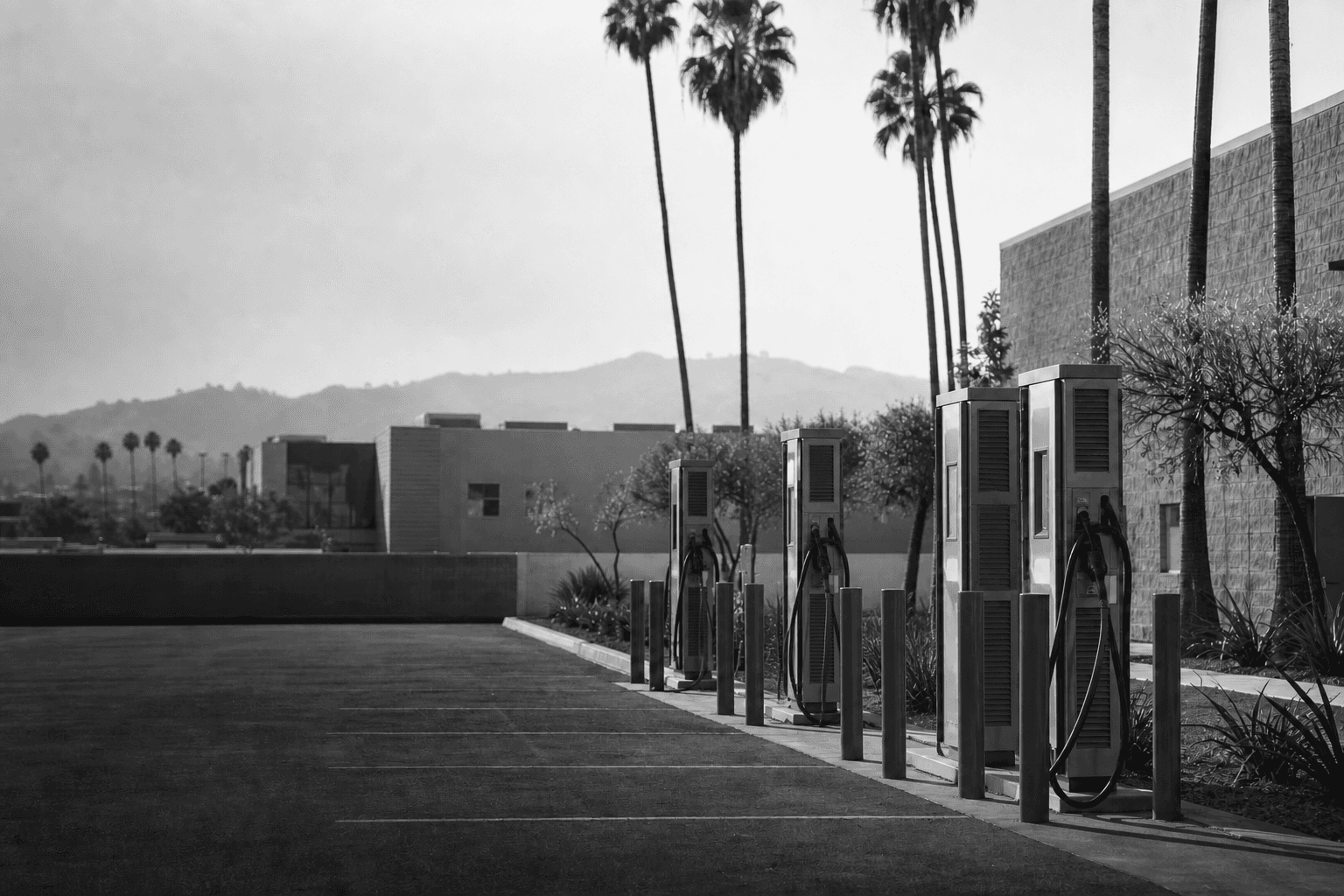
Four Level 2 ports beside the electrical room may need almost no civil work. The same four ports across an occupied lot add trenching, restoration, longer conductors, and voltage-drop math. The equipment did not change. The distance did.
Lower-complexity site
Short route, spare capacity
• Spare breaker space and service headroom
• Chargers placed near existing power
• Conduit run close to the first 25 feet
• Little or no pavement to cut and restore
Higher-complexity site
New capacity, long route
• Load calculation calls for a service upgrade
• Long underground run across active parking
• Boring under drive aisles or fire lanes
• DC fast power with demand-charge exposure
Replace guesses with measurements
The site walk should settle the expensive questions first
The first visit is not a parking-space count. The reviewer should locate the utility service, the transformer, the main switchgear, the distribution panels, and the spare breakers, then run a load calculation under NEC 220 against real demand history instead of nameplate ratings. That calculation is the single biggest swing in a New Mexico quote, because it decides whether a service upgrade sits inside the project or outside it.
Outside, walk the route. Mark proposed charger positions, accessible stalls, pedestrian paths, drainage, bollard locations, and every pavement type the conduit has to cross. A straight line on an aerial photo can run through a fire lane, a storm line, or a loading dock that stays busy all day. Distance is priced by the foot, so a route that looks shorter on paper is worth confirming with a tape and with the people who run the lot.
The operating interview matters just as much. When do vehicles arrive, how long do they stay, who responds when a port goes dark, and does anyone need to be billed? Federal guidance places utility coordination and incentive eligibility in this same phase rather than after design, because programs are approved before construction and rarely pay backward.
A remote number is a range, not a bid.
Photos and a utility bill can narrow the problem. A firm scope needs a measured conduit route, verified spare capacity, and a decision on which stalls are genuinely buildable. Every assumption still waiting on field confirmation belongs in writing on the estimate.
After the install
Ownership terms and funding timing decide the real total
The installation quote is one number; the ownership model is another. A fleet that buys and owns its equipment carries every repair but keeps full control and a lower overall cost. Provider-owned equipment shifts maintenance onto a contract, and that contract is where you look for a response time, a repair time, and an uptime requirement in writing. Plan up to $400 per charger per year for maintenance, and note that annual extended warranties on DC fast chargers can run over $800 per charger. Most networks also sell a maintenance plan for an added annual fee, which is fine as long as you know exactly what it buys.
Funding is the other half of the total. Utility programs in New Mexico are real money, but they are approved before work begins, so the application belongs next to the utility conversation in planning.
Ownership
Decide who fixes it
Own the equipment and you control it but absorb every repair once the warranty term ends. Hand it to a provider and the contract has to name response time, repair time, and an uptime floor, or a dark port becomes nobody's problem.
Funding
Money moves before construction
PNM's program caps Level 2 at $5,000 per port and public DC fast at $50,000 per station, covering up to 100% of project cost in some cases. Other New Mexico utilities set very different caps, so confirm which one serves the address early.
Build once, activate deliberately
Phasing, lifetime cost, and the credit that is no longer on the table
You do not have to energize every future port on day one. The disruptive work — underground conduit, pull boxes, equipment pads, reserved panel space, and communications pathways — can be built while you activate only the ports current demand supports. That is worth the most where the lot will be hard to reopen or where fleet turnover follows a known replacement schedule. Phasing only works with a written plan: final port count, assumed charging power, expansion triggers, and which gear is installed now versus deferred.
Federal support has changed shape. The 30C Alternative Fuel Vehicle Refueling Property Credit covered 30% of qualifying charging property, up to $100,000 per station, for property in an eligible census tract, and tax-exempt and government entities could claim it through elective pay. It applied to charging equipment purchased through June 30, 2026, so for a project starting now it is history rather than a budget line. Anything already placed in service under that window is a filing question for your accountant, not a planning assumption.
That puts utility and state programs at the front of the stack, and it makes the lifetime number matter more. Electricity, demand charges, network subscriptions, maintenance, and eventual replacement all outlive the installation invoice.
Before you compare bids
Five things a comparable quote has to show
Bids only compare when they price the same port count, the same route, and the same scope of civil and utility work. If one excludes trenching or permitting and another includes it, the two totals are not the same number.
01
Port count, charger power level, and the dwell time the design assumes
02
The load calculation, verified spare capacity, and whether a service upgrade is included
03
Measured conduit route in feet, with trenching, boring, and pavement restoration priced
04
Permits, inspections, utility coordination, and commissioning shown as line items
05
Network term, annual fees, warranty length, and who responds when a port fails
Keep planning locally
Related EV charging pages in Santa Fe
Get a defensible number
Price the equipment and the building together.
Send the address, operating target, and target opening date. Flux will identify what must be verified before the project can be priced.
Price my chargersQuestions
Straight answers.
What does the charging equipment itself cost?
Federal cost data puts single-connector Level 2 equipment between $400 and $6,500 and DC fast equipment between $10,000 and $40,000. Level 1 units run $300 to $1,500. Installation is priced separately.
Why do two Santa Fe sites price so differently?
Distance and capacity. Past the first 25 feet, each additional 10 feet of conduit typically adds $75 to $150, and a load calculation that calls for a service upgrade is the single biggest swing in a New Mexico quote.
Is the federal 30C tax credit still available?
No. It applied to charging property purchased through June 30, 2026, at 30% up to $100,000 per station in eligible census tracts. Equipment already placed in service under that window is a filing question; a new project should not budget for it.
What should I plan to spend after installation?
Estimate up to $400 per charger per year for maintenance, plus network fees and electricity. Annual extended warranties on DC fast chargers can exceed $800 per charger, and demand charges hit DC fast sites hardest.
Sources used for this guide
- [1]afdc.energy.gov — Alternative Fuels Data Center: Procurement and Installation for Electric Vehicle Charging Infrastructure
- [2]irs.gov — IRS Alternative Fuel Vehicle Refueling Property Credit
- [3]evchargeracademy.com — EV Charger Installation Cost in New Mexico: 2026 Price Guide | EVCharger Academy
- [4]info.chargepoint.com — New Mexico EV Charging Incentives | ChargePoint
- [5]afdc.energy.gov — Alternative Fuels Data Center: Operation and Maintenance for Electric Vehicle Charging Infrastructure
- [6]afdc.energy.gov — U.S. DOE AFDC Electric Vehicles for Fleets