THE SHORT ANSWER
Hardware runs $3,500 to $90,000 per connector before install
Price the hardware first: about $3,500 per Level 2 connector and $38,000 to $90,000 per DC fast connector. Installation is billed separately, near $2,500 per Level 2 connector and $20,000 to $60,000 per DC fast connector. Hold that total next to the Evergy ceiling before you pick a charger mix, because a fleet site earns up to $65,000 and a workplace site up to $25,000. That covers several Level 2 ports, but only a slice of one fast charger.
These are national planning ranges, not a bid for your property. Your final number shifts with panel and service capacity, how far power must travel to the stalls, pavement cutting, port count, and which rebate tier your site qualifies for.
PICK YOUR LANE
Three ways commercial sites charge
The first cost decision is not which brand of charger to buy. It is how long your vehicles sit still. Federal guidance points workplaces and multifamily buildings toward Level 1 and Level 2 charging, and points public charging hosts toward Level 2 and DC fast charging. That single split can move a project by an order of magnitude, because it changes the service size, the conductor run, and the concrete work.
Level 2 works when a vehicle parks for a shift or a night. DC fast charging earns its cost when dwell time is short. It can add 100 to 200 or more miles of range in 30 minutes, which is why fleets use it between shifts. It also carries an operating penalty: DC fast charging is more likely than Level 1 or Level 2 to trigger demand charges, which are billed on your highest 15-minute average use in a billing period.
One option gets overlooked. Instead of a pedestal at every stall, you can install 120/240-volt receptacles and use portable Level 1 or Level 2 units. That lowers project cost and makes a failed unit simple to swap.
WHERE THE MONEY GOES
The line items that actually move
Two facilities can buy identical chargers and land far apart on price. The difference is almost always what sits between the electrical room and the parking stall. These are the lines to compare first when two Kansas City bids do not match.
BUYING GUIDANCE
How to scope this before you take bids
Order of operations matters more than which vendor you pick. Federal planning guidance is direct about it: set scope, budget, funding, and timeline first, and engage the electric utility early to identify installation needs and costs, including upgrades to electrical service and equipment. A utility conversation that happens after you have signed a purchase order is where budgets break.
Decide the number and type of ports you need both near term and long term. The second half is the part buyers skip. Trenching a parking lot once for eight circuits costs far less than trenching it twice for four. Federal siting guidance names proximity to incoming electricity, proximity to a wireless connection if you need one, weather, and room for future expansion as the factors to weigh, and every one of them lands in the price of EV charger installation.
Then settle two commercial questions before bids arrive. First, will the stations be networked? Networking is what lets you collect utilization data and take payment, it brings ongoing fees, and it is what makes managed load management practical. Second, who owns the equipment? Evaluate ownership during planning, because ownership decides who pays for a failed unit in year four. Write both answers into your request for quotes so every bidder prices the same project.
TWO SITES
What makes the same job cheap or expensive
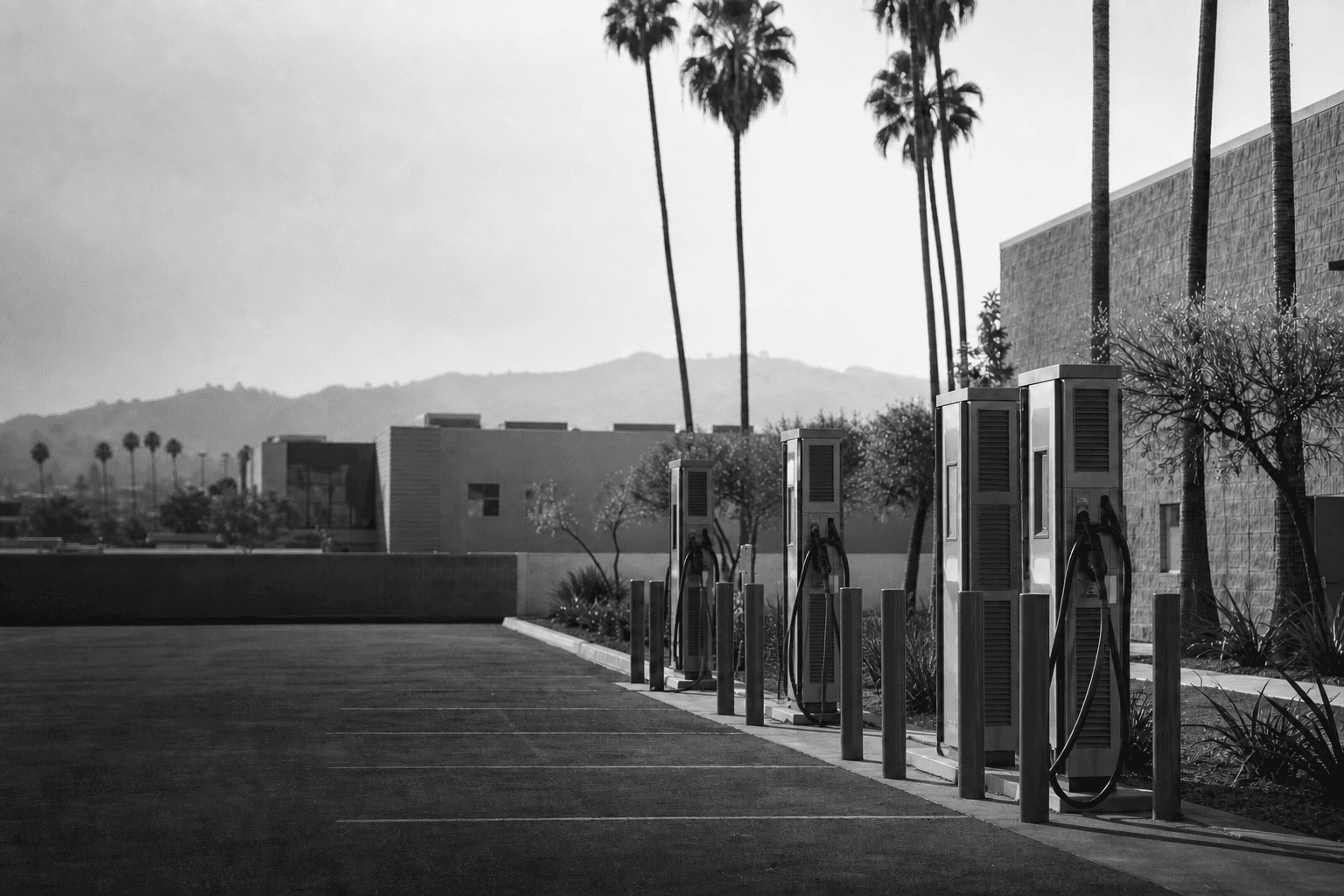
The same eight ports can be a routine electrical job or a small construction project. What separates them is almost never the charger. It is the distance to power, the condition of the parking surface, and whether the existing service has room to spare.
LOWER COMPLEXITY
Short run, spare capacity
The electrical room sits near the parking area, the existing service has headroom, the conduit run is short, and you are installing Level 2 ports for vehicles that park for hours. Permitting is routine and the schedule is measured in weeks.
HIGHER COMPLEXITY
Long run, loaded service
Power sits on the far side of the property, the service is already spoken for, and you want DC fast charging. Now you are pricing utility coordination, a possible service upgrade, long trenching across drive lanes, pad work, and a schedule that follows the utility's calendar instead of yours.
SITE REVIEW
What a good site walk finds
A site walk should end with four answers, and any one of them can move the number by five figures.
Start with capacity. The question is not whether the building has power. It is how much of the service is already committed and what is left once the chargers land. Federal checklists put an early utility conversation about installation needs and costs, including upgrades to electrical service and equipment, near the top of the planning list, because that answer decides everything downstream.
Second, the route. Walk the actual path from the electrical equipment to the stalls. Count the feet. Note every slab, curb, drive lane, and landscape bed the conduit must cross, and ask what restoring each surface costs. This is where two bids on identical chargers separate.
Third, the stalls themselves: which spaces get used, how vehicles pull in, where the cable has to reach, and where accessible parking sits. Fourth, the future. Where do chargers four through ten go, and what can you stub in now while the trench is already open? A walk that skips any of these produces a quote you will renegotiate during construction.
The one question that changes everything
How much spare electrical capacity does this building have today? If it covers your charging load, the project is conduit, concrete, and equipment. If it does not, you are pricing a service upgrade, and that is a different project with a different timeline.
KANSAS CITY SPECIFICS
Permits, inspections, and the local schedule
Kansas City runs building, electrical, and mechanical permits through the Compass KC permitting system, and the development fee schedule sits in Section 18 of the city Building Code. Your contractor pulls the electrical permit, but you should still know the fee basis, because a bid that leaves permits as a vague allowance is not a fixed price.
Inspections are the part that quietly moves a schedule. The city cuts off next-day building permit inspection requests at 4:00 PM, and the cutoff for eligible same-day priority two-hour inspections is 1:00 PM. Inspections are scheduled through Compass KC, by phone, or by email. Larger projects can also trigger special inspections under the Kansas City Building and Rehabilitation Code, which are periodic or continuous observations tied to plans sealed by the engineer or architect of record.
Ask these before you sign
Who pulls the electrical permit, does the drawing set need a sealed design professional, and do special inspections apply to this scope? Those three answers set both your permit line and your realistic in-service date.
AFTER THE INSTALL
Who owns it, and who pays to run it
Two decisions outlive the installation. The first is who owns the equipment. Federal planning guidance treats ownership as something you evaluate up front, alongside whether the stations need to be networked, because ownership decides who carries the repair bill later. Some site hosts buy and own outright. Others let a provider own the hardware. Neither is wrong, but they look very different in year five.
The second is whether you charge for use. Hosts who want to recover costs can bill by kilowatt-hour, by session, by length of time, or through a subscription. Session and time-based pricing is common in states where non-utilities are not allowed to resell electricity. Worth knowing: more than 20% of public charging in the United States is still free to use, so free charging is a legitimate amenity strategy rather than a mistake. Utilization decides which model actually pays back.
OWNERSHIP
Own it or host it
Owning the hardware gives you control over pricing, uptime, and data. Hosting a provider's equipment moves capital cost and repairs off your books, along with the pricing decision and the revenue. Settle this before the request for quotes goes out, not after.
COST RECOVERY
Free, metered, or subscription
Free charging works as a tenant or employee amenity. Metered pricing by kilowatt-hour or session makes sense when demand is real and you want the equipment to pay for itself. Match the model to how full the stalls actually get.
OVER THE LIFE
Phase the trench, then look past year one
Phase the concrete, not the chargers. The expensive, disruptive part of this project is getting power to the parking area: trenching, conduit, and pad work. Chargers are the easy part to add later. So build make-ready capacity for where you want to end up, and hang only the ports you need today.
Sequence the money too, because this part has a deadline attached. Evergy's commercial charging rebates run in three steps: review the qualifications, apply and wait for pre-approval, then finish the paperwork once the stations are installed and in service. Pre-approval comes before installation. A facility that buys and installs first can spend a rebate it will never collect. On the federal side, the 30C credit depends on eligible locations, and Argonne National Laboratory publishes a locator you can check by address before you commit.
Then look past year one. Running cost is electricity plus maintenance plus network fees. Electricity is not only cents per kilowatt-hour. Demand charges are billed on your highest 15-minute average use in a billing period, and DC fast charging is far more likely to trigger them. Evergy's business EV rate plan rewards charging outside the 4 to 8 p.m. high-demand window, so a shift to overnight charging plus a real charger maintenance plan can matter more to five-year cost than the equipment price.
QUOTE CHECKLIST
Five things every bid should show
Bids that look different are often pricing different projects. Ask every contractor to put these five things in writing. Once all three quotes carry the same five lines, you can compare them honestly, and you will usually find the gap is scope rather than markup.
01
Service capacity findings
Existing available capacity, the load the chargers add, and whether a service upgrade is in scope or excluded.
02
The route to the stalls
Linear feet of trench and conduit from the source to each stall, plus asphalt or concrete restoration.
03
Equipment and port count
Make, model, charging level, ports per unit, and what gets stubbed in now for future units.
04
Permits and inspections
Permit fees, the drawing set, any special inspection scope, and who schedules inspections with the city.
05
Warranty, network, and service
Warranty term, annual network fee, uptime commitment, and guaranteed response time for a repair.
Keep planning locally
Related EV charging pages in Kansas City
Get a defensible number
Price the equipment and the building together.
Send the address, operating target, and target opening date. Flux will identify what must be verified before the project can be priced.
Price my chargersQuestions
Straight answers.
How much can incentives cover on a Kansas City commercial charging project?
Evergy offers commercial rebates of up to $65,000 for fleet charging, up to $40,000 for public charging in Missouri, and up to $25,000 for workplace or tenant charging, with limits on ports per site. The federal 30C credit can cover up to 30% of purchase and installation cost in eligible locations. Apply for the Evergy rebate and get pre-approved before you install.
Do we need an electrical service upgrade to add chargers?
Not always. It depends on how much of your existing service is already committed and how much load the chargers add. Federal planning guidance puts an early utility conversation about service and equipment upgrades near the top of the checklist, because that answer sets the budget. Networked systems also make managed charging easier, which spreads demand instead of adding it all at once.
What does it cost to run chargers after installation?
Plan on electricity, maintenance, and network fees. Station owners should estimate up to $400 per charger annually for maintenance, and annual extended warranties for DC fast chargers can run over $800 per charger per year. Demand charges, billed on your highest 15-minute average use in a billing period, are the line most facilities underestimate.
How do Kansas City permits and inspections affect the schedule?
Building and electrical permits go through the city's Compass KC system, and fees follow the development fee schedule in Section 18 of the Building Code. Timing matters: next-day inspection requests cut off at 4:00 PM, and eligible same-day priority two-hour inspections cut off at 1:00 PM. Larger projects may also require special inspections tied to sealed plans.
Should we install Level 2 or DC fast charging?
Follow dwell time. If vehicles sit for a shift or overnight, Level 2 covers the need at a much lower installed cost. DC fast charging fits short dwell, since it can add 100 to 200 or more miles of range in 30 minutes, but it costs more to install and is more likely to trigger demand charges.
Can we start with a few ports and expand later?
Yes, and it is usually the cheaper path. Trenching and conduit are the disruptive costs, so size the underground work and the electrical room for where you want to end up, then add ports as demand grows. Federal siting guidance lists future expansion as a factor to weigh when you choose the charging location.
Sources used for this guide
- [1]afdc.energy.gov — Alternative Fuels Data Center: Procurement and Installation for Electric Vehicle Charging Infrastructure
- [2]kcmo.gov — Permits | CITY OF KANSAS CITY | OFFICIAL WEBSITE
- [3]evergy.com — Evergy Commercial EV Charging Rebates
- [4]afdc.energy.gov — Alternative Fuels Data Center: Operation and Maintenance for Electric Vehicle Charging Infrastructure
- [5]afdc.energy.gov — U.S. DOE AFDC Electric Vehicles for Fleets
- [6]kcmo.gov — Inspections | CITY OF KANSAS CITY | OFFICIAL WEBSITE