THE SHORT ANSWER
What a commercial HVAC replacement includes
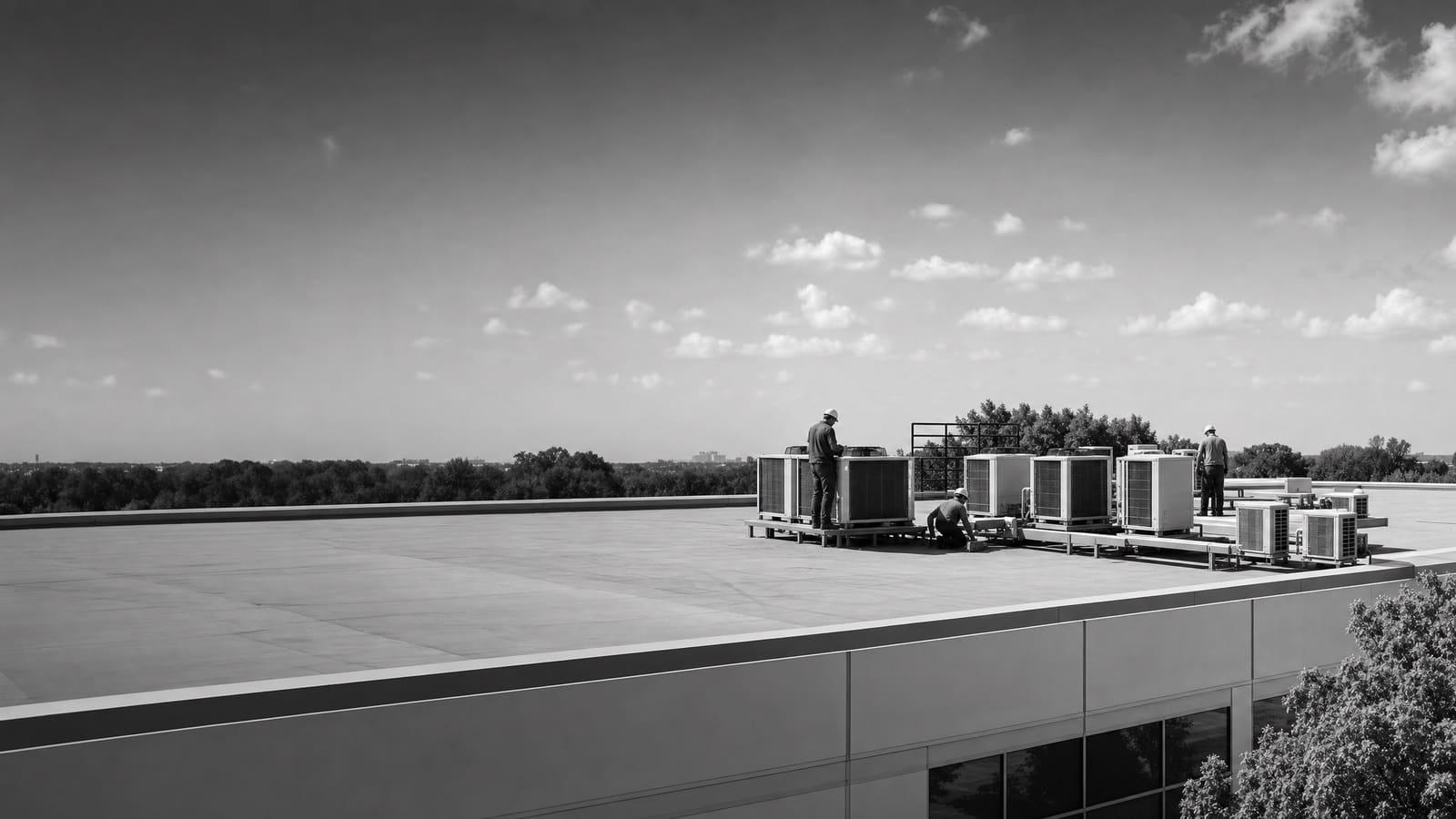
A commercial HVAC replacement covers the load review, equipment selection, refrigerant recovery, rigging and set, mechanical and electrical connections, permits, and commissioning. Replacement usually beats one more repair once a unit passes fifteen years and still costs you comfort calls. Department of Energy figures put the annual energy waste of an old, inefficient rooftop unit at $900 to $3,700 per unit, which is money a repair never gives back.
A site review still sets the price. It has to confirm tonnage against current occupancy, the curb and roof structure, available electrical capacity, and how a crane reaches the unit.
THREE WAYS TO GO
Three replacement paths, and who each one fits
Most buyers are choosing between three things, and the choice is usually made before anyone looks at a price. Like-for-like is the fastest way back to cooling and the cheapest to engineer, but it carries forward whatever sizing mistake the old unit had. A right-sized replacement recalculates the load against how the space is used now, which is the honest option when occupancy, tenant fit-out, or plug loads have changed since the original install. An electric heat pump rooftop unit is the third path, and it is a live option here. Department of Energy guidance treats today's heat pump rooftop units as capable of handling most or all of the winter heating demand across the U.S. West, where winters are mild. What it needs from your building is electrical capacity and roof space, so that gets confirmed before it goes on a quote.
WHAT MOVES THE NUMBER
Where the money actually goes
Installed price is mostly equipment, but the surprises are almost never equipment. These are the lines that move a quote after the fact, so have them priced up front instead of left open.
BUYING GUIDANCE
Buy on a plan, not in a panic
Most rooftop units get replaced the day they die, in the week the building can least afford it. Department of Energy guidance is blunt about the cost of that habit: units over fifteen years old waste substantial energy and money compared with current models, and facility managers tend to wait until the equipment fails outright or stops holding the space. Replacing on your own schedule is not only a comfort decision. It is the only version of this project where you get to compare equipment, absorb a real lead time, and choose the week the crane shows up.
The efficiency gap is large enough to matter. The high-efficiency rooftop specification the Department of Energy developed with manufacturers targeted up to fifty percent less energy use than the standard units of the time, and more than twenty models now exceed it. That does not make the premium tier automatic. It makes it worth pricing side by side with the base unit, against your actual run hours, before you decide the cheaper box is the cheaper box.
Ask for both numbers on the same page: installed cost and expected annual operating cost. A unit that costs more to buy and less to run is an easy decision to defend once the second number is written down.
COMPLEXITY CHECK
What makes this a simple job or a hard one
Two jobs with the same tonnage can be a week apart on schedule and far apart on price. The difference is almost always access, power, and whether the new unit fits the hole the old one left.
LOWER COMPLEXITY
Straight swap on an open roof
Matching tonnage, the existing curb, electrical service that is already adequate, and a crane that can set up in a lot you control. Permit scope stays mechanical and electrical, and the unit is set and connected in a morning.
HIGHER COMPLEXITY
New footprint, new power, tight site
A larger unit, a curb adapter or structural review, a panel that needs upsizing, and a crane that has to reach over an occupied building or a street. Add controls integration and the schedule stretches from days into weeks.
BEFORE YOU BUY
What the site review has to settle
The quote is only as good as the walk that produced it. Department of Energy guidance for rooftop replacement lists what decides feasibility, and the list is almost entirely physical: electrical capacity, physical constraints on the roof, gas lines, equipment availability, and whether contractors in the area are set up to install and service the technology you picked. None of those get answered from a nameplate photo.
Electrical capacity is the one that stops projects. A higher-efficiency unit or an electric heat pump can draw more than the equipment it replaces, and finding that out after the order is placed turns a two-day job into a service upgrade with its own timeline. Roof constraints come next: curb size, structural capacity, clearance to neighboring units, and whether the crane has both a path and a place to stand.
Equipment availability belongs in the same conversation. Lead time is part of the decision, not a footnote to it. A contractor who gives you a price without a delivery date has given you half a quote.
Ask for this before you sign
One page listing tonnage and efficiency tier, confirmed electrical capacity, curb and structural scope, the crane and lot plan, permit responsibility, and a delivery date. Any line left blank is where the change order comes from.
IN IRVINE
Permits, and the roof you are already standing on
California building departments permit HVAC work on its own application, and the same permit families cover mechanical and electrical upgrades or repairs alongside re-roofing. Confirm the exact requirements with the Irvine building division before equipment is ordered, because the permit path affects your schedule more than it affects your price.
That overlap is worth a decision, not just a checkbox. If the roof under the unit is within a few years of replacement, the change-out is the cheapest time to deal with it. The crane is already scheduled, the curb is already open, and the membrane around it is already getting cut. Doing it later means a second mobilization and a second permit on a roof that is now carrying new equipment.
Climate helps the equipment choice here. Regional guidance treats mild-winter West locations as good candidates for a heat pump rooftop unit as the primary heat source, which is not true everywhere in the country.
One local decision worth making early
Pull the roof into the scope conversation at the same time as the unit. Ask your contractor to quote the change-out with and without the surrounding roof work, then decide once, with both numbers in front of you.
OWNERSHIP
Two things that outlive the install
The install ends in a day or two. What you signed for lasts fifteen to twenty-five years, and two decisions made at purchase set how that stretch goes. The first is refrigerant. New commercial equipment ships on newer low-GWP refrigerants, and federal rules under Section 608 of the Clean Air Act govern how refrigerant is handled and recycled in stationary air conditioning and heat pump equipment. That means certified recovery when the old unit comes off, and it means a roof where two units no longer take the same charge. The second is who services what you bought. Equipment nobody nearby is set up to maintain is a slow problem, and it surfaces in month eighteen, not week one.
REFRIGERANT
Plan for a mixed roof
Recovery from the old unit has to be handled under federal rules by certified technicians. After that, your service contract and spare-parts plan carry two refrigerants until the rest of the fleet turns over.
SERVICEABILITY
Buy what can be serviced
Before selecting, confirm that contractors in the area install and service the model and technology you chose. Availability of qualified labor is part of the equipment decision, not an afterthought.
PHASING
If you have more than one unit
A building with six rooftop units has a different problem than a building with one. Replacing all six at once buys you a single mobilization, one crane, one permit cycle, and a fleet that ages together, which means it will also need replacing together in twenty years. Replacing them as they fail gives you the opposite: no capital spike, a permanent maintenance load, and the emergency premium every time one drops in August.
The middle path is a ranked plan. Rate each unit by age, run hours, repair history, and how much the space it serves actually matters. Replace the worst two now, budget the next two for the following cycle, and put the rest on a watch list with an agreed trigger, such as a compressor failure, a second major repair in one season, or a set age.
Procurement gets easier once that list exists. You can hold one specification across units, negotiate against a known quantity, and place orders early enough that lead time stops being an emergency. Organizations that upgraded rooftop units through the Department of Energy's replacement campaign treated it as a program rather than a series of surprises: more than 43,000 units, and roughly $37 million a year in combined energy savings.
COMPARING QUOTES
Five things every bid should state
Bids that look far apart are usually just scoped apart. Make each one show the same five things and the comparison takes ten minutes instead of a meeting.
01
Equipment, in full
Manufacturer, model, tonnage, efficiency tier, refrigerant, and heat source. Not "a 10-ton unit."
02
A delivery date
Quoted lead time for that specific unit, and what happens to the price if it slips.
03
Curb, roof, and rigging
Curb adapter or reuse, any structural work, crane size, staging area, and hours the lot is closed.
04
Electrical and gas scope
Confirmed service capacity, any panel or feeder work, and how the existing gas line is handled.
05
Permits and commissioning
Who pulls and pays for permits, and which startup readings get documented at handoff.
Get a defensible number
Price the equipment and the building together.
Send the address, operating target, and target opening date. Flux will identify what must be verified before the project can be priced.
Get a free estimateQuestions
Straight answers.
When is replacement smarter than another repair?
Age plus repair pattern usually decides it. Federal rooftop guidance flags units over fifteen years old as substantial energy wasters compared with current models, and puts the annual waste of an old, inefficient unit at $900 to $3,700. Once a unit is in that range and taking repeated repairs, the money spent keeping it alive is money that never comes back.
Should the replacement be like-for-like or resized?
Confirm the load either way. If the space and how it is used have not changed since the original install, like-for-like is often correct and it is the fastest path back to cooling. If occupancy, tenant fit-out, or equipment load has changed, resizing fixes comfort problems the old tonnage was never able to solve.
Is an electric heat pump rooftop unit a real option here?
It is worth pricing. Federal guidance treats today's heat pump rooftop units as capable of covering most or all winter heating demand across the mild-winter West. What decides it for your building is electrical capacity, roof space and physical constraints, what happens to the existing gas line, and whether local contractors are set up to service the technology.
Does a rooftop replacement in Irvine need a permit?
Plan on it. California building departments permit HVAC work on its own application, in the same family that covers mechanical and electrical upgrades and re-roofing. Confirm the specifics with the Irvine building division before ordering equipment, and ask your contractor to state in the quote who pulls the permits and who schedules the inspections.
What happens to the refrigerant in the old unit?
It gets recovered, not vented. EPA rules under Section 608 of the Clean Air Act govern how refrigerant is handled and recycled in stationary air conditioning and heat pump equipment, so recovery is certified work and part of the installed scope. New equipment ships on newer low-GWP refrigerants, which is worth planning for in service contracts covering a mixed fleet.
Sources used for this guide
- [1]betterbuildingssolutioncenter.energy.gov — DOE Advanced Rooftop Unit Replacement Guidance
- [2]betterbuildingssolutioncenter.energy.gov — DOE Commercial Heat Pump Rooftop Unit Replacement Guidance
- [3]betterbuildingssolutioncenter.energy.gov — DOE High-Efficiency Commercial Rooftop Unit Toolkit
- [4]energy.gov — DOE Efficient Commercial Rooftop Air Conditioner Program
- [5]epa.gov — EPA Stationary HVAC Refrigerant Management
- [6]californiacity-ca.gov — HVAC Permits