THE SHORT VERSION
What a commercial HVAC replacement includes
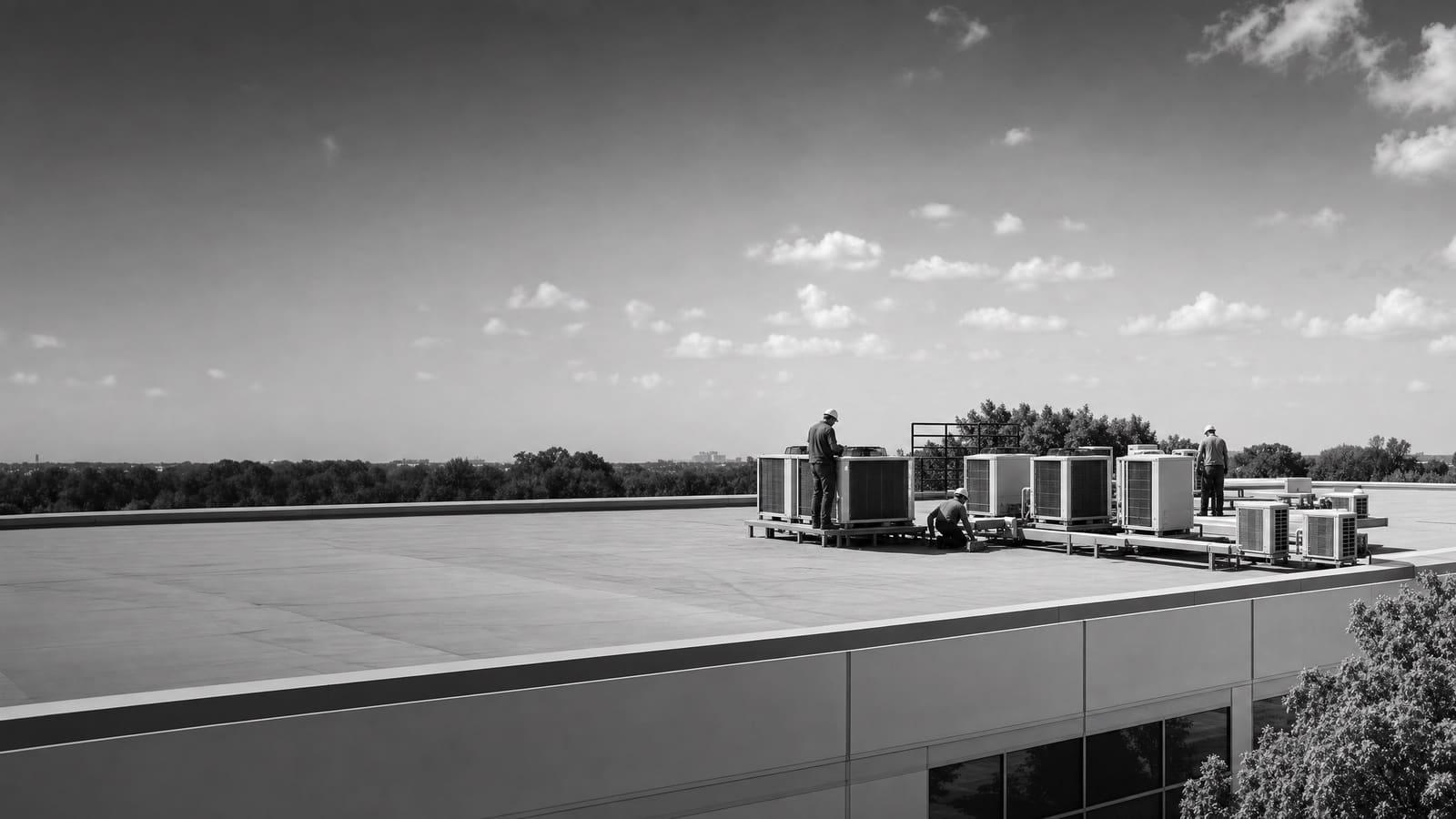
A commercial HVAC replacement covers a confirmed load calculation, equipment selected against real lead times, curb and rigging work, mechanical and electrical connections, controls integration, and documented commissioning. Replacement beats another repair once the unit is past roughly fifteen years, once repairs start repeating, or once it can no longer hold the space on a design day. Rooftop units that old commonly waste between $900 and $3,700 per unit every year against current equipment, which is usually the number that settles the argument.
A site review still has to verify curb size and roof structure, available electrical capacity, gas and refrigerant routing, crane access, and whether the replacement triggers requirements the old unit never had.
THREE WAYS TO GO
Three ways to handle an aging rooftop unit
Most buildings end up on one of three paths, usually by default rather than on purpose. The first is replacement on failure: wait until the unit stops holding the space, then buy whatever can ship that week. The second is a planned like-for-like swap at the end of service life, same tonnage and same fuel, scheduled when the building can spare the roof. The third is a planned upgrade, where the replacement is chosen for efficiency or moves heating from gas to a heat pump. Federal efficiency work pushed high-efficiency rooftop units into the mainstream, and the units built to the original high-performance specification were designed to cut rooftop energy use by up to half against the older minimum standard. More than twenty models now exceed that specification. The difference between the three paths is not the crane day. It is what the unit costs to run for the next fifteen years.
WHAT MOVES THE NUMBER
What drives commercial HVAC installation cost
There is no single installed price for a commercial unit, because a large share of the money sits outside the equipment itself. These are the lines that move a quote up or down, roughly in the order they surprise people.
IN PRACTICE
Choosing the replacement unit
The equipment decision comes down to three questions: how much capacity the space actually needs, how efficient the unit should be, and whether heating stays on gas.
Capacity should come from how the building is used today, not from the nameplate on the failed unit. Twenty years changes occupancy, plug load, lighting, and sometimes the envelope. A unit sized for the old building can be oversized for the current one, which costs money to buy and shows up later as short cycling and humidity complaints.
Efficiency is a spending decision more than a technical one. Because older units waste $900 to $3,700 each year against current equipment, the premium for a better tier gets paid back out of the operating budget rather than the capital budget.
Fuel is the third question. A heat pump rooftop unit is mechanically similar to a standard air-conditioning unit but reverses to provide heating. Across most of the South and West, current heat pump units can carry most or all of a building's winter heating demand, which makes all-electric and dual-fuel configurations realistic rather than experimental. What decides it is electrical capacity at the building, local electricity and gas prices, and whether the unit you want is actually available.
SCOPE CHECK
What makes a replacement simple or complicated
Two replacements with identical tonnage can differ sharply in price and duration. The difference is almost never the unit itself. It is what the unit connects to and how hard it is to get up there.
LOWER COMPLEXITY
A straightforward swap
Same tonnage and fuel, same curb footprint, adequate electrical service already at the roof, clear crane access from an area you can close for one morning, and stand-alone controls. Set and connected in a day, with startup the same week.
HIGHER COMPLEXITY
A project, not a swap
A different footprint or heavier unit, a fuel change that needs new electrical capacity, tight access that forces a larger crane and outside coordination, integration into building automation, or a space that has to stay conditioned through the work.
BEFORE YOU BUY
What the site review has to confirm
A quote written from a phone call is a guess. The site review is where the price becomes real, and it is short, usually a couple of hours on the roof and in the electrical room.
Start with the unit: nameplate tonnage, voltage, phase, fuel, refrigerant, and age. Then the curb. If the replacement has a different footprint it needs an adapter, and the adapter has to be measured rather than assumed. Roof structure matters whenever the new unit is heavier or larger than the one coming off.
Infrastructure comes next, and it is where electric conversions live or die. Available capacity at the panel, spare breaker space, feeder size, and the run from the panel to the roof decide whether a heat pump unit is a swap or a project. Gas lines get the same treatment in reverse when heating moves off gas.
Then access: crane reach, staging space, which stalls close, and for how long. Finally controls, meaning what the current unit talks to and what the new one has to talk to. Equipment availability belongs in the same conversation. The best-fitting unit is the wrong answer if it ships in twelve weeks and the building needs cooling now.
Bring these to the walkthrough
A nameplate photo, last year's utility bills, the roof age and any warranty still on it, your electrical panel schedule, and the hours the building can lose the space. Those five items answer most of the questions that otherwise become change orders.
OWNERSHIP
Two decisions that outlive the install
The install takes a week. The unit is on the roof for fifteen years or more, and two decisions made during the project set what those years cost.
The first is refrigerant. New commercial equipment ships on newer, lower-global-warming-potential refrigerants, and federal rules govern how refrigerant is handled, serviced, and recovered by certified technicians. None of that changes day-one operation. It does change how you plan service contracts and spare parts on a roof holding several vintages at once.
The second is who carries the cost. In a leased building the replacement is usually capital while the operating savings land on someone else's utility bill. That split is worth settling before the quote is signed, because it decides whether an efficiency upgrade is a good investment for the party actually funding it.
REFRIGERANT
Plan for a mixed fleet
If the roof holds five units and you replace one a year, you will run two refrigerants side by side for years. Keep the service contract, technician certification, and parts stock aligned with what is actually up there.
LEASE STRUCTURE
Match who pays to who saves
When the owner buys the unit and the tenant pays the power bill, an efficiency upgrade needs a mechanism, whether a pass-through, a rent adjustment, or a shared-savings term. Without one, nobody has a reason to fund the better unit.
PLANNING AHEAD
Phasing a roof with several units
Most commercial roofs do not hold one unit. They hold four, or nine, or thirty, installed the same year and aging at the same rate. That makes the replacement question a scheduling question.
Replacing on failure spreads the spending but concentrates the pain. Every failure is an emergency, every emergency buys whatever is available, and the fleet never becomes any more consistent. Phasing does the opposite. Rank units by age, condition, and how critical the space is, then replace two or three a year on planned crane days with equipment ordered months ahead. Rigging costs less per unit when several are set the same morning, and over a few years the roof converges on one or two models instead of nine.
The savings are not theoretical. In one national upgrade campaign, more than two hundred organizations replaced or retrofitted over 43,000 rooftop units and cut a combined $37 million a year from their energy bills.
Procurement follows the same logic. Lock the specification once, price on a fleet basis instead of unit by unit, and ask about lead times before you ask about price. Ask about available utility and program incentives before the order goes in rather than after the unit is set.
APPLES TO APPLES
Five things a comparable quote should show
Two quotes for the same roof are only comparable when both spell out the same five things. If one is missing an item, that work did not disappear. It just moved into a change order.
01
The unit, named exactly
Manufacturer, model, tonnage, efficiency tier, heating type, and refrigerant, not just "replacement rooftop unit."
02
Equipment lead time
A real availability date next to the price, plus what happens to the schedule if that date slips.
03
Curb, structure, and rigging
Adapter or new curb, any structural work, crane size, staging area, and how long the lot is closed.
04
Connections and any capacity work
Electrical, gas, refrigerant, duct transitions, and any panel or feeder upgrade the new unit requires.
05
Commissioning and closeout
Startup, charge and airflow verification, control settings, permits and inspections, warranty registration, and documentation handed over.
Get a defensible number
Price the equipment and the building together.
Send the address, operating target, and target opening date. Flux will identify what must be verified before the project can be priced.
Get a free estimateQuestions
Straight answers.
When is replacement a better call than another repair?
When the unit is past roughly fifteen years, when repairs start repeating, or when it can no longer hold the space. Units that old waste real money every year, and replacing proactively beats replacing on failure because you choose the equipment instead of taking whatever is available.
Should the replacement be like-for-like or right-sized?
Confirm the load either way. If occupancy, equipment, and operating hours have not changed, like-for-like is often correct and it is the fastest path back to cooling. If the space is used differently than it once was, right-sizing fixes comfort problems the old unit never could.
Is a heat pump rooftop unit a realistic replacement?
Frequently, yes. Heat pump rooftop units are technologically similar to standard air-conditioning units and add reverse-cycle heating. Across most of the South and West they can handle most or all of a building's winter heating. The gate is electrical capacity at the building, plus local electricity and gas prices.
Why will nobody quote a rooftop replacement over the phone?
Because most of the cost sits outside the equipment. Curb fit, roof structure, electrical capacity, crane access, and controls integration can differ by a wide margin between two buildings with identical tonnage. A short site review turns those unknowns into a number you can hold someone to.
How long does the work take?
On site, a single packaged replacement is typically a day or two: crane set, connections, then startup. Equipment lead time is the honest variable and it can run weeks, which is why availability belongs on the quote right next to the price.
What does a new unit change about refrigerant service?
New commercial equipment ships on newer low-GWP refrigerants, and handling, recovery, and technician certification are governed by federal rules. Day-one operation is unaffected. The practical effect is on planning, since a roof with mixed vintages runs more than one refrigerant and the service contract should say so.
Sources used for this guide
- [1]betterbuildingssolutioncenter.energy.gov — DOE Advanced Rooftop Unit Replacement Guidance
- [2]betterbuildingssolutioncenter.energy.gov — DOE Commercial Heat Pump Rooftop Unit Replacement Guidance
- [3]betterbuildingssolutioncenter.energy.gov — DOE High-Efficiency Commercial Rooftop Unit Toolkit
- [4]energy.gov — DOE Efficient Commercial Rooftop Air Conditioner Program
- [5]epa.gov — EPA Stationary HVAC Refrigerant Management