THE DIRECT ANSWER
What a commercial HVAC replacement includes
A commercial HVAC replacement covers confirming the load for how the building is used now, selecting equipment against real availability, the rigging and curb work to land it, the gas, electric, and control connections, and commissioning before handoff. Replacement beats another repair once the unit is old enough that the waste is continuous — federal guidance flags rooftop units over 15 years old, with inefficient units wasting roughly $900 to $3,700 each per year.
No number is real until someone measures the curb, checks the roof structure, and confirms the electrical service and crane path. Those three items move price and schedule more than the unit itself.
THE THREE CHOICES
Repair again, swap like-for-like, or right-size
Most buyers are choosing between three paths, and the honest comparison is not price against price. It is price against how many more seasons the building gets, and what the unit costs to run in the meantime.
Federal guidance is blunt about the common failure mode: owners wait until the unit no longer conditions the space, needs constant service, or dies outright. Replacing proactively usually beats replacement-on-failure, because a planned swap is scheduled around your operating hours instead of an emergency crane call in July. It can also beat a straight like-for-like swap at end of life, since newer efficiency tiers cut energy use meaningfully against older equipment.
Which path fits depends on how much has changed inside the building. Same tenant, same hours, same equipment load, and a matched replacement is usually right. Different occupancy, added plug loads, or comfort complaints the old unit never solved, and the load calculation is worth doing first.
WHAT MOVES THE NUMBER
Where commercial installation budgets actually move
There is no universal installed price for commercial HVAC, and any number quoted before someone sees the roof is a guess. These are the line items that separate two bids on the same building, and each one should appear on the quote as its own number rather than folded into a single total.
IN PRACTICE
Reading the equipment decision honestly
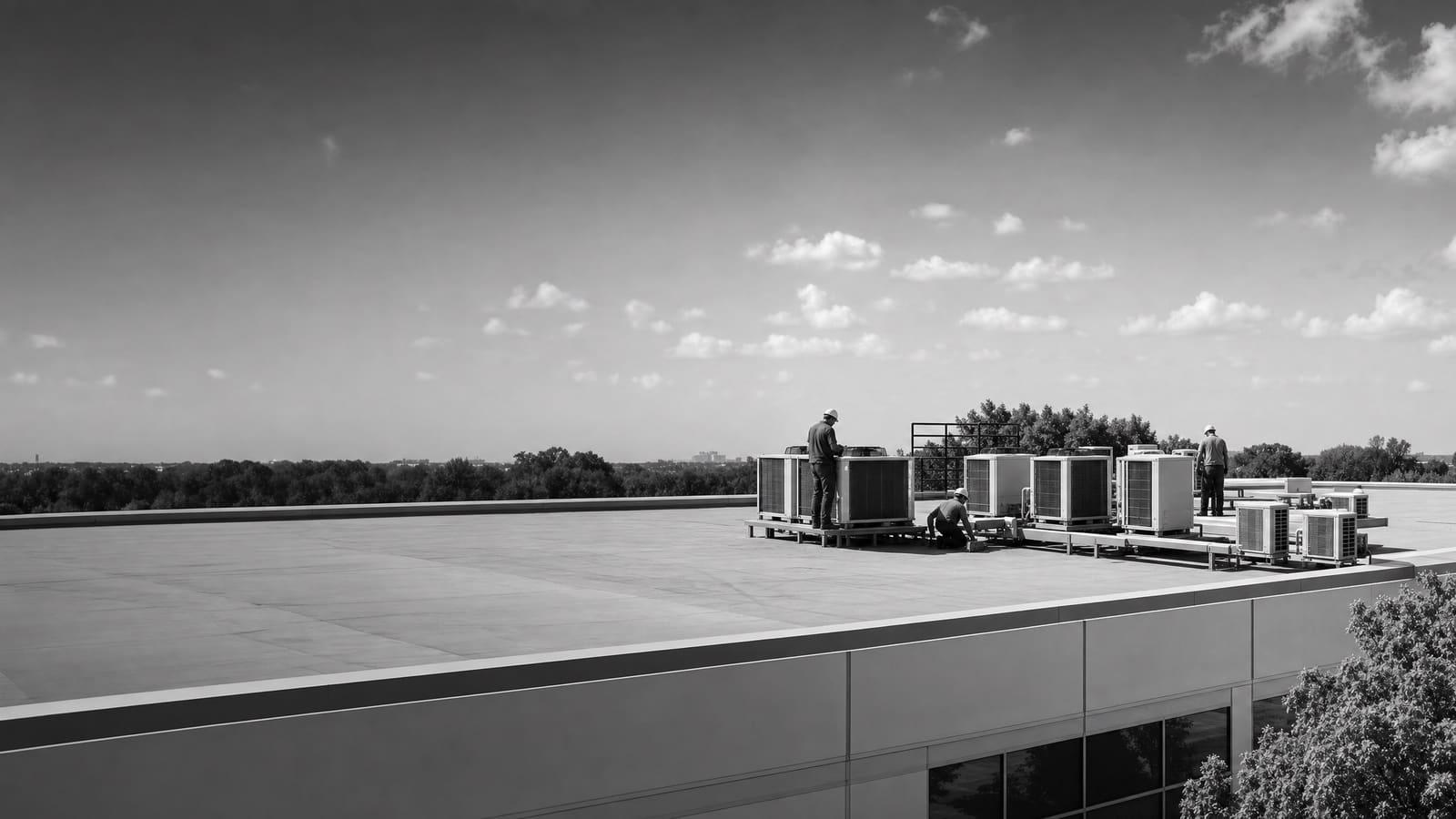
The visible part of a rooftop replacement is one morning. The crane arrives, stalls are coned, the old unit comes off, and the new one lands on a curb adapter measured weeks earlier. Everything that makes that morning uneventful happened before it: the rigging plan, the structural check, confirmed gas and electrical, and a weather call the day before.
The decision worth spending real time on is what lands on that curb. Rooftop units condition close to half of all commercial floor space in the country, so the market is deep and the spread between efficiency tiers is wide. Federal work with manufacturers produced units specified to cut energy use by up to half against the older standard, and a range of models has since exceeded that specification. That spread is why the cheapest unit on the bid sheet is rarely the cheapest unit to own.
The second question is fuel. Heat pump rooftop units are mechanically similar to air-conditioning units but add reverse-cycle heating, and they come in dual-fuel, all-electric, and cold-climate versions. Federal guidance notes that heat pump efficiency falls as outdoor temperatures drop, so these units do their best work where winter heating demand is mild to moderate. That makes fuel a building-level question about winter heating hours, electricity and gas prices at your meter, and whether the panel can carry the load.
COMPLEXITY CHECK
What makes a replacement simple or hard
Two buildings with the same tonnage can be a one-morning job and a three-week project. The difference is almost never the unit itself. It is what the unit has to connect to, and what the crane has to reach over.
LOWER COMPLEXITY
Matched swap on an open roof
Same tonnage on the existing curb, gas and electrical already sized, an open lot for the crane, and a control system the new unit speaks to natively. Permits are typically mechanical and electrical, and the outage is measured in hours.
HIGHER COMPLEXITY
Bigger unit, tight site, or fuel change
A growing footprint or tonnage pulls in structural review. Switching to all-electric heating pulls in panel capacity and possible service work. Add a shared lot, limited crane reach, or a space that cannot lose conditioning during business hours, and phasing becomes the real design problem.
BEFORE YOU BUY
What the site review has to settle
A useful site review answers questions in an order, because each answer can change the next. First, the load: how the space is used today, not what the nameplate said twenty years ago. Occupancy, plug loads, lighting, and envelope all changed while the old unit ran, and sizing off the old tag repeats a decision nobody has checked since.
Second, the infrastructure. Federal heat pump guidance treats this as a go or no-go screen rather than a detail: electrical capacity at the panel, physical constraints on the roof and the curb, and what happens to the existing gas line. A site that needs a service upgrade to go all-electric is not disqualified, but that cost belongs in the comparison from the start rather than arriving later as a change order.
Third, availability. Equipment availability is a real constraint on commercial units, and a specification nobody can deliver this season is not a plan. Options should arrive with lead times attached to them.
Last, the handoff. Startup, charge, airflow, and control settings verified against spec, then documented. Commissioning is where the comfort complaints of month two get prevented.
The screen that decides fuel
Before anyone prices an electric conversion, three answers should exist in writing: how much winter heating this building actually needs, what electricity and gas cost at this meter, and whether the electrical service can carry the added load without an upgrade.
OWNING THE SYSTEM
Two things that outlive the install
The installation is a week of attention. The unit is more than a decade of it. Two decisions made during procurement set how the rest of that time goes, and both are easy to skip when a unit is down and everyone wants the fastest path back to cooling.
The first is refrigerant. New commercial equipment ships on newer low global-warming-potential refrigerants, and EPA rules under the Clean Air Act govern how refrigerant is handled, recovered, and recycled in stationary air-conditioning and heat pump equipment. None of that changes day-one operation. It changes parts stocking and service planning on a roof running several vintages at once.
The second is knowing when the next one is due, before it tells you.
REFRIGERANT
Mixed fleets need a plan
Recovery from the old unit falls under EPA Section 608 and belongs in the installer's scope. On a roof with several vintages, confirm your service contract and parts stocking cover both refrigerant families, not just the new one.
SERVICE LIFE
Waste is invisible until you look
Old rooftop units burn money continuously and nothing on the roof announces it. A short annual review of runtime, service history, and utility spend turns end-of-life into a scheduled decision instead of a July emergency.
PHASING AND PROCUREMENT
Replacing several units without doing them all at once
Buildings rarely have one aging unit. They have five, bought the same year, failing in the same window. The instinct is to replace on failure, one at a time, because each individual swap looks affordable on its own. Federal guidance argues the other way, and the reason is not sentiment about planning. Emergency work costs more, arrives with whatever equipment is available instead of what was specified, and lands in the season the building can least afford downtime.
A workable middle path is a phased plan built on age and condition. Rank the units, replace the worst two now while the crane is already scheduled and mobilized, and put the rest on a defined window. Mobilization is a real cost, and units set on the same day share it.
The lifetime comparison is what makes the case internally. A higher-tier unit costs more on the bid sheet and less every month it runs, so the fair comparison is installed price plus what the unit costs to operate across its service life, not installed price alone. Ask for the efficiency tier of each option and the annual energy estimate behind it. If a bid will not show that, it is not a comparison. It is a price.
THE QUOTE
Five things a comparable quote shows
Two bids are only comparable when they price the same scope. These five items are where scope quietly differs, and each should appear as its own line rather than inside a lump sum.
01
Equipment, tonnage, and efficiency tier
The exact model, its capacity, and where it lands against current efficiency standards. Not just a brand name.
02
Curb, structure, and rigging
Curb adapter, any structural work, crane size, lot closure time, and who pulls each permit.
03
Connections and service work
Gas, electrical, refrigerant lines, and any panel or service upgrade the selected equipment requires.
04
Controls and commissioning
Integration with the existing automation system, plus startup, charge, airflow, and documented verification against spec.
05
Lead time and outage window
Real availability for the specified unit, the substitute if it slips, and how long the space goes unconditioned.
Get a defensible number
Price the equipment and the building together.
Send the address, operating target, and target opening date. Flux will identify what must be verified before the project can be priced.
Get a free estimateQuestions
Straight answers.
When is replacing a commercial unit better than another repair?
When the waste becomes continuous rather than occasional. Federal guidance flags rooftop units over 15 years old as significant energy wasters, and inefficient units can burn roughly $900 to $3,700 a year each. Add repeat service calls and the repair stops being the cheaper choice.
Should a rooftop unit be replaced like-for-like or resized?
Confirm the load either way. If occupancy, hours, and the equipment inside the space have not changed, a matched replacement is usually right and it is faster. If use changed or the old unit never held comfort, the load calculation comes first.
Is a heat pump rooftop unit the right choice?
It depends on the building, not the category. Heat pump rooftop units add reverse-cycle heating and come in dual-fuel, all-electric, and cold-climate versions. Efficiency falls as outdoor temperatures drop, so weigh winter heating hours, electricity and gas prices at the meter, and panel capacity before committing.
Who handles the crane, permits, and inspections?
The installing contractor should own the rigging plan, lot coordination, permits, and inspections inside the installed price. Confirm that in writing before signing. A quote that leaves permits or crane time as an allowance is not the same scope as one that includes them.
Will a new unit use a different refrigerant?
New commercial equipment ships on newer low global-warming-potential refrigerants, and EPA rules govern how refrigerant is recovered and recycled when the old unit comes off. Day-one operation is unaffected, but a roof running mixed vintages should plan service contracts and spare parts around both.
Sources used for this guide
- [1]betterbuildingssolutioncenter.energy.gov — DOE Advanced Rooftop Unit Replacement Guidance
- [2]betterbuildingssolutioncenter.energy.gov — DOE Commercial Heat Pump Rooftop Unit Replacement Guidance
- [3]betterbuildingssolutioncenter.energy.gov — DOE High-Efficiency Commercial Rooftop Unit Toolkit
- [4]energy.gov — DOE Efficient Commercial Rooftop Air Conditioner Program
- [5]epa.gov — EPA Stationary HVAC Refrigerant Management