THE DIRECT ANSWER
What a commercial HVAC replacement includes
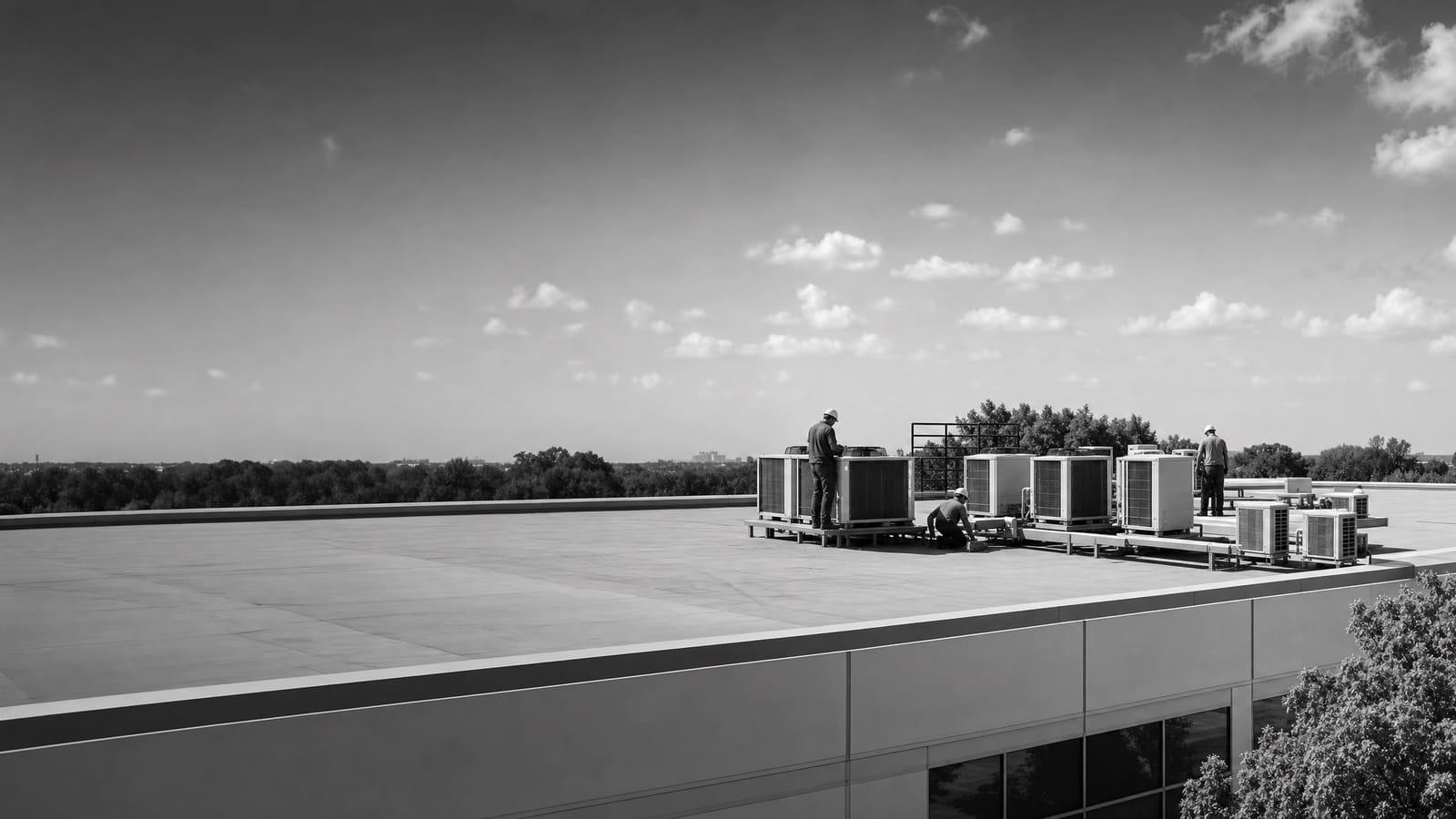
A commercial HVAC replacement covers load verification, equipment selection, removal with certified refrigerant recovery, rigging and setting the new unit, gas and electrical connections, controls, and commissioning. Replacement beats another repair once a unit is past fifteen years and failures repeat. The Department of Energy puts the energy waste of an old, inefficient rooftop unit at $900 to $3,700 per unit every year, before you count the service calls.
A site review still has to confirm curb size, roof structure, panel capacity at the unit, gas line availability, and crane access before any of that becomes your actual price.
THREE WAYS TO GO
Three replacement paths worth pricing
Most buildings have three real options. The right one depends less on preference than on what the roof, the panel, and the schedule allow.
The straight replacement puts equivalent equipment on the existing curb. It is the fastest path back to conditioned space and the easiest to permit. It also carries forward whatever sizing error the old unit had.
The high-efficiency upgrade costs more up front and buys the difference back every year the unit runs. The federal rooftop unit specification targeted up to 50% less energy use than the standard equipment of its day, and the campaign built around that spec reports more than 43,000 units upgraded for a combined $37 million in annual savings.
The heat pump path replaces gas heat with reverse-cycle heating, either all-electric or dual-fuel. It changes the electrical question, the gas line question, and sometimes the winter backup plan. That belongs in the first conversation, not in a change order.
WHERE THE MONEY MOVES
The lines that swing a replacement price
No two roofs price the same, so compare bids line by line instead of on the bottom number. These are the items that move most between quotes, and the ones a vague proposal tends to leave out.
BUYING GUIDANCE
Buy the replacement instead of reacting to it
Most rooftop units get replaced the week they die. That is the most expensive way to buy one. Federal guidance on rooftop replacement is blunt about the pattern: managers wait until the unit stops conditioning the space, needs constant service, or fails outright. Replacing an inefficient unit on purpose often beats both replacement-on-failure and a like-for-like swap at the end of its life.
The difference is leverage. A planned replacement lets you compare equipment, wait out a lead time, put the crane on a Sunday, and actually price efficiency. An emergency replacement takes whatever sits on the regional shelf, on whatever day a rigging crew is free, with portable cooling running in the meantime.
So inventory the roof before the season that will break it. Write down the age, tonnage, refrigerant, and repair history of every unit. Anything past fifteen years with a repeat service record goes on a replacement list with a budget number next to it, even if you do not act this year. That list is what turns a failure into a scheduling problem instead of a shutdown.
SCOPE CHECK
What keeps a replacement simple
Two buildings can order the same tonnage and get very different prices. The gap is almost always the conditions around the unit, not the unit itself.
LOWER COMPLEXITY
Straight swap conditions
The new unit fits the existing curb or a standard adapter. The roof carries the weight without reinforcement, the panel has room for the load, and the lot gives the crane a clear place to set up. These jobs are usually a single set.
HIGHER COMPLEXITY
Conditions that add scope
Growing tonnage, a roof deck that needs framing work, a tight or shared lot, a panel already near capacity, or a move to heat pump heating that changes the electrical and gas picture at the same time.
BEFORE THE QUOTE
What a site review has to confirm
A quote written from a nameplate photo is a starting range, not a price. The site review is where that range collapses into a number, and the federal checklist for rooftop replacement points at the same handful of things every time.
Electrical capacity comes first. There has to be room in the panel and in the service for whatever the new unit draws, and that question gets sharper if heat pump heating is on the table. Physical constraints come next: curb dimensions, roof structure, clearance around the unit, and whether a crane can reach the location without closing more of the lot than the building can spare.
Gas lines are third. If the building keeps gas heat, the existing line has to serve the new burner. If it does not, someone has to decide what happens to that line and who pays to handle it.
Equipment availability is last, and it quietly sets the schedule. A unit that is right on paper but weeks out from delivery is a different project than one sitting in a regional warehouse.
Confirm these four before comparing bids
Panel capacity at the roof, curb and structural condition, what happens to the gas line, and confirmed equipment availability. A bid that skips any of the four is quoting a different job than the one you will end up buying.
OWNERSHIP QUESTIONS
Two things to settle before the crane date
The equipment decision is usually easy compared to the ownership decision behind it. Two questions cause most of the friction afterward.
The first is who is really buying. Commercial HVAC sits awkwardly in most lease structures, and a replacement is a capital event even when it feels like maintenance. If the tenant pays and the landlord keeps the asset, the efficiency conversation gets short, because the party who benefits from lower bills is not the party writing the check.
The second is whether this is one replacement or the first of several. Rooftop units installed together tend to age together. A building that replaces one unit this year and expects two more within a few seasons should price all three now, even if only one gets set.
LEASE STRUCTURE
Who owns the capital item
In a triple-net structure the tenant may fund the replacement while the landlord keeps the asset. That split decides who cares about efficiency tier and who only cares about today's invoice. Settle it in writing before equipment is selected.
FLEET STRATEGY
One unit or the whole roof
Buildings with several rooftop units rarely fail one at a time for long. Replacing two or three together shares the crane day and the permit work, and keeps the fleet on one refrigerant and one service plan.
OVER THE LIFE OF THE UNIT
Phasing, procurement, and lifetime cost
Purchase price is the smallest interesting number in this project. The unit runs for years after the crane leaves, and what it costs to run is the part that compounds. The federal efficiency standard issued for commercial rooftop equipment in December 2015 was projected to save businesses $167 billion in utility bills over the lifetime of the covered products. That is a useful reminder of which column the money actually sits in.
That should shape phasing. If the roof is full of aging units and the budget will not cover all of them, replace on operating hours rather than on age. The unit serving a space that runs open all day is burning more of that $900 to $3,700 annual waste than the one over a stockroom, so it earns the first slot no matter which nameplate is older.
Procurement follows the same logic. Lock the equipment order before you finalize the crane date, because availability is the variable you control least. And keep commissioning attached to the purchase. A high-efficiency unit that was never balanced, charged, and set up correctly is an expensive standard unit with a better label.
QUOTE CHECKLIST
Five things a comparable quote shows
Two bids on the same roof can differ widely and both be honest, because they are not scoping the same job. These five items make bids comparable. Ask for them in writing before you decide.
01
Make, model, tonnage, efficiency rating
Plus the refrigerant the unit uses, so the service contract and spare parts plan stay consistent across the roof.
02
Confirmed lead time in writing
The delivery date the price depends on, not a general comment about availability.
03
Curb, structural, and roof work
Adapter or new curb, any framing, and who patches and warranties the roof penetration.
04
Rigging plan and lot impact
Crane size, staging location, how many stalls close, and for how long.
05
Commissioning and closeout documents
Startup report, airflow and charge verification, controls setup, permit sign-off, and refrigerant recovery records.
Keep planning locally
Related mechanical pages in Cincinnati
Get a defensible number
Price the equipment and the building together.
Send the address, operating target, and target opening date. Flux will identify what must be verified before the project can be priced.
Get a free estimateQuestions
Straight answers.
When does replacement beat another repair?
Once a unit is past about fifteen years and the same failures keep returning, the repair is buying time on equipment that is already costing you. Federal figures put the annual energy waste of an old, inefficient rooftop unit at $900 to $3,700 per unit, which usually outruns the savings from one more compressor or board.
Is a high-efficiency unit worth the price difference?
It depends almost entirely on operating hours. The federal high-performance rooftop specification targeted up to 50% less energy use than the standard equipment of its time, and the national campaign built around it reports over 43,000 units upgraded for a combined $37 million in annual savings. The longer a unit runs, the faster that gap closes.
Should a gas rooftop unit be replaced with a heat pump?
Sometimes, and the answer is site-specific. Heat pump rooftop units are most efficient in mild to moderate heating conditions and lose efficiency as outdoor temperatures fall. Federal guidance points to electrical capacity, physical constraints, gas line decisions, and equipment availability as the deciding factors. Dual-fuel and cold-climate models exist for buildings with real winter heating loads.
What sets the schedule for a replacement?
Equipment availability, not the crane. The set and connections happen in a planned window that tenants mostly notice as coned-off parking. The waiting happens before that, while the selected unit ships. That is why a confirmed delivery date belongs on the quote next to the price.
What happens to the refrigerant in the old unit?
EPA rules under Section 608 of the Clean Air Act govern how refrigerant is handled and recovered from stationary air-conditioning and heat pump equipment. Recovery has to be done by certified technicians, and the records belong in your closeout package. Ask which refrigerant the new unit uses so your service plan stays consistent across a mixed roof.
Sources used for this guide
- [1]betterbuildingssolutioncenter.energy.gov — DOE Advanced Rooftop Unit Replacement Guidance
- [2]betterbuildingssolutioncenter.energy.gov — DOE Commercial Heat Pump Rooftop Unit Replacement Guidance
- [3]betterbuildingssolutioncenter.energy.gov — DOE High-Efficiency Commercial Rooftop Unit Toolkit
- [4]energy.gov — DOE Efficient Commercial Rooftop Air Conditioner Program
- [5]epa.gov — EPA Stationary HVAC Refrigerant Management