THE SHORT VERSION
What a commercial HVAC replacement actually includes
A commercial HVAC replacement covers the load confirmation, equipment selection against real lead times, curb and structural work, refrigerant recovery under EPA rules, the crane set, and commissioning. Replacement beats another repair once a unit is past about fifteen years and the repairs are stacking up. DOE puts the waste from an old, inefficient rooftop unit at $900 to $3,700 a year, so a second compressor repair on a tired unit often buys very little.
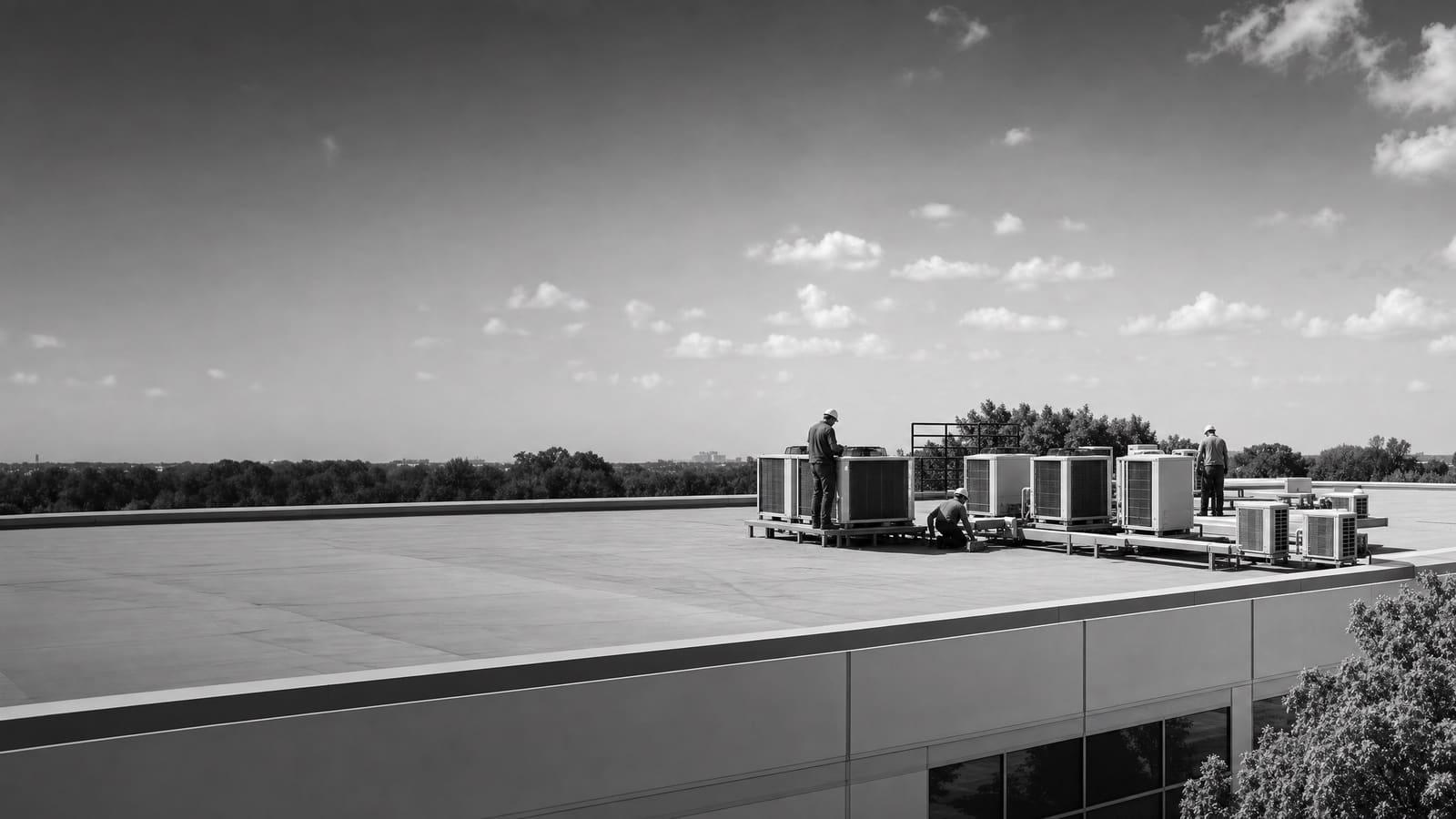
A site review has to confirm the real load, the curb footprint, whether the roof structure carries the new unit, available electrical capacity, gas line status, and where a crane can set up.
THREE PATHS
The three replacement choices, and when each one is right
Most commercial replacements come down to three choices, and the right one depends on how many hours the unit actually runs. A packaged rooftop unit that cycles a few hours a day in a lightly occupied space rarely justifies a premium efficiency tier. A unit that runs hard six days a week usually does, because the savings compound every year the equipment stays on the roof.
DOE's rooftop work is a useful reference here. High-efficiency units built to its performance specification were designed to cut energy use by up to 50 percent against the older standard, and more than 20 models now exceed that specification. Organizations working through the Advanced RTU Campaign upgraded more than 43,000 units and reported a combined $37 million in annual energy savings.
There is a fourth path worth naming. If the unit is mechanically sound but the controls are primitive, an advanced controls retrofit can capture part of the savings without a crane day at all.
WHAT MOVES THE NUMBER
The lines that decide an installed price
Nobody can price a commercial replacement from a tonnage figure alone. These are the lines that move an installed quote most, and the ones worth asking a contractor to break out separately. Two bids that look identical on the cover page usually differ somewhere in this list.
SIZING
Like-for-like swap or right-sized system
The nameplate on the old unit is a record of a decision somebody made fifteen or twenty years ago, under conditions that may no longer exist. Occupancy changes. Lighting gets replaced and stops throwing heat. A tenant adds a server closet or a kitchen line. Sizing the replacement off that nameplate carries every one of those old assumptions forward, including any mistake in the original sizing.
That does not mean every project needs a full load calculation from scratch. If the space, the schedule, and the envelope are genuinely unchanged and nobody is complaining about comfort, a like-for-like swap is often the honest answer, and it is the fastest path back to conditioned air. The case for right-sizing gets stronger when you can point to something specific: rooms that never hold setpoint, humidity complaints, short cycling, or utility bills that climbed without a matching change in how the building is used.
The useful middle position is to confirm the load and then decide. The calculation is a small line item next to the equipment. It either validates the existing tonnage, which makes a like-for-like decision defensible rather than lazy, or it shows the unit has been oversized for years, which is usually where the comfort complaints were coming from all along.
SCOPE
What keeps a replacement simple, and what adds scope
Not every replacement carries the same risk. The gap between a straightforward swap and a project with real scope usually comes down to five things: the curb, the structure, the electrical service, the access, and whether the building can go down during working hours.
LOWER COMPLEXITY
Straight swap conditions
The existing curb fits or takes a standard adapter, the roof structure already carries the load, electrical service is unchanged, the crane has clear reach from the lot, and the building has a natural window in its schedule.
HIGHER COMPLEXITY
Conditions that add scope
Tonnage or footprint grows, the panel has no spare capacity, the unit sits behind a parapet or over occupied space, the building cannot go down during business hours, or a fuel switch changes both the electrical and the gas scope.
BEFORE THE QUOTE
What a site review has to answer
A real quote starts on the roof, not on the phone. The visit is short, but it has to settle a specific list of questions, because several of them can change the number by more than the equipment does.
DOE's guidance on rooftop equipment groups these into infrastructure questions: electrical capacity, physical constraints, and gas lines. Electrical capacity surprises owners most often. A unit that adds electric heat or reverse-cycle heating draws differently than the gas-heat unit it replaces, and if the panel has no room, the service work can rival the equipment cost. Physical constraints cover curb dimensions, roof access, structural capacity, and whether a crane can actually reach the location from your lot. Gas lines matter in both directions: a new gas unit needs adequate supply, and an all-electric unit leaves a line that has to be properly abandoned.
Equipment availability belongs on the same list. Lead time is part of the decision, not a footnote to it, because a unit that ships weeks out changes what you do in the meantime and whether temporary cooling is part of the plan.
Ask for the infrastructure findings in writing
Electrical capacity, curb and structural condition, gas line disposition, and crane access should appear as written findings in the proposal. If they are missing, what you have is an estimate of the equipment, not of the project.
OWNERSHIP
Two questions that outlive the install
Two questions outlive the crane day, and both are cheaper to answer now than after the unit is on the roof.
The first is refrigerant. EPA regulations under Section 608 of the Clean Air Act govern how refrigerant is handled, recovered, and recycled in stationary air conditioning and heat pump equipment, and those obligations follow the equipment for its whole service life. They apply when the old unit comes off and on every service call after that. Ask which refrigerant the new unit uses and whether your service contractor already stocks and handles it, because a mixed fleet running two refrigerants becomes a parts and training problem rather than a comfort one.
The second is whether this is one unit or the first of several. If a roof carries four units of similar age, the replacement you are quoting now is really phase one, and the efficiency tier, controls platform, and refrigerant you lock in set the pattern for the rest.
WHO PAYS
Cost and benefit can split
Under some lease structures the tenant funds the replacement while the landlord keeps the asset. Settle who chooses the efficiency tier before the quote lands, because the party paying and the party collecting the savings are not always the same.
WHO SERVICES IT
The contract outlasts the crew
The install crew leaves and the service relationship stays. Confirm who owns startup documentation, warranty registration, and the first year of maintenance, and that they are certified to handle the refrigerant in the unit you picked.
TIMING
Phasing, procurement, and lifetime cost
Replacement on failure is the most expensive way to buy commercial HVAC, and it is still the most common. DOE is blunt about the pattern: managers often wait until a unit no longer conditions the space, needs constant maintenance, or fails outright, when proactively replacing an inefficient unit is frequently the better business move than either replacement on failure or a like-for-like swap at the end of service life.
The arithmetic is easier to see across a roof than on a single unit. An old, inefficient rooftop unit can waste $900 to $3,700 a year. Multiply that by four aging units and the annual waste starts to resemble a payment on new equipment. That is the number worth setting next to a phased plan: one or two units a year, on your schedule, at negotiated pricing, instead of one emergency at a time at whatever the market charges in the middle of a heat wave.
Phasing also fixes the procurement problem. Emergency replacement means taking whatever unit is available regionally. A planned replacement lets you specify the efficiency tier, order the curb adapter to the right dimensions, book the crane for a day the lot is empty, and write commissioning into the contract instead of hoping for it.
COMPARING BIDS
Five things a comparable quote should show
Two quotes for the same roof can differ by a wide margin and both be honest, because they are not covering the same scope. These five line items make bids comparable. If a proposal is missing them, the difference in price is probably a difference in what is included.
01
Equipment, tonnage, and efficiency tier
The exact model and rating, not a tonnage figure and a brand name.
02
Lead time and availability
A committed ship window, plus what happens to the space while you wait for it.
03
Curb, structural, and rigging scope
Adapter or new curb, any structural work, crane size, and lot closure hours.
04
Electrical, gas, and controls work
Panel and service changes, gas line disposition, and building automation tie-in.
05
Commissioning and closeout
Startup, charge and airflow verification, documentation, permits, and warranty registration.
Keep planning locally
Related mechanical pages in Cleveland
Get a defensible number
Price the equipment and the building together.
Send the address, operating target, and target opening date. Flux will identify what must be verified before the project can be priced.
Get a free estimateQuestions
Straight answers.
When is replacement better than one more repair?
Once a rooftop unit passes about fifteen years, it can waste substantial energy compared with newer equipment, and DOE puts that waste at $900 to $3,700 per unit each year. When a unit that old needs a second significant repair, the repair usually buys time rather than performance, and planned replacement beats waiting for the failure.
Does a heat pump rooftop unit make sense for our building?
It depends on winter heating hours and electrical capacity. Heat pump efficiency drops as outdoor temperatures fall, trending toward parity with electric resistance heating in the coldest conditions, which is why dual-fuel and cold-climate heat pump units exist alongside all-electric ones. If your site sees long stretches of hard heating demand, the heating backup plan matters as much as the unit.
How long will the building be without cooling?
The crane set itself is a single planned outage that can be scheduled around your operating hours. Equipment lead time is the real variable, and it should be on the quote next to the price. If the wait is long and the space cannot go without conditioning, temporary cooling belongs in the plan rather than in a later change order.
What happens to the refrigerant in the old unit?
EPA regulations under Section 608 of the Clean Air Act govern how refrigerant is handled, recovered, and recycled in stationary air conditioning and heat pump equipment. Recovery is part of the removal scope and should be performed by certified technicians and documented, not treated as an afterthought on demolition day.
Should we replace every rooftop unit at once?
Rarely all at once, but rarely one at a time by accident either. If several units are the same age, price a phased program of one or two per year so you control the schedule, the specification, and the pricing. Lock the efficiency tier, controls platform, and refrigerant on the first unit so the rest of the roof stays consistent.
Sources used for this guide
- [1]betterbuildingssolutioncenter.energy.gov — DOE Advanced Rooftop Unit Replacement Guidance
- [2]betterbuildingssolutioncenter.energy.gov — DOE Commercial Heat Pump Rooftop Unit Replacement Guidance
- [3]betterbuildingssolutioncenter.energy.gov — DOE High-Efficiency Commercial Rooftop Unit Toolkit
- [4]energy.gov — DOE Efficient Commercial Rooftop Air Conditioner Program
- [5]epa.gov — EPA Stationary HVAC Refrigerant Management