THE DIRECT ANSWER
What a commercial HVAC replacement actually covers
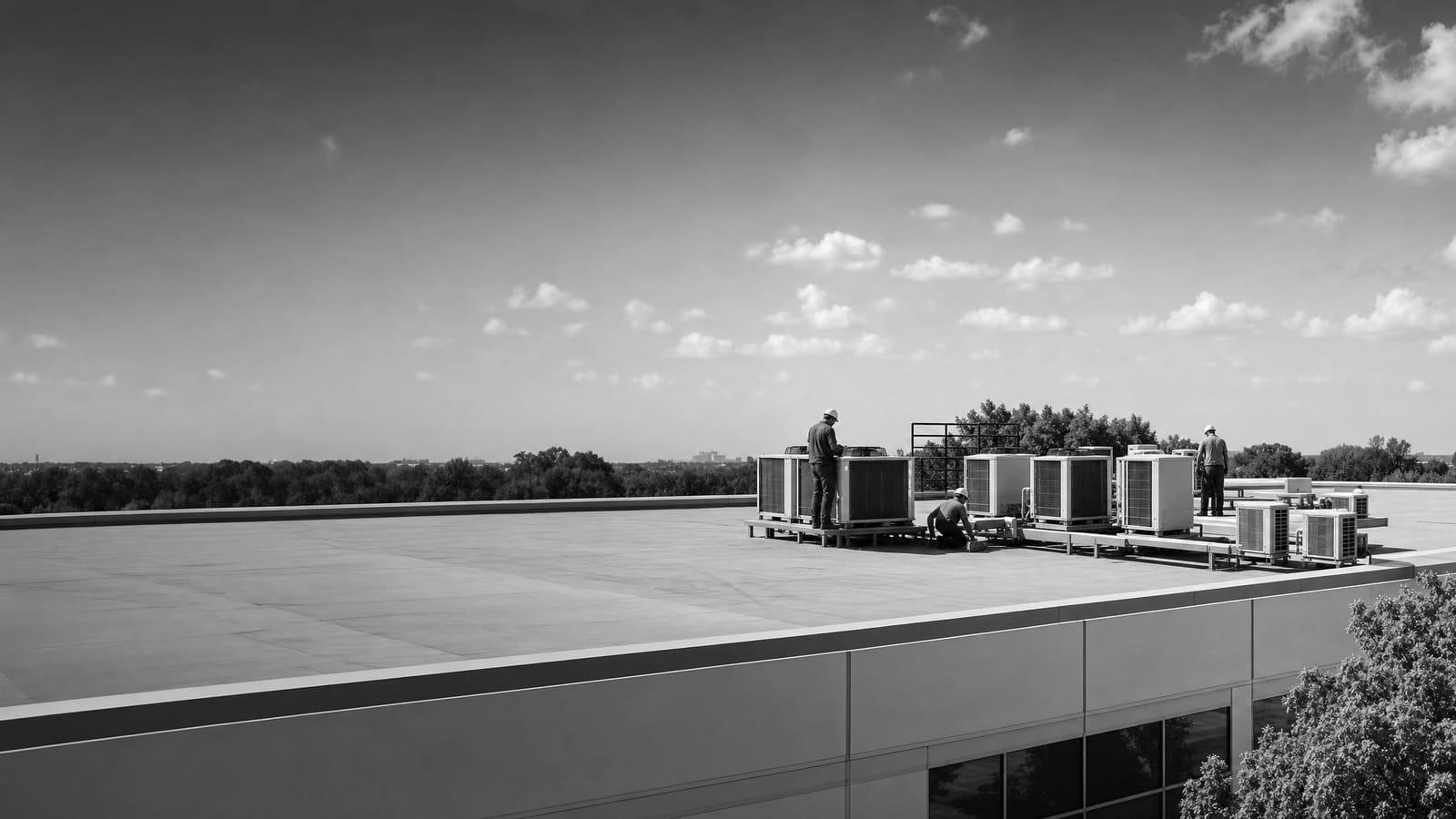
A commercial HVAC replacement covers the load check, the equipment decision, rigging and the crane day, the gas, electrical, and controls connections, and commissioning that proves the system performs. Replacement usually beats another repair once a packaged rooftop unit passes about fifteen years. Federal work on older commercial units found they waste roughly $900 to $3,700 per unit every year, which is money you are already spending whether or not you replace.
A site review still has to confirm the curb and roof structure, the tonnage the space needs today, available electrical capacity, and crane access. Until those four are settled, an installed price is a guess.
THE OPERATING CHOICE
Three ways to replace a rooftop unit
Most buildings pick from three paths. The first is a like-for-like swap: same tonnage, same fuel, same curb where it fits. It is the fastest way back to conditioned air and the cheapest to engineer. The second is a high-efficiency replacement in the same footprint. Federal testing pushed manufacturers to build packaged units that cut energy use by up to half against the older standard, and more than twenty models now clear that bar. The third is a heat pump rooftop unit, either all-electric or dual-fuel, which adds reverse-cycle heating instead of a gas section. Federal guidance treats that as a real decision rather than a default: climate, electricity and gas prices, electrical capacity, equipment availability, and installer experience all decide whether it pays. Pick the path before you request quotes. Otherwise you get three prices for three different projects and no way to compare them.
WHAT MOVES THE NUMBER
The lines that decide your installed price
Nobody can quote a rooftop replacement from a tonnage number alone. These are the items that move the installed price most, and the ones worth settling during the site visit instead of during a change order.
REPAIR OR REPLACE
How to make the call before the unit makes it for you
The repair-versus-replace decision gets easier once you stop staring at the single invoice in front of you. Federal guidance on rooftop units is blunt about the usual pattern: managers delay until the unit no longer holds the space, needs constant service, or fails outright. Replacing on failure is the most expensive version of the same decision, because it strips out every choice you would have made calmly, including equipment, efficiency tier, schedule, and price.
The age line worth watching is fifteen years. Past that, a packaged unit can waste a serious share of what it costs to run, and that waste is already on a utility bill you pay every month. When a unit that old needs a compressor or a heat exchanger, the repair buys you a season and the replacement buys the next fifteen years.
Newer equipment flips the answer. If the unit is under ten years, still holds the space, and needs a fan motor or a control board, fix it and keep the capital. The useful habit is tracking which units are near the line, so the replacement becomes a budget item next year instead of an emergency next July.
SCOPE CHECK
Simple swap or engineered project
Two replacements with the same tonnage can be very different jobs. What separates them is almost never the unit itself. It is the curb, the power, and the roof access.
LOWER COMPLEXITY
Same footprint, same fuel
The new unit matches the old curb or takes a standard adapter. Gas and electrical service stay as they are. The lot has room for the crane, and the building can give up a few stalls for part of a day. Permitting stays narrow because nothing moved and nothing grew.
HIGHER COMPLEXITY
New footprint, new load, or tight access
Tonnage or footprint changes, so the roof structure gets reviewed. Electric heating pushes the service, or the gas line has to be reworked. The crane needs a street closure or a long reach over the building. Each of those adds cost, calendar time, and usually another inspection.
BEFORE YOU BUY
What a real site review has to settle
A quote is only as good as the walk that produced it. Load comes first. Sizing should be built from how the space is used now, not from the nameplate of a unit specified two decades ago. Occupancy, plug load, lighting, and envelope work all change what the building actually needs, and an oversized unit short-cycles its way through comfort complaints for its whole life.
Next comes the physical picture. Someone should stand on the roof and measure the curb, look at how the unit is supported, and confirm where gas, power, and condensate run. Then they should stand in the parking lot and figure out where a crane sets up, what it has to reach over, and how many stalls close for how long.
Last comes capacity. Federal heat pump guidance calls out electrical capacity, physical constraints, and gas lines as the infrastructure items that decide whether a given site can take a given unit. Those answers change what you can buy, so they belong before the order, not after it.
Ask for the walk before the price
If a contractor prices your replacement without seeing the roof and the lot, you are looking at an estimate that will move. Ask which of the four items were verified in person: curb and structure, electrical capacity, gas or refrigerant routing, and crane access.
NEWARK CONTEXT
Cold winters change the heat pump question here
Heat pump rooftop units are a real option in Newark, but the specification matters more here than it does in a mild-winter market. Federal guidance is direct about the physics: as outdoor temperatures fall, heat pump heating efficiency drops and trends toward parity with electric resistance heat. Standard heat pump units are best suited to mild-to-moderate winter heating, which is why the same product that fits a southern roof is often the wrong pick for a northern one.
For a Newark building, that points you toward one of two honest answers. Either specify a cold-climate heat pump unit rated for the heating you actually need in January, or keep a dual-fuel arrangement so the gas section carries the coldest hours. The deciding inputs are your winter heating hours and the gap between local electricity and gas prices, not a general preference for electric equipment.
Confirm the permit path before you order
Permit scope tracks how much the project changes. A same-location replacement is usually the narrowest path, while a larger unit, a moved curb, or a service upgrade pulls in more review. Have your installer confirm the required permits and inspections with the local building department and name them on the quote.
OWNERSHIP
Who pays, and what happens after year one
Two questions decide more about a rooftop replacement than the equipment brand does. The first is who carries the cost and who collects the savings, which is rarely the same party in a leased building. The second is what the new unit does to the rest of your fleet. A replacement is also a service decision, because the unit you buy this year sets the parts, the refrigerant, and the technician skill set you live with for the next fifteen. Answer both before you sign, and the efficiency conversation stops being abstract.
OWNER-OCCUPIED
You pay once and keep the savings
The efficiency case is straightforward because the capital and the utility bill sit in the same budget. This is where a higher efficiency tier usually earns its premium, especially on a building with long cooling hours and a unit already past fifteen years.
LEASED OR MULTI-TENANT
The split decides the spec
If tenants pay the utilities, the owner buying the efficient unit collects nothing directly. Sort out recovery language early. Otherwise the default becomes the cheapest compliant box, and the building carries that decision for another equipment lifetime.
PLANNING AHEAD
Phasing, procurement, and lifetime cost
Buildings with more than one rooftop unit get a real advantage from sequencing. When you replace on a plan, you order into normal lead times, schedule the crane on a day that suits the tenants, and standardize on equipment your service contractor already stocks parts for. When you replace on failure, you take whatever unit is available that week at whatever price it carries, and you pay for the outage on top.
The scale of the opportunity is documented. Through the federal Advanced RTU Campaign, more than two hundred organizations upgraded over forty-three thousand rooftop units, and those upgrades save a combined $37 million a year on energy bills. The 2015 efficiency standard for commercial units was projected to save businesses $167 billion over the lifetime of the products. That is what a fleet of correctly specified units returns over time.
So build the list. Note the age, tonnage, fuel, and service history of every unit on the roof. Flag anything past fifteen years, and decide now which ones get replaced on schedule and which ones you are willing to run to failure. That single page turns emergency capital into planned capital.
COMPARING QUOTES
Five things a comparable quote shows
Three quotes are only useful if they describe the same project. These five items make them comparable, and each one is a place where a low number is hiding scope.
01
Unit, tonnage, and efficiency tier
Model number and heating type, not just "replace RTU." Efficiency tier is where two prices quietly diverge.
02
Curb, adapter, and structural scope
Whether the new unit lands on the existing curb, needs an adapter, or requires framing, and who verified it.
03
Crane, rigging, and lot plan
Who provides the crane, how long the lot is affected, and which day the work is scheduled for.
04
Permits, inspections, and code items
Which permits are pulled, who pulls them, and whether economizer or controls work is included or excluded.
05
Startup and commissioning report
Charge, airflow, and control settings verified against spec, documented in writing so the warranty holds.
Keep planning locally
Related mechanical pages in Newark
Get a defensible number
Price the equipment and the building together.
Send the address, operating target, and target opening date. Flux will identify what must be verified before the project can be priced.
Get a free estimateQuestions
Straight answers.
When does replacing a rooftop unit beat repairing it again?
Fifteen years is the line worth watching. Past that, a packaged unit can waste a large amount of energy annually, and federal analysis of older commercial units put that waste at roughly $900 to $3,700 per unit each year. If a unit that old needs a compressor or a heat exchanger, the repair buys a season. Under ten years with a failed motor or board, repair and keep the capital.
Does a heat pump rooftop unit make sense on a Newark building?
It can, but the specification matters. Heat pump heating efficiency falls as outdoor temperatures drop, and standard units are best suited to mild-to-moderate winters. In a cold-winter market, that usually means a cold-climate unit sized for real January heating or a dual-fuel arrangement that keeps a gas section for the coldest hours. Electrical capacity and the local gas-to-electric price gap decide the rest.
What actually sets the schedule on a replacement?
Equipment availability, almost always. The crane day itself is short and predictable once the curb, power, and access are confirmed. What stretches a project is waiting on a unit, especially a larger tonnage or a special configuration. Ask for lead time next to the price on every quote, because the fastest bid is often the one with a unit already in the region.
How much does commercial HVAC installation cost?
There is no honest universal price, because tonnage, efficiency tier, curb and structural work, electrical capacity, and crane access each move the number substantially on the same-sized job. Ask for the installed price broken into those lines. The offsetting side is documented: aging inefficient units waste roughly $900 to $3,700 each per year, which the replacement stops paying out.
What happens to the refrigerant in the old unit?
It has to be recovered and handled under federal Clean Air Act rules covering stationary refrigeration and air conditioning equipment. That work is done by certified technicians, and it is a normal part of any professional removal. Make sure recovery and disposal appear on the quote so it is not billed later as an extra.
Sources used for this guide
- [1]betterbuildingssolutioncenter.energy.gov — DOE Advanced Rooftop Unit Replacement Guidance
- [2]betterbuildingssolutioncenter.energy.gov — DOE Commercial Heat Pump Rooftop Unit Replacement Guidance
- [3]betterbuildingssolutioncenter.energy.gov — DOE High-Efficiency Commercial Rooftop Unit Toolkit
- [4]energy.gov — DOE Efficient Commercial Rooftop Air Conditioner Program
- [5]epa.gov — EPA Stationary HVAC Refrigerant Management
- [6]newarkca.gov — Building Inspection Division | Newark, CA