THE SHORT VERSION
What a commercial HVAC replacement actually includes
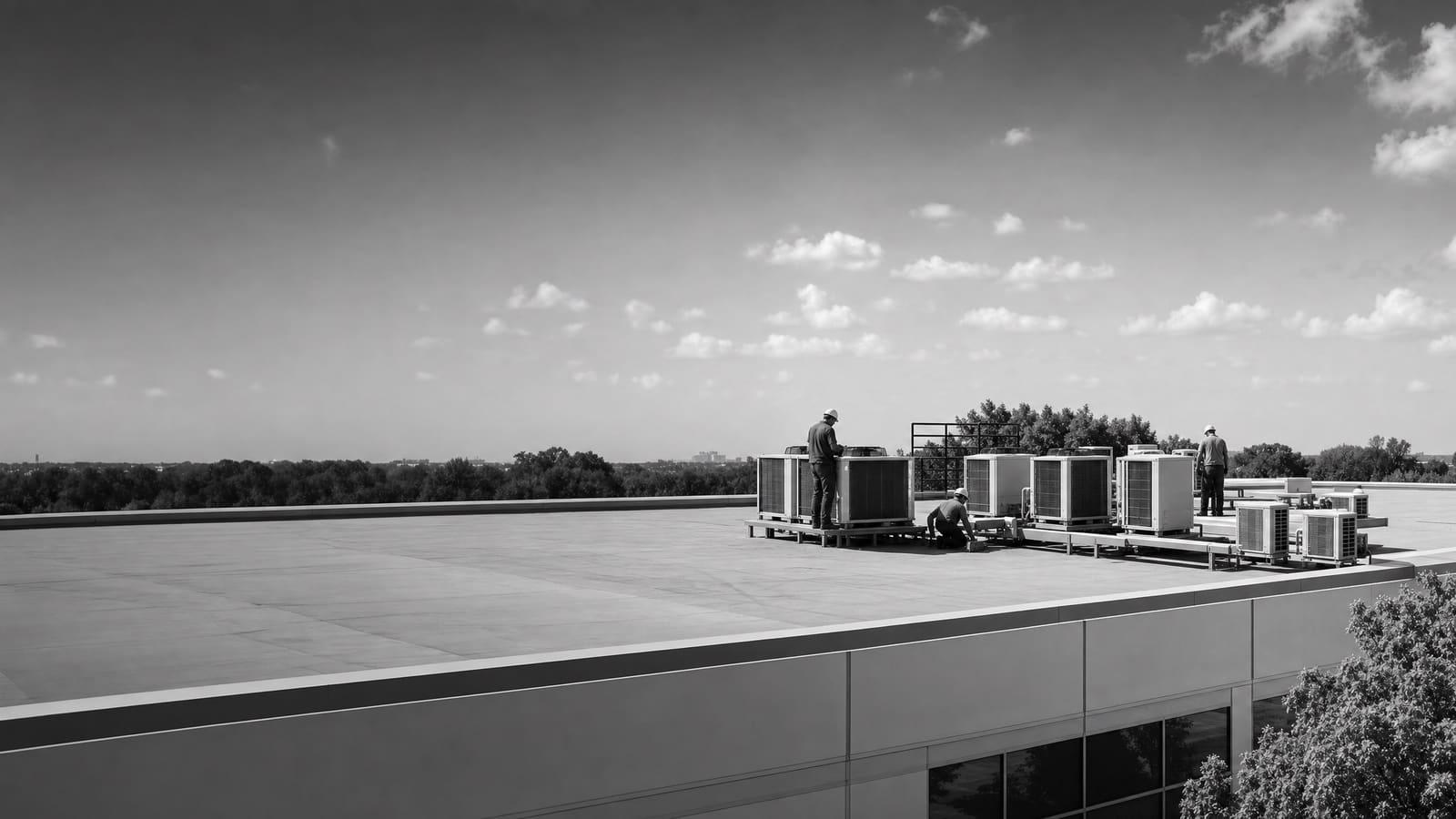
A commercial HVAC replacement covers load verification, equipment selection, rigging and set, mechanical and electrical connections, controls integration, and documented startup. Replacement usually beats another repair once a unit is past 15 years and repairs are stacking up. Department of Energy research puts the annual waste from an old, inefficient rooftop unit at $900 to $3,700. That failing unit charges you twice: once on the repair invoice, and again every month on the utility bill.
A site review has to confirm the real load, the roof and curb condition, crane access, and the electrical and gas capacity already at the unit. Those four items decide whether a like-for-like swap is even on the table.
THREE WAYS TO GO
Three choices to settle before you buy equipment
Most owners jump straight to picking a unit. The better first question is which of three paths fits the building. Department of Energy guidance frames it plainly: an owner can replace an aging rooftop unit or retrofit it with advanced controls, depending on which makes better financial sense. A controls retrofit keeps the existing box and improves how it runs. Replacement resets both the clock and the efficiency tier.
If replacement wins, the second fork is fuel. A heat pump rooftop unit is technologically similar to an air-conditioning rooftop unit but adds reverse-cycle heating. Heat pump units run most efficiently where winter heating is mild to moderate, and federal guidance treats today's units as appropriate across most of the South and West. That does not make the choice automatic. Electrical capacity, physical constraints, gas lines, equipment availability, and installer familiarity all have to check out before an all-electric unit is the right answer for a specific roof.
WHAT MOVES THE NUMBER
Where the money actually goes
An installed price is the equipment plus everything the building makes you do to land it. These are the lines that separate two quotes written for the same roof, and the ones worth asking about before you compare totals.
IN PRACTICE
Buy the replacement, not just the unit
Most rooftop units get replaced the hard way. Department of Energy guidance describes the pattern exactly: facility managers delay buying a new unit until the old one no longer conditions the space, needs constant service, or fails completely. Replacing proactively usually beats replacement-on-failure, and it often beats a like-for-like swap made at the end of a unit's service life, because you choose the timing, the efficiency tier, and the crew instead of taking whatever is available in August.
The second thing to get right is size. Sizing from the old nameplate carries forward whatever the last engineer assumed about the building. Occupancy changes, plug loads change, and envelope work changes the number. A load confirmed against how the space is used today is the difference between a unit that holds setpoint quietly and one that short-cycles for the rest of its service life.
Third, treat availability as part of the decision rather than a scheduling detail. Equipment availability is one of the items federal guidance tells owners to verify before committing to a technology, and it belongs on the quote next to the price. A unit that is right on paper and unavailable for the season is not the right unit.
SITE CONDITIONS
What keeps this simple, and what makes it hard
Two buildings can buy the same tonnage and get quotes that are not close. The gap is almost always site conditions, and most of it is predictable from a walk on the roof.
LOWER COMPLEXITY
Same fuel, same footprint
The new unit matches the old one's fuel and footprint, the curb takes an adapter, the deck is sound, and a crane reaches from the lot. Gas and electric are already sized for what is going back on. Permitting is routine and the outage is short.
HIGHER COMPLEXITY
New fuel or a bigger unit
Tonnage or footprint grows, so structural review enters the schedule. Moving to an all-electric heat pump unit puts electrical capacity on the critical path, and retiring a gas line has to be planned rather than discovered. Constrained access adds crane time and closures.
BEFORE YOU SIGN
What a real site review has to settle
A quote written from a nameplate photo is a starting number, not a price. Before anyone commits to equipment, someone should stand on the roof and settle a short list of questions.
Start with infrastructure, because infrastructure is what kills schedules. Federal guidance on rooftop heat pumps names three checks directly: electrical capacity, physical constraints, and gas lines. Electrical capacity decides whether an all-electric unit is realistic without a service upgrade. Physical constraints decide whether the unit you want fits the opening and the access path. Gas lines decide what gets capped, kept, or extended.
Then settle the load, sized against current occupancy and equipment rather than the plate on the old unit. Then settle refrigerant. New equipment ships on newer refrigerants, and the old charge is recovered under federal rules by a certified technician, so a building with mixed-vintage units should plan parts and service before the fleet splits.
Finally, settle who owns what. The rigging plan, lot coordination, permits, inspections, and startup documentation either sit inside the installed price or land on you later at a worse rate.
The four answers to get in writing
Electrical capacity at the unit, physical fit and access, what happens to the gas line, and a load confirmed against today's use. If a quote does not show those four, it is pricing an assumption about your building instead of your building.
OWNERSHIP MATH
Two things to weigh past the install date
The installation is one week of your life. The unit is on the roof long after the crane leaves, and two questions decide whether those years are quiet or expensive.
The first is what the unit costs to run. Rooftop units condition close to half of all U.S. commercial floor area, which is why federal efficiency work targeted them so heavily: the high-performance specification aimed at units cutting energy use by up to 50% against the prior standard. Buying the cheapest tier is a decision to pay the difference every month instead.
The second is who else has to live with the choice. Lease structure decides whether the owner or the tenant sees the utility savings, and a fleet of mixed-vintage units decides how complicated service becomes.
OPERATING COST
The efficiency tier is a monthly decision
Old, inefficient units waste $900 to $3,700 a year each. Across even a small fleet, the tier chosen at purchase becomes the largest recurring number in the mechanical budget.
FLEET AND LEASE
Who sees the savings, and who services it
If the tenant pays utilities, an efficiency upgrade pays the tenant unless the lease says otherwise. And every new refrigerant on the roof adds a service and parts variation your contractor has to carry.
PHASING
Replacing several units without replacing them all at once
Buildings rarely have one aging unit. They have five, bought in the same year, aging on the same schedule. Replacing all of them in one season is the cleanest engineering answer and the hardest budget conversation, so most owners phase the work.
Phasing works when the order is driven by something real. Rank by age and service history first, since units past 15 years are where the waste concentrates. Then rank by what each unit serves: the zone generating complaints, the tenant with a renewal coming, the space with the heaviest equipment load. Replacing the loudest unit first feels good. Replacing the most expensive one to run pays better.
Volume is the other lever. The federal campaign built around this work saw more than 200 organizations upgrade over 43,000 rooftop units, cutting a combined $37 million a year in energy costs. You are not operating at that scale, but the principle carries down: a planned multi-unit program buys better than five separate emergencies. Pricing a three-year replacement plan up front, even if you only release the first year of it, gets you standardized equipment, one controls approach, and a contractor who already knows your roof.
QUOTE CHECKLIST
Five things every comparable quote should show
Two quotes are only comparable when they scope the same work. Ask for these five lines explicitly, and the gap between two numbers stops being a mystery. It becomes a list of what one contractor included and the other left for later.
01
Equipment, capacity, and efficiency tier
Model number, tonnage, fuel, and the efficiency rating in writing. Not "a new rooftop unit."
02
Curb, roof, and structural scope
Adapter or new curb, a deck repair allowance, and whether structural review is included or excluded.
03
Rigging, access, and outage window
Crane size, staging area, lot closure hours, and how long the space goes without conditioning.
04
Permits, inspections, and refrigerant recovery
Who pulls permits, who meets the inspector, and who certifies recovery of the old charge.
05
Startup, commissioning, and documentation
Charge, airflow, and control settings verified against spec, documented, and handed over with the warranty.
Keep planning locally
Related mechanical pages in Durham
Get a defensible number
Price the equipment and the building together.
Send the address, operating target, and target opening date. Flux will identify what must be verified before the project can be priced.
Get a free estimateQuestions
Straight answers.
When is replacement better than another repair?
Once a unit is past 15 years and repairs are stacking up, the math usually turns. Older units waste a meaningful amount of energy every month, so a repair that keeps an inefficient unit alive is paying twice. Replacing proactively also beats replacing on failure, because you choose the timing and the equipment instead of taking whatever is available mid-season.
How much does a commercial HVAC replacement cost?
There is no honest universal number, because equipment is only part of the total. Curb work, crane access, electrical capacity, and controls integration move the price more than tonnage alone does. What you can price confidently is the other side of the ledger: an old, inefficient rooftop unit wastes $900 to $3,700 a year, and that is the number a replacement has to beat.
Should you switch to a heat pump rooftop unit?
Heat pump rooftop units are technologically similar to air-conditioning units but add reverse-cycle heating, and they run most efficiently where winter heating is mild to moderate. Federal guidance treats today's units as appropriate across most of the South and West. Confirm electrical capacity, physical constraints, and gas lines at the unit before committing.
What happens to the refrigerant in the old unit?
It is recovered, not vented. Federal rules govern the handling and recycling of refrigerant in stationary refrigeration, air-conditioning, and heat pump equipment, and recovery is performed by certified technicians. Newer equipment also ships on newer refrigerants, so a building with mixed-vintage units should plan parts and service around that.
Is a controls retrofit ever a better buy than a new unit?
Sometimes. Federal guidance presents it as a genuine fork: replace the aging unit, or retrofit it with advanced controls, depending on which makes better financial sense. A retrofit fits when the equipment still has service life left and the real problem is how the unit runs rather than whether it runs at all.
Sources used for this guide
- [1]betterbuildingssolutioncenter.energy.gov — DOE Advanced Rooftop Unit Replacement Guidance
- [2]betterbuildingssolutioncenter.energy.gov — DOE Commercial Heat Pump Rooftop Unit Replacement Guidance
- [3]betterbuildingssolutioncenter.energy.gov — DOE High-Efficiency Commercial Rooftop Unit Toolkit
- [4]energy.gov — DOE Efficient Commercial Rooftop Air Conditioner Program
- [5]epa.gov — EPA Stationary HVAC Refrigerant Management