THE NUMBER
What commercial EV charging costs in Warren
Across metro Detroit, a commercial Level 2 port typically lands between $3,500 and $18,000 installed. The charger itself is the smaller half: single-connector Level 2 hardware runs about $400 to $6,500, and DC fast units run about $10,000 to $40,000 before any site work. Fully installed, DC fast dispensers in this market are quoted from roughly $75,000 to $350,000 each. The gap between hardware and installed price is the electrical work.
These are planning benchmarks for the Detroit–Warren area, not a quote for your address. Panel capacity, trench distance, pavement restoration, and utility service work move the number more than the charger brand does.
PICK THE JOB FIRST
Three ways to run charging in Warren
The cheapest charger is the one that matches how your property is already used. Decide the operating job before anyone prices hardware, because the job sets the power level, and the power level sets most of the budget.
Dwell time is the deciding factor. If vehicles sit for hours — employees, tenants, overnight fleet returns — Level 2 finishes the job while nobody is watching. If vehicles have to leave in twenty minutes, only DC fast does that, and you pay for the service capacity standing behind it.
The split is straightforward. Workplaces and multifamily properties should be looking at Level 1 and Level 2. Public-facing hosts weigh Level 2 against DC fast. Fleets have a fourth option worth pricing: 120/240-volt receptacles feeding portable units instead of a pedestal at every stall, which lowers project cost and makes a failed unit easy to swap.
THE LINE ITEMS
What belongs in a Warren charging budget
A complete quote separates the equipment from the work around it. These are the lines that decide whether your project lands at the low end of the range or the high end, roughly in order of how much each one can move.
BUYING GUIDANCE
How to keep the electrical work from running the budget
The charger is a catalog item. The path from your service to the stalls is not, and that path is where quotes separate. Two identical Level 2 pedestals can differ by five figures on the same street, because one connects to a panel twenty feet away and the other needs a trench across a parking lot plus a subpanel to feed it.
So start scoping at the electrical room, not the parking plan. Pull the service size, look at what the building already draws at peak, and count the spare amps honestly. If capacity is short, you have three moves before a full service upgrade: load management that shares available power across ports, energizing fewer ports now, or moving the stalls closer to power and accepting a less convenient location.
Bring the utility in during planning, not after design. Service upgrades and metering changes drive both cost and schedule, and they are the two things you cannot compress at the end. In this metro, contract to energized commonly runs four to nine months, and longer when utility service work is involved. A site walk that catches a full panel in month one is worth more than any hardware discount.
TWO SITES, TWO PRICES
What makes a Warren install cheap or expensive
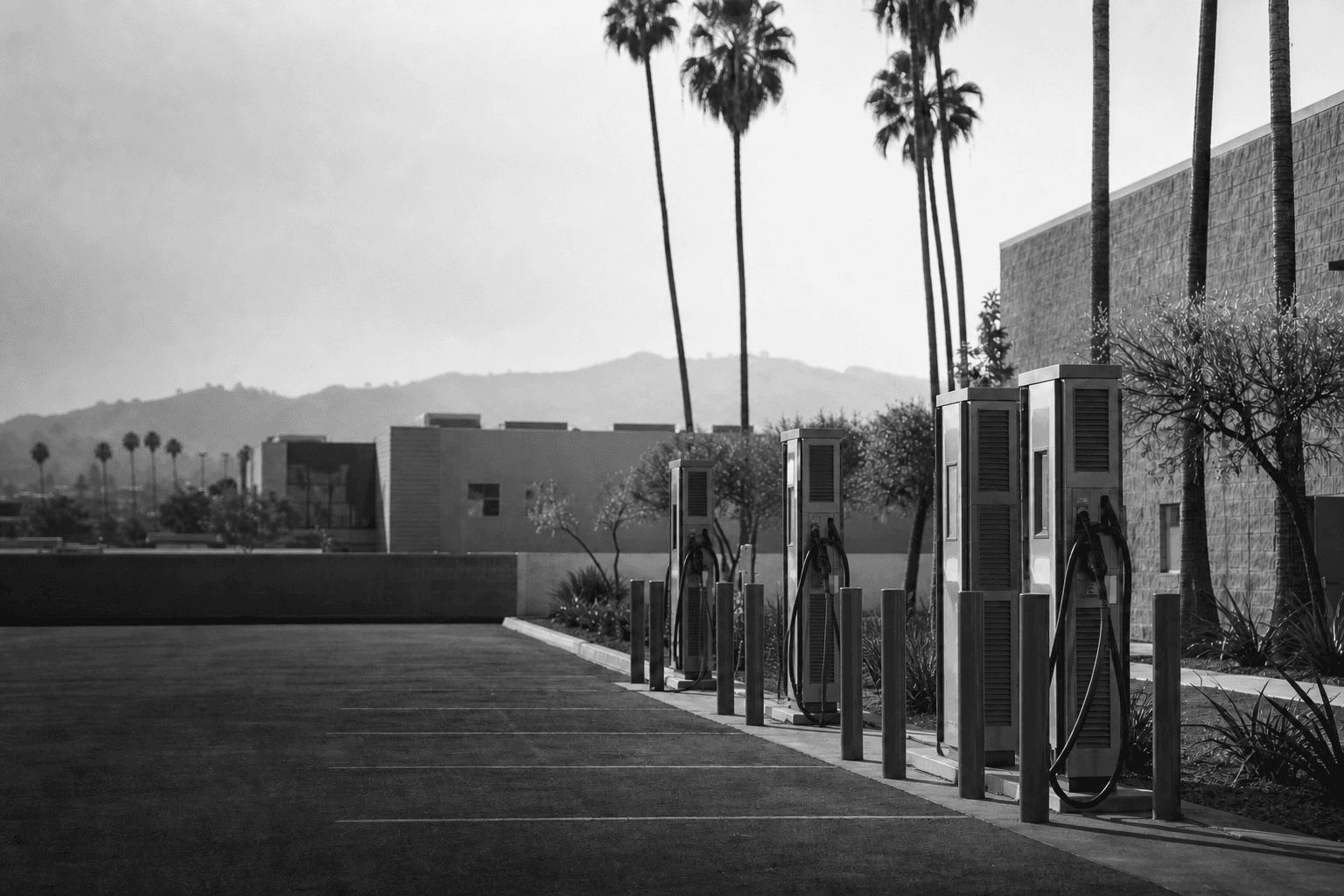
Nothing about the charger changes between these two buildings. Everything about the price does. Walk your property against both descriptions before you set a budget, because the answer is usually visible from the electrical room door.
LOWER COMPLEXITY
Short runs, spare capacity
Stalls sit near the electrical room. The panel has spare amps and spare breaker space. The run stays short, no pavement gets cut, and no utility service work is needed. Level 2 here lands at the low end of the installed range.
HIGHER COMPLEXITY
Long runs, full panel, fast charging
Stalls sit across the lot. The panel is full, so the job adds a subpanel or a service upgrade with utility lead time. Pavement gets cut and restored. Add DC fast and you are sizing service for a different class of load entirely.
BEFORE YOU BUY
The site review that makes quotes comparable
A useful scoping visit answers four questions in order. What is the service size, and what is left over at peak? How far is it from that gear to the stalls you want, and what surface is in between? How many ports do you need live on day one, and how many do you expect to add? And who owns the equipment and the uptime once it is energized?
That last question gets skipped, and skipping it costs the most later. Responsibility for maintenance has to be assigned in writing — site host, charging network, or installer — and the maintenance agreement should carry a response time, a repair window, and an uptime requirement. A charger nobody owns is a charger nobody fixes.
Scope the second phase while the trench is still open. Conduit and pull boxes are cheap when the pavement is already cut and expensive when it is not. If you expect to double your port count in three years, size the raceway and reserve the panel space now, energize what you need today, and let the rest wait.
Ask for the panel schedule
Before you accept any price, get the service size, the measured peak demand, and the spare breaker space in writing. Three contractors quoting the same panel schedule and the same trench length produce comparable numbers. Without it, you are comparing guesses.
WARREN SPECIFICS
What Warren changes about the job
Michigan sets the licensing floor and the city enforces the rest. The installer needs a Michigan LARA electrical license, and every job needs its own electrical permit and inspection from the local authority having jurisdiction — for a Warren property, that is the city building department. EVITP certification is not a statewide mandate, but it is commonly required on utility-program, public-agency, and federally funded charging work, so ask for it if any outside money is in your stack.
Utility coordination in this metro runs through DTE Energy or Consumers Energy depending on the address, so confirm which one serves your meter before you plan around a service upgrade. Commercial site plan and electrical permitting here has been running roughly twelve to twenty weeks, which usually makes permitting and utility work — not equipment lead time — the long pole in the schedule.
Start the utility conversation first
DTE's Charging Forward and Consumers Energy's PowerMIDrive programs can cover part of the utility-side service upgrade cost, and both run through approved-contractor lists. Confirm your installer is enrolled before you sign, and engage the utility during planning rather than after design.
AFTER IT IS ENERGIZED
Two decisions that outlive the install
Capital cost is one year. Ownership and operating cost are every year after, and both get decided during procurement whether you decide them deliberately or not.
Two choices do most of the work. First, does your organization own the equipment, or does a provider own it and operate it on your property? Second, do you charge for use, and how? Per kWh, per session, per hour, and subscription pricing are all in play, and more than twenty percent of public charging is still free to use.
Neither answer is universally right. A tenant amenity and a revenue asset are different businesses, with different hardware, different networking, and very different tolerance for downtime.
OWNERSHIP
Own it or host it
Owner-operated equipment lowers overall cost and gives you full control of pricing and access — but repairs, warranty gaps, and replacement all land on you. Provider-owned removes that burden, and the upside along with it.
OPERATING COST
Watch the demand charge
Utility bills often ride on the highest fifteen-minute average draw in the billing period. DC fast charging is far more likely to trigger those demand charges, which is why load management and time-of-use rates belong in the design, not the retrofit.
THE LONG VIEW
Phasing, procurement, and what it costs to keep
Build in phases and buy the infrastructure once. The expensive, disruptive part of a charging project is the civil and electrical work. The chargers themselves are the part you can add, replace, or upgrade later. Owners who run conduit and panel capacity for eight ports and energize three spend more on day one and far less over five years than owners who reopen the trench.
Procurement discipline pays too. Engage equipment vendors, a certified electrical contractor, and the utility during planning, and settle the networking, payment, and ownership questions before selecting hardware — those decisions change which hardware qualifies. Some organizations will need a formal solicitation. If yours does, the scoping work above is what makes the RFP produce comparable bids instead of a stack of incompatible assumptions.
Then hold a real operating line. Electricity, demand charges, networking, payment processing, and maintenance continue for the life of the asset. A charger out of warranty with no maintenance agreement is the failure mode that turns a working amenity into a dead pedestal in a good parking space.
QUOTE CHECKLIST
Five things a comparable Warren quote shows
Bids only compare when they describe the same work. Ask every contractor to show these five, in dollars, on separate lines. If a quote hands you one number for the whole job, send it back.
01
Hardware, by model and port count
Make, model, power level, connector type, mounting, and activation fees, priced separately from labor.
02
The electrical run, measured
Trench footage, conduit and wire size, pavement cutting and restoration, and exactly where the run starts and ends.
03
Panel work and utility scope
Spare capacity found, any subpanel or service upgrade required, and who is coordinating with the utility.
04
Permits, inspection, and schedule
Local electrical permit, inspection, and an honest date from signed contract to energized ports.
05
Operating cost and responsibility
Network fees per port, maintenance plan, warranty term, and a named party responsible for uptime.
Keep planning locally
Related EV charging pages in Warren
Get a defensible number
Price the equipment and the building together.
Send the address, operating target, and target opening date. Flux will identify what must be verified before the project can be priced.
Price my chargersQuestions
Straight answers.
How much does one commercial Level 2 port cost in Warren?
Plan on roughly $3,500 to $18,000 installed per port across metro Detroit. The hardware is only about $400 to $6,500 of that. The rest is trenching, conduit, panel work, permits, and restoration, which is why the range is so wide.
Why does DC fast charging cost so much more?
The hardware alone runs about $10,000 to $40,000 per unit, and installed dispensers in this metro are quoted from roughly $75,000 to $350,000. The service capacity behind a fast charger is a different class of electrical work, and it is far more likely to trigger utility demand charges.
Is the federal 30C tax credit still available?
Not for new projects. The Alternative Fuel Vehicle Refueling Property Credit ended for property placed in service after June 30, 2026. Projects energized on or before that date still claim it at filing, based on the placed-in-service date and an eligible census tract. Budget new Warren projects around utility programs instead.
How long does a commercial charging project take here?
Four to nine months from contract to energized chargers is typical for this metro, and longer when utility service upgrades are involved. Commercial site plan and electrical permitting alone has run about twelve to twenty weeks, so start the utility and permit conversations during planning.
What should I budget for after the chargers go live?
Network software runs roughly $15 to $40 per port per month. Budget up to $400 a year per charger for maintenance, and note that extended warranties on DC fast units can exceed $800 per charger per year. Electricity, demand charges, and payment processing sit on top of that.
What makes a site cheap to install on?
Spare capacity in the panel and stalls close to the electrical room. Distance and a full panel are the two conditions that turn a small project into a large one, and both are visible on a single site walk.
Sources used for this guide
- [1]afdc.energy.gov — Alternative Fuels Data Center: Procurement and Installation for Electric Vehicle Charging Infrastructure
- [2]irs.gov — IRS Alternative Fuel Vehicle Refueling Property Credit
- [3]winsparking.com — EV Charging Station Installation in Detroit, MI | Wins Parking
- [4]evchargeracademy.com — Michigan EV Charger Installer License Requirements (2026)
- [5]afdc.energy.gov — Alternative Fuels Data Center: Operation and Maintenance for Electric Vehicle Charging Infrastructure
- [6]afdc.energy.gov — U.S. DOE AFDC Electric Vehicles for Fleets