THE NUMBER
Commercial EV charging installation cost in St. George
Most commercial Level 2 charging in St. George lands between $2,000 and $7,500 per installed port. The charger is the small part. Level 2 units run $400 to $6,500 each, and DC fast hardware runs $10,000 to $40,000 before a single trench is cut. Everything between those numbers is site work: panel capacity, conduit distance, and how far your stalls sit from the electrical room.
A site walk has to confirm spare capacity with an NEC 220 load calculation and measure the real conduit route. Those two findings decide whether your quote sits near the bottom of the range or the top.
PICK THE PATTERN FIRST
Three ways commercial sites actually charge
The first cost decision is not which brand of charger to buy. It is how long your vehicles sit still.
Long dwell time is the cheap condition. A vehicle parked overnight or through a full work shift fills on Level 2 without the electrical weight fast charging demands. Short dwell time is the expensive condition. If drivers stop for twenty minutes, you are buying DC fast hardware and the service capacity behind it.
Fleets get a third path. Instead of a pedestal at every stall, you can install 120/240-volt receptacles and keep portable Level 1 or Level 2 units in the vehicles. That trims the install and turns a failed unit into a swap instead of a service call.
Choose the operating pattern, then price the equipment that matches it. Doing it in the other order is how sites end up with fast chargers serving cars that were going to be parked all day anyway.
THE LINE ITEMS
What belongs in a commercial charging budget
A comparable quote breaks these out separately. When one bid comes in thousands under another, the difference is almost always hiding in the panel line or the trench line, not in the charger.
HOW TO READ A QUOTE
Why two St. George quotes can differ by thousands
The equipment ranges above are wide, but they are not the reason quotes diverge. A Level 2 charger is a fairly settled product. What moves a commercial number is the path between your electrical service and your parking stalls, and that path is different at every building.
Start with capacity. A load calculation under NEC 220 tells you whether the existing service can carry the new load. If it can, chargers land on a new breaker and the electrical work stays contained. If it cannot, the project adds a subpanel or a service upgrade, and that single finding can reset the entire budget. This is the reason a bidder who has not done a load calculation cannot give you a real price.
Then measure the run. Distance is priced in a fairly linear way, roughly $75 to $150 for each additional 10 feet past the first 25, so a stall on the far side of the lot costs more than a stall by the door in a way you can predict. What is less predictable is what the trench crosses. Finished asphalt, landscaping, and drive lanes all add restoration work that has nothing to do with electricity and everything to do with the final invoice.
TWO SITE TYPES
What makes a site cheap or expensive to build on
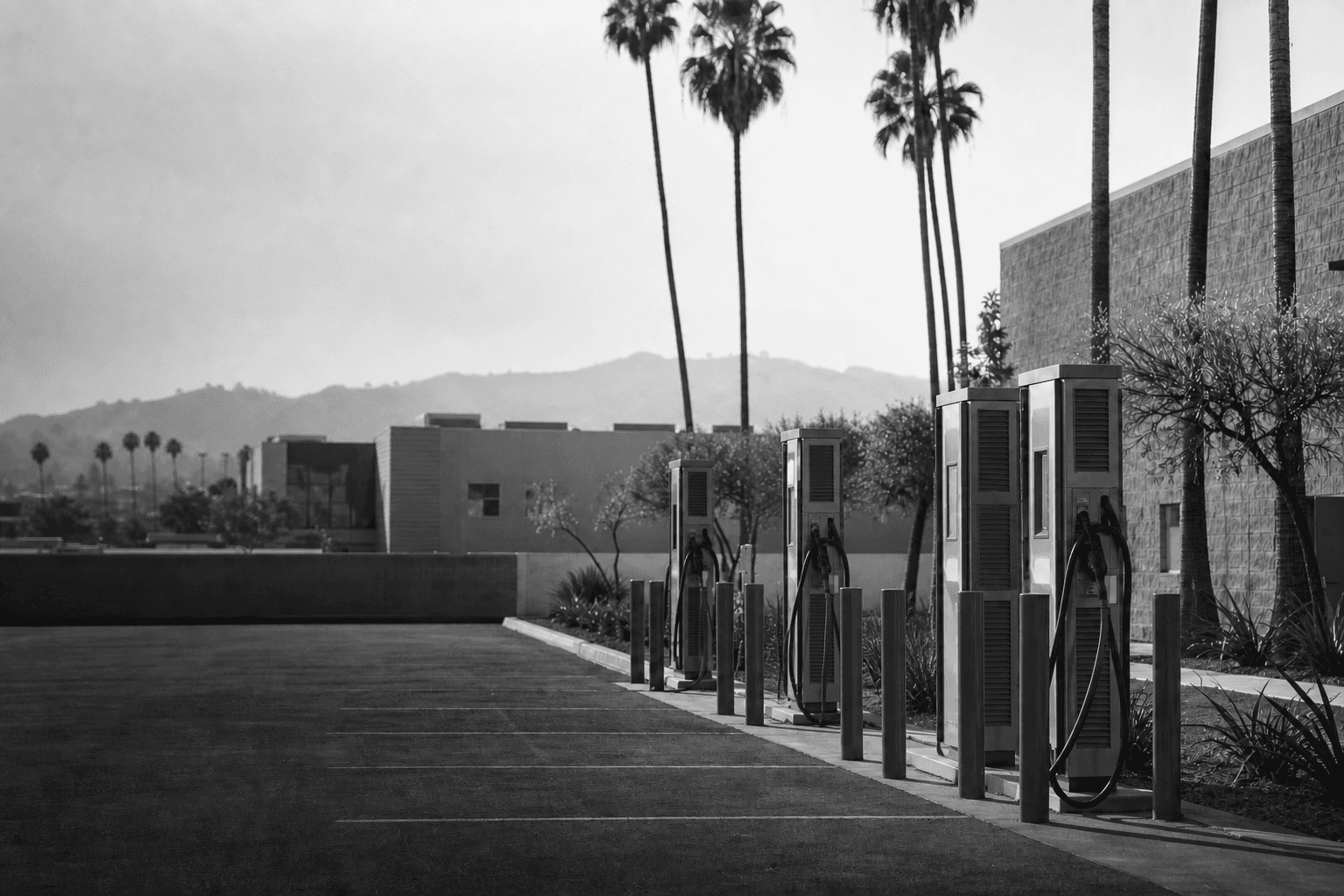
Two commercial buildings a mile apart in St. George can quote thousands apart on identical hardware. These are the conditions that decide which side of the range you land on.
LOWER COMPLEXITY
Short runs, spare capacity
Stalls near the electrical room, a panel with real headroom under the load calculation, and a short conduit path that avoids finished paving. Level 2 ports on sites like this sit near the bottom of the installed range.
HIGHER COMPLEXITY
Long runs, full panel
Stalls across the lot, a service already near capacity, and a trench crossing drive lanes. Distance adds cost steadily at $75 to $150 per 10 feet, and a required service upgrade changes the project class entirely.
SCOPING THE WORK
What a real site review has to produce
A quote without a site visit is a guess dressed up in a number. Federal installation guidance is direct about the sequence: pick the location based on how many units you need now and later, measure proximity to incoming electricity and metering, check whether you need a wireless connection for networked units, account for weather, and leave room to expand. Every one of those items has a dollar consequence, and none of them can be assessed from a satellite image.
The electrical findings matter most. You want a written load calculation against the existing service, a measured conduit route with the surface types called out, and a circuit schedule showing breaker size and conductor gauge for each port. Because EVSE is treated as a continuous load, a 48-amp charger is not a 48-amp circuit, and a bid that sizes it that way is either wrong or hiding a change order.
The last piece is the utility conversation. Bring the utility in early to confirm both near-term and long-term charging requirements, what rate the site will land on, and whether any upgrade to service equipment is needed on their side. That call often reshapes the design before anyone orders hardware.
Ask for the load calculation in writing
A verbal assurance that the panel has room is not a scope document. The written calculation is what separates a bid you can hold someone to from a number that grows during construction.
ST. GEORGE SPECIFICS
What changes locally
Three local items belong in your budget conversation. The first is your utility. Rocky Mountain Power's Wattsmart EV charger incentives are the primary utility program to check on Utah commercial work, but any incentive only applies in the territory that actually serves your meter. Confirm which utility bills the address before you count a rebate into the number.
The second is permitting. Fees and inspection turnaround vary city by city across Utah, and St. George handles its own review, so build the local timeline into the schedule instead of assuming a statewide default.
The third is climate. Federal siting guidance lists weather impacts as a selection criterion, and in southern Utah that means giving cabinets shade, clearance, and airflow rather than mounting them on an unshaded west-facing wall.
Check incentive eligibility during the site walk
Verify eligibility before the contract is signed, not after. Compare bids on net cost after incentives, because gross numbers hide which contractor actually did the utility homework and which one is planning to hand you the difference later.
AFTER THE INSTALL
Two decisions that outlive the invoice
Capital cost gets the attention, but two choices made during scoping follow the site for years: who owns the hardware, and what the electricity actually costs to deliver.
OWNERSHIP
Own the equipment or let a provider own it
Equipment you purchase, install, and maintain yourself lowers overall cost and gives you full control. It also makes every repair yours. Before choosing, pin down warranty coverage, who responds to a failure, and the required uptime.
OPERATING COST
Demand charges and rate structure
Electricity cost is not just per kilowatt-hour. Demand charges are typically based on the highest 15-minute average use in a billing period, and DC fast charging triggers them far more readily than Level 2. Ask whether a time-of-use rate applies.
PHASING AND LIFETIME COST
Build for the ports you will need later
The cheapest second charger is the one you planned for during the first install. Trenching, conduit, and panel work are the expensive parts of a commercial project, and they are far cheaper to do once at a slightly larger size than to do twice. Oversized conduit and a panel with intentional headroom cost little at the time and save a repeat excavation later. Load management is the other lever. It lets you put more ports behind the same service, which can push a service upgrade several years down the road or off the table entirely.
Incentives should be treated as a moving target rather than a fixed discount. The federal 30C refueling property credit covered a share of qualifying charging equipment and installation for property in eligible census tracts, but it no longer applies to property placed in service after June 30, 2026. Budget St. George projects at gross cost, treat utility programs as the live lever, and confirm the current federal position with your tax advisor before assuming either way.
Then carry the running cost forward. Plan on maintenance of up to $400 per charger per year, plus network fees if the units are connected, and know that once a warranty lapses a broken charger becomes an expensive surprise.
BEFORE YOU SIGN
Five things a comparable quote should show
If two bids are hard to compare, it is usually because one of them left these out. Ask for all five in writing and the numbers become comparable in an afternoon.
01
The load calculation
A written NEC 220 calculation against the existing service, not a verbal assurance that the panel has room.
02
The measured conduit route
Trench and conduit footage, the surfaces it crosses, and who is responsible for restoring pavement.
03
The circuit schedule
Breaker size and conductor gauge per port, sized for continuous load as the code requires.
04
Permit and inspection scope
Which permits are pulled, who pulls them, and the assumed inspection turnaround in St. George.
05
Ongoing costs, listed separately
Network fees, warranty term and coverage, maintenance responsibility, and annual cost per charger.
Keep planning locally
Related EV charging pages in St George
Get a defensible number
Price the equipment and the building together.
Send the address, operating target, and target opening date. Flux will identify what must be verified before the project can be priced.
Price my chargersQuestions
Straight answers.
How much does one commercial Level 2 charger cost in St. George?
Plan on $2,000 to $7,500 per installed port. The hardware itself runs $400 to $6,500 per unit, and the rest is electrical work. Sites with stalls near the panel and spare capacity land low. Long trenches, pavement cuts, or a service upgrade push toward the top.
Why is DC fast charging so much more expensive?
The hardware alone runs $10,000 to $40,000 per unit, and the service behind it is a different class of electrical work. Fast charging also triggers demand charges far more readily than Level 2, so the operating cost is higher too.
What is the single biggest cost variable?
Panel capacity. A load calculation under NEC 220 determines whether the job needs a service upgrade, and that finding is the largest swing in a Utah commercial quote. Conduit distance is second, adding roughly $75 to $150 per 10 feet past the first 25.
Are there incentives for commercial charging in St. George?
Rocky Mountain Power's Wattsmart EV charger incentives are the main utility program to check on Utah commercial projects, so confirm which utility serves your meter first. The federal 30C credit no longer applies to property placed in service after June 30, 2026.
What does it cost to run chargers after installation?
Budget up to $400 per charger per year for maintenance, plus network fees if the units are connected. Extended warranties on DC fast chargers can exceed $800 per charger per year, and out-of-warranty repairs get expensive quickly.
Sources used for this guide
- [1]afdc.energy.gov — Alternative Fuels Data Center: Procurement and Installation for Electric Vehicle Charging Infrastructure
- [2]irs.gov — IRS Alternative Fuel Vehicle Refueling Property Credit
- [3]evchargeracademy.com — EV Charger Installation Cost in Utah: 2026 Price Guide | EVCharger Academy
- [4]chargemybuilding.com — EV Charging Installers in Salt Lake City, UT | ChargeMyBuilding
- [5]afdc.energy.gov — Alternative Fuels Data Center: Operation and Maintenance for Electric Vehicle Charging Infrastructure
- [6]afdc.energy.gov — U.S. DOE AFDC Electric Vehicles for Fleets