THE NUMBER
What commercial EV charging costs in Roswell
Budget $2,500 to $7,000 per installed Level 2 port on a typical Roswell commercial site. The charger is the small half of that: single-connector Level 2 hardware runs $400 to $6,500, and DC fast units run $10,000 to $40,000 before a single trench is cut. Installed, plan on $40,000 and up per DC fast unit, and past $150,000 once the service work is real.
A site walk has to confirm spare panel capacity, the distance from the electrical room to the stalls, and whether the pavement between them has to be opened.
THE THREE PATHS
Three ways to charge on a commercial property
Most of the cost question is really a charging-level question. Level 1 and Level 2 fit places where vehicles sit for hours: workplaces, multifamily parking, and tenant stalls. Level 2 charges a typical EV battery overnight, which makes it the default for fleets that park at the yard every night. Public-facing hosts, where a driver stops for twenty minutes and leaves, are the ones who need DC fast charging, and that is where the price jumps by an order of magnitude.
There is a third path owners skip too often. Instead of a pedestal at every stall, a fleet can install 120/240-volt receptacles and hand out portable Level 1 or Level 2 units. That lowers overall project cost, and a portable unit is simple to swap when it fails instead of scheduling a service call on a fixed pedestal.
THE LINE ITEMS
Where the money actually goes
A quote that only names the charger is not a quote. These are the lines that decide whether your project lands at the bottom of the range or the top of it.
WHAT MOVES THE PRICE
Why two identical chargers cost different money
Two buildings can buy the same charger and pay very different totals. The charger is a catalog item. Everything between your electrical service and the parking stall is custom work, and that is where the spread lives.
Distance is the first driver. A stall thirty feet from the electrical room needs a short conduit run. A stall at the far edge of the lot needs a trench, and if there is asphalt in the way, the project pays to cut it, backfill it, and patch it. Being close to incoming electricity is the cheapest advantage a site can have.
Capacity is the second. If the panel has spare amps, the chargers land on it and the electrical scope stays small. If it does not, the project buys a subpanel, a new feeder, or a service upgrade with the utility involved, and the budget moves with it. DC fast charging almost always lands in that second category, which is much of why the installed number sits so far above the hardware sticker.
The practical takeaway: pick stalls close to power before you pick stalls close to the front door. Visibility is worth something. It is rarely worth thirty thousand dollars of trench.
TWO SITE TYPES
What makes a site cheap or expensive
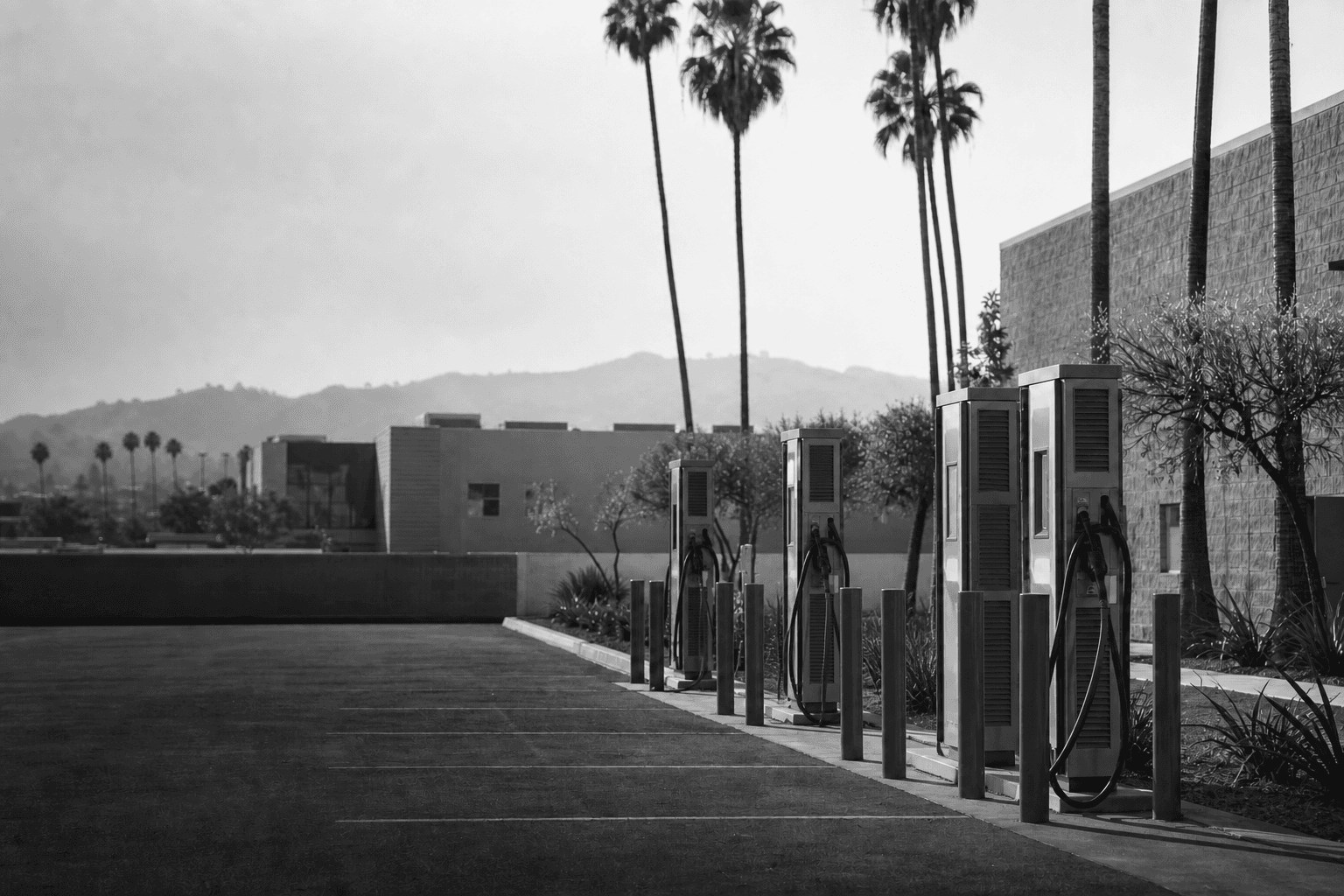
Before anyone quotes, you can usually tell which side of the range your property sits on. The difference is not the charger. It is the distance, the pavement, and the panel.
LOWER COMPLEXITY
Short run, spare capacity
Stalls near the electrical room, a panel with room left on it, and a surface nobody has to cut. Level 2 ports on a site like this land near the bottom of the installed range.
HIGHER COMPLEXITY
Long run, full panel
Parking across the lot, a panel already at its limit, and pavement in between. Add a service upgrade or DC fast equipment and the project moves from an electrical job to a construction job.
SCOPING THE WORK
What a real site review has to settle
A site review is not a formality. It is the step that turns a range into a number. The walk should measure the actual route from the service equipment to each proposed stall, read the existing panel and what capacity is left on it, and confirm what is under the pavement before anyone prices a trench.
It should also look forward. Deciding how many ports you want in five years is far cheaper to solve on the first dig than the second. Conduit and panel space installed now cost a fraction of reopening the same pavement later, so the review should size the near-term count and the long-term count separately.
The utility belongs in this conversation early. They confirm what the service can carry, what upgrades they require, and what rate you land on, and their timeline is usually the longest one in the project. Getting them involved during scoping is what keeps the schedule honest. The same goes for permits and inspection: both have lead times, and both belong in the plan rather than in the surprise column.
Ask for this before you sign
A quote should name the panel it lands on, the spare capacity it assumed, the length and route of the conduit run, and whether pavement restoration is included. If those four are missing, the number is a guess.
OWNING VS OPERATING
Two costs that outlive the install
The install is one check. The station then runs for years, and two decisions made during scoping set what those years cost.
The first is ownership. The second is how your electricity gets billed once the chargers are pulling load. Neither shows up on a hardware quote, and both are far easier to change before construction than after. Put in writing who is responsible for maintenance and repairs — the site host, the charging network, or the installer — and make the maintenance agreement name a response time, a repair time, and an uptime requirement. Without those three, an uptime promise is not enforceable.
OWNERSHIP
Buy it, or let a provider own it
Owning the equipment lowers overall cost and gives you full control, but you carry every repair once the warranty ends. Budget up to $400 a year per charger, and over $800 a year for a DC fast extended warranty.
RATE EXPOSURE
Demand charges and time of use
Utility bills often price the highest fifteen-minute average use in a billing period. DC fast charging triggers those demand charges far more often than Level 2. Ask your utility whether a time-of-use rate applies before you pick equipment.
BUILDING IT IN STAGES
Phasing, procurement, and the ten-year number
Most commercial sites do not need every port on day one. They need the trench dug once. The efficient pattern is to build the underground infrastructure for the full count you expect, energize a smaller number of chargers now, and add heads as demand shows up. Utilization data from a networked station tells you when that moment arrives instead of leaving you to guess.
Procurement deserves the same care. Bring the utility, the equipment vendor, and the electrical contractor into the plan together, because each holds a constraint the others cannot see. If your organization requires a formal solicitation, write the site conditions into it, or you will get bids that are not comparable. In Georgia, EVITP certification is not a blanket state mandate, but it is frequently required on federally funded, utility-program, and public-agency projects, which is worth confirming if any outside money touches your build.
Then run the ten-year number rather than the install number. Add electricity, network fees, maintenance, and warranty renewals to the capital cost, and subtract whatever the station earns if you charge for use. Pricing can be by kilowatt-hour, by session, by time, or by subscription. More than twenty percent of public charging is still free to use, so revenue is a choice, not a given.
THE CHECKLIST
Five things a comparable quote shows
Two bids are only comparable when both describe the same scope. Before you weigh the totals against each other, confirm every quote answers these five. Anything missing here is a change order waiting to happen.
01
Charger count, level, and connector
Model, number of ports, and whether each unit is networked or standalone.
02
The electrical run, in feet
Route length, trenching, conduit, wire, and who restores the pavement afterward.
03
Panel and service work
The panel it lands on, the capacity left on it, and any upgrade the utility requires.
04
Permits, inspection, and schedule
Who files, which inspections apply, and the expected in-service date.
05
Ongoing costs, spelled out
Network fees, warranty term, maintenance responsibility, response time, and uptime commitment.
Keep planning locally
Related EV charging pages in Roswell
Get a defensible number
Price the equipment and the building together.
Send the address, operating target, and target opening date. Flux will identify what must be verified before the project can be priced.
Price my chargersQuestions
Straight answers.
How much does one commercial Level 2 charger cost in Roswell?
Plan $2,500 to $7,000 per installed port. The hardware is $400 to $6,500 per connector; the rest is the electrical run, panel work, permits, and restoration. Simple sites near power land low.
Why is DC fast charging so much more expensive?
The hardware alone runs $10,000 to $40,000 per unit, and the service feeding it is a different class of electrical work. Installed, plan on $40,000 and up, and more when the utility has to upgrade service.
What does it cost to keep chargers running after the install?
Estimate up to $400 a year per charger for maintenance, plus network fees if the station is networked. Extended warranties on DC fast chargers can run over $800 per charger per year.
Can I still use the federal charger tax credit?
The federal 30C credit covered up to 30% of purchase and installation for property in eligible census tracts, but it does not apply to property placed in service after June 30, 2026. Treat it as history for new builds and confirm current options with your tax advisor.
What makes a site cheap to install on?
Stalls near the electrical room and a panel with spare amps. Distance and a full panel are the two things that turn a small project into a large one.
Sources used for this guide
- [1]afdc.energy.gov — Alternative Fuels Data Center: Procurement and Installation for Electric Vehicle Charging Infrastructure
- [2]irs.gov — IRS Alternative Fuel Vehicle Refueling Property Credit
- [3]pci-consultants.com — EV Infrastructure Charging Company in San Diego, CA | PCI Consultants
- [4]evchargeracademy.com — Georgia EV Charger Installer License Requirements (2026)
- [5]afdc.energy.gov — Alternative Fuels Data Center: Operation and Maintenance for Electric Vehicle Charging Infrastructure
- [6]afdc.energy.gov — U.S. DOE AFDC Electric Vehicles for Fleets