
THE DIRECT ANSWER
What commercial EV charging costs in Plymouth
Equipment is the part with published numbers. Single-connector units run $300 to $1,500 for Level 1, $400 to $6,500 for Level 2, and $10,000 to $40,000 for DC fast charging. Installation is the other half, and it is site-driven. One Minnesota cooperative rebate program caps commercial charging support at 50 percent of materials cost, or of project cost, up to $50,000 per member, which tells you the scale utilities expect these projects to reach.
A site review has to confirm spare capacity in the existing service, the distance from the electrical room to the stalls, and whether pavement gets cut. Those three answers set most of the installed price.
THE CHOICE
Three ways to set up commercial charging
The first decision is not the brand. It is what the chargers are for.
Workplace and multifamily sites can usually meet the need with Level 1 and Level 2 equipment, because vehicles sit for hours anyway. Public-facing sites are the ones that should weigh Level 2 against DC fast charging, because dwell time is short and drivers want to leave. Fleet depots have a third path worth knowing: instead of a pedestal at every parking spot, install 120/240-volt receptacles and use portable Level 1 or Level 2 units stored in the vehicles. That lowers overall project cost and turns a failed charger into a swap rather than a service call.
Charging level is also an electrical scope choice, not just a speed choice. Fast charging is far more likely to trigger demand charges, and it is the tier most likely to require utility service and equipment upgrades. Level 2 asks less of the building, and most workplace lots never miss the difference.
THE LINE ITEMS
Where the money actually goes
Hardware is the line everyone compares. It is rarely the line that decides the budget. These are the pieces that separate a cheap install from an expensive one, ordered roughly by how much they can swing between two buildings on the same street.
THE BUYING GUIDE
How to buy this without overpaying
Order of operations matters more than shopping. Pick the site before you pick the charger. The federal development checklist puts site selection first for a reason: proximity to incoming electricity, proximity to a wireless connection if the units are networked, weather exposure, and room for future expansion all get locked in by that one choice. Moving the stalls forty feet closer to the electrical room changes the price more than switching hardware brands ever will.
Bring the utility in early, before drawings are final. Their job is to confirm what the site needs now and later, and to price any service or equipment upgrades. No contractor can invent that number for you. The same conversation surfaces rate implications, which matter because charging bills include demand charges based on the highest fifteen-minute average use in a billing period. Fast charging triggers those far more readily than Level 2 does.
Then settle networking and ownership, because both change the quote. Networked units collect utilization data and can take payments. Non-networked units cost less and can still collect fees through RFID, a mobile app, or a parking attendant. Neither is wrong. Only one is right for how you plan to run the lot.
TWO SITES
What makes an install cheap or expensive
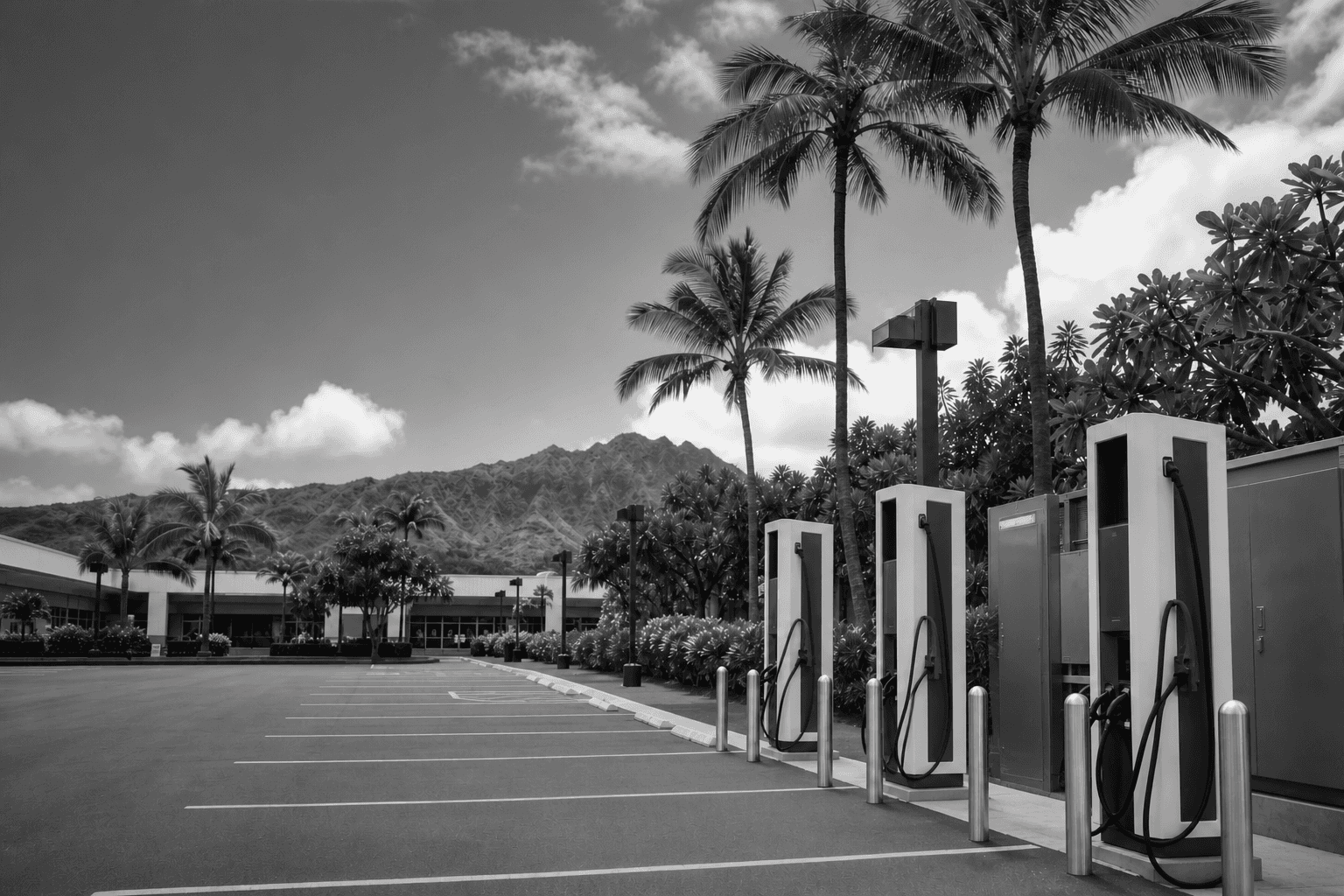
Two buildings can order identical chargers and get quotes that are not close. The difference is almost never the equipment. It is what stands between the incoming service and the parking stall, and how much of it has to be opened, upgraded, or rebuilt.
LOWER COMPLEXITY
Short run, spare capacity
The stalls sit near the electrical room, the existing service has headroom, and the run never leaves the building side of the pavement. Level 2 equipment, a short conduit path, and a routine permit and inspection cycle.
HIGHER COMPLEXITY
Long run, upgraded service
The stalls sit across the lot, the panel is full, and the path crosses drive lanes. Now you are scoping a service upgrade with the utility, cutting and restoring pavement, and building the schedule around inspections.
THE SITE REVIEW
What a real scoping visit has to settle
A quote you can trust comes out of a visit, not a phone call. The visit exists to answer the questions that get expensive later if someone guesses at them.
Start with the count. How many ports do you need now, and how many do you want to add later without reopening the ground? Trenching once for future capacity beats trenching twice. That single answer changes conduit size, wire, and sometimes the panel.
Then walk the path. The reviewer should trace the actual route from the service to the stalls, note every pavement cut, curb, drive lane, and island, and mark where pull boxes have to land. Weather belongs in that walk too, because Minnesota winters load the equipment, the cable management, and the restored surfaces all at once.
Last, settle who owns what. Maintenance responsibility should be assigned in writing before install, not discovered after a failure. The contract should name a response time, a repair window, and an uptime requirement. Chargers out of warranty are expensive to fix, and assuming the network handles it is not a maintenance plan.
Ask for these four before you sign
Port count now and later, the exact conduit route with every pavement cut named, the utility's written answer on service upgrades, and who owns maintenance. If any of the four is missing, what you are holding is an estimate, not a quote.
MINNESOTA RULES
State rules that belong in a Plymouth budget
Minnesota adds requirements that belong in the budget on day one, not at commissioning.
Retail chargers must display the price per kilowatt-hour in whole cents or tenths of a cent, or state that the electricity is free. If more than one price can apply, the terms that determine each price have to be shown. Chargers must also display the power level, the type of energy transfer, and any additional fees. Labeling has to comply with federal rules and with NFPA 70 Article 625.
The Minnesota Department of Commerce inspects EV chargers for compliance annually, and owners pay an inspection fee of $100 per port. Beginning July 1, 2027, public charger operators owe an excise tax of five cents per kilowatt-hour. Chargers that provide electricity at no cost, and chargers under 50 kilowatts, are exempt.
One decision this drives
If you plan to charge drivers, the $100-per-port annual inspection and the 2027 excise tax are real operating lines. A free-to-use Level 2 bank under 50 kilowatts sits outside the excise tax entirely, which is a legitimate reason to choose it for a workplace lot.
OWNING IT
Two things to decide before the first quote
Capital cost gets the attention. Operating cost decides whether the installation was a good idea three years in.
Two questions drive most of that. First, who owns the hardware, and therefore who is responsible when a port goes down. Second, whether you charge for use, and how. Both are answerable now, and both change what you should buy today.
The federal picture has also moved. The alternative fuel vehicle refueling property credit covered qualified business property placed in service through June 30, 2026, at six percent of cost, capped at $100,000 per port, and only in eligible census tracts. Projects placed in service by that date still claim it at filing. New Plymouth projects should not be budgeted around it.
OWNERSHIP
Buy it or let a provider own it
Equipment you purchase and own reduces overall cost and gives you full control of pricing and access. It also makes every repair, warranty gap, and out-of-warranty failure your line item to carry.
REVENUE
Free, metered, or subscription
Fees can be collected by kilowatt-hour, by session, by length of time, or by subscription. More than twenty percent of public charging is still free to use, and free is a valid answer for a workplace lot.
THE LONG VIEW
Phasing, procurement, and the ten-year number
Most sites should not install everything at once, but should trench for everything at once. The expensive, disruptive part of this project is the path: the conduit, the wire, and the pavement you open to place them. Sizing that path for the port count you expect in five years costs a modest amount today and saves an entire second mobilization later. Hardware, by contrast, gets better and cheaper while it sits in a catalog.
Procurement deserves the same patience. The federal checklist assumes you engage the utility, the equipment manufacturer, and the network provider while the plan is still a plan, so their input lands before the budget is fixed. Some organizations need a formal solicitation. If yours does, build the timeline around it, and add inspection lead time, which shapes the schedule as much as construction.
Then run the ten-year number instead of the install number. Budget up to $400 per charger per year for maintenance, and expect fast-charger extended warranties to run over $800 per charger per year. Add networking fees if the units are networked, add the $100 annual state inspection per port, and add electricity, where demand charges tied to the highest fifteen-minute average use can dominate the bill on a fast-charging site.
THE CHECKLIST
Five things a comparable quote shows
Two quotes are only comparable if both answer the same five questions. If one leaves a line blank, it is not the cheaper bid. It is the incomplete one, and the missing work returns as a change order.
01
Port count and charging level
Number of ports, charging level, connector type, and whether the design leaves room to add more later.
02
The electrical path
Trench length, conduit and wire sizing, every pavement cut, and who restores the surface afterward.
03
Utility scope
What the utility confirmed about capacity, any service or equipment upgrades required, and their cost and lead time.
04
Permits and inspection
Permit fees, inspection requirements, and the schedule impact of both.
05
Networking, signage, and maintenance
Software and activation fees, signage and striping, warranty term, and who is responsible for repairs.
Keep planning locally
Related EV charging pages in Plymouth
Get a defensible number
Price the equipment and the building together.
Send the address, operating target, and target opening date. Flux will identify what must be verified before the project can be priced.
Price my chargersQuestions
Straight answers.
How much does commercial EV charging equipment cost?
Single-connector unit costs run $300 to $1,500 for Level 1, $400 to $6,500 for Level 2, and $10,000 to $40,000 for DC fast charging. Installation is a separate cost and is driven by your site, not by the hardware you pick.
Is the federal EV charger tax credit still available?
No. The alternative fuel vehicle refueling property credit applied to qualified business property placed in service through June 30, 2026, at six percent of cost up to $100,000 per port, and only in eligible census tracts. Projects placed in service by that date still claim it at filing. New projects cannot count on it.
Are there utility rebates for commercial charging in Minnesota?
Some Minnesota electric cooperatives run commercial EV charging rebate programs. One requires pre-approval before the project starts and caps the rebate at 50 percent of materials cost, or of project cost, up to $50,000 per member. Confirm what your serving utility offers before you order equipment, since pre-approval programs do not pay backward.
What does commercial charging cost to run each year?
Estimate up to $400 per charger per year for maintenance, and over $800 per year for a DC fast charger extended warranty. Add networking fees on networked units, the $100 per port annual state inspection fee, and electricity, including demand charges.
Will Minnesota's EV charging excise tax apply to my site?
Beginning July 1, 2027, public EV charger operators must pay an excise tax of five cents per kilowatt-hour and report kilowatt-hours sold each month. Chargers that provide electricity at no cost and chargers with a capacity under 50 kilowatts are exempt.
Sources used for this guide
- [1]afdc.energy.gov — Alternative Fuels Data Center: Procurement and Installation for Electric Vehicle Charging Infrastructure
- [2]irs.gov — IRS Alternative Fuel Vehicle Refueling Property Credit
- [3]mvec.net — 2026-Commercial-EV-Charging-FILLABLE-2.pdf
- [4]afdc.energy.gov — Alternative Fuels Data Center: Operation and Maintenance for Electric Vehicle Charging Infrastructure
- [5]afdc.energy.gov — U.S. DOE AFDC Electric Vehicles for Fleets
- [6]afdc.energy.gov — Alternative Fuels Data Center: Minnesota Laws and Incentives