THE NUMBER
What commercial charging actually costs here
Budget in two pieces. Hardware for a single Level 2 connector runs about $400 to $6,500, and a DC fast unit runs about $10,000 to $40,000. Installation is separate. Across Los Angeles County, a straightforward Level 2 install covering labor, wiring, and permit fees reports at roughly $1,500 to $1,700 per unit. Commercial-grade equipment, long conduit runs, and any electrical service upgrade sit on top of that figure.
These are planning benchmarks, not a Palmdale quote. Panel capacity, distance from the electrical room, pavement restoration, and utility lead times move the final number in both directions.
PICK THE JOB FIRST
Three ways commercial charging gets used
The equipment follows the job, not the other way around. Federal guidance splits site hosts into rough groups, and the split holds up in the field. Workplaces and multifamily buildings serve drivers who park for hours, so Level 1 and Level 2 equipment covers them. Public and customer-facing sites serve drivers who park for minutes, which is where Level 2 and DC fast charging belong. Fleets sit in between. Vehicles come home to a yard and sit all night, and Level 2 charges a typical battery inside that window.
Decide this before anyone prices hardware. A site that buys DC fast charging when its dwell time is eight hours has bought speed it will never use, and it has also bought the electrical service that speed requires. The cheapest good project is usually the one that matched the charger to how long the car actually sits.
THE LINE ITEMS
Where the money goes
A quote is not one price. It is a stack, and only the top line is the charger. These are the lines that decide whether your project lands near the benchmark or well above it.
BUYING GUIDANCE
What actually decides your number
Federal siting guidance puts two questions ahead of everything else: how close the stalls are to incoming electricity, and whether the site will need more ports later. Both are cost questions wearing a design hat. Distance sets the trench. Future ports set the conduit and panel you should buy once instead of twice.
There is a cheaper shape for some sites. Rather than a pedestal at every parking location, you can install 120-volt or 240-volt receptacles and use portable Level 1 or Level 2 units that stay with the vehicles. Federal fleet guidance names this as a way to cut overall project cost, and it carries a second benefit. A portable unit that fails gets swapped, not excavated.
Weather exposure belongs on the list too. The federal siting checklist treats weather impact as a real selection factor, so enclosure rating, cable management, and mounting details are worth confirming in the quote rather than after the first hot summer. The same goes for signage, striping, and security, which are genuine line items that get discovered late on projects that skipped the checklist.
TWO SITES
What makes a Palmdale install cheap or expensive
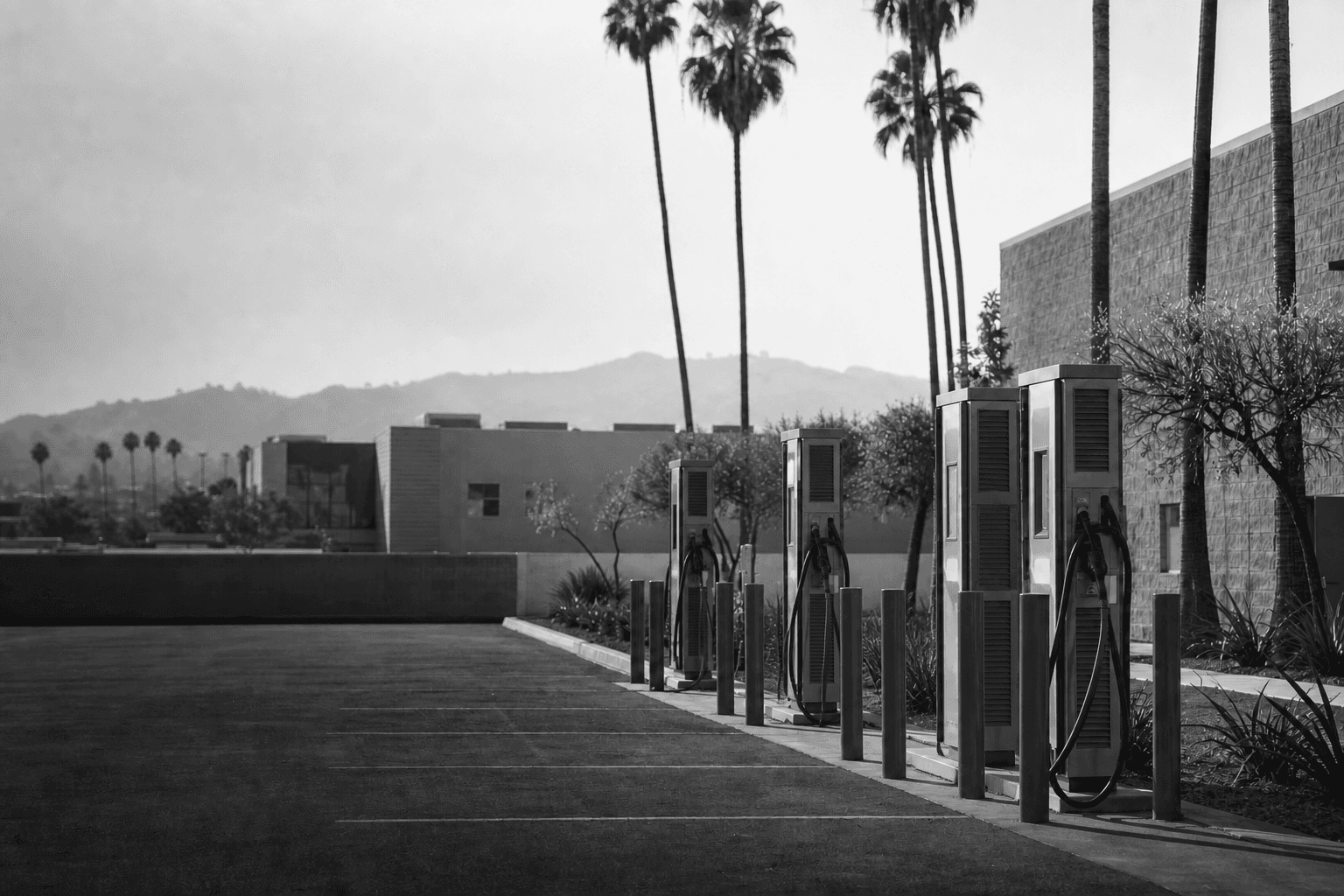
Two buildings on the same street can price a mile apart. The difference is rarely the charger. It is capacity, distance, and what the crew has to cut through to get power to the stall.
LOWER COMPLEXITY
Short run, spare capacity
The panel has amps to give, the stalls sit near the electrical room, and the route runs through landscaping or existing conduit. Permits are routine and the utility has little to do. These projects land close to benchmark.
HIGHER COMPLEXITY
Long run, full panel
The stalls sit across the lot, the panel is full, and the route crosses pavement that has to be cut and restored. Add a service upgrade or new metering and the utility timeline, not the hardware, sets your in-service date.
BEFORE YOU PRICE IT
The scoping work that pays for itself
The federal checklist for charging projects front-loads almost everything, and that ordering is the useful part. Before hardware gets chosen, you settle scope, budget, funding mechanism, and timeline. You decide how many ports and what type. You bring in your serving utility and a certified electrical contractor early, because the utility is the only party that can tell you what your service actually supports and what an upgrade would cost.
You also decide three things people leave for later and then pay for. Whether the stations are networked, since that sets payment capability and whether you collect utilization data. Who owns the equipment, which sets who pays for repairs. And whether your organization needs a formal solicitation, which moves the schedule more than any construction step.
Incentives and code review belong in the same pass. Programs generally have to be applied for before construction begins, and permitting requirements shape both the drawings and the calendar. Scoping is where a Palmdale project either gets a real number or gets a number that changes twice.
Ask the utility first, not last
Federal guidance names utility engagement as a planning step, not a closing step. The utility confirms what your service supports, what an upgrade costs, and how your rate treats charging load. That answer can reshape hardware choices, so get it before you sign for equipment.
PALMDALE SPECIFICS
What this market changes
Palmdale sits inside the Los Angeles County labor market, and that market has a documented floor. Reported Level 2 installs across LA County cities, including nearby Santa Clarita, run roughly $1,400 to $1,700 with labor, wiring, and permit fees included. Read that as a floor and not a forecast. Those figures exclude commercial-grade equipment and any electrical service upgrade, and both are normal on commercial sites.
The federal charger credit is also location-specific. Eligibility depends on the census tract the property sits in, so two Palmdale properties a few miles apart can land on opposite sides of the rule. There is a federal locator tool built for exactly this question, and the tract check is worth running before the credit goes anywhere near a pro forma.
Check the tract before you count the credit
The federal refueling property credit turns on census tract eligibility and on the placed-in-service date, and for business use it applies to depreciable property. Run your address through the federal locator and confirm current terms with your tax advisor before the credit offsets any line in your budget.
AFTER THE INSTALL
Two costs that outlive the invoice
Capital cost gets the attention. The operating side is where a charging site quietly succeeds or fails, and two decisions set it: who owns the equipment, and how the power is billed. Neither one shows up in a hardware quote. Both are far easier to settle before construction than after.
Budget for upkeep from day one. Federal guidance puts average maintenance at up to $400 per charger per year, and annual extended warranties for DC fast chargers can run over $800 per charger per year. Level 2 units often carry a fixed-term warranty at a lower cost, but when that term ends, the repair bill is yours.
OWNERSHIP
Who owns the charger
Owning the equipment reduces overall cost and gives you full control, but you carry every repair. Provider-owned equipment shifts that burden and adds fees. Either way, put maintenance responsibility, response time, repair time, and an uptime requirement in writing.
ELECTRICITY
How the power is billed
Charging bills combine per-kilowatt-hour charges with demand charges tied to the highest 15-minute average use in a billing period. DC fast equipment triggers those far more readily than Level 2. Ask the utility whether a time-of-use rate applies.
PLAY THE LONG GAME
Phasing beats buying it all at once
Very few Palmdale sites need their final port count on day one. The better version of this project separates what is cheap to do now from what is expensive to do twice. Trenching, conduit, and panel capacity are the expensive-to-repeat items. Chargers are not. Pulling conduit for eight stalls while the trench is already open, then energizing four, usually beats paying for two mobilizations.
Procurement deserves the same patience. Federal guidance suggests engaging equipment and network providers during planning so they respond to your timeline instead of dictating it, and it suggests timing equipment delivery against when vehicles or tenants actually arrive. A charger sitting in a crate for five months has started its warranty clock without earning anything.
Then price the decade, not the invoice. Add per-kilowatt-hour and demand charges, maintenance, network fees, and warranty renewals to the capital number before you compare two proposals. A cheaper install with a heavier rate profile and no warranty coverage is not the cheaper project. It is the project whose costs arrive later, in smaller pieces, on a different budget line.
THE CHECKLIST
Five things a comparable quote shows
Two quotes are only comparable when they scope the same work. Ask every bidder for these five in writing before you compare totals. Missing lines are not savings. They are the parts that come back later as change orders.
01
Port count, level, and connector type
Stated per stall, with the equipment price broken out from the installation price.
02
The electrical scope
Trench length, conduit and wire, pavement cut and restoration, and any panel or service upgrade priced as its own line.
03
Permits, inspection, and utility coordination
Who files, who schedules, and what each of those steps does to the in-service date.
04
Networking, payment, and data
Whether stations are networked, what the software costs each year, and who holds the account.
05
Maintenance, warranty, and uptime
Term length, response time, repair time, an uptime commitment, and what a renewal costs.
Keep planning locally
Related EV charging pages in Palmdale
Get a defensible number
Price the equipment and the building together.
Send the address, operating target, and target opening date. Flux will identify what must be verified before the project can be priced.
Price my chargersQuestions
Straight answers.
How much does a commercial Level 2 charger cost in Palmdale?
Hardware for a single Level 2 connector runs about $400 to $6,500. Installation prices separately. Reported Level 2 installs around Los Angeles County run roughly $1,400 to $1,700 with labor, wiring, and permit fees included, though commercial-grade equipment and any service upgrade push a real commercial quote above that.
Why is DC fast charging so much more expensive?
The equipment alone runs about $10,000 to $40,000 per unit, and the electrical service behind it is a different class of work. DC fast charging is also more likely to trigger demand charges than Level 1 or Level 2, so it costs more to run, not just more to build.
What should I budget for maintenance each year?
Plan on average maintenance of up to $400 per charger per year. Annual extended warranties for DC fast chargers can exceed $800 per charger per year. Level 2 warranties are often fixed-term and cheaper, but once the term ends, repairs are the owner's cost.
Can the federal tax credit reduce my cost?
Possibly, and it depends on where you are. The federal refueling property credit applies to depreciable business property placed in service in an eligible census tract, and eligibility is decided by location. Run the address through the federal locator tool and confirm current terms with a tax advisor before budgeting around it.
What makes a site cheap to install on?
Spare panel capacity and stalls near the electrical room. Distance and a full panel are the two conditions that turn a small project into a large one, mostly through trenching, pavement restoration, and upgrade work.
Sources used for this guide
- [1]afdc.energy.gov — Alternative Fuels Data Center: Procurement and Installation for Electric Vehicle Charging Infrastructure
- [2]irs.gov — IRS Alternative Fuel Vehicle Refueling Property Credit
- [3]winsparking.com — Fleet EV Charging in Denver, CO | Wins Parking
- [4]promatcher.com — EV Charging Station Cost - Los Angeles, California
- [5]afdc.energy.gov — Alternative Fuels Data Center: Operation and Maintenance for Electric Vehicle Charging Infrastructure
- [6]afdc.energy.gov — U.S. DOE AFDC Electric Vehicles for Fleets