THE NUMBER
What commercial EV charging costs in Orem
Budget per port, not per project. Commercial charging hardware runs about $400 to $6,500 for a Level 2 unit and $10,000 to $40,000 for a single-connector DC fast charger. Installation on Utah commercial and multifamily properties commonly lands between $2,000 and $7,500 per station. A small Level 2 bank on a site with spare panel capacity sits near the bottom of both ranges. DC fast changes the class of electrical work, and the budget moves with it.
A site review has to confirm three things before any of that is real: spare capacity at the panel, the distance from the electrical room to the stalls, and what the surface between them is made of.
THREE WAYS TO RUN IT
Pick the operating model before you price hardware
The charger you buy follows from how long vehicles sit. Where cars park for hours — employees, residents, hotel guests — Level 2 fills a typical battery overnight and keeps the electrical work modest. Where drivers stop for minutes and leave, DC fast is the only equipment that fits, and it brings the service work, the demand charges, and the price to match. Fleets are their own case: vehicles return to one yard, sit all night, and can often be served with lower-cost portable units fed from installed receptacles instead of a pedestal at every stall.
Decide which of these describes your parking before anyone quotes a unit. The wrong operating model does not show up as a slightly higher invoice. It shows up as chargers nobody uses, or a line of drivers waiting on ports that were never sized for turnover.
WHAT'S IN THE NUMBER
The lines that make up a charging budget
A charging quote is mostly not the charger. These are the lines that move, roughly in order of how far they can swing between two otherwise identical properties.
BUYING GUIDANCE
Where the money actually goes
Two buildings can buy the same charger and get quotes that are not close. The difference is almost always distance and capacity. A stall thirty feet from a panel with headroom is a short conduit run and a breaker. A stall at the far edge of the lot, fed from a panel that is already full, means trenching, pavement cut and restoration, new gear, and possibly a service upgrade before the first port energizes. That is why per-foot pricing matters: past the first twenty-five feet, each additional ten feet typically adds $75 to $150 in labor and material, and a long run turns that from a rounding error into a real line item.
So the order of operations is backwards from how most people shop. Start with the load calculation, not the catalog. It tells you how many amps the building can actually give up, which sets how many ports you can energize without buying more service. Then pick stalls against that answer, weighing proximity to the incoming service and metering, the surface the conduit has to cross, and where you would want to expand later.
Networking is the last hardware decision, and it is a business decision more than an electrical one. If you plan to collect fees, restrict access, or track charging load separately from the rest of the building, you need networked units and the subscription that comes with them. If you do not, you are paying monthly for reporting nobody reads.
SITE CONDITIONS
What makes a site cheap, and what makes it expensive
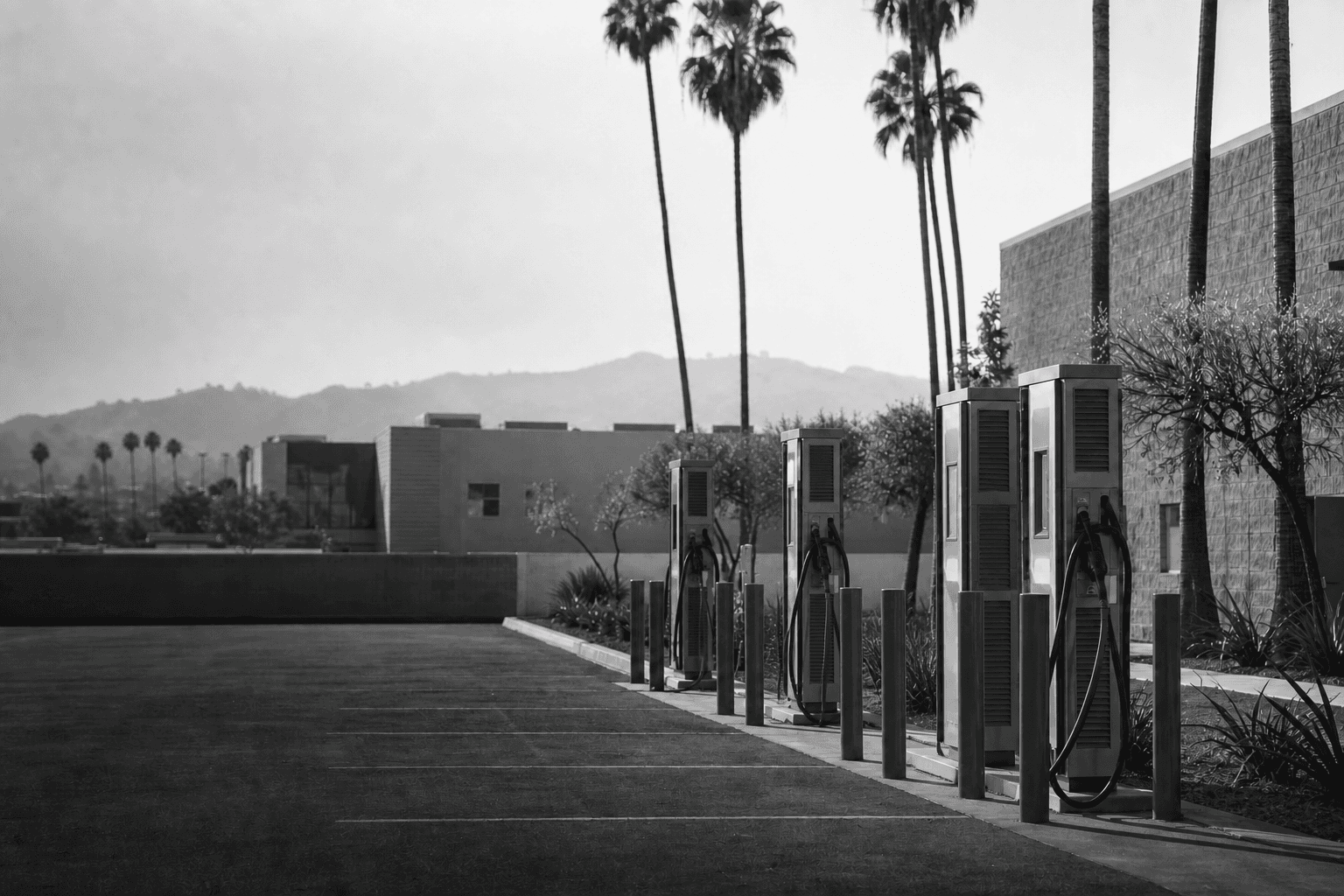
Nothing about the charger changes between these two properties. Everything about the electrical work does, and that is where the quote is won or lost. Before you compare bids, work out honestly which column your building sits in.
LOWER COMPLEXITY
Short runs, spare amps
Stalls within sight of the electrical room, a panel with headroom left on the load calculation, and a landscaped or unpaved path for conduit. Level 2 ports here land near the bottom of the installed range.
HIGHER COMPLEXITY
Long runs, full panels
Chargers across the lot from a panel with nothing left. Now you are paying by the foot for conduit, cutting and restoring pavement, and possibly buying a service upgrade before a single port turns on.
SCOPING
What the site review has to settle
A useful site review answers questions in an order, and the first one is not which charger you like. It starts at the service: what the load calculation says the building can give up, whether the panel has physical space left, and what an upgrade would cost if it does not. That single answer separates a project that lands in the low thousands per port from one that does not.
From there it is measurement. Feet from the source of power to each stall. What the conduit has to cross — landscaping, asphalt, structured deck — and who restores it afterward. Where the meter sits and whether metering has to change. Whether the location has wireless coverage, if the units will be networked. Whether the spot protects the equipment and cable management from weather, which belongs in siting right alongside proximity to power.
The last pass is the paperwork everyone underestimates: permits, inspection requirements and their effect on the schedule, signage and striping, and the utility's own review of what you are asking the service to carry.
Bring the utility in early
Engage the utility during planning, not after the design is drawn. Service upgrades, metering changes, and rate implications are their decisions to make, and discovering them late is the most common reason a charging project slips.
AFTER INSTALL
Two decisions that outlive the install
The install takes a few weeks. Ownership lasts a decade. Two questions decide what the chargers cost you after the crew leaves, and both should be settled in writing before anyone orders equipment.
The first is who owns the hardware. The second is who is responsible when it stops working — the site host, the charging network, or the installer. Neither has a universally right answer, but leaving either one vague is reliably expensive, because a broken charger outside its warranty costs real money and a vague contract means nobody is obligated to fix it quickly.
OWNERSHIP
Buy it, or let a provider own it
Equipment you own is purchased, installed, and maintained by you. That lowers overall cost and gives full control over access and pricing, but every repair, warranty claim, and replacement is yours to fund and manage.
SERVICE TERMS
What the maintenance contract must say
Budget up to $400 per charger per year for maintenance, and more for DC fast — extended warranties there can run over $800 per charger annually. Any contract should name a response time, a repair time, and an uptime requirement.
PHASING
Build for the second phase now
Phase the ports, not the trench. Excavation and conduit are the expensive, disruptive part of the job, and they do not get cheaper the second time you open the same pavement. If the plan is four ports now and twelve later, size the pathway for twelve while the ground is open. Load management does the same work on the electrical side, letting more ports share capacity you already have instead of buying service you would use only at peak. A common starting point is making ten to twenty percent of spaces EV-capable while energizing five to ten percent, then expanding as demand shows up.
Check incentives during the site visit, not after the invoice. In Utah, Rocky Mountain Power's Wattsmart EV charger incentives are the first program to price against. The federal 30C credit covers up to thirty percent of qualifying charging property, capped at $100,000 for commercial property, but only in eligible census tracts, and what you can claim is tied to the placed-in-service date — confirm both with your tax advisor before you count it in a budget.
Then look at year two. Demand charges are typically based on the highest fifteen-minute average use in a billing period, and DC fast equipment is far more likely to trigger them than Level 2. Time-of-use rates and scheduled charging can blunt that, which is exactly the kind of thing worth designing around before the concrete is cut.
COMPARING QUOTES
Five things a comparable quote shows
Two bids for the same job should be legible side by side. If any of these is missing, you are not comparing prices — you are comparing how much each contractor left out of the page.
01
The load calculation
Not a guess about spare capacity. The calculation itself, and what it concluded about needing a panel or service upgrade.
02
The measured run
Feet from the electrical source to each stall, the surface the conduit crosses, and who restores pavement afterward.
03
Circuit and wire per port
Charger amperage, breaker size, and conductor size, so you can confirm two bids are quoting the same capability.
04
Permits and utility coordination
Listed as their own line items with a schedule, not buried inside a lump labor number.
05
Year-one operating cost
Network fees, warranty term, and who owns maintenance, with response time and uptime spelled out.
Keep planning locally
Related EV charging pages in Orem
Get a defensible number
Price the equipment and the building together.
Send the address, operating target, and target opening date. Flux will identify what must be verified before the project can be priced.
Price my chargersQuestions
Straight answers.
How much does one commercial Level 2 port cost?
The unit itself runs roughly $400 to $6,500 depending on power, connectors, and networking. Installed cost on commercial and multifamily properties in Utah commonly lands between $2,000 and $7,500 per charging station, with panel capacity and conduit distance deciding where in that range you land.
Why is DC fast charging so much more expensive?
The hardware alone runs $10,000 to $40,000 per single-connector unit, and the electrical service behind it is a different class of work entirely. DC fast equipment is also far more likely to trigger utility demand charges, so the operating cost climbs alongside the capital cost.
What makes two similar sites price so differently?
Distance and spare capacity. A load calculation decides whether you need a service upgrade, which is the single biggest swing in a quote. Then distance bills by the foot — past the first 25 feet, each additional 10 feet typically adds $75 to $150 in labor and material.
Can incentives cover part of the cost?
Often. Rocky Mountain Power's Wattsmart EV incentives are the Utah program to check first. The federal 30C credit covers up to 30 percent of qualifying charging property, capped at $100,000 for commercial property in eligible census tracts, and eligibility depends on the placed-in-service date — verify it with your tax advisor.
What does it cost to keep chargers running?
Plan on up to $400 per charger per year for maintenance, plus any network subscription. Extended warranties on DC fast chargers can exceed $800 per charger per year. Repairs on out-of-warranty equipment are the expensive surprise, so settle responsibility in the contract.
How many ports should we start with?
A common starting point is making 10 to 20 percent of spaces EV-capable while energizing 5 to 10 percent, then expanding as demand appears. Load management lets you add ports within the capacity you already have instead of buying more electrical service up front.
Sources used for this guide
- [1]afdc.energy.gov — Alternative Fuels Data Center: Procurement and Installation for Electric Vehicle Charging Infrastructure
- [2]irs.gov — IRS Alternative Fuel Vehicle Refueling Property Credit
- [3]evchargeracademy.com — EV Charger Installation Cost in Utah: 2026 Price Guide | EVCharger Academy
- [4]chargemybuilding.com — EV Charging Installers in Salt Lake City, UT | ChargeMyBuilding
- [5]afdc.energy.gov — Alternative Fuels Data Center: Operation and Maintenance for Electric Vehicle Charging Infrastructure
- [6]afdc.energy.gov — U.S. DOE AFDC Electric Vehicles for Fleets