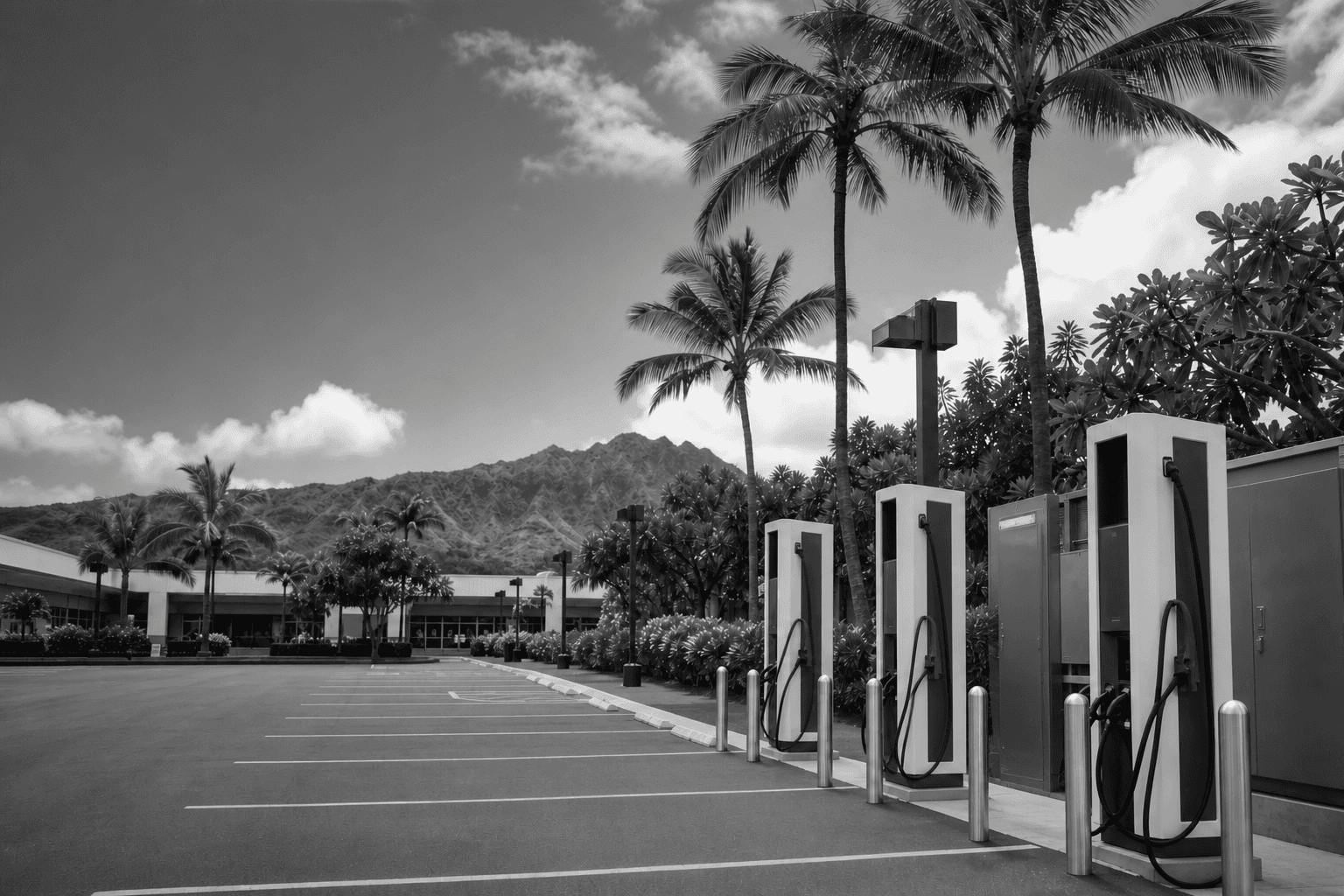
Direct answer
Level 2 hardware starts near $400; installed stations run $2,000 to $7,500.
Equipment and installation are two separate numbers. Federal data puts single-connector Level 2 hardware between $400 and $6,500, and DC fast units between $10,000 and $40,000. Installed cost at Charleston-area commercial and multifamily properties typically runs $2,000 to $7,500 per charging station. DC fast projects sit well above that range once the electrical service, trenching, and utility coordination are priced.
These are planning benchmarks, not a North Charleston quote. Panel capacity, conduit distance, pavement restoration, permit turnaround, and the charging schedule all move the final number.
Start with the schedule
Charging power should follow how long the vehicles actually sit
Start with the parking schedule, not the charger catalog. Federal guidance points workplaces and multifamily properties toward Level 1 and Level 2 charging, and points public charging hosts toward Level 2 and DC fast charging. That split is really about time. A vehicle parked for eight hours does not need expensive power. A vehicle parked for twenty minutes does.
Level 2 sends alternating current to the vehicle, and the vehicle's onboard charger decides how fast that becomes battery energy. Paying for a higher nameplate rating does not make a car accept power faster than its own equipment allows. DC fast charging moves the conversion outside the vehicle and pushes direct current to the battery. It buys turnaround speed, and it asks far more of the building's electrical service.
There is a third path that often gets skipped. Federal fleet guidance notes that 120- or 240-volt receptacles paired with portable Level 1 or Level 2 units can lower overall project cost, because you are not installing a pedestal at every parking location. Portable units are also simpler to swap when one fails. Work the daily miles and the available parking hours first, then let that math pick the power level.
Build the whole number
What belongs in a commercial charging budget?
A budget that lists only chargers is not a budget. Separate the equipment from the work needed to power it, permit it, and keep it running. The tags show where the price risk actually sits.
Buy the box last
Hardware selection should follow the site, not lead it
A charger nameplate is a request, not a promise. Selection should follow two answers: what the vehicles need, and what the building can feed.
Circuit sizing is where that request turns into money. The electrical code treats charging equipment as a continuous load, so a 48-amp charger needs a 60-amp circuit and 6 AWG copper. Multiply that across a row of stalls and the panel question answers itself. This is why the load calculation belongs at the front of the project instead of after the equipment order.
Compare more than power. Connector type, cable reach, pedestal or wall mounting, environmental rating, accessibility, payment options, load-management support, warranty length, and parts availability all matter over the life of the unit. Weather exposure sits on the federal siting checklist for a reason: a pedestal in an open lot lives a harder life than a unit mounted under cover. Federal guidance also asks site hosts to decide early whether stations need to be networked, whether utilization data will be collected, and whether payment capability is required. Each of those is a cost and a contract, not a checkbox.
Decide ownership at the same time. Equipment the facility buys, installs, and maintains costs less overall and gives full control, but every repair after the warranty is yours. Provider-owned equipment shifts that risk, usually in exchange for fees. Neither answer is wrong. Discovering the answer after the chargers are in the ground is.
The expensive path
Why two North Charleston lots price differently
Two properties can order identical chargers and get quotes that are not close. The site decides. Distance to usable power, pavement, and spare panel capacity move the number more than the badge on the unit.
Lower-complexity site
Short route, spare capacity
• Spare breaker space and service capacity
• Stalls near the electrical room
• Short surface or wall-mounted route
• Little or no pavement to cut and restore
Higher-complexity site
New capacity, long route
• Load calculation triggers a service upgrade
• Long trench across an occupied lot
• Boring under drives, fire lanes, or landscaping
• DC fast charging with high peak demand
Replace guesses with site facts
A site walk should answer the expensive questions first
Federal siting guidance is blunt about what to check: how close the stalls are to incoming electricity, whether metering changes are needed, whether a wireless connection reaches the equipment, how weather hits the location, and where the next set of ports will go.
Start in the electrical room. Locate the service, the transformer, the main gear, the distribution panels, and the spare breaker space. Nameplate ratings are only the opening bid. Demand history and the existing load calculation tell you whether that spare capacity is really free once the building's normal load is counted.
Then walk the route. Mark proposed charger positions, accessible stalls, pedestrian paths, vehicle circulation, drainage, and pavement types. A straight line on an aerial photo can cross a fire lane, a storm line, or an active loading dock. Walking it with facilities staff surfaces those conflicts while the drawing is still cheap to change.
Finish with operations. Ask when vehicles arrive, how long they sit, what happens when a stall is blocked, and who answers when a port goes dark. Signage, security, and inspection requirements belong on the same list, because each one can move the schedule as much as the electrical work does.
A remote number is a range, not a scope.
Photos, panel schedules, and utility bills narrow the problem. A firm price needs measured routes and verified electrical capacity. Any estimate should list the assumptions still waiting on field confirmation.
North Charleston planning
Confirm the permit path and the serving utility early
Two local items decide a lot of this budget. The first is permitting. Most South Carolina charging installations need an electrical permit, and some scopes need additional approvals. Fees and inspection turnaround vary city by city across the Charleston area, so the schedule you assume for one jurisdiction does not transfer to the next one over.
The second is the utility. Dominion Energy and Duke Energy Progress run the programs worth checking before a South Carolina project is priced, and federal guidance says to engage the utility early to identify installation needs, service upgrades, and rate impacts. Confirm which utility serves the address before the budget is set.
Federal help is thinner than it was. The 30C refueling property credit covered up to 30% of qualifying cost, capped at $100,000 for commercial property, and only in eligible census tracts. It ended for property placed in service after June 30, 2026, so treat it as history rather than a live line item.
The North Charleston takeaway
Confirm the serving utility, the electrical permit path, and inspection sequencing while charger locations can still move on paper. Ask about utility program requirements before construction, because approval timing can affect what qualifies.
After the install
The construction price is not the cost of running chargers
Electricity is the obvious ongoing line, and it is not only cents per kilowatt-hour. Utility bills often include a demand component tied to the highest 15-minute average use in a billing period, and DC fast charging is far more likely to trigger that than Level 1 or Level 2. Some utilities offer time-of-use rates that reward shifting charging to cheaper hours.
Maintenance is smaller but constant. Routine care is mostly storing cables properly, checking parts, and keeping units clean. Federal guidance still says to plan on up to $400 per charger per year, and annual extended warranties for DC fast chargers can run over $800 per charger. Repairs outside warranty get expensive quickly.
Networked sites also carry a pricing decision: by kilowatt-hour, by session, by time, or by subscription. More than 20% of public charging is still free to use, so recovering cost is a choice, not a default. Put responsibility in writing either way. Decide whether the site host, the network, or the installer owns maintenance, and require a response time, a repair window, and an uptime commitment in the contract.
Year one
Commissioning and activation
Commissioning, staff training, network activation, payment setup, signage, security, and a clear path for reporting a port that will not start.
Every year after
Recurring ownership cost
Electricity and demand charges, network fees, maintenance up to $400 per charger, warranty renewals, damaged cables, and out-of-warranty replacement.
Build once, add ports deliberately
Phasing controls the first budget without rebuilding the lot
Size the first phase to demand you can actually see. A common starting point at commercial and multifamily properties is making 10% to 20% of parking spaces EV-capable while activating chargers at 5% to 10%, then expanding as use grows. Load management lets you fit more ports inside existing electrical capacity instead of buying capacity that sits idle for years.
Do the disruptive work once. Trenching, conduit, pull boxes, equipment pads, reserved panel space, and communication pathways are cheap to install while the lot is already open and expensive to add after it is repaved. Federal siting guidance lists future expansion as a factor to weigh when the location is chosen, not later. That only works if the plan is real. Record the final port count, the assumed charging power, and which equipment is deferred, so the next contractor is not guessing at the original intent.
Then decide how you buy. Some organizations need a formal solicitation, and that adds calendar time at the front of the project alongside utility coordination and inspection scheduling. Either way, ask each bidder to price the immediate phase and at least one expansion alternate. That shows what flexibility actually costs instead of leaving you with a promise that the site is future-ready.
Before you compare bids
Five things a comparable quote should show
Ask every bidder to price the same port count, power level, conduit route, panel work, restoration, permits, and network term. If one bid excludes utility or civil work and another includes it, the totals are not comparable.
01
The charging use case: vehicle dwell time and energy needed per session
02
Existing service capacity, the load calculation, and any load-management assumption
03
Exact charger locations and the measured conduit route, with restoration included
04
Permits, inspections, utility coordination, networking, and commissioning scope
05
An expansion alternate so future ports do not mean reopening the lot
Keep planning locally
Related EV charging pages in North Charleston
Get a defensible number
Price the equipment and the building together.
Send the address, operating target, and target opening date. Flux will identify what must be verified before the project can be priced.
Price my chargersQuestions
Straight answers.
How much does one commercial Level 2 charger cost in North Charleston?
Plan $2,000 to $7,500 per installed station for commercial and multifamily work in the Charleston area. Hardware alone runs $400 to $6,500 per connector. Distance to power and spare panel capacity decide where you land.
Why is DC fast charging so much more expensive?
The equipment runs $10,000 to $40,000 per connector, and the electrical service behind it is a different class of work. DC fast charging is also far more likely to trigger utility demand charges than Level 1 or Level 2.
Is the federal 30C charging tax credit still available?
Not for new work. It covered up to 30% of qualifying cost, capped at $100,000 for commercial property in eligible census tracts, and it ended for property placed in service after June 30, 2026. Confirm your situation with a tax advisor.
What makes a site cheap to install on?
Spare breaker space and stalls near the electrical room. Past the first 25 feet, every extra 10 feet of run typically adds $75 to $150, and a service upgrade is the single biggest swing in a South Carolina quote.
Sources used for this guide
- [1]afdc.energy.gov — Alternative Fuels Data Center: Procurement and Installation for Electric Vehicle Charging Infrastructure
- [2]irs.gov — IRS Alternative Fuel Vehicle Refueling Property Credit
- [3]evchargeracademy.com — EV Charger Installation Cost in South Carolina: 2026 Price Guide | EVCharger Academy
- [4]chargemybuilding.com — EV Charging Installers in Charleston, SC | ChargeMyBuilding
- [5]afdc.energy.gov — Alternative Fuels Data Center: Operation and Maintenance for Electric Vehicle Charging Infrastructure
- [6]afdc.energy.gov — U.S. DOE AFDC Electric Vehicles for Fleets