THE NUMBER
Commercial EV charging installation cost in Murrieta
Charger hardware is the part with a published range. A single-connector Level 2 unit runs $400 to $6,500. DC fast charging equipment runs $10,000 to $40,000 per unit. Installation sits on top of that. Reported California pricing puts a basic Level 2 install near $1,500 to $1,700, but that figure covers residential work and excludes commercial-grade equipment and any electrical service upgrade. On a commercial lot, the electrical work is usually the larger number.
A site review has to confirm three things before the number is real: spare capacity in your panel, the distance from that panel to the stalls, and what your utility says it can feed today.
THE FIRST DECISION
Three ways to run charging at a commercial site
Before you price anything, decide what the chargers are for. Federal guidance splits it cleanly by who parks there. Workplaces and multifamily buildings should look at Level 1 and Level 2, because cars sit for hours and slower power is enough. Public-facing hosts should look at Level 2 and DC fast, because drivers want to leave. Fleets have a third path: instead of a pedestal at every stall, install 120 or 240 volt receptacles and use portable Level 1 or Level 2 units that ride in the vehicles. That lowers project cost and turns a failed unit into a swap instead of a service call.
The choice is a cost decision more than a technology one. Level 2 spreads a modest electrical load across many stalls. DC fast concentrates a large load at a few, and that load is what pulls the utility, the transformer, and your monthly bill into the conversation.
THE LINE ITEMS
What belongs in a commercial charging budget
A real quote separates the hardware from the work around it. The federal procurement checklist puts service upgrades, permits, inspections, signage, and ongoing operating costs in the same budget as the chargers themselves. If a bid only prices the units, it is not a budget yet.
HOW THE PRICE IS BUILT
Why two identical chargers cost different money
The charger is a catalog item. The path to it is not. Nearly every dollar of variance in a commercial charging quote comes from the distance between your electrical service and the stalls you picked, and from whether that service has room to spare.
Federal siting guidance says it plainly: choose the location based on proximity to incoming electricity and to any metering you may need to add. That is not a design preference, it is a budget instruction. Stalls near the electrical room mean a short run through an existing path. Stalls at the far edge of the lot mean cutting pavement, laying conduit, pulling wire, and putting the surface back. The chargers are identical. The invoices are not.
Capacity is the other half. If the building has spare amperage, the chargers connect to what is already there. If it does not, the project adds a panel or a new service, and the utility joins your schedule. That is the point where a straightforward job becomes a long one.
The useful move is to price two layouts: the number at the convenient stalls, and the number at the cheap stalls. Sometimes the answer is worth relocating four parking spaces. Sometimes the convenient location is worth paying for. You cannot make that trade without both numbers, and most buyers never ask for the second one.
SITE CONDITIONS
What makes a Murrieta site cheap or expensive
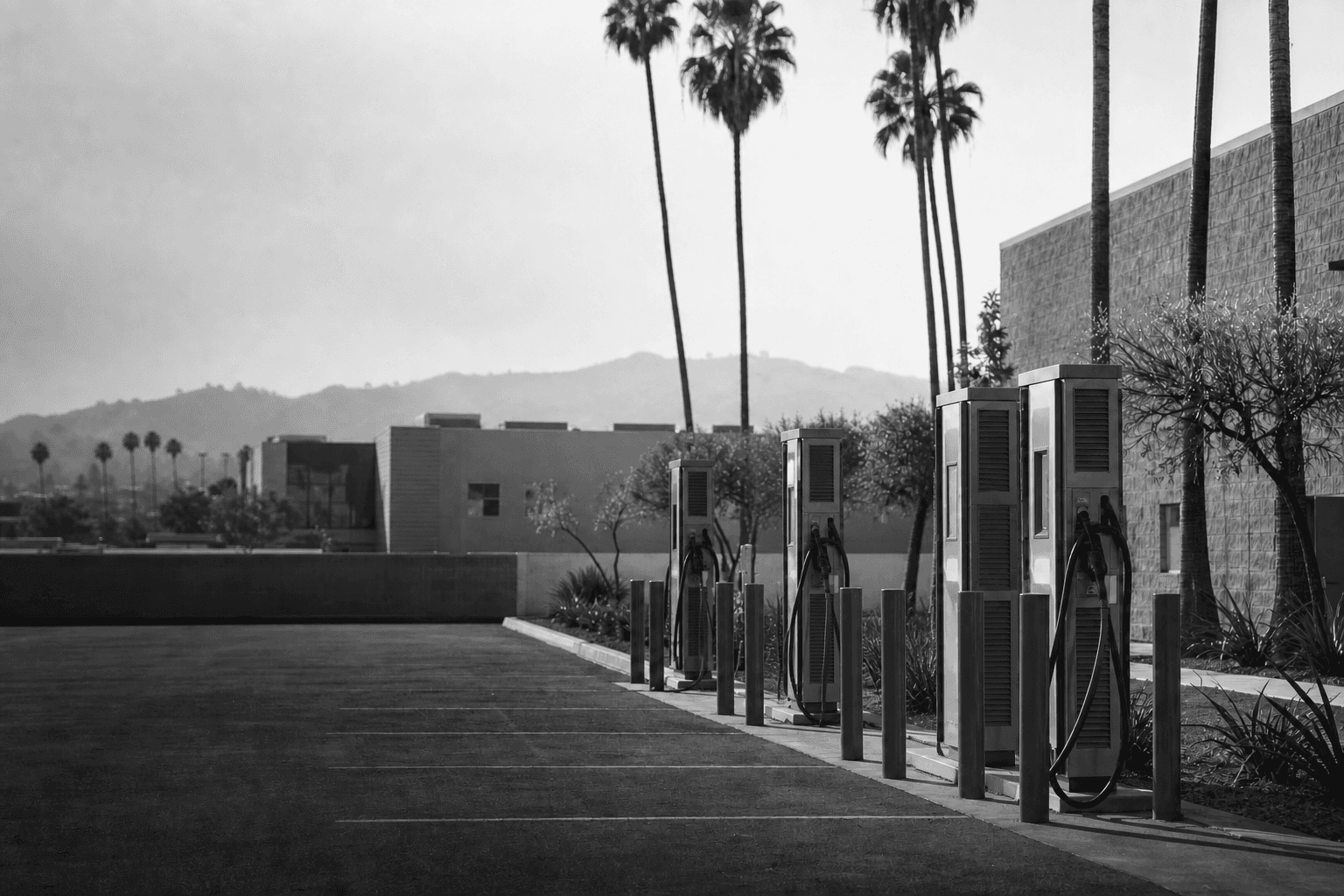
Two buildings on the same street can quote very differently. The split is almost always power and pavement: how much spare capacity the service has, and how much ground sits between it and the stalls you want to use.
LOWER COMPLEXITY
Short run, spare capacity
Stalls within sight of the electrical room. The existing service has amps to spare. Conduit follows a path that already exists. Level 2 only, no new utility equipment, and a routine permit.
HIGHER COMPLEXITY
Long run, full panel
Stalls across the lot from a panel with nothing left. Trenching through finished pavement, a new panel or service, and utility coordination on their calendar. DC fast at any real count usually lands here.
SCOPING
The site review that makes a quote trustworthy
A charging quote is only as good as the walk that produced it. The federal installation checklist reads like a punch list for that walk, and it is worth holding a contractor to it.
Start with the service. Someone has to open the panel, read the existing load, and say in writing how many amps are available. Then measure the run to each candidate stall group and note what sits on top of it: landscaping, asphalt, concrete, a drive aisle that cannot close during business hours. Then handle the boring items that become change orders later. Is there a wireless signal at the stalls if the chargers are networked? Where does signage go? What does security look like after dark? Does metering change?
The utility conversation belongs in the same week, not after the contract. Federal guidance is direct about engaging the utility early to identify installation needs and costs, including upgrades to service and equipment, and to confirm both near-term and long-term charging requirements.
Ask for the near-term and long-term station count in the same breath. Trenching once for eight stalls and energizing four is almost always cheaper than trenching twice.
Ask for the load calculation in writing
Available amperage, run distance to each stall group, and surface type. Those three numbers decide the price. A bidder who will not put them on paper is guessing, and you find out during construction.
IN MURRIETA
What this city adds to the schedule
Two steps in the federal checklist are local by definition: obtaining permits, and determining inspection requirements along with how they affect the timeline. In Murrieta that means city plan review and the electrical permit run on one track while your serving utility runs a second track for service and metering. Neither waits for the other.
Published California pricing is thinner than buyers expect. Reported Level 2 figures for California markets sit near $1,500 to $1,700 installed, but those numbers describe residential work and specifically exclude commercial-grade equipment and service upgrades. Treat them as a floor for the simplest possible job.
Weather belongs on the siting list too. Federal guidance names weather impacts as a factor in choosing a charging location, which in inland Southern California means considering sun and heat exposure before the pedestals get set.
Run permitting and utility work in parallel
The city permit and the utility service request are separate queues with separate clocks. Sequencing them one after the other is the most common way a Murrieta charging project loses a season.
OWNERSHIP
Who owns the chargers, and who fixes them
Equipment ownership is a real decision, not paperwork. Federal fleet guidance frames it as a choice between owning the chargers outright and letting the equipment or network provider own them. Owning reduces overall cost and gives you full control. It also makes you responsible for every repair, every warranty question, and every replacement after the term ends.
The other half is the maintenance agreement. Routine care is light: store cables so they do not get damaged, check parts periodically, keep the units clean. Repairs are the expensive part, and they get much more expensive once a warranty ends. Decide in writing whether the site host, the network, or the installer carries that cost, and put a response time, a repair window, and an uptime requirement in the contract.
YOU OWN IT
Lower total cost, full responsibility
You buy, install, and maintain the units. Cost is lower and control is complete. Every repair, warranty question, and replacement is yours to schedule and pay for.
PROVIDER OWNS IT
Less control, less exposure
The equipment or network provider holds the asset. You trade some control and margin for someone else carrying repair risk. Read what the agreement actually promises on uptime.
OVER TIME
Phasing, operating cost, and what to build once
Capital cost gets the attention. Operating cost decides whether the project still feels good in year three.
Electricity is the obvious line, but the shape of the bill matters more than the rate. Charging costs include per-kilowatt-hour charges, and demand charges are typically based on the highest fifteen-minute average use recorded in a billing period. DC fast charging is far more likely to trigger those than Level 1 or Level 2. That is the real argument for spreading load across more Level 2 stalls when your dwell time allows it. Some utilities offer time-of-use rates or other rate incentives for charging infrastructure owners, and that is worth asking about before you sign anything.
Then decide what you charge drivers, if anything. Common structures are per kilowatt-hour, per session, by length of time, or a subscription. More than twenty percent of public charging is still free to use, so free is a legitimate business choice when the chargers exist to attract tenants or customers rather than to earn revenue.
Phase the conduit, not the chargers. The expensive, disruptive work is opening the ground and pulling wire. Sizing that path for the station count you expect in five years, and energizing only what you need now, is the cheapest future-proofing available on a commercial lot.
COMPARING BIDS
Five things a comparable quote must show
Bids that look different usually are different. Make every contractor price the same scope, on the same stall locations, at the same station count, and the comparison gets easy.
01
Available capacity, stated as a number
The existing service size, the calculated existing load, and the amperage actually left for charging.
02
The run, measured
Distance from the point of connection to each stall group, and what surface has to be opened and restored.
03
Utility scope, separated
What the utility provides, what you provide, and which items are estimates waiting on their engineering.
04
Hardware, by model and connector count
Make, model, power level, connectors, warranty term, and whether networking is included or billed annually.
05
Permits, inspections, and closeout
Who pulls permits, who schedules inspections, and what commissioning documents you receive at the end.
Keep planning locally
Related EV charging pages in Murrieta
Get a defensible number
Price the equipment and the building together.
Send the address, operating target, and target opening date. Flux will identify what must be verified before the project can be priced.
Price my chargersQuestions
Straight answers.
How much does a commercial Level 2 charger cost in Murrieta?
Hardware is the published part: $400 to $6,500 per Level 2 connector, depending on the unit. Installation is site specific and is often the larger number. Reported California pricing near $1,500 to $1,700 covers residential work only and excludes commercial equipment and service upgrades.
Why is DC fast charging so much more expensive?
The equipment alone runs $10,000 to $40,000 per unit, and the electrical service behind it is a different class of work. DC fast is also far more likely to trigger demand charges, which are based on your highest fifteen-minute average use in a billing period.
Is the federal charging tax credit still available?
Not for new projects. The 30C credit covered up to 30 percent of purchase and installation cost, and only in eligible census tracts. It no longer applies to property placed in service after June 30, 2026. Projects placed in service on or before that date still claim it at filing.
What does it cost to keep chargers running?
Plan up to $400 per charger per year for maintenance. Extended warranties on DC fast chargers can run over $800 per charger annually. Networked stations usually carry a separate software or maintenance plan fee on top of that.
What makes one site cheaper to install on than another?
Spare capacity in the existing service and a short run to the stalls. Distance and a full panel are the two conditions that turn a modest project into a large one.
Sources used for this guide
- [1]afdc.energy.gov — Alternative Fuels Data Center: Procurement and Installation for Electric Vehicle Charging Infrastructure
- [2]irs.gov — IRS Alternative Fuel Vehicle Refueling Property Credit
- [3]winsparking.com — Fleet EV Charging in Denver, CO | Wins Parking
- [4]promatcher.com — EV Charging Station Cost - Los Angeles, California
- [5]afdc.energy.gov — Alternative Fuels Data Center: Operation and Maintenance for Electric Vehicle Charging Infrastructure
- [6]afdc.energy.gov — U.S. DOE AFDC Electric Vehicles for Fleets