THE NUMBER
What commercial EV charging costs in Mission Viejo
Two numbers set the budget: the charger, and the electrical work behind it. Single-connector equipment runs about $400 to $6,500 for Level 2 and $10,000 to $40,000 for DC fast charging. Installed pricing reported around Southern California lands near $1,500 to $1,700 for a basic single Level 2 unit with labor — and that figure excludes commercial-grade equipment and any service upgrade, which is exactly where commercial budgets separate from it.
A site review has to confirm available panel capacity, the distance from the point of connection to the stalls, and whether the service can carry the load before any of those numbers hold.
CHOOSE THE LEVEL
Three ways to charge, three budgets
The equipment choice sets the floor of the budget and most of the operating cost that follows. Pick it from dwell time, not from the spec sheet. If vehicles sit for eight hours — employee parking, overnight fleet, resident stalls — slow charging finishes the job and costs a fraction of fast charging to install. If vehicles sit for twenty minutes, only DC fast charging moves enough energy to matter, and the electrical service has to grow to match. There is a middle path worth pricing too: instead of a pedestal at every stall, install 120- or 240-volt receptacles and use portable Level 1 or Level 2 units. That lowers project cost, and a failed unit gets swapped rather than serviced in place. Mixing levels on one site is common and often correct — a bank of Level 2 for all-day parkers, one fast charger for the vehicles that cannot wait.
THE LINE ITEMS
Where a commercial charging budget actually goes
Hardware is the line everyone shops. The rest of the sheet is where quotes drift apart, and where two bids on the same building can differ by more than the chargers cost. Read these lines first, and ask every bidder to break them out separately instead of rolling them into one installed price per port.
BUYING GUIDANCE
How to price the project without guessing
Start with the panel, not the catalog. Every commercial charging quote is really a quote on your electrical service, and the honest way to find the number is to have someone open the panel, read the capacity that is actually free, and measure the run to the stalls you want to use. A site with spare amps and stalls near the electrical room is a short project. A full panel and a run across the lot is a different job at a different price, using the very same chargers.
Bring the utility in early. Service upgrades, metering, and rate structure are utility decisions, and they set both cost and schedule. Ask what rate the site lands on once chargers are running, and whether time-of-use or charging-specific rates are available, because the electricity bill outlives the install.
Then decide what you are buying: energy, or a business. If the chargers exist to serve employees, tenants, or your own fleet, buy the least equipment that meets the dwell time. If you plan to sell charging, the network, the uptime terms, and payment handling matter more than the sticker on the hardware. Either way, settle the port count before you shop — the fastest way to overspend is buying speed the parking pattern never uses.
SITE CONDITIONS
What makes a site cheap, and what makes it expensive
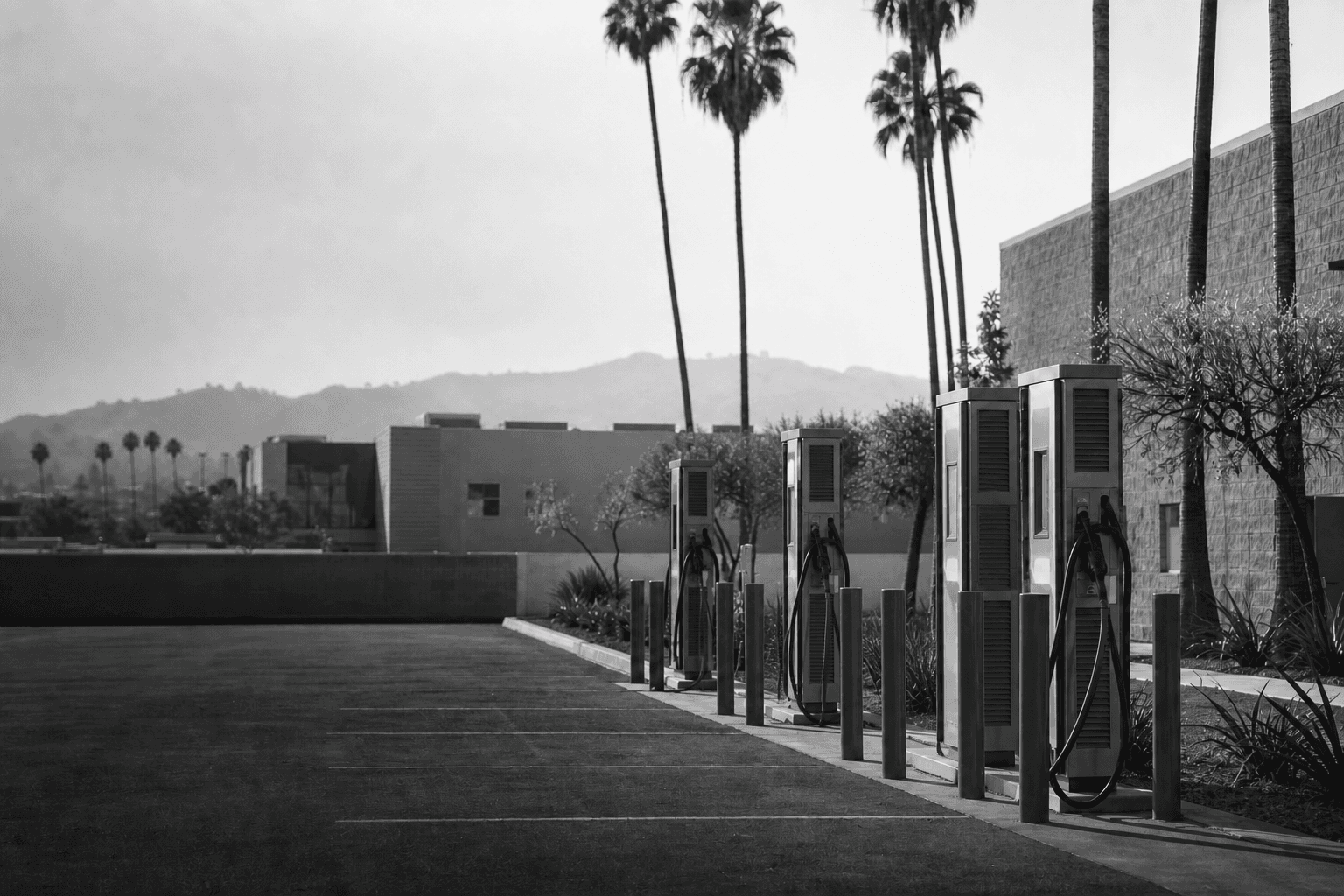
Two buildings on the same street can quote at very different numbers, and the difference is rarely the charger. It is available capacity, the distance to the stalls, and what has to be cut open to connect the two. Both conditions below are common in commercial lots.
LOWER COMPLEXITY
Short runs, spare capacity
Stalls within sight of the electrical room, a service with amps to spare, and a landscaped or gravel path for conduit. The work stays inside the building's existing capacity, so no service upgrade is triggered.
HIGHER COMPLEXITY
Long runs and a full panel
Stalls across the lot, a panel already near its limit, and concrete or asphalt that has to be cut, trenched, and restored. Add DC fast charging and the electrical service itself usually has to grow.
SCOPING
What a site review has to settle before pricing
A number you can trust comes out of a walk, not a phone call. The review should end with four facts written down: how many amps the service has free today, how far the proposed stalls sit from the point of connection, what the path between them is made of, and how many ports the site needs in year five rather than year one.
That last one saves the most money. Trenching a lot once for eight ports and energizing four is far cheaper than trenching twice. Conduit and capacity are the expensive things to add later; chargers are the easy part.
The review should also settle ownership. Equipment you buy outright costs less over its life and stays fully under your control, but every repair and every warranty gap is yours. Equipment owned by a network or provider shifts that burden, and the cost profile with it. Decide which model you want before bids arrive, because it changes what each bidder is quoting. Then get maintenance in writing, with a response time, a repair window, and an uptime commitment. A charger nobody owns is a charger nobody fixes.
Four numbers to have before you request bids
Available panel capacity in amps, distance from the point of connection to the stalls, the surface the conduit has to cross, and your five-year port count. With those four, competing quotes become comparable. Without them, every bid is a guess.
AFTER THE INSTALL
What the chargers cost once they are running
Capital cost is the part buyers negotiate. Operating cost quietly decides whether the project was worth it. Three things drive it: electricity, demand charges, and upkeep. Electricity is billed per kilowatt-hour, and many utilities also bill demand based on the highest fifteen-minute average draw in a billing period — which is why DC fast charging is far more likely to trigger a demand charge than Level 2. Networked ports add an annual software fee that buys payment processing, access control, and the utilization data telling you whether to add ports or stop where you are. Upkeep is smaller but constant: store cables properly, check parts, keep equipment clean, and budget up to $400 per charger per year.
OWNERSHIP
Own the equipment, or let a provider own it
Owning outright lowers lifetime cost and gives you full control, but repairs, warranty gaps, and replacements are yours. Provider-owned equipment trades some of that savings for someone else carrying the failures.
REVENUE
Charge for it, or fold it into the property
You can bill by kilowatt-hour, by session, by time, or by subscription — or not bill at all. More than twenty percent of public charging is still free to use, offered as an amenity rather than a revenue line.
PHASING
Build once, energize in stages
The cheapest version of a bigger charging program is one trench. Size the conduit, the pull boxes, and the panel space for where you expect to be in five years, then energize only the ports you need now. The incremental cost of oversized conduit while the trench is already open is small. The cost of reopening a finished lot is not.
Procurement deserves the same discipline. Take bids from contractors who install commercial charging regularly, and hand each of them the same scope: port count, locations, equipment level, and who is supplying the hardware. If bidders are free to assume different scopes, you are not comparing prices — you are comparing assumptions.
One planning note on federal money. The 30C refueling property credit, which covered up to 30 percent of qualifying equipment and installation cost at properties in eligible census tracts, no longer applies to new projects placed in service after June 30, 2026. Work placed in service on or before that date still claims it at filing. Build today's budget on the utility and state layers instead, and confirm any program with your utility before construction starts, because most rebates will not pay backward.
THE CHECKLIST
Five things a comparable quote must show
Bids that hide these lines are not cheaper, only vaguer. Ask every contractor to break the number out this way, against the same scope, so the sheets can sit side by side and the differences actually mean something.
01
Equipment, by make and connector count
Model, power level, connector type, and quantity — plus who buys it, you or the contractor.
02
The electrical run, in feet
Trench length, conduit size, wire, and how the surface gets restored. This is the line that explains most gaps between bids.
03
Panel and service work, priced separately
New panel, subpanel, or service upgrade shown as its own number, never folded into the charger price.
04
Permits, inspection, and utility coordination
Fees, who files, who schedules inspections, and who carries the utility conversation.
05
Recurring costs for the first year
Network and software fees per port, maintenance coverage, warranty term, and what happens once that term ends.
Keep planning locally
Related EV charging pages in Mission Viejo
Get a defensible number
Price the equipment and the building together.
Send the address, operating target, and target opening date. Flux will identify what must be verified before the project can be priced.
Price my chargersQuestions
Straight answers.
How much does commercial EV charging equipment cost per port?
Single-connector equipment runs about $400 to $6,500 for Level 2 and $10,000 to $40,000 for DC fast charging. Level 1 units run roughly $300 to $1,500. Installation is priced separately and usually moves the total more than the hardware does.
Why do two quotes for the same building differ so much?
Almost always the electrical run and the panel. Distance from the point of connection, whether pavement has to be cut and restored, and whether the service has spare capacity change the number more than the charger choice does.
What does it cost to keep chargers running?
Plan on up to $400 per charger per year for maintenance, plus electricity and any network fees. Extended warranties on DC fast chargers can run over $800 per charger per year.
Is the federal 30C tax credit still available?
Not for new work. It covered up to 30 percent of qualifying equipment and installation cost at properties in eligible census tracts, but it does not apply to property placed in service after June 30, 2026. Projects finished on or before that date still claim it at filing.
Can we start small and add ports later?
Yes, and it is usually the cheapest path — if the trench, conduit, and panel space are sized for the larger build now. Adding capacity after the lot is closed up costs far more than oversizing it once.
Sources used for this guide
- [1]afdc.energy.gov — Alternative Fuels Data Center: Procurement and Installation for Electric Vehicle Charging Infrastructure
- [2]irs.gov — IRS Alternative Fuel Vehicle Refueling Property Credit
- [3]winsparking.com — Fleet EV Charging in Denver, CO | Wins Parking
- [4]promatcher.com — EV Charging Station Cost - Los Angeles, California
- [5]afdc.energy.gov — Alternative Fuels Data Center: Operation and Maintenance for Electric Vehicle Charging Infrastructure
- [6]afdc.energy.gov — U.S. DOE AFDC Electric Vehicles for Fleets