THE NUMBER
What commercial charging costs per port
Commercial Level 2 ports in Texas commonly install for about $3,500 to $18,000 each, all in. The charger is the small part: a single-connector Level 2 unit runs roughly $400 to $6,500, and DC fast hardware runs about $10,000 to $40,000 per unit. Fully installed DC fast projects reach $75,000 to $350,000 per dispenser once the service work is counted. The spread comes from the electrical distance between your power and your stalls.
Those ranges assume the panel has spare capacity and the run is short. A site review has to confirm real available amperage, the distance from the electrical room to the stalls, and whether pavement gets cut.
THE THREE PATHS
Three ways to run charging at a commercial property
Start with how long vehicles sit still. That one fact points to the equipment before any price does. Cars parked four hours or more charge fine on Level 2, and Level 2 usually keeps the electrical work inside the service a building already has. Vehicles that must leave in twenty minutes need DC fast power, and DC fast power usually means a conversation with the utility about service size.
The second question is who pays to use it. Charging that serves tenants, employees, or guests is an amenity, and it gets judged on retention and occupancy. Charging sold to the public or to a fleet operator is revenue equipment, and it has to earn back both the install and the monthly electricity.
The third is timing. Very few commercial sites need their full charger count on day one, and building for a count you have not proven is the most common way to overspend.
THE LINE ITEMS
What belongs in a commercial charging budget
A real quote breaks into these lines. Ask every bidder to show them separately, because a single lump-sum number hides exactly the items that vary most from site to site.
WHAT MOVES THE PRICE
Distance and capacity decide most of it
Two questions settle most of the number. How far is the power from the stalls, and how much of it is already spare? A charger set close to an electrical room with open breaker space is mostly hardware and labor. Move that same charger to the far corner of the lot and the job becomes trenching, conduit, wire, and pavement restoration, priced by the foot rather than by the port. A fifty-foot run and a two-hundred-foot run are not the same project even when the equipment is identical.
Capacity is the second lever, and it is the one that can double a budget. If the building has amperage to spare, chargers tie in and the work stays inside the existing service. If it does not, the project picks up a subpanel, sometimes new switchgear, and sometimes a change to the utility service. That is where a modest Level 2 install starts to look like an electrical project with chargers attached.
Hardware choice matters less than people expect. A commercial Level 2 unit spans roughly $400 to $6,500 depending on connectors, cable management, and networking. That is real money, but it is smaller than the swing between an easy run and a hard one. Pick the charger for the duty cycle and the software you can live with, then let site conditions tell you what the install costs.
EASY VERSUS HARD
What separates a clean install from a heavy one
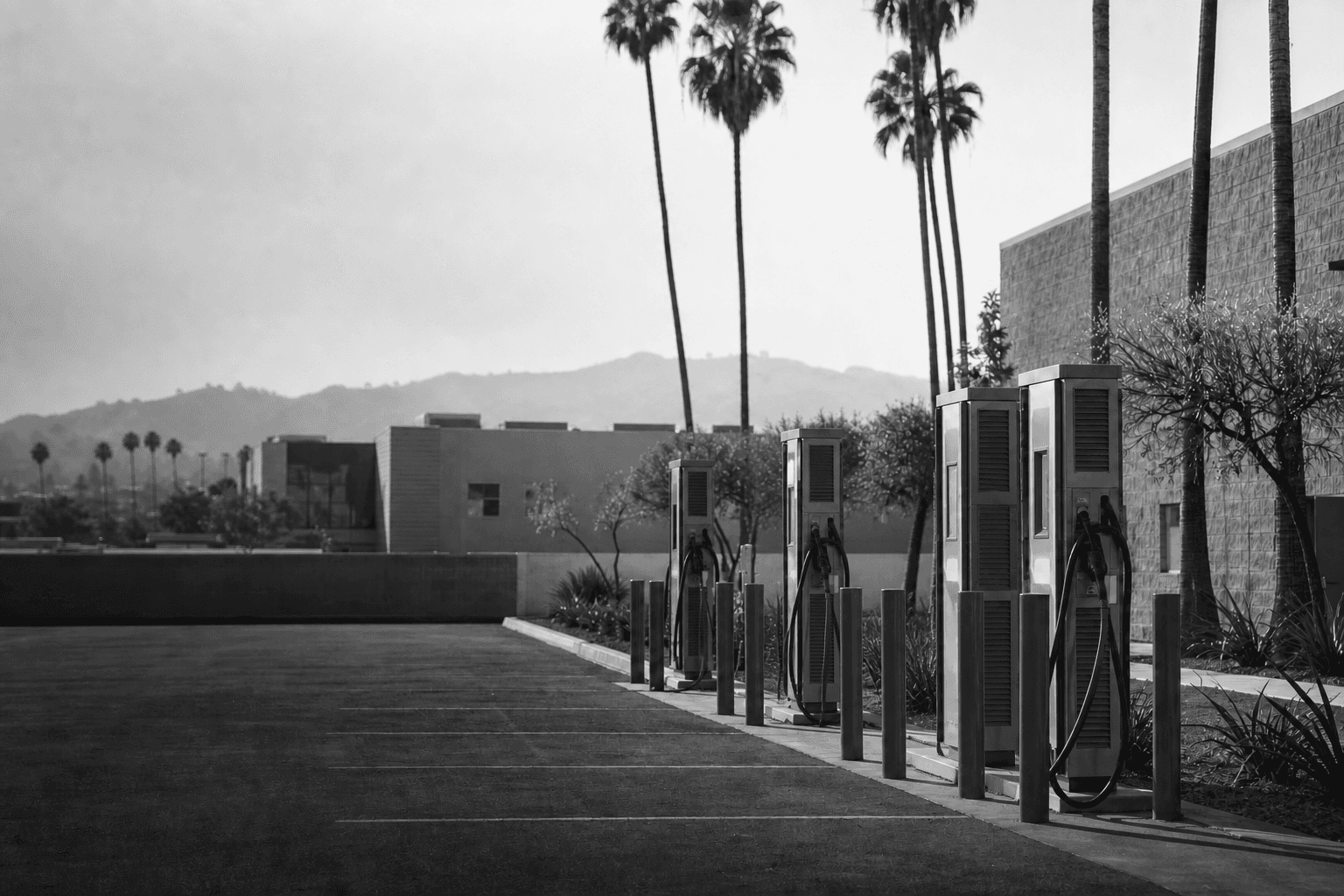
The same charger costs very different money depending on what sits between it and the service. These are the conditions on each side of that line.
LOWER COMPLEXITY
Short runs, spare capacity
Stalls near the electrical room, open breaker space, and a soft or gravel path for conduit. The Level 2 load fits inside the service the building already has, so two to four ports go in without a utility change.
HIGHER COMPLEXITY
Long runs, full panels
Stalls across the lot, a panel with nothing left, saw-cut pavement that has to be restored, or DC fast power that pushes the site past its service size. Transformer and switchgear work then sets both the schedule and the price.
SCOPING
Why the site walk sets the price
Nobody can price this from a photograph. The site walk exists to answer a short list of questions, and every one of them changes the number.
The first is capacity. An electrician reads the panel schedule, checks the main service size, and looks at what the building actually draws on a hot afternoon rather than what the labels claim. Spare amperage on paper often disappears once real load is measured. The second is the route. Someone walks the path from the electrical room to the proposed stalls, notes the surface, and marks where conduit can go underground versus where pavement has to be opened and put back.
The third is the stall plan itself. Charger placement affects cable reach, accessible parking layout, protection from vehicle strikes, and how easily you can add ports later without digging the same trench twice. The fourth is the utility. If the project pushes the site past its service size, equipment lead time and utility scheduling become the longest item in the timeline, not construction.
A contractor who answers all four before quoting is giving you a number you can hold them to.
Four answers to get before you accept a price
Measured spare capacity, the exact conduit route and surface type, a stall plan that leaves room to expand, and a clear statement of whether the utility service has to change. Anything missing here is a change order waiting to happen.
OWNING AND OPERATING
Two decisions that outlive the install
The capital number gets all the attention, but two choices made during scoping follow the site for years. The first is who owns the hardware, which decides who carries repair risk and who controls pricing. The second is how the site draws power, which decides what the monthly bill looks like once the chargers are busy. Both are easier to set up front than to fix later.
OWNERSHIP
Own the equipment or let a provider own it
Buying outright costs more up front and keeps full control of pricing, data, and uptime, along with every repair bill. Provider-owned models lower the capital ask and move maintenance off your plate, usually in trade for revenue share or a longer contract.
OPERATING COST
Demand charges and the monthly bill
Electric bills often include a charge tied to the highest fifteen-minute average draw in a billing period, and DC fast charging triggers it far more readily than Level 2. Load management, session scheduling, and time-of-use rates keep that line predictable.
SEQUENCING AND LIFETIME COST
Order the money before you order the equipment
Utility make-ready and grant programs generally pay for work that has not started yet, so applications go in before construction rather than after. State grant programs in Texas have supplemented charging projects, and what is open changes year to year. Confirm the current window while you are still scoping, because the application calendar, not the contractor, often sets the start date. The federal 30C credit no longer applies to charging property placed in service after June 30, 2026. Projects that energized before that date still claim it at filing, but new builds should be budgeted without it. Charging equipment is still depreciable business property, so ask your tax advisor how the installed cost gets recovered.
Then look past year one. The install is a single check. Network software runs roughly $15 to $40 per port each month, maintenance runs up to about $400 per charger per year, and DC fast extended warranties can pass $800 per charger annually. Electricity is the largest ongoing line, and how you price sessions, whether by kilowatt-hour, by session, by time, or by subscription, decides how much of it comes back. A five-year view usually changes which quote is actually the cheaper one.
COMPARING BIDS
Five things a comparable quote shows
Line items are the only way to compare two bids on the same site. If a proposal collapses into one number, ask for these five before signing anything.
01
Hardware, by model and connector count
Unit price per charger, mounting method, and whether networking hardware is included or added.
02
The electrical run, priced by length
Trench footage, surface type, conduit and wire size, and who pays to restore cut pavement.
03
Panel and service work, stated plainly
Measured spare capacity, any subpanel or switchgear, and whether a utility service change is assumed.
04
Permits, inspection, and utility coordination
Who files, who schedules, and what the quote assumes about approval time.
05
Year-one operating cost
Software per port per month, warranty term, maintenance responsibility, and the uptime commitment.
Keep planning locally
Related EV charging pages in Mission
Get a defensible number
Price the equipment and the building together.
Send the address, operating target, and target opening date. Flux will identify what must be verified before the project can be priced.
Price my chargersQuestions
Straight answers.
How much does one commercial Level 2 charger cost installed?
Plan on roughly $3,500 to $18,000 per port. Sites with stalls near the electrical room and spare panel capacity land at the low end. Long runs, pavement cuts, and panel work push toward the high end.
Why does DC fast charging cost so much more?
The hardware alone runs about $10,000 to $40,000 per unit, and the electrical service behind it is a different class of work. Fully installed DC fast projects commonly run $75,000 to $350,000 per dispenser once service upgrades are counted.
Is the federal charging tax credit still available?
The 30C credit does not apply to charging property placed in service after June 30, 2026. Projects energized before that date still claim it at filing. New projects should be budgeted on utility and state programs, with depreciation handled by your tax advisor.
What should I budget after the chargers are live?
Network software of roughly $15 to $40 per port monthly, maintenance up to about $400 per charger yearly, extended DC fast warranties that can pass $800 per charger, and electricity including any demand charge.
What makes a site cheap to install on?
Spare capacity in the existing service and stalls close to the electrical room. Distance and full panels are the two conditions that turn a small charging project into an electrical project.
Sources used for this guide
- [1]afdc.energy.gov — Alternative Fuels Data Center: Procurement and Installation for Electric Vehicle Charging Infrastructure
- [2]irs.gov — IRS Alternative Fuel Vehicle Refueling Property Credit
- [3]santibanservicesgroup.com — Commercial EV Charging in Houston: 2026 Infrastructure & Installation Guide - Santiban Services Group
- [4]winsparking.com — EV Charging Station Installation in Dallas, TX | Wins Parking
- [5]afdc.energy.gov — Alternative Fuels Data Center: Operation and Maintenance for Electric Vehicle Charging Infrastructure
- [6]afdc.energy.gov — U.S. DOE AFDC Electric Vehicles for Fleets